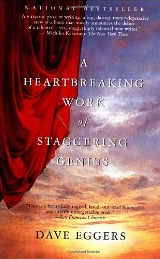
Day Twelve: A Heartbreaking Work of Staggering Genius

Cover for A Heartbreaking Work of Staggering GeniusBefore I start this review, I have to apologize for the untimely posts this week. I’ve told several people that I would try to post a review every weekday during my lunch, but lately we’ve been having a lot of Internet outages. So, I’m posting when I can.

A Heartbreaking Work of Staggering Genius is based upon true events of Dave Eggers’s life. When he was 22 years old, his mother and father died within months of each other, leaving his family to split up and himself in charge of his eight-year-old brother, Toph. They live in bachelor squalor while Eggers obsesses. Eventually, they move to San Francisco, where he becomes a founder of Might Magazine.

I didn’t read this book for a long time because I was put off by its title, but it received so many good reviews that I finally picked it up from curiosity. I have to preface my remarks by saying that I have lately gotten some clues that I don’t understand modern humor (i.e., I am officially a geezer), especially when I’ve tried to watch movies that are dubbed “hilarious.”

Readers might get a clue about how this book is going to proceed from its set of “Rules and Suggestions for the Enjoyment of this Book.” One of them is to skip the middle of the book. Good suggestion.

I found the first 100 pages or so about his parents’ deaths and his subsequent struggles affecting and absorbing. However, this is one of the few books that I just couldn’t finish. I found it so juvenile and smug that it was absolutely grating, but that’s not why I stopped. When Eggers abandons his straight narrative, he begins musing, and his prose devolves into unbelievably long, rambling paragraphs. His approach has been deemed “inventive” and even “the memoir as metafiction” (yikes!). I was actually only 30 pages from the end of the book when he started another of his lengthy asides, and I just couldn’t take it anymore. I gave up.

Day Eleven: Snow Flower and the Secret Fan

Cover for Snow Flower and the Secret FanBest Book of Week 3!

Lisa See, the author of Snow Flower and the Secret Fan, explains that she was inspired to write the novel after learning about nu shu, a secret, simplified writing used by women in a remote area of China to communicate with each other for centuries. The writing was suppressed for years after the Japanese invasion of China and during the Cultural Revolution, so it is now known only by a few scholars who learned it from the last women who knew it.

Snow Flower and the Secret Fan is a beautifully written story about the love between two women in 19th century China. Near the beginning of the novel, Lily’s mother delays the date of her foot binding a year from the traditional age of six so that she can enter into a special relationship, called laotong, with another girl named Snow Flower. Laotong, or “old same” girls must match each other as closely as possible in birth date and time, height, and other qualities, including the date of their foot binding. Snow Flower sends Lily an invitation to enter into this relationship written on a fan in nu shu. This relationship is supposed to be advantageous to Lily, the daughter of a farmer, because Snow Flower comes from a family that is higher in status and can teach her to be more refined. The end purpose of all this is to find her the best husband possible when the time comes.

The foot binding itself is horrifically described near the beginning of the novel, when Lily’s short life as a free child is ended by this process of trying to bend the foot so that all but the big toe meet the heel and it ends up as close to three inches long as possible.

At lot of the novel is about suffering. The way of life was circumscribed in many ways, with the women spending most of their lives in one room. As children and young women they are considered worthless burdens to their family until they “marry out.” Then they are considered burdens by their husbands and mothers-in-law until they justify their existence by having sons.

Lily’s relationship with Snow Flower opens up her world a bit. They visit a shrine together every year. Snow Flower comes to visit Lily, and they spend days and nights whispering, telling their secrets and hopes. They send messages to each other on their fan.

The hardest thing for me to explain is the extent of the innocence of these girls, how they are full of good will, despite their difficult and painful lives. How they try to do their best even though they are constantly criticized. How even the aphorisms and songs that they hear every day tell them their purpose is just to serve others, yet they try to be cheerful.

Lily relates the story from the viewpoint of an old woman to explain something that she did that she will always regret. Eventually, Lily’s successful marriage and good luck and Snow Flower’s loss of status lead to a divide between the women and then an apparent act of betrayal. The story effectively explores the linkage between love, hurt, and jealousy.

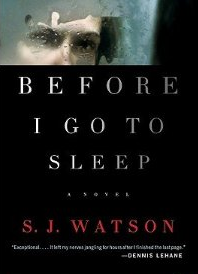
Day Ten: Before I Go to Sleep

Cover for Before I Go to SleepBest Book of Week 2!

Before I Go to Sleep by S. J. Watson is a stunningly creepy novel that successfully creates a sense of growing dread. It is not really a traditional mystery, more like a slow-starting but absorbing thriller.

Every morning Christine awakens not knowing who the man in her bed is and thinking she should be younger, sometimes twenty years younger, sometimes a lot younger than that. Every morning her husband Ben has to explain who he is, show her pictures of their life together, and explain that years before she had a traumatic brain injury that causes her to forget everything when she goes to sleep at night.

A neurologist calls her each day to explain he has been treating her without her husband’s knowledge and reminds her to take out her journal and read it. As she reads and keeps her journal every day, she begins to remember a few things by herself, and she finds her husband is telling lies. She remembers having a baby, but he says they never had children. She has specific memories of a good friend who he claims moved away to Australia, but she finds out she didn’t. Her husband always has good explanations for these lies, but more and more things begin to disturb Christine.

Should she trust her husband or not? Is she falling back into the paranoia that has been a symptom of her illness? And how exactly was she injured in the first place?

Day Nine: Mary Boleyn

Cover for Mary BoleynIn the introduction to Mary Boleyn, biographer Alison Weir talks about the many misconceptions we have about Anne Boleyn’s less famous sister, which were not only derived from such popular fictions as The Tudors (wildly inaccurate, but I still loved it!) and The Other Boleyn Girl (ditto), but also from biographers and historians over the centuries. Weir calls her book both a biography and a historiography, because she tackles many published statements about Mary’s life and attempts to show the extent of their truth or even likelihood.

Because most of Mary’s life was spent in the background of her glittering, ambitious family, not many actual records or letters that mention her exist, and only a couple of her own letters survive. Even the exact date of her birth is unknown, so that there has been been debate about whether Mary is the older or younger of the two sisters. (Weir makes a good case for older.)

Weir examines Mary’s life from as early as it is known and explores such subjects as whether she had an affair with the King of France (yes, probably a short one), whether she came from that with a ruined reputation, as has been alleged (no, but her family may have sent her away from court), whether she had an affair with Henry VIII (yes, but possibly reluctantly), whether she was then labeled a “famous whore” as has also been alleged (no, hardly anyone knew about it), whether she was married off to an unworthy but complaisant husband as a result (no, she married before the affair to William Carey, a wealthy and influential courtier who was one of Henry VIII’s trusted friends), and so on.

The picture Weir paints is of a woman who has repeatedly been smeared over the centuries. She certainly did not seem to be ambitious, like the rest of her family, because she got very little from her royal lovers. She was almost certainly also not well regarded by her family, probably because she had taken these lovers without gaining an advantage. After her first husband died, she eventually remarried for love, William Stafford, a relatively poor man much lower in status who was 12 years her junior. After she was cut off from her family and court as a result, she described the time of her widowhood as “bondage” and stated in a letter to Thomas Cromwell that no one in the world cared for her except Stafford.

Mary seems to have been slighted by her family for much of her adult life and was finally exiled from them because of her second marriage. This separation may be the only reason she survived her sister and brother.

Weir makes a strong case for Mary’s first child, Katherine Carey, being the unacknowledged daughter of Henry VIII. An appendix relates what happened to Mary’s descendants. Weir remarks that Henry VIII’s line is believed to have died out with Elizabeth I, but assuming she is correct about Katherine’s birth, she provides a fascinating list of some of the famous British people who can trace their lineage back to Mary’s daugher—and so to Henry—including Winston Churchill, Charles Darwin, Lord Nelson, Vita Sackville-West, Ralph Vaughn Williams, Princess Diana, Camilla Parker-Bowles, and Queen Elizabeth II herself.

Day Eight: The Virgin Suicides

Cover for The Virgin SuicidesI haven’t read this book in a year, but my brother asked me to review it. So, excuse me if I get the chronology mixed up or something. The book is told mostly in flashbacks, and it’s hard for me to remember what happens first.

The Virgin Suicides by Jeffrey Eugenides is one of those incredible books that make you wonder how they could be someone’s first novel. I was turned off by the title and subject matter of the book so I didn’t read it at first. But I caught the movie one night on TV and was mesmerized by it, so I decided to read the book.

The Virgin Suicides is written from the point of view of a group of boys growing up in the 70s in Grand Blanc, Michigan, a wealthy suburb of Detroit. The boys are fascinated by the five beautiful Lisbon sisters and their family life. Although they all go to the same school, the girls are kept isolated from other teenagers by their mother’s strictness. Their father is an easy-going science teacher at their school.

The boys begin by spying on the girls, then collecting souvenirs of the girls’ lives, which they go over incessantly, trying to understand them. In an experiment of leniency, Mrs. Lisbon allows the sisters to have a few classmates over to the house, including the boys, but the deadly dull party ends disastrously with the suicide of the youngest girl.

As the boys begin to connect more directly with the girls and the family alternates between trying to be more normal and totally isolating the girls, the family becomes more unhinged.

The book is sometimes lyrical, sometimes sophomoric sounding, sometimes witty, and savagely ironic, painting a vivid picture of the time and place. The disintegration of urban Detroit and its surrounding areas, symbolized by the neighborhood losing all its trees to the Dutch Elm disease, parallels the disintegration of the Lisbon family.

Day Seven: Bury Your Dead

Cover for Bury Your DeadLast fall I read about the series of mysteries by Louise Penny, some of which have received numerous mystery book awards. They all take place in Quebec and feature Chief Inspector Armand Gamache. Bury Your Dead is not the first in the series, but it is the first one I read, and I wrote the most about it in my book diary. However, if you decide to read these books, you should make a special effort to read them in order, starting with Still Life. I did not, and I was sorry at times, because most of the books are set in the same small, charming village and you can sometimes tell who the murderer of a previous book is just by who is missing from the village in a later book. Also Bury Your Dead in particular reveals the outcome of the previous book, because Inspector Gamache decides that he perhaps did not get it right that time and sends his second to re-investigate.

That being said, I think I liked Bury Your Dead best of all the Penny books I have read, because it partly takes place in the fascinating Quebec City. That is where Inspector Gamache is recovering from a case that turned out horribly, during which he was badly injured.

He discovers a delightful building in the city, the Literary and Historical Society, full of old books and documents about the English population of the city, and he meets some of the historians. Then the body of a French-heritage historian who has been obsessed with finding the missing remains of Samuel de Champlain is found in the society’s basement, and the board of the society asks him to investigate. The board is particularly worried because there has been some strain between the English minority and the French majority in the city, some of it fostered by the dead historian.

In the meantime, Gamache has asked his second, Inspector Jean-Guy Beauvoir, who is also on leave, to return to the small village of Three Pines and find what they missed in the last case, as he is convinced they made a mistake.

While this is all happening, Gamache is haunted by the memories of the young agent who was held captive and died during the incident that injured both Gamache and Beauvoir.

The book skillfully follows both plots and flashbacks to the investigation that went wrong. The characters in this series are well developed and interesting. The plots are tight and the mysteries difficult to figure out. The small village setting could become problematic, because the cast of characters is limited, but so far I have been enjoying the books.

Day Six: Waverley

Cover for WaverlyI have been trying to offer a mix here, not just mystery mystery mystery, and so far I have just reviewed books I’ve liked. But I plan to also review books I didn’t like. This book isn’t one of them; I’m just warning you.

I had a hard time even getting interested in reading anything by Sir Walter Scott after having been forced to plow through the dreaded and deadly dull Ivanhoe in high school. I tried rereading it again some years ago because sometimes things you find dull in high school are more interesting when you’re older, but it wasn’t. I have often wondered what criteria high schools use when picking the English curriculum, when there are much more vibrant classics available. I can only suppose that they thought a tale of knights, derring-do (whatever that is), and Richard the Lionheart would interest high school students. When you read Ivanhoe, it’s hard to imagine that at one time Scott’s books were waited for with bated breath by the whole family.

But most of us probably haven’t tried to read his Scottish novels, or the Waverley novels, as they are called. This review is about the novel called Waverley, presumably the one the others are named after. It was written in 1814 but is set in 1745. Scott’s Scots dialects are a little difficult—a glossary would be nice—and he can occasionally be a bit long-winded, but his Scottish novels are much more interesting and amusing than Ivanhoe.

Waverley is a dreamy, wealthy youth brought up in England who has been neglected by his father and raised by his uncle, a man of Jacobite sympathies. A romantic man of undetermined principles, he cannot decide what to do with himself, so he is sent off by his uncle to join the army.

On leave from a regiment stationed in Lowland Scotland, he goes to visit an old friend of his uncle. He makes a visit to the Highlands out of curiosity and ends up embroiled in the Jacobite conspiracy. He is charged with desertion and treason, mostly because he’s in the wrong place at the wrong time.

Part of Scott’s intent, I believe, was to show the British of the times that the Highland Scots were not just a bunch of savages and to depict them realistically.

The book is entertaining and humorous at times, and also occasionally a little ponderous. Waverley is a hapless hero who finds himself drawn into one fix after another, which perhaps makes him a more modern protagonist than you would expect.

Day Five: The Thousand Autumns of Jacob de Zoet

Cover for The Thousand Autumns of Jacob De ZoetTie for Best Book of Week 1!

I have read two books by David Mitchell and they were completely different. The first that I read, Cloud Atlas, was a stunningly unusual science fiction novel divided into sections, where each section was much farther in the future and was narrated by a character speaking in a patois of English that got a little harder to understand. Eventually, the sections all fitted together like a puzzle. It was fascinating. Others apparently thought so, too, because it was short-listed for six awards, including the Man Booker Prize.

But this review is for The Thousand Autumns of Jacob de Zoet, a historical novel about late 18th Century Japan. Jacob is a clerk for the Dutch East Indies company who arrives in Japan in 1799. An honest, hard-working young man, he has signed on for a six-year term so that he can earn enough money to go home and marry his sweetheart, Anna.

Jacob finds that foreigners are only allowed to live on an island called Dejima in the Nagasaki Harbor and they cannot set foot on the Japanese mainland. Only certain Japanese, some interpreters and court officials, are allowed on Dejima. But the Japanese students of a Swedish physician are allowed, and one of them is the midwife Orito Aibagawa. Jacob is fascinated by her and ends up falling in love with her.

Jacob’s boss claims to intend to clean up the rampant corruption in the company, so he sets Jacob the task of reconciling the books from the previous years, which makes him some enemies. When Jacob refuses to sign a bogus manifest, he is left on the island with only his enemies as his boss departs.

Orito’s father dies, and her stepmother sells her off to a mountaintop shrine where sinister rites are being performed.

The story was full of interesting descriptions of the customs and laws of 18th Century Japan. And this reminds me that I need to pick up another David Mitchell book soon and read it.

Day Four: The Rhetoric of Death

Cover for The Rhetoric of DeathOne of the many surprising things I learned from the historical mystery The Rhetoric of Death by Judith Rock is that an important part of the curriculum of 17th century rhetoric, as instructed by the Jesuits, was ballet. I don’t quite get the connection, but there it is. This novel, written by a historian whose dissertation is about the Louis le Grand in Paris, is full of interesting details about life in 17th century France.

Charles du Luc, a Jesuit maître of rhetoric, has had a position arranged by his cousin, the Bishop of Marseilles, at the famous Louis le Grand school. Du Luc isn’t really qualified to be employed by such an esteemed school, but the bishop wants to get him out of Provence because Charles has just finished helping smuggle his Huguenot cousin from there to Switzerland.

The school is two weeks away from its annual performance, an enormous, lengthy (some were as long as 12 hours) ballet and rhetoric production of The Labors of Hercules that will be attended by the king himself, and du Luc is assigned to assist with the dance rehearsals. On his first day, the distracted student who is to play Hercules runs off from the rehearsal and disappears. On the same day, his little brother is almost run down by a horse. Charles thinks these two events may be connected and is even more sure when the first boy is found strangled in a latrine.

At the same time Charles finds himself under suspicion from the authorities because he was the last person to see the first boy alive and was on the scene right after the second boy was almost run down. He is also facing hostility from a fellow member of the Jesuit school who takes an instant dislike to him, a member of the powerful De Guise family.

This novel does a good job of making the period come alive. Unfortunately, the mystery is not nearly as effective as the history. I figured out the motive and the person behind the murders on about page 50. Shortly thereafter I figured out who the actual murderer was. However, the test for me on a mystery, since I often figure out the solution, is whether I am still interested in reading it. In this case, I found the characters, story, and historical background interesting enough to finish.

Day Three: The Darkest Room

Cover for The Darkest RoomTie for Best Book of Week 1!

I love dark mysteries, good ghost stories, and books about family secrets. The Darkest Room by Johan Theorin, a Swedish mystery writer, is one of my discoveries from the past year. It is an excellent book, atmospheric, absorbing, part mystery and part ghost story.

Katrine and Joachim move to Öland, a large island off the coast of Sweden, with their two children. Katrine has been living on the island with the children for several months and remodeling their house while Joachim finishes up his teaching job. Katrine lived in an outbuilding of the house as a child with her artist mother.

The house itself is almost a character in this book, and the first few chapters are about its history. It was built to be the home for the families of lighthouse keepers, and two lighthouses are nearby. The walls of the house are actually built from the wood salvaged from a ship wreck, and as with any old house, many people have died there. There are local stories about the house.

Joachim has just arrived to live permanently in the house, but he needs to make one more trip to pick up a load of things from their home in an upscale neighborhood of Stockholm, a home that they had also bought and restored. On his way back to the island, he gets a confused call from the Öland police who tell him that his daughter has drowned off the pier near the house. But when he gets home, he finds it is not his daughter but Katrine who has died. The police told him the wrong name. As he tries to take care of his young children and cope with his grief, Joachim begins to think the house is haunted. And his daughter is having strange dreams about her mother.

In the meantime, a policewoman starts work at the new police post on the island. Her first investigation involves a rash of robberies of summer cottages. Another point of view is of one of the housebreakers, who is becoming dismayed by the growing violence of his partners, who have decided that they will get more by breaking into occupied houses. The atmosphere and our sense of dread builds as Joachim gets a little odder and the housebreakers become more vicious.

And let’s not forget that we don’t actually understand the circumstances of Katrine’s death.

I was especially impressed by Theorin’s skill in revealing important pieces of information naturally throughout the book instead of laying them out at the beginning. For example, early on Joachim has a few stray thoughts about a woman. He feels some guilt about her but we don’t know why or who she is. We find out later, naturally, as Joachim thinks about her, in addition to some other facts that turn out to be important to the plot. This technique doesn’t seem artificial at all, but more organic and reflective of how thoughts and memory actually work.

I’ve read one other book by Theorin, also set on Öland. I can’t wait to read more.