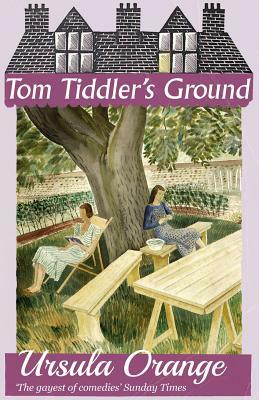
Review 2328: Tom Tiddler’s Ground

At the beginning of World War II, socialite Caroline Cameron takes her baby daughter to stay in a country village with her old school mate, Constance Smith. Caroline is witty but spoiled, and she has begun to feel that her husband John is coddling her too much. She thinks that Constance is nice but naïve, and her husband Alfred, who married up, is a social climbing bounder.

Caroline is surprised by how involved she gets with the lives around her. Constance also has an evacuee mother and baby staying with her. The mother is a sullen girl who pays little attention to the badly underweight baby. Once Nurse and Caroline change his food, he begins to gain weight and Constance begins to care for him.

Alfred is embarrassed because his half sister Mary moved to town as the grocer’s wife. He tries to avoid her, but Constance welcomes her.

Caroline, however, is being tempted into an affair with Vernon, an actor friend. She is displeased with her husband because he doesn’t want to discuss his first marriage, which she’s heard conflicting stories about. When she is in town with Vernon’s friends, she finds herself telling stories about her country friends and then feeling a little disloyal to them.

Although it deals with some serious issues, this is a charming novel about growing to understand other people.

Related Posts

Company in the Evening

Begin Again

Which Way?

Review 2327: Chenneville

John Chenneville, a Union officer, awakens in a field hospital in Virginia to find that the Civil War is over and he has been lying in a coma for months. He has a healing wound on his head where a chain hit him after an explosion. The war is over, but it takes him months to be well enough for the journey home to Bonnemaison in Missouri on the Mississippi.

Once home, he can tell something bad has happened, but he has to wait for his Uncle Basile to arrive from New Orleans to learn what it is. In the meantime, he occupies himself with trying to restore his ravaged estates. Finally, his uncle tells him that on another one of the family estates further south, his sister, her husband and baby have been murdered. His mother has gone to live with Uncle Basile and has not spoken since the event. After waiting longer to improve his strength and coordination, Chenneville sets off to avenge them.

He finds it is an open secret that they were murdered by a man named Dodd. Dodd was a deputy, and it’s clear that the sheriff is going to do nothing about it but has warned Dodd that someone is after him. After going on a wild goose chase, Chenneville learns that Dodd has fled southwest to Texas. He is killing people on the way, and Chenneville eventually finds himself a suspect for one of the murders.

Jiles seems to like writing about people on journeys, and she likes the setting of post-Civil War Texas. Chenneville finds in East Texas an area once more populous and prosperous, now wild and desolate. This novel is involving and eventful as you wonder how Chenneville can avenge his family without destroying his own life.

Related Posts

The Color of Lightning

Simon the Fiddler

News of the World

Review 2326: Fear Stalks the Village

Joan Brook has been working as companion for Lady D’Arcy, a woman suffering from dementia, when she is visited for the day by a friend from London. The village where Joan lives is so perfect that her friend begins making up stories about the villagers’ dirty secrets.

It’s not too much later when Miss Asprey, a respectable old lady who is a social leader of the village, admits to having received an anonymous letter alleging a past of improprieties. The Rector tries to keep her admission a secret, but the word gets out.

Things seem to settle down except that some people believe that the letter was sent by Miss Corner, a hearty writer of boys’ books. This belief is based on the way the envelope was addressed, using Miss Asprey’s middle initial, which only someone who knew her as a girl would know. Then Miss Corner receives a similar letter. Almost immediately after, she accidentally overdoses with sleep medicine.

The Rector calls his old friend Ignatius Brown for help. The once perfect village is under a shadow. Rumors are going about that Dr. Perry poisoned Miss Corner because of an inheritance, so some people change doctors. He actually did benefit from her will, but he hasn’t received anything yet and is having difficulties because of his wife’s spending and his loss of income. Moreover, he misses Miss Corner, who was his only friend after the Rector, whom he thinks has been indiscreet. Ignatius thinks that the relationship between Miss Asprey and her companion, Miss Mack, has something odd about it.

The novel slowly builds an atmosphere of fear and mutual distrust as more letters appear. Perhaps too slowly. Although White is skilled at building tension, it takes a long time before anything more sinister happens.

The character of Joan is about the only likable one in the novel except for poor Miss Corner. The Rector, Joan’s love interest, is a bit neurotic for me as are most of the villagers. But White does do an excellent job of portraying psychological pathology.

I received this book from the publisher in exchange for a free and fair review.

Related Posts

Some Must Watch

The Wheel Spins

Two-Way Murder

Review 2325: Homestead

In her research for Homestead, Melinda Moustakis incorporated her grandparents’ stories of homesteading in Alaska. Yes, in 1956, you could still receive a homesteading grant in exchange for working and making a home on the land. That was a surprise to me, too.

Lawrence Beringer is a withdrawn and hard man who has just filed homesteading documents for 150 acres of land when he meets Marie. Marie has traveled from Texas to stay with her sister Sheila and Sheila’s husband Sly with the plan of finding a husband so that she never has to return home. Within hours of meeting each other, Lawrence and Marie are engaged.

The couple live on a bus the first year while Lawrence clears land, plants a crop, and finally builds a cabin. Life is difficult, but for Marie, most difficult is understanding Lawrence, who is very withdrawn. For Lawrence has found he cares too much and must stay away to keep himself together. A miscarriage when Marie is almost at term doesn’t help, especially because Marie understands that her part of the bargain is providing children.

Conditions begin to improve, but even when things are good between them, Lawrence is aware that he’s keeping a secret from Marie.

I felt some distance from both of these characters but found the story fascinating nonetheless. It is written telegraphically, in short, sometimes partial sentences. Despite the descriptions of such activities as plowing, building a cabin, or planting potatoes, this novel is mostly a study of two distinct characters.

Related Posts

Coming into the Country

The Horseman

The Orchardist

Review 2324: Wonder Cruise

Just a little note to say that my biography index page has been selected as one of the Top 30 Biography Blogs on the web by Feedspot. I received a nice email from the founder, Anuj Agarwal, informing of this.

I don’t usually read romance novels, but a few reviews made Wonder Cruise sound like it was more than that. I received the book, to see that it was being marketed as a romance. However, it turns out to be an untraditional representative of the genre.

Ann Clements is a naïve and inexperienced 35-year-old. Before taking a tedious job in a London office as a typist, she lived with her brother, a strait-laced and judgmental rector, and his dull family. Ann dresses dowdily and goes back and forth between her boring job and her dreary lodgings.

Then she wins a sweepstakes—half of a six-hundred-pound winnings from a bet on a horse made by her office mate. All that morning something had been making Ann think of a Mediterranean cruise, so before she loses her nerve, she books passage, after encouragement of her boss.

Her brother Cuthbert vociferously disapproves and even says Ann should give the money to her niece. When Ann is finally on board, she finds herself to be afraid of almost everything. She is seasick, has brought the wrong clothes, and is afraid to do something wrong. Her dining mates are dreadful, but on her first night she meets Oliver Banks, a man she met briefly the day she won the sweepstakes.

This novel mostly dwells on Ann’s self-development—her emergence from a timid woman who thinks she is already old and past chances of happiness to someone who is much more open and wants a chance at happiness.

It’s hard to explain why this novel is not a standard romance without giving too much away. I’ll just say that it takes some unexpected turns.

Related Posts

One Afternoon

It Ends with Revelations

Yoked with a Lamb

Review 2323: Literary Wives! Mrs. March

Today is another review for the Literary Wives blogging club, in which we discuss the depiction of wives in fiction. If you have read the book, please participate by leaving comments on any of our blogs.

Be sure to read the reviews and comments of the other wives!

This month we welcome a new member, Kate of booksaremyfavoriteandbest! She will join in for the next review in June.

My Review

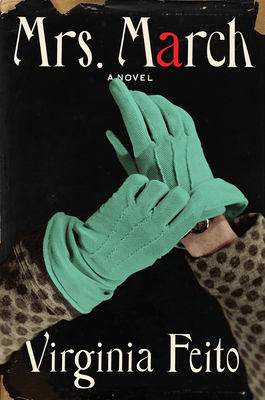
Set in an undefined time that is probably the 1950s or 60s, Mrs. March is a character study of a woman disintegrating. This all begins at her favorite pastry shop. Mrs. March is a woman highly concerned with appearances. She is married to George March, a writer whose most recent novel is a hit. She is figuratively torn asunder when the shop owner asks her if she minds being depicted in George’s book as the main character, Johanna. Mrs. March hasn’t exactly read the book, but she knows that Johana is an ugly whore whose clients don’t even want to be with her.

Mrs. March immediately becomes obsessed by the idea that he has portrayed her and that everyone is talking about it. She doesn’t read the book, which might be a reasonable reaction, but she destroys a few copies and roots through George’s desk trying to discover his secrets. There she finds an article about a missing teenager in Maine and immediately begins to believe that George, who periodically visits a cabin in the same town, has had something to do with it.

This novel takes a deep look at the psychological behavior of a woman who is unraveling. At times it is darkly funny, sometimes tipping nearly to absurdism. Mrs. March is not likable, her behavior is often outrageous, yet it’s hard to turn away from the page.

What does this book say about wives or about the experience of being a wife?

It’s hard to answer this question, actually, because we don’t see much of George. You have to wonder in the first place what would make George give such an unpleasant character as Johanna all of his wife’s rather distinct mannerisms, especially since most of the time he seems affectionate and soothing to her. Artists can be clueless, but it also seems clear that Mrs. March is so self-obsessed that she is detached from everyone, even her son.

Literary Wives logo

What does the poor woman have to do all day except clean up things she doesn’t want her maid to see and prance around town in her fur coat shopping? It’s enough to drive anyone mad. Yet is seems that no one is stopping her from doing whatever she wants to except, possibly, the notion of how it would look if she, say, got a job.

And how things look seems to be the dominating force in her life. We get a few glimpses into her childhood where her cold mother taught her this priority.

George has his secrets, but he is really not at all important in this novel. Mrs. March is able to adjust her notion of George instantly, thinking he’s a murderer while preparing his birthday party. What a book!

Related Books

The Wife

The Tortoise and the Hare

The Bird’s Nest

Review 2322: A Well Full of Leaves

Laura is from a poor family, but lack of money isn’t the problem so much as lack of love. Her father earns very little and is often drunk. Her mother constantly complains, offers no affection to her children, and tells them they are ungrateful.

At the opening of the novel, Anda, the oldest at 16, is beautiful but selfish. Robert, at 14, loves reading about history but has been made to quit school for a job as a clerk. Both pick on Steve, the youngest at 11, who deeply feels the lack of affection. Only Laura, who is 12 or 13, seems to care about him, and she has learned to adapt to their circumstances by losing herself in the tiny details of life, to enjoy living. She tries to teach her outlook to Steve, but he just becomes more bitter.

A crisis comes when Steve is 14. Although he is the best student of Greek in school and has a good chance at university, their mother tells him she removed him from school so he can work. This is just meanness, because Anda is leaving home, and Robert and Laura are working, so the household is better off than it ever has been. After a huge family fight, Steve burns all his books.

The novel begins to be about the relationship between Laura and Steve. Steve becomes a famous actor with a very bad reputation. He has many affairs but says he loves only Laura. Once their father dies, Laura goes to live with Steve. The real crisis comes when Laura falls in love.

Although I agree with a lot of Laura’s ideas, Myers expresses them far too often and in a florid writing style that seems to belong to the early Romantics. Sometimes, I had no idea what she was talking about and other times, I didn’t want to think about it enough to figure it out. Parts of the novel are absolutely fraught in tone, especially at the end.

Related Posts

Which Way?

The Old Man’s Birthday

The Other Side of the Bridge

Review 2321: Classics Club Spin Result! Weatherley Parade

Note: the name on this cover image is misspelled. The cover on the book I have looks the same but is spelled correctly.

In Weatherley Parade, Richmal Crompton takes a look at changes in society through the lens of one upper-class family, the Weatherleys. Her novel begins with the return of Arthur Weatherley from the Boer War in 1902 and ends in the midst of World War II in 1940.

The novel is written in vignettes, chapters that take up a few hours, a few days, or a few months. What with children, grandchildren, and other relatives, there are many characters. No one is completely lovable or unlikeable. They are shown with their good points and flaws.

During the years, there are many events—happy and unhappy marriages, separations, a divorce, and deaths. Among these events, there is one treatment of a child that is hard to forgive.

Among some of the characters is Aunt Lilian, a young woman in 1902 of whom her brother Arthur despairs. He can’t understand why she keeps jilting one fiancé after another. She runs with a fast crowd and seems restless and bored. At first, I thought she was just ahead of her time, dissatisfied with traditional women’s roles, but I liked her less as time went on, and she eventually turns to alcoholism.

Arthur’s two children are Clive and Anthea. Clive is a boy who thinks everything should be done properly and by the rules, which doesn’t make him a popular schoolboy or, later, schoolmaster or father, even though his intentions are good. Anthea likes to have people’s attention, which works well when she is the mother of many children but isn’t so successful when they begin leaving the nest.

The novel stops in to visit these characters and their descendants at key periods of their lives. The scope here is broad rather than particular, so we don’t get to know any characters extremely well. I thought the depiction of changing times and attitudes was interesting, but I felt fairly neutral about most of the characters.

Related Posts

Family Roundabout

The Old Man’s Birthday

Greenbanks

A Century of Books: How Am I Doing? February Report

In January, I foolishly decided to join Simon Thomas’s Century of Book Challenge, even though I knew that reading 100 books, one for each year in a century, from 1925-2024, would be tough because last year I only read 169. So, how am I doing?

I decided that the method I chose last month to keep track was meaningless to anyone but me, so it makes more sense if I list the years for which I don’t yet have entries. If you want to see the details, see my Century of Books page.

  • 1925-1934: entries needed for 1926-31
  • 1935-1944: entries needed for all years except 1941 and 1943
  • 1945-1954: entries needed for all years except 1947
  • 1955-1964: entries needed for all years except 1958 and 1959
  • 1965-1974: entries needed for all years except 1965, 1972, and 1974
  • 1975-1984: entries needed for all years except 1976
  • 1985-1994: entries needed for all years
  • 1995–2004: entries needed for all years
  • 2005-2014: entries needed for all years except 2009, 2010, and 2012
  • 2015-2024: entries needed for 2015 and 2024

Read in February (up to today):

  • Fear Stalks the Village by Ethel Lina White from 1932
  • The Warrielaw Jewel by Winifred Peck from 1933
  • Wonder Cruise by Ursula Bloom from 1934
  • Tom Tiddler’s Ground by Ursula Orange from 1941
  • Weatherley Parade by Richmal Crompton from 1943
  • Skeletons in the Closet by Jean-Patrick Manchette from 1976
  • Murder at the Residence by Stella Blómkvist from 2012
  • Mrs, March by Virginia Feito from 2021
  • Chenneville by Paulette Jiles, The Bookbinder by Pip Williams, and Somebody’s Fool by Richard Russo from 2023