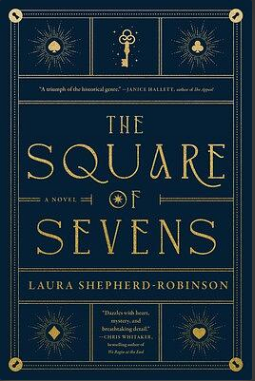
This period’s Best Book is The Square of Sevens by Laura Shepherd-Robinson!
Reviews, reviews, and more reviews

This period’s Best Book is The Square of Sevens by Laura Shepherd-Robinson!
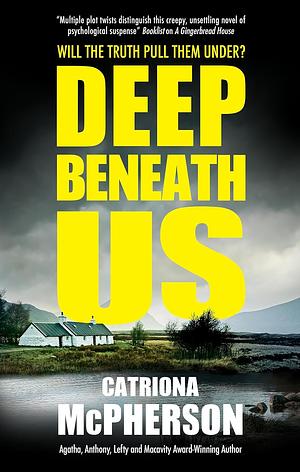
As a teenager, Tabitha had a mental breakdown and had to be hospitalized. Now her husband has left her for another woman. He has divulged her history of mental illness to her employer, who fired her for not divulging it when she was hired. This loss has resulted in the loss of her home and as a result, the custody of her son. She has returned to her family home on a remote moor because she has nowhere else to go, and at the beginning of the novel, she has decided to recede into madness. She feels a rumble and thinks she imagined it, but it is someone trying to blow up the dam.
Gordo hears the explosion and goes to the police to report it. That’s why the police are nearby when Tabitha realizes she can’t get her cousin Davey to answer his door. They find Davey inside, an apparent suicide, having taken the insulin left over after his mother’s death. At the cottage, Tabitha meets Davey’s friends Gordo and Barrett, with whom he regularly collected trash on the beach.
Tabitha, Gordo, and Barrett can’t make sense of Davey’s death nor of the police assumption that Davey tried to blow up the reservoir dam. Even though Tabitha finds a note, Davey doesn’t seem to be the type of person to commit suicide. Later, Tabitha is astonished to learn she has inherited Davey’s cottage—and delighted because it means she can offer her son a home, which he immediately agrees to accept. Then she and her new friends are astonished again to find that Davey has been hoarding all the junk the three men have picked up off the moor for the last 15 years.
Barrett is delighted to find his ex-wife wants to leave his two daughters with him, and with Tabitha’s son, the teenagers insist that Davey was murdered. As the adults and teens look into it, they end up digging into the tangled past of Tabitha’s family—the distant mother, the two brothers who were estranged for years and then apparently committed suicide on the same day (or did they?), the two cousins who eloped, one of them Davey’s brother, the other Tabitha’s sister, Tabitha’s near death as part of her father’s suicide—and why Tabitha remembers almost nothing.
This novel isn’t as much of a thriller as an extremely atmospheric and tangled mystery as Tabitha and her friends try to sort out the truth of her family’s past. Although the sequence of events around Davey’s death ended up seeming unlikely to me, my doubts didn’t interfere with my enjoyment of the novel.

Whenever I make up a new Classics Club list, I try to include some very early works. This one was probably written in the 12th or 13th century, but it draws from much earlier stories of the Oghuz Turks. The stories are said to be told and assembled by Dede Korkut, a shaman and bard.
The book comprises twelve stories and an additional work called “The Wisdom of Dede Korkut.” It seems that all of these early heroic stories, no matter what country they come from, are very similar, mostly concerned with fighting. Although the stories vary between more formal language, slang, and poetic language, they have formulaic sections. For example, several stories begin with a formula like this, only varying the names:
Beyindir Khan son of Kam Ghan had risen from his place. He had pitched his white pavilion on the black earth. His many-coloured parasol had reared toward the sky. In a thousand places his silken carpets had been spread.
All of the stories are addressed to the Khan, and most end with a sort of religious blessing directed at him. The characters often declaim, and when they do, there is a formula I found quite charming. It says something like “Thereupon Kanli Koja declaimed; let us see, my Khan, what he declaimed.”
Most of the stories, as I said, are about fighting. Sometimes a warrior is captured, and then years later a brother or son goes out to get him back. It seems that the captive is always sent out to fight the warrior, and once they figure out who they are, they unite and kill the captors. In one story, a hero informs his mother that he’ll only take a bride who will jump on her horse before him, ride before him to his enemies, and then chop off their heads before he gets there. When he finds a girl who does just that, he gets mad at her. But they make up.
All these heroes seem to have very short tempers and kill almost everyone they meet. One guy spends about six pages boasting of his exploits but inserts into the boasting several times how much he hates warriors who boast. I suspect there’s a sense of humor involved in that.
If you’re interested in reading a couple hundred testosterone-filled pages, this is the book for you.
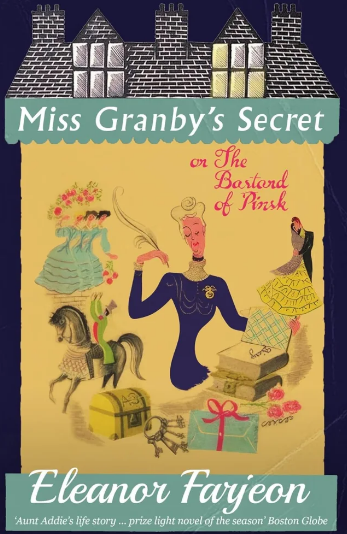
I was thrilled to learn that Dean Street Press was continuing its Furrowed Middlebrow imprint. This novel is an entertaining entry in that line.
In 1912, Pamela receives a bequest from her great-aunt Addie Granby of a house and a box of keepsakes and papers. Aunt Addie had been a well-known romance writer, but her modern great niece doubts that her spinster aunt ever understood the facts of life. Pamela finds hints that Addie had a romance when she was 16 with someone named Stanislaw. She also wrote her first novel.
The entirety of the novel, entitled The Bastard of Pinsk, is included within this novel. It begins with a conscientious list of terms that some polite young man has given her definitions for. As an example, “bastard” is given as “a very noble Hero of Royal Blood.”
The novel within the novel is made funny by the naïveté of its author, who writes in a Romantic, florid style and flings about words she doesn’t know the meaning or connotations of. Her Romantic upbringing and reading in the Gothic tradition are manifest in the ridiculous plot. If I have any criticism, it’s that it’s a bit too long. However, it picks up as it goes along.
Twenty years later Pamela learns that her friend Adey has been nursing an old man—her Aunt Addie’s Stanislaw! Now, she thinks, is her opportunity to find out about Aunt Addie’s past.
I received this book from the publisher in exchange for a free and fair review.

Last week, the New York Times published the list of the top 100 books of the 21st century as determined by their readers. I was one of the readers who submitted my top 10 list, although I admit that I didn’t think of some books I might have included. I thought I’d take a look at this new list from several angles .
The books on this list that were also on my list are these:
Not so good, but I did a little better if you add in the books that were on my shortlist but got scratched off to get down to 10:
I tend to have eccentric tastes, so I wasn’t surprised that some of the books I put on my list weren’t included on the top 100 at all. The rest of the books on my top 10 were:
Of course, I noticed books on the list that I might have put on my list if I’d thought of them:
There are a couple books that I actually have on my pile to read. (In fact, one is next, but I haven’t brought it along with me on my trip because it’s so fat.) So, I haven’t read them yet but intend to:
There are lots of books on this list that I admire. It’s just difficult to bring a list down to 10 books from all those written since 1999. However, let’s get down to it. There are lots of wildly popular books that I think are overrated. In my opinion only, here are the ones from this list. Don’t get mad at me if they’re your favorites. I’m just saying they shouldn’t be on a list of the best books of the century.

Margaret Steggles is a girl who yearns for beauty in her life. She is a schoolteacher moving to London for a new job, and she has been taught by her mother not to expect marriage. She tends to drift into reveries when contemplating beautiful scenery, literature, or music.
A small accident brings her into the chaotic household of Hebe and Alex Nislund. She finds Hebe beautiful but rude and is disappointed by Alex, who is a famous painter, because he seems so ordinary. Their housekeeper, Grantey, learning where Margaret lives, walks her home, because Grantey is returning to her primary place of employment, where she is an old retainer of Hebe’s parents, the celebrated playwright Gerard Challis and his wife Seraphina. Grantey invites her to stop by to visit at their home, Westwood, which is just up the hill from Margaret’s Highgate neighborhood.
A famous playwright is heady stuff for Margaret, who loves Challis’s plays. Although she doesn’t drop in on Grantey, she meets Zita, a German refugee and servant from Westwood, in the hardware story trying to find someone to mend a fuse before a party begins. The store can’t help, but Margaret can. She meets Gerard Challis and is struck by hero worship.
But Gerard is a pompous, humorless, unaffectionate, and selfish man who delights in carrying on chaste affairs with beautiful young women until they become demanding, at which point he dumps them without ceremony. He has coincidentally set his eye on Hilda, who just happens to be Margaret’s best friend. Hilda has plenty of admirers, though, and isn’t impressed, even though he is clearly wealthy and has told her he is single and his name is Marcus. This rejection of course makes him more eager.
Margaret is accepted into the Challis household as a friend and visitor, especially after the Nislund house is bombed and they all move in, too. Margaret enjoys being there even though they mostly treat her as a convenient person for helping take care of Alex and Hebe’s three small children. Margaret’s friendship with Zita can also be difficult because Zita is volatile, but they go to beautiful concerts together.
Margaret has also started helping John, a coworker of her father. He has been struggling to care for his mentally challenged daughter while his housekeeper is ill.
This novel made me laugh out loud sometimes, especially at the descriptions of the plots of Challis’s plays. The introduction tells us that Challis is based on a real person. I’d like to know who! (It turns out to be some guy named Charles Morgan.) In other respects, I really enjoyed this novel about Margaret’s development in self-respect and her shedding of her romantic myopia. This is a good one!
Just a quick note before my review: I’ll be posting during the next three weeks from various locations in the U. S., and Europe. So, my reviews may come out at funny times or may even be sporadic. I hope not.
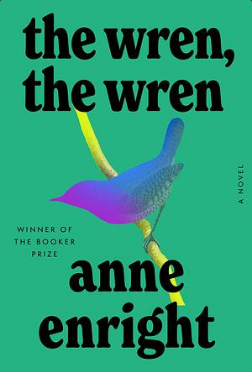
The Wren, The Wren is the story of three generations of an Irish family and how they are affected by the desertion of a father.
The first section of the novel is narrated by Nell, the granddaughter of the Irish poet, Phil McDaragh. At first, her section is delightful—exuberant, funny, it made me laugh out loud. But then she unfortunately falls in love with Felim, neglectful and abusive.
The next section is from the point of view of Carmel, Nell’s mother and Phil’s daughter. She has a close relationship with Nell until Nell’s teen years, but she is haunted by memories of her father, who deserted his family while Carmel’s mother Terry was ill with cancer. It is Carmel’s memory that the last thing he did before he left was throw a tantrum about a missing wristwatch, which Carmel later spots on his wrist during a TV interview.
We briefly see a few things from Phil’s point of view, mostly about his own childhood, and chapters are separated by his poetry or by old songs translated from Celtic. There is a lot of bird imagery in all the sections. The McDaraghs are conscious of birds.
This is a powerful novel about lasting damage from a harmful act and the time it can take to heal. It is often funny, with a dry humor, and just as often sad.
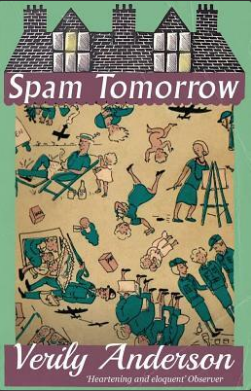
Spam Tomorrow is Verily Anderson’s memoir. Although it briefly hits other times of her life, it concentrates on the war years and ends shortly after D-Day.
The book begins with Anderson’s marriage to Donald, an event not encouraged by her parents because of his lack of wealth and an age difference that is unstated but I figure has to be at least 20 years.
At the beginning of the war, Verily, having already been warned off Donald , volunteers as an ambulance driver. At first, the drivers mostly just wait around to be dispatched, and later, she is erratic in her actual attendance at this job, getting very sick and later going off when she feels like it. She keeps running into Donald, though, who is found unfit for the military because of physical reasons and instead is working for the Ministry of Information. Finally, they decide to marry.
Most of the book has to do with the struggles—sometimes serious ones but related in a lighthearted manner—of living in London during the Blitz, of a difficult pregnancy, of motherhood, and of problems trying to find a suitable home to raise children when you’re not well off and being bombed.
Again, although sometimes concerned with serious problems, like Verily’s difficult first childbirth and subsequent illness, the memoir is related in a lighthearted manner and is often amusing. It provides yet another angle on British life during the war.
This morning I opened up my administrative page to the apparently pleasant sight that I had lots and lots of comments. In fact, they were links to my site. However, when I started to approve them, many of which came from the same site in Spanish, I couldn’t see any context around them. Usually, I see a few words that show they’re saying something about my review. So, I went to the website they were on, only to find that someone had copied my entire Authors page over to their site, with links to my reviews. The only difference was that all the titles had been translated to Spanish.
I don’t read or speak Spanish, but it was seemed to me that the site was presenting them as links to biographies of the authors named, which they are not. I looked at one other page on the site, and I am guessing that it was a copied page as well, with direct links to someone else’s site. I’m guessing that all their pages are like this. In fact, they have created an “informative” website by wholly copying material from other people’s sites.
Essentially, since my Authors page links to all of my reviews, I feel like they are trying to take credit for all of my web content, and I believe that the other website authors would feel the same.
Since the other site was also on WordPress, I looked up how to address the issue through them. They first want you to contact the other site holder. Well, I tried, through their comments, and stunningly, they wanted my phone number before I could leave a comment, something I am not going to leave. So, I filed a form with WordPress asking for the content to be removed.
If you are a blogger, has anything like this happened to you?

It’s time to participate in another Classics Club spin. If you want to participate, post a numbered list of 20 books from your Classics Club list by Sunday, July 21. On that date, the club will announce a number, which determines which book you read for the spin. Then you try to read the book and post a review by September 22.
So, here’s my list for the spin:
Writer and Historian
There is nothing more satisfying than reading a book while sipping a hot cup of tea.
A historical fiction book blog
Emerging as an artist
Liz Dexter muses on freelancing, reading, and running ...
For mostly adult, literary, fiction; focusing on Historical, Biographical, and Women's Fiction.
"Well, there’s so much to read, and I’m so far behind." Wallace Stegner
Read to live and live to read
A bookish blog (mostly) about women writers of the nineteenth and twentieth centuries
A Celebration of Russian Literature
Reading: it's personal
Based in Romania, reading all over the world. Mostly fiction, some memoires and a little bit of poetry.
Adam Burgess
"Vivre le livre!"
"History is a vast early warning system." Norman Cousins
Scottish Book Blogger
"She had read novels while other people perused the Sunday papers" - Mary Elizabeth Braddon
A word after a word after a word is power. --Margaret Atwood
Books • Opera • Art • History
FOR DISCERNING READERS
Your online source for Jane Austen and her legacy
A Community of Classics Lovers
A blog about Irish books, writers, writing and everything in between.
A suggestion a day from the Williamsburg Regional Library

