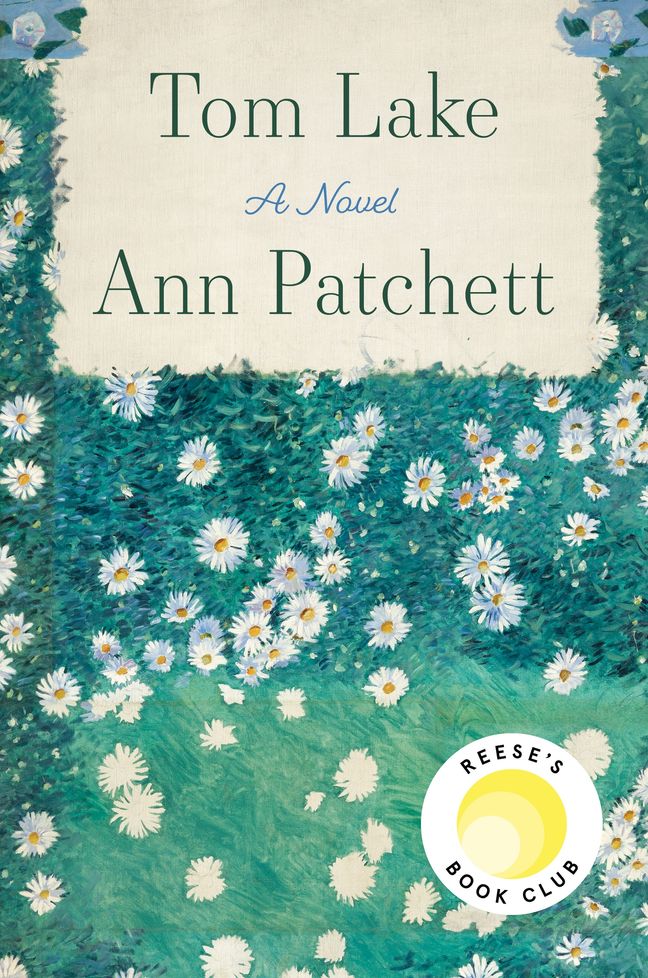
Review 2264: Tom Lake

On the farm in Northern Michigan that has been in her husband’s family for generations, Lara has been coaxed by her three grown daughters to tell them about her relationship with Peter Duke, a now famous movie star. There has been a triggering event for these stories, but we don’t learn about it for a long time. In any case, these stories take place between sessions of cherry picking and other hard work.

Lara becomes an actress without planning to. When she is in high school helping with auditions for Our Town, the girls trying out for Emily are so bad that she tries out herself and gets the part. Later in college, she takes the part again, and it happens that Ripley, a movie producer, has been persuaded to attend to see his niece. Instead, he decides that Lara is perfect for an upcoming role.

Lara makes a movie, but there is a long delay before it comes out, so she ends up taking the part of Emily again at a summer stock theater in Michigan called Tom Lake. At Tom Lake, she is swept into an affair with Peter Duke, a young, charismatic actor, on her first day. The summer starts out magical, but Lara has a lot to learn about acting, herself, and Duke.

The present-time novel is set during the pandemic, but even though the story has some heart-wrenching parts, its overall atmosphere is so cozy, so happy in its setting, that it feels like the family has its own little nest. You want to go and live with this fictional family. I was born and grew up in Michigan, and although I never lived on a cherry farm, this book made me nostalgic.

Patchett is also a terrific storyteller. This novel is paced brilliantly. The sections where she tells her story seem just about right in length while the rest portrays a warm family life and hard work on the farm. I loved this book.

Related Posts

Commonwealth

State of Wonder

Once upon a River

Nonfiction November: Week Two

Week Two of Nonfiction November is hosted by Volatile Rune. The theme is Choosing Books, and here is its description:

What are you looking for when you pick up a nonfiction book? Do you have a particular topic you’re attracted to? Do you have a particular writing style that works best? When you look at a nonfiction book, does the title or cover influence you? If so, share a title or cover which you find striking. 

Cover for The Wicked Boy

I am not nearly as big a nonfiction reader as I am a fiction reader, so to answer this question, I had to look back at my list of nonfiction books since I started my blog. It’s clear that I like to read books about literary subjects and biographies and memoirs, often by or about literary figures, but although I have read a few, not often celebrity biographies and memoirs. I think in general I just look for nonfiction books that pique my interest in some way, either because of who wrote them or what they are about.

Although the cover generally influences me for fiction books, I haven’t been able to discover that I read any nonfiction books because of their covers. However, I will read books by certain authors: the biographers Doris Kearns Goodwin, Claire Tomalin, and Ron Chernow, for example. I also like true crime novels, but mostly true crime of an older vintage, so I have enjoyed a couple of books by Kate Summerscale (The Suspicions of Mr. Whicher, The Wicked Boy) and have another one on my pile.

Cover for Annals of the Former World

There are also periods of history I’m interested in, particularly the Wars of the Roses. I’ll read histories and biographies about that time.

I am not very scientific minded, but occasionally I hear of a book about science that sounds fascinating. I have an upcoming review of The Bathysphere Book that I found really interesting, and it has a great cover illustration.

Ten years ago, I discovered John McPhee’s Annals of the Former World, about how our continent was formed geologically, in four big, fat volumes, and I read every one. Fascinating stuff, and McPhee is a great writer.

Review 2263: The Shadows of London

Cat Lovell and her partner Brennan have a commission to build a new almshouse and some houses where the old almshouse burnt down in 1666. However, workmen find a body in a rubbish pile on the site. Not only does the body need to be identified because it has no face, but a magistrate named Rush closes down the entire site until the inquest. This is unnecessary, but Cat’s employer Mr. Hadgraft, says that Rush originally was a partner in the undertaking and pulled out, so he is trying to get back at Hadgraft. For Cat and Brennan, the situation is urgent, because they only have a few months before winter closes the work down.

Cat’s friend James Marwood now works entirely for Lord Arlington, who assigns him the task of discovering the corpse’s identity. He finds there are two missing men who might be the victims. One is John Ireton, a civil servant who has disappeared. The other is a Frenchman, Monsieur Pharamond (a pseudonym). Both were involved in fleecing a young French lady-in-waiting in Dieppe.

This novel also tells the true story of that lady-in-waiting, Louise de Keroualle, who has attracted the attention of Charles II. Both Lord Arlington and the King of France see a benefit in having a young French, Catholic girl in the King’s bed. But Louise herself is hoping for a way out.

Marwood’s investigations indicate that his and Cat’s old nemesis, Roger Durrell, a tough for Buckingham, might have killed the dead man. Another issue is that James has become infatuated with Hadgraft’s daughter, and Hadgraft seems unexpectedly eager for the marriage. Cat finds herself surprisingly jealous.

This is an excellent series, and another exciting entry in it. I especially liked the ending.

Related Posts

The Royal Secret

The Last Protector

The King’s Evil

Review 2262: The Theft of the Iron Dogs

The Theft of the Iron Dogs is another novel by E. C. R. Lorac that is set in the beautiful Lune valley of Lancashire, along with Fell Murder and Crook O’Lune. In order, it comes after Fell Murder and before Crook O’Lune.

Giles Hoggett has been busy with the harvest for weeks, but it is over, and he decides to walk over to check a cottage he owns next to the river. After he notices that someone has disarranged his woodpile, he goes into the cottage and finds someone has stolen an old coat, hat, and glasses as well as a bag, rope, and the iron firedogs out of the fireplace. In speaking with neighbors, he finds that another cottage owner has had his waders stolen.

Giles is inclined to blame small thefts on a tinker couple, referred to as potters in the North. No one has seen the potter’s wife, Sarah Gold, for some time, and it’s not lost on Giles and his brother George that the missing items could point to the disposal of a body. Hoggett knows that Chief Inspector Macdonald was in the area earlier investigating the fell murder, so he writes a letter to Macdonald expressing his concern.

Macdonald is investigating the theft of clothing coupons that he thinks might involve a criminal named Gordon Ginner, and he takes a weekend off after a trip up to Manchester on this case to check out the situation in the fells. While he is there, he finds a body hidden under tree roots in a deep pool of the river. It is Gordon Ginner.

I especially like these mysteries set in the fells, because they are so atmospheric. It is clear Lorac loved that area of the country. And incidentally, from this one I learned what a fell is. I just had a vague idea that it was a valley.

I received this book from the publisher in exchange for a free and fair review.

Related Posts

Fell Murder

Crook O’Lune

Murder in the Mill-Race

Nonfiction November

I thought I might participate in Nonfiction November this year. I haven’t participated before, not being the biggest nonfiction reader, but I thought I’d try to do a post a week, if they are appropriate. I am also planning to review two nonfiction books this month, including one I originally intended for the 1962 Club, but it didn’t fit my schedule.

The host for this week’s Nonfiction November is Based on a True Story, so people’s reviews and comments will be listed there.

So, here is the description for the theme for this week:

Week 1: Your Year in Nonfiction : Take a look back at your year of nonfiction and reflect on the following questions – What was your favourite nonfiction read of the year? Do you have a particular topic you’ve been attracted to more this year? What nonfiction book have you recommended the most? What are you hoping to get out of participating in Nonfiction November?

I have read eight nonfiction books this year, three of which I haven’t reviewed yet (although two are coming up in a few weeks). They are listed in order of my reviews:

These books don’t easily fall into categories, but:

  • 3 are memoirs and 1 is a biography
  • 4 are related to literature, 3 by authors known in the literary world and the last about Shakespeare’s work
  • 1 is a sort of travelogue or nature book
  • 2 are science-related

The books I enjoyed most were The Other Day, a memoir of Dorothy Whipple’s childhood, which was touching and funny, and The Bathysphere Book, a nonlinear account of the ocean explorations of William Beebe in a bathysphere, leading up to his deepest dive in 1930. This book was really interesting and included vivid descriptions of a bunch of colorful characters. Unfortunately, my reviews of these two books won’t appear until November or December. Silent Spring also made my mind boggle.

I have only recommended The Bathysphere Book to my husband. It will be interesting to see if he reads it.

I didn’t really have in mind gaining anything by participating except maybe that participation will draw me into reading more nonfiction.

Review 2261: Jenny Wren

This novel is called Jenny Wren after its main character, Jenny Randall, but I actually preferred her sister, Dahlia. The two sisters are the daughters of a mismatched couple, beautiful but lower-class Louisa and Randall, who is her social superior. Once her husband got over his infatuation, he criticized her actions and her manners and made himself responsible for their daughters’ education. Both have the right accents and manners, but Jenny cares more about what people think than Dahlia does and is ashamed of her mother, particularly because while their father was away at the war (WWI), Louisa had an affair with Thomas Grimshaw, a local farmer.

Now their father has died, and Louisa has sold the farm and purchased a large house in a fashionable neighborhood in Upper Radstowe to open a boarding house. The Dakins next door are friendly to the girls until they mistake Louisa for the cook. Miss Jewel, who also runs a boarding house, is hostile and on the look out for hints of scandal, such as that suggested by Thomas Grimshaw’s visits every Saturday. Louisa isn’t happy to see him, but she sold him the farm and borrowed money from him to buy the house. He’s hoping she will fail and be forced to marry him.

Jenny has dreams of meeting some young upper-class man and falling in love with him, but she sees the very existence of her mother as a threat to this “future.” She is disposed to like Edwin Cummings, their boarder, but looks down on him as worker in a shop. He is an expert on antique furniture and wants to have his own shop, and she is beginning to be friends with him when she meets the son of the local gentry, Cyril Merriman, and falls in love with him. After a misunderstanding, she lets him believe her name is Jenny Wren and is afraid to tell him who she actually is.

In the meantime, Dahlia goes from making fun of Mr. Sproat, the curate, to beginning to like him. However, the family’s second boarder, Miss Morrison, hopes to marry him.

Louisa, who makes several badly misjudged decisions based on wrong assumptions, invites her sister Sarah to stay with them. Sarah turns out to be an unpleasant woman who wants to take the boarding house over from Louisa. To do that, she decides both girls must leave the house and Louisa must marry Grimshaw, and she sets out to bring these outcomes to pass.

The novel concentrates on Jenny, because she undergoes the most personal growth. I found her to be quite foolish at times, and her attitude to her mother made it hard for me to relate to her, but she grows up in the end.

Related Posts

Chatterton Square

Miss Mole

Four Gardens

Reading Thirkell’s Barsetshire Series In Order: Final Wrap-Up!

Yes, after more than two years of reading a book a month, I finally finished reading all of Angela Thirkell’s Barsetshire novels in order. That’s 29 of them! A few brave folks at least kept up with me by reading and or by commenting on one or more of my reviews.

  • Brona of Brona’s Books
  • Silvia Cachia
  • Davida Chazan
  • Christine of All the Vintage Ladies
  • Liz Dexter of Adventures in Reading
  • Penelope Gough
  • Gypsi
  • Helen of She Reads Novels
  • The Readable Word
  • Renee
  • Anne Roy
  • Sue
  • Mary Taylor-Lee
  • Simon Thomas of Stuck in a Book
  • Yvonne of A Darn Good Read

I hope I didn’t forget anyone.

Having finished this project (yay!), I thought I’d wrap up by making a few points about the project in general:

  • Was the project worth it? In a way. Before I started it, I had been reading the books arbitrarily, when I came across them, and I think I had read eight or nine of them before. However, attacking them in this way, I would have vague ideas that I had seen characters before but could seldom remember much about them or their relationships with other characters. Reading the books in order helped with this a lot. Some characters who recurred in almost every book became very familiar to me and I could remember others easily. However, I wished I had made a spreadsheet for myself from day one to note relationships and what I knew of each character, it got that complicated, especially toward the end when Thirkell seemed to introduce characters out of the blue and for only one book.
  • Were the books written before and during the war really the best ones? That’s the common understanding, but I think they kept up their quality longer than that. In answer to this question, I would say that the last four or five books weren’t quite up there with the rest.
  • What is the effect of reading one a month? Reading one a month does have the problem that you get a little tired of Thirkell’s tropes. She has character types that reappear and she has conversations that keep repeating. Also, she does remind you of things that happened to the characters, but towards the end, she brings these things up more than once a book. I think if you were reading one book a year, as you would if you read them as they were released, this wouldn’t bother you as much as if you are reading one a month. In fact, the reminders of what happened to the characters in previous books would be helpful.
  • Did the last book being finished by someone else matter? Maybe not. The only difference I could detect were a few conversations, especially at the birthday party, that didn’t seem as clever as usual. Otherwise, I really couldn’t see much difference. However, I have no idea how finished this novel was before Thirkell died. If anything, I would say that there were fewer things repeated in the same book, a problem I had been running into for the last three or four books.
  • Were there things I didn’t like about the books? Yes, there were quite a lot of comments that we now consider politically incorrect, especially toward the end of the series. At first, I just put them down to the times, but after a while, they seemed to get worse. There were some racist expressions, despite there being no actual nonwhite characters, and a lot of classist attitudes.
  • What is valuable about this series? Even though it is set among privileged characters, it is a chronicle of the changes to society that were caused by the war and its aftermath.
  • Who were my favorite characters? Lady Emily, Lucy Marling, Miss Merriman, Wicks, Lord and Lady Pomfret (Gillie and Sally Foster), Lord Stoke, Gradka, whom I at first found irritating, but afterwards made me laugh as soon as she appeared.

Anyway, I’m glad that I finished this project and am glad to be finished with it!

Review 2260: #ThirkellBar! Three Score and Ten

Three Score and Ten is the last novel of Angela Thirkell’s Barsetshire series, finished by a friend after her death. Could I tell the difference? Maybe.

As I’ve commented before, Thirkell’s later books don’t really have plots, but this book works toward three events—Mrs. Morland’s 70th birthday, a romance for Lord Mellings, and another romance for Sylvia Gould, whom I don’t even remember meeting before.

As usual with the later works, the novel consists of a series of tea parties and dinners, with the Barsetshire Agricultural Show also taking place. Mrs. Morland entertains her grandson Robin because his siblings have the measles, and he is exactly as I remember his father, Tony, as a boy, including behaving several years younger than his age of ten or eleven.

The birthday party gives its author the opportunity to bring in almost everyone who has ever appeared in the series. Several characters who aren’t invited appear in an indignant meeting called because of the intentions of Lord Averfordbury to tear down Wiple Terrace, home of Miss Bent and Miss Hampton and several Southbridge school teachers, and put up a factory.

Could I tell that not all of the novel was written by Thirkell? Not so much, although maybe the conversations at the birthday party are not as clever. Twenty pages, by the way, are devoted to that party, which is about 18 more than were taken for any of the many weddings that appeared in the series (although admittedly most were only mentioned) and about 15 too many.

One more issue that has little to do with the original novel. I think I’ve had occasion to comment about the earlier Moyer Bell editions (all of the post-war novels) that they had a lot of typos. I haven’t mentioned that in a while because they got better, but this book had lots of them, including ones that show the text couldn’t have even been subjected to a spell checker.

Related Posts

Love At All Ages

Close Quarters

A Double Affair

Review 2259: The Dry

I had some problems with the only other book I’ve read by Jane Harper, but I thought I’d try The Dry, her first and most acclaimed novel.

Aaron Falk, an Australian Federal agent, has returned to his home town for the first time in 30 years. Even though he is returning for the funeral of Luke Hadler, his childhood best friend, he probably would not have come if he hadn’t been urgently summoned by Luke’s father, Gerry.

Falk’s return is not warmly welcomed. When he was 16, one of his close friends, Ellie Deacon, was found drowned, with foul play suspected. A piece of paper with his last name on it was found in her room, and both he and his father were harassed until they left town.

The finding in the current crime is that Luke shot his son and wife and then himself over despair at the impending failure of his farm. The drought has gone on so long that many farmers have failed and along with them, most of the local businesses. The town is a shadow of its former self.

Gerry doesn’t believe his son shot his family. He wants Falk to stay a few days and investigate. Falk reluctantly agrees.

When he begins investigating, he finds that the local cop, Sergeant Raco, thinks some things were missed in the original investigation, which, since he was new in town, was conducted by the police from the nearest large town. Falk and he begin working together despite the local hostility toward Falk.

While he is at it, Falk also tries to find out what might have happened to Ellie. Are the two events related?

This novel was nicely plotted, with believable characters. The setting was so effectively described that at times I felt I could feel the heat and the town under pressure from the environment, old hostilities, and an unthinkable crime.

Related Posts

The Survivors

Truth

The Broken Shore