Review 2093: #ThirkellBar! County Chronicle

In introducing County Chronicle, I find it impossible to avoid spoilers for those who have not read the previous book, The Old Bank House. So, beware.

The novel begins where the previous one left off, if not slightly before that, with Lucy Marling wondering how her parents are going to take her engagement to Sam Adams, the wealthy older ironmonger who is not from her class. They take it comparatively well. It is her beloved brother Oliver who tries to flatten her excitement with his disapproval, so that Lucy realizes for the first time how selfish he is.

Speaking of selfish men, Francis Brandon is now happily married, but he’s been taking his mother for granted and is even rude to her. His mild-mannered wife Peggy is distressed by it but doesn’t have the courage to say anything. Others are beginning to notice, and Mrs. Brandon realizes it was a mistake for them all to live together.

Isabel Dale, a cousin of Robin Dale, takes a job with Mrs. Marling to help her with Lucy’s wedding and stays on to help her with her correspondence. She also sometimes helps Oliver with his book.

Although the Barsetshire set have tended to stay away from the Omnium Castle crowd, Francis and Peggy Brandon have been spending time there doing amateur theatrics with Lady Cora and Lord Silverbridge, the Duke’s heir. We find the ducal family impoverished but very nice. Eventually, Isabel and Oliver are introduced to the family by Roddy Wickham.

Although I didn’t like this one quite so much as The Old Bank House, it was still good. Several characters’ problems are resolved in a satisfying way, and the two romances are as sweet as they are understated.

Related Posts

The Old Bank House

Love Among the Ruins

Private Enterprise

Review 2092: The Fair Jilt

I know that Aphra Behn wrote some bawdy comedies, and that’s what I was hoping The Fair Jilt would be. However, this prose work from 1688, which I read for my Classics Club list, is anything but funny.

Behn starts out with a long dissertation about foppishness, although it’s hard to say what that has to do with her story. She does not approve. Then she tells a story about a very beautiful woman named Miranda. She seems to like to pose her prose writing as if she is telling a true story with the names changed, as she did with Oroonoko.

Miranda starts out her career by flirting with all the men but never granting them favor. She lives in a sort of convent in Antwerp for women who have not made vows, but it seems to be full of her suitors. It is this kind of female aggression in her characters that has gotten Behn praise from feminists, but I’m not sure they understand her message. (Of course, she earns it for being a woman writer in the 17th century, as well as a spy.)

Miranda, who is as wealthy as she is beautiful, is living a gay and carefree life until she meets a beautiful young friar who is a prince with an unhappy past. She falls madly in love with him, but he is not interested. This fact enrages her and things go from bad to worse—for him.

Her continued career gets deeper into depravity after she marries handsome Prince Tarquin, even though he adores her. Her crimes include taking her husband’s ward’s fortune, lying, and incitement to murder.

So, you can imagine what a jolly tale this is. It even includes a man living after he is halfway decapitated. The biggest disappointment of this very unfunny work is that Miranda has a better fate than she deserves.

Related Posts

Oroonoko

The Duchess of Malfi

The Poison Bed

Review 2091: Final Acts: Theatrical Mysteries

British Library Crime Classics’ latest collection of mystery short stories has some connection to the theater. Some stories are only peripherally connected—feature an opera singer, perhaps—while others are set there and show a deep knowledge of that environment. As usual, the stories are ordered chronologically, beginning with a 1905 story by Baroness Orczy and ending with one from 1958 by Christianna Brand.

Baroness Orzcy’s “The Affair at the Novelty Theater” is a complicated story about the disappearance of some priceless pearls.

“The Affair at the Semiramis Hotel” by A. E. W. Mason is one of the super-complicated crime stories common in the earlier years involving people in costumes, a robbery, and a burglary.

“In View of the Audience” by Margarite Steen is a creepy one about a young man who gets on the wrong train and ends up accompanying a strange man to a derelict theater, where he hears about an old unsolved murder.

“Blood Sacrifice” by Dorothy Sayers leaves the reader to decide if there is a crime or not. Young playwright John Scales is furious with Mr. Drury, who has bastardized Scales’s play to make it a success. Then an accident places Drury in Scales’s power. This is the first story in the book in which characterization plays much of a role.

“The Blind Spot” by Barry Perowne is about a playwright who had a brilliant idea for a locked room mystery when he was drunk but can’t remember it sober.

“I Can Find My Way Out” by Ngaio Marsh probably shows the most knowledge of the theater, as a leading man is murdered in his dressing room.

“The Lady Who Laughed” by Roy Vickers is a strange story about a clown who murders his wife for finding him funny.

I enjoyed the satisfying surprise ending of “The Thirteenth Knife” by Bernard J. Farmer.

In “Credit to William Shakespeare” a poisoning onstage is solved through a man’s knowledge of Hamlet.

I think my favorite story was “After the Event” by Christianna Brand, where her detective, Inspector Cockrill, ruins the Great Detective’s favorite story by explaining how he got it wrong.

I received this book from the publishers in exchange for a free and fair review.

Related Posts

The Christmas Card Crime and Other Stories

The Edinburgh Mystery and Other Tales of Scottish Crime

Silent Nights

Review 2090: A Pin To See a Peepshow

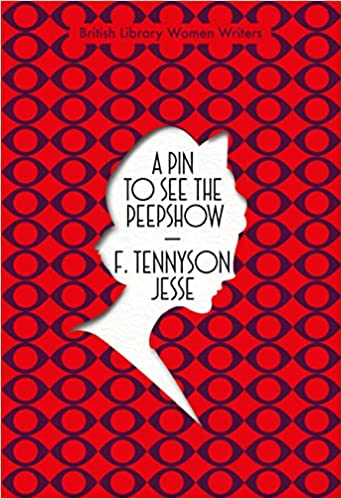
A Pin to See a Peepshow is a fictionalized retelling of a famous British true crime. Jesse, who was a contributor to the Notable British Trials series, chose to make the life of her main character and the details of the crime slightly different from the actual events.

Julia Almond is an unusual girl who projects the assurance that her life is going to be different from that of the others around her. She has a sense of style and after finishing schooling, is able to find work at a small dressmakers.

Julia has lived mostly in a daze of romantic daydreams except for her work at the shop, where she thrives and is promoted. But she finds her real life boring and seems to care only for her dog, Bobbie. She is waiting for a great love.

What she gets is Mr. Starling, a friend of her father’s. During the First World War, her father dies. Her mother can’t afford the house even with Julia’s small salary, so her uncle, aunt, and cousin move in and begin to order things as they want. Julia’s bedroom, which has been her sanctuary, is invaded by her cousin Elsa. Julia is told that Bobbie can’t sleep in her room. She kicks up enough of a fuss to get that changed but finds Elsa trying to lure Bobbie away from her. When Julia finds living at home unbearable, she decides at twenty to marry Mr. Starling, whose wife has died and who looks a lot more handsome in his uniform. This, of course, does not work out well, but she gets along for years until she meets Leonard Carr, a sailor seven years younger, who begins pursing her.

Jesse’s message is that Julia would not have ended up as she does if she had not been lower class and financially insecure. Any poorer and she would have just left with her lover. Richer and divorce would have been commonplace, but to her it was a scandal. Further, although she was innocent of murder, she was convicted because of her adultery and the difference in age between her and her lover.

Jesse paints an open-eyed but sympathetic picture of Julia. Although I could have done without some of the sections at the end where others reflect on the execution, it is a powerful and affecting piece of writing.

Related Posts

Famous Trials

The Suspicions of Mr. Whicher

The Wicked Boy

Review 2089: The White Priory Murders: A Mystery for Christmas

Although The White Priory Murders is not explicitly set at Christmas, it has a nice, snowy setting. I received this novel just recently and thought I’d post my review in time for Christmas.

Carter Dickson is a pseudonym for John Dickson Carr, who was known for locked door mysteries. I confess to not being big on them, but this one is a different sort from the usual very cerebral locked door mystery and has some moments of true suspense.

James Bennett is the American nephew of Sir Henry Merrivale, an amateur sleuth. He has traveled to England with a group of people in the movies and is concerned about an attempted poisoning, so he consults Merrivale. The people concerned are centered around Marcia Tait, a glamorous actress who was ignored by the British acting establishment but has since made it big in America, so she is determined to star in a historical play in England. With her are Rainger, a director; John Bohun, a theatrical presenter; Jervis Willard, an actor who will play opposite Marcia; Emery, her publicist; and Louise Carewe, the daughter of a potential investor, Lord Canifest, who wants to marry Marcia. Someone has sent Marcia a box of chocolates, and Emery was slightly poisoned after eating one. Merrivale says the attempt was not serious.

Later, though, the entire group goes to stay at the White Priory, a centuries old house owned by John Bohun’s brother Maurice and also occupied by his niece, Katherine. Bennett arrives very early in the morning to find that John Bohun has just discovered Marcia’s body in the pavilion where she insisted on spending the night. She has been beaten around the head, but the biggest mystery is the fresh snow around the pavilion, unbroken by any footprints except John’s, going in. According to the events established during the night, she must have been murdered after the snow began falling.

Everyone has secrets, and soon there is a series of attempted murders, attempted suicides, and successful murders, as Inspector Masters summons Merrivale to help him figure it all out.

I received this novel from the publishers in exchange for a free and fair review.

Related Posts

The Seat of the Scornful

The Lost Gallows

Death of Jezebel

Review 2088: Mrs. Tim Flies Home

I intended to read the Mrs. Tim books in order, but that hasn’t quite worked out, and I received this one just in time for Dean Street Press in December.

Hester Christie (Mrs. Tim) reluctantly leaves her husband in Kenya, where he is now posted, to form a household in England that her children can return to for the summer holidays. But en route she stops for two days in Rome. There she is unexpectedly met by family friend Tony Morley. Her couple days of sightseeing with him create a misunderstanding that travels all the way back to England to cause trouble for her through the person of Mrs. Alston, whom she met on the plane from Kenya to Rome.

Mrs. Tim has found a house in Old Quinings called the Small House. Although she loves the house, she finds she has a troublesome back neighbor and a landlady who isn’t to be trusted. She also meets some pleasant neighbors and helps out a young man in his romance with a nice young girl. She solves a mystery and finds out why some of the villagers are treating her oddly.

This book is another breezy entry in the Mrs. Tim series, written in the form of letters to her husband. It gets a little patronizing toward the ancient Romans (conveniently forgetting about the Inquisition), but they’re dead so they won’t mind. Otherwise, it’s an entertaining read.

I received this book from the publisher in exchange for a free and fair review.

Related Posts

Mrs. Tim of the Regiment

Mrs. Tim Gets a Job

The Two Mrs. Abbotts

Review 2087: Burnt Sugar

When Antara was three, her mother Tara took her and left her home out of boredom to join an ashram, becoming the guru’s lover. In the ashram, Antara hardly ever saw her mother, and when she did, Tara alternated between effusive love and abuse.

Now Antara notices her mother is losing her memory. Although she tries to help her with diet and memory exercises, she still bears her a lot of resentment for events in the past. But this novel reveals its secrets slowly, and its secrets include betrayal. This novel, which I read for my Booker project, is mostly a character study about a woman who felt unloved as a child and is still suffering.

Antara is an artist, good enough to have her own show in a gallery, so I found it disturbing how slighting her family was about her art. When her mother burns some of her drawings, no one is upset, and later someone refers to her art as a hobby.

Antara is not a reliable narrator, nor is she a likeable person, but I found this novel fascinating.

Related Posts

The Blazing World

Suzanne

Black & White

Review 2086: Beyond the Rice Fields

I was looking forward to reading Beyond the Rice Fields as the second book set in Madagascar that I’ve recently read (the other was Red Island House) but even more so as the first book ever translated from Malagasy into English. It is set during a fascinating period in the 19th century.

The child Tsito has been a slave since his family were killed or sold into slavery, but his luck changes when he is bought by Rado, a trader in zebu who travels all over the country. He purchases Tsito more as a companion for his young daughter Fara, the product of an unmarried union with Bao, a very beautiful dancer. So, Tsito grows up in a family unit with Fara, Bao, and Bebe, Bao’s mother.

When he is older, Tsito learns to read from foreign missionaries, and this makes him valuable to Andriantsitoha, the provincial lord. He takes Tsito to the City of Thousands to work for him. Tsito is hoping to earn his freedom, because he is in love with Fara. However, the political situation is looking more uncertain since rule of the kingdom was forcibly seized by the Sovereign Queen after the death of the Sovereign King. Powerful lords are taking land away from others who seem to have no judicial recourse, and Andriantsitoha has very little power in the city. The country becomes more chaotic, as a backlash against Christianity leads to large-scale denunciations and slaughter.

I know nothing about the history of Madagascar, so I probably would have found this novel fascinating except for issues that may or may not be cultural. It was hard for me to know. I often found myself confused about the larger picture because except for the final dramatic scenes in the last 50 pages of the book, Naivo doesn’t explain what’s going on very clearly. He tends to only bring in information or characters when he needs them, and if then, doesn’t really give them much dimension. For example, some of the children that Fara and Tsito play with become important later in the book, but he hardly mentions them as children and doesn’t show you what they are like, except the bully.

The narrative point of view switches between Tsito and Fara, and Fara spends a lot of time recounting stories and thinking about some family curse that is never fully explained. So, during the first half or so of the novel, I wasn’t always sure whether we were in the past or the present.

In general, I felt that Naivo had a problem knowing what to tell and when.

Related Posts

Red Island House

Things Fall Apart

When Rain Clouds Gather

Review 2085: The Suspicions of Mr. Whicher

Last summer, my husband and I watched a set of programs on BritBox—not a series but separate movies each with the title “The Suspicions of Mr. Whicher” and a different subtitle. When I looked at the credits, the name Kate Summerscale rang a bell, and I realized I had read her book The Wicked Boy about a Victorian true crime. The Suspicions of Mr. Whicher is also nonfiction, about a famous Victorian murder and the detective whose career was nearly destroyed by the case.

In June 1860, the Kent family awakened to find three-year-old Saville Kent missing. Searches of the property eventually located him under the seat of an outside privy with his throat cut. A window of the dining room was ajar.

The initial investigation was botched, with local police assuming the crime was committed by a servant or outsider, and even hiding some potential evidence. John Whicher, a top detective in the newly formed detective department, was assigned to the case after two weeks, as a result of reported bungling.

Mr. Whicher was thorough in his investigation despite lack of cooperation and even obstruction by the local officials. He concluded that Saville was murdered by his 16-year-old sister, Constance (this is not a spoiler because this information comes out fairly early in the book), but felt he didn’t have enough proof to make an arrest. However, the local magistrates pushed him into it.

It is the national reaction to the crime and Mr. Whicher’s suspicions that Summerscale concentrates on, as well as telling what happened to the principals later. This is a really interesting book, relating how Mr. Whicher was a model for early fictional detectives and how this case affected early crime fiction.

Related Posts

The Wicked Boy: The Mystery of a Victorian Child Killer

The Invention of Murder: How the Victorians Revelled in Death and Detection and Created Modern Crime

Famous Trials