Review 2068: The Secret Adversary

I decided to read all of Christie’s Tommy and Tuppence novels after learning that they were her favorites of all her sleuths. There are unfortunately only a few of these novels, and The Secret Adversary is the first.

Tommy and Tuppence are old friends who haven’t seen each other for a while when they meet again after World War I. They are both broke and have been looking for work, so they decide to band together to look for jobs, calling themselves Young Adventurers, Inc. On leaving the café where they have been lunching and discussing this plan, Tuppence is approached by a man who overheard them and says he thinks he has a job for them, but when he asks her name, she says, “Jane Finn,” a name she heard mentioned in the café. He reacts indignantly and leaves.

After placing an ad, Tommy and Tuppence are contacted for work and find that the job oddly involves Jane Finn, who was a passenger on the Lusitania when it was sunk five years before and is believed to have been the recipient of a package important to the government. Tommy and Tuppence are hired to find Jane Finn.

The search brings with it many adventures, during which their steps are dogged by a mysterious Mr. Brown, apparently a criminal mastermind. This novel has a silly Cold War plot before the Cold War, and the slang spoken by an American millionaire seems completely unlikely. I think Christie must have watched too many gangster movies. However, Tommy and Tuppence are delightful and resourceful, so this was a fun reading experience.
Related Posts

By the Pricking of My Thumbs

The Seven Dials Mystery

Destination Unknown

Review 2067: Christine Falls

Benjamin Black is a pen name for Irish writer John Banville. Christine Falls is the first of his Quirke mystery series, set in the 1950’s.

Quirke is returning to his office in the pathology department of a Dublin hospital when he finds Malachy Griffin working on a report at Quirke’s desk. Mal, his brother-in-law, has no business being there, and Quirke notices he is working with a file for Christine Falls, a new arrival in the morgue whose death is listed as “pulmonary embolism.” Quirke thinks about this and after he finds out that Christine was a maid in Mal’s house, he does an autopsy, finding that she died in childbirth from a hemorrhage.

So, what happened to Christine’s child? Quirke’s inquiries lead him to a laundry run by the Catholic church, where he is told the child died. But information from an inhabitant tells him that isn’t true, and in fact, in the opening of the novel, a nurse is taking a baby on a ship to Boston.

The more Quirke looks into the whereabouts of the child, the more pushback he gets, and the secret seems to involve his wife’s family, with whom he already has difficult relationships. But more is going on, he learns, when a witness is tortured to death.

Christine Falls is a dark novel that comments on the relationship between the powerful and the weak. It is eloquently written and definitely a page-turner.

Related Posts

The Sea

The Last September

Brooklyn

Review 2066: The Candy House

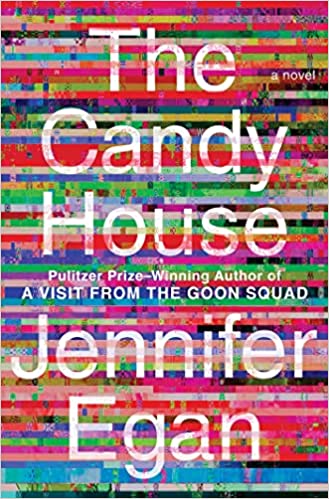
The Candy House is billed as a follow-up to A Visit from the Goon Squad, but at first, aside from its structure as linked short stories, I wasn’t sure why. Bix, a wealthy high-tech entrepreneur, is not one of the characters from the original novel, I don’t think, nor is Alfred Nollander, whose quest for authenticity leads him to scream in public just so he can see the expressions on people’s faces. (Although later I realized he was a child in the first book.)

However, as I continued reading, I encountered familiar names and realized I was dealing mostly with descendants and connections of the original characters. A lot of the novel deals with social media run amok, a world where it is common for people to upload their unconsciousness to the internet using the software provided by Bix’s company, Mandala, and the opposition to this and other such practices by the company formed by Chris Salazar, the son of Benny of the previous book.

The novel doesn’t seem as experimental in form as the original, although there is a chapter constructed in Instant Messages and another of a recorded manual, but that’s really because Egan’s approach, which was unusual when the previous novel was published, is more common now. Set from the 1990s to roughly the 2030s, the novel is more futuristic.

Although I wasn’t blown away by this book as I was by its predecessor, I was happy to revisit the lives of its characters, all of whom eventually reappear, even those from the ridiculous tale that parodied the P. R. field. Another good one for Egan.

Related Posts

A Visit from the Goon Squad

Look at Me

The Keep

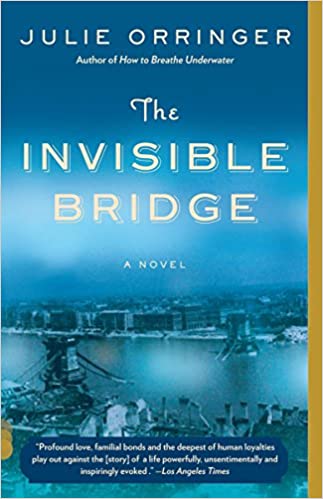
Review 2065: The Invisible Bridge

One of the reasons I learned to love reading was that I got swept up into another time or place or even world. As I got older and more discriminating, this experience happened less often. It happened most recently within a few pages of starting The Invisible Bridge, which I read for my James Tait Black project.

Andras Lévi, a young Hungarian Jew, arrives in Paris in 1937 to study architecture. He has brought with him a letter that an acquaintance asked him to mail once he was in Paris. He mails the letter but notices the address.

Soon he is involved in the technicalities of art school, made more difficult because he almost immediately loses his scholarship, a first act of the anti-Semitisim that is perceptibly increasing, although not as bad in Paris as it was in Budapest. He seeks a job at a theater from Zoltán Novak, a man he met on the train from Hungary. When he begins a friendship there with an older actress, she sends him to lunch with friends at the address on the envelope he mailed, and that’s how he meets Klara, an older woman with whom he falls madly in love.

This novel, which starts out seeming very particular, about a love affair between two people, grows into a novel of great breadth, covering events of World War II, the Hungarian Holocaust, life in work camps, the siege of Budapest. All of it is centered in the importance of family.

I absolutely loved this novel. It is sweeping, wonderfully well written, touching, harrowing. And what a story, based on the lives of Orringer’s grandparents. I can’t recommend this book enough.

Related Posts

Great House

A Town Like Alice

Between the Woods and the Water: On Foot to Constantinople: From the Middle Danube to the Iron Gates

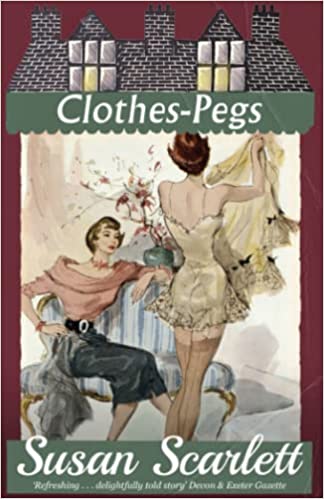
Review 2064: Clothes-Pegs

After reading Susan Scarlett’s Summer Pudding, I wasn’t sure she was my jam. However, I was surprised by how much I enjoyed Clothes-Pegs, a Cinderella story.

Annabel Brown is an unassuming young woman whose only ambition is to do well at her job as a seamstress before marrying some young man whom she loves. She has no idea that she is beautiful.

Her employer, Tania Petoff, has noticed her, though. Tania runs an exclusive dress shop, designing and making her own creations in the shop. When one of her models quits without notice, she decides to give Annabel a try.

At first, Annabel feels totally out of place in her promotion. Of the three other models, Bernadette, Freda, and Elizabeth, only Bernadette is nice, and she helps Annabel out with suggestions.

When Annabel sees Octavia Glaye at a fitting, she thinks she’s the most beautiful woman she has ever seen. But Octavia is jealous of how much attention her friend, Lord David de Bett, pays to Annabel. Annabel soon notices David, though, and falls in love with him on sight. She doesn’t have any illusions of a future with him. She is content to love him.

For his part, David is struck by Annabel’s naturalness and innocence but thinks he’ll probably marry Octavia. Octavia is ready to try to make Annabel regret any attention David pays her.

The Cinderella story was fun, but I especially enjoyed the parts about Annabel’s engaging middleclass family. Annabel is a nice, occasionally foolish but usually practical heroine who only gets into situations because of her lack of experience and the venom of others.

I received this book from the publisher in exchange for a free and fair review.

Related Posts

Summer Pudding

Beneath the Visiting Moon

Touch Not the Nettle

Review 2063: Can You Forgive Her?

Can You Forgive Her? is the first of Trollope’s Palliser novels. Phineas Finn, which I read first, is the second. Palliser doesn’t actually appear in this novel until page 150, but then he plays an important role.

At issue in this novel are three romances, which explore the theme of who has the power in courtship and marriage. The most important is that of Alice Vavasor, and as I read her story, I couldn’t help reflecting how different it reads now. Alice is in love with and engaged to John Grey, but she feels that he is too perfect. Further, she is inclined to marry a man in politics while he prefers a retired life in the country.

As Trollope explains it, she overthinks her impending marriage. She goes on a trip to Switzerland with her cousin Kate Vavasor and Kate’s brother George. Years before, Alice was engaged to George but he somehow betrayed her and the engagement was broken off. But Kate is determined that Alice will marry George. George seems indifferent, but he frankly needs Alice’s money for a run for parliament. Slowly, though, readers learn that George is a scoundrel.

Another love triangle involves Alice’s cousin Lady Glencora. Lady Glencora is newly married to Plantagenet Palliser, the heir to the Duke of Omnium. Lady Glencora, a great heiress, is very young, and she was madly in love with Burgo Fitzgerald, a young wastrel. Her horrified relatives quickly pushed her into a marriage with Palliser, but he doesn’t have much in common with her and doesn’t know how to handle her. Lady Glencora befriends Alice and confides in her that Burgo wants her to run away with him. She is unhappy enough to be tempted.

The final love triangle is a comic one. Kate Vavasor’s Aunt Mrs. Greenow is a wealthy widow who has two suitors. Mr. Cheeseacre is a vulgar wealthy farmer who talks about his money all the time. The other is Captain Bellfield, who has some style and panache but probably isn’t a captain and has no money.

Modern audiences may have problems with some of the assumptions of this novel, but I always try to keep modern judgements out of my opinion of older novels. I found this novel interesting and especially got involved in Alice’s situation. She is so honest yet so misguided that it made her story intriguing. I was a little bored with the comic romance, although it dealt with some of the same issues as the other relationships.

Related Posts

Phineas Finn

Doctor Thorne

Barchester Towers

Review 2062: The Prisoner of Zenda

When I was making up my Classics Club list, I thought it might be fun to read The Prisoner of Zenda, a book I’ve heard of for years. I was surprised to find it was really good!

Rudolf Rassendyll is the younger brother of a British nobleman whose family has a tradition that an ancestress had an affair with a Ruritanian prince, bestowing on some of the family a pointed nose and red hair that Rudolph has himself. The family also stays away from Ruritania, but when Rudolf hears there is to be a coronation of the new king, he decides to attend.

Since Strelsau, the city where the coronation is to be held, is going to be crowded, he decides to stay in the village of Zenda and travel in for the ceremony. He lands in Zenda the day before and, while wandering in the woods, encounters the King, who looks exactly like him except for a beard. Amused, the King invites him to Zenda Castle, where he is staying as a guest of his brother, Duke Michael.

When the King drinks a bottle of wine gifted by Michael, his attendants can’t wake him. Duke Michael has drugged him so he’ll miss his coronation. The King’s attendants, Fritz and Sapt, talk Rudolf into impersonating the King just for the coronation. But things don’t go exactly as planned.

This adventure story is fast moving with interesting characters and lots of action. A fun read!

Related Posts

Kidnapped

The Sea-Hawk

The Queen of the Caribbean

Review 2061: The Seat of the Scornful

In the first scene of The Seat of the Scornful, we meet Justice Ireton, who really believes that an innocent man cannot be found guilty in his court. He lets a convicted man leave the court thinking he is going to be hanged when the justice intends to sentence him to life, as if that’s not punishment enough.

Later, his daughter Connie comes to see him at his seaside retreat, bringing along her fiancé, Anthony Morrell, a flashy dresser of Italian extraction whom Ireton immediately distrusts. Morrell, once alone with the justice, accepts an offer of £3000 to leave Connie alone.

The next night, the girl at the telephone exchange receives a call asking for help at the justice’s cottage followed by a gunshot. The justice is discovered seated at his desk holding a gun with Morrell’s body on the floor, shot in the head. Ireton claims to have been cooking in the kitchen when he heard a shot and came in to find the body and the gun.

Carr’s ungainly amateur detective, Gideon Fell, works with Inspector Graham to figure out what happened. Early the next morning Morrell’s lawyer explains that Morrell is actually a wealthy man with his own candy company who intended to give Ireton the £3000 as a gift for Connie to teach him a lesson.

Although the actual solution to this murder is very simple, it is followed by a series of fairly unbelievable events. However, I have a much bigger problem, without saying too much, with how Fell wraps up the case. Let’s just say that the victim, who was obviously not a nice guy but wasn’t the creep Ireton thought him, is not regarded at all. The introduction to the British Library edition says that other readers have questioned the book’s ethics. Let me say that I think the ending is extremely classist, that if Morrell had been a different type of person, the ending would have been different. Edwards states that Carr, Agatha Christie, and Anthony Berkeley were all pondering whether any murder is justified. Well, this one isn’t.

I received a copy of this book from the publishers in exchange for a free and fair review.

Related Posts

The Lost Gallows

Jumping Jenny

Murder on the Orient Express

Review 2060: Moominsummer Madness

I intended to read Moominsummer Madness for the 1954 Club last spring, but it didn’t arrive from the library in time. So, I read it when it did arrive.

The Moomin family are on holiday when a huge tidal wave floods the valley. Their house gets flooded and they end up taking refuge on what they think is a floating house but is actually a theater.

Moomintroll and his friend Snork Maiden are separated from the others when they camp out for the night in a tree and the theater is cut loose. And Little My also gets lost when she falls through a trap door.

I usually try to review children’s books in terms of how attractive they might be to both kids and adults. Kids like books with lots of silliness, which is probably why these books are so popular. They don’t have much internal logic, though. I thought the book was only slightly interesting.

Related Posts

The Mischievians

Tumford the Terrible

The Full Moon at Napping House