Best friends Annie Francis and Mark Webster, aged 13, disappear on the way to the candy store. The search for them is disrupted by a snowstorm, so they’re not found for several days, in a shallow ditch with a trail of candy leading to it. DI Edgar Stephens thinks they were meant to be discovered earlier, but the snow prevented it.
The police find that Annie had written plays performed by younger children on a stage at the home of neighbor Brian Baxter. The early plays were innocuous, but by all accounts the latest is darker. Annie has shown an interest in the real German fairy tales with dark plot lines. Her newest play is called The Stolen Children.
Edgar’s friend Max Mephisto is performing in a pantomime in town, and through him, Edgar hears of a similar murder that took place in 1917. It seems an odd coincidence that some of the older pantomime performers were in town at the time. The murderer was caught and is dead, but could there be a connection?
Edgar gets a call from Daphne Young, a teacher who was helping Annie with her play, saying she’s discovered something. But she is also found murdered before he can talk to her.
I don’t seem to be getting as involved with the Brighton series, set in the 1950’s, as I have with Griffith’s Ruth Galloway or Harbinder Kauer books. However, I like the vaudeville theme and am willing to stick with it for a bit.
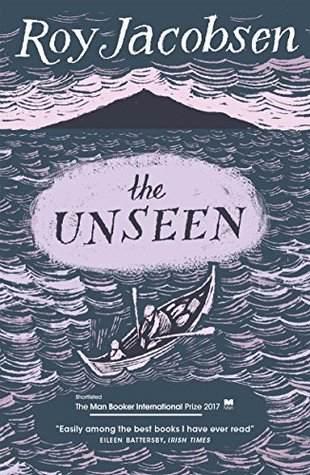
I have to admit to buying The Unseen because of its cover. I’m glad I did, because before I was halfway through, I was ordering the second book in the Barrøy trilogy. Although I’m not reading the shortlist for the Booker International prize, this novel was shortlisted for it.
After reading much of Halldor Laxson’s Independent People under the belief that it was describing Icelandic life in Medieval times, only to find out it was set in the 20th century, I don’t make assumptions about the times in which novels are set anymore. The Unseen describes a similarly primitive existence, with not many hints to its timeframe, but I finally figured out it begins a few years before World War I.
Ingrid’s family lives on Barrøy, one in an archipelago of many small islands in northern Norway. Each island is occupied by one family, and although the islands are in sight of each other, visits are rare, so the family has to be fairly self-sufficient.
Ingrid’s father, Hans, works hard and dreams of a different life for his family. His immediate dream is for a quay to make it easier for boats to land, so that when Uncle Erling arrives with his large fishing boat each January to pick up Hans for the yearly fishing, he can get off the boat. The novel relates the everyday events of the family’s life—the four-month fishing trips, the haying and fish drying in summer, milking cows, moving livestock from one small island to another for grazing, collecting and cleaning down from the eider ducks. And the big events—births, deaths, expansions and contractions of the residents of the islands.
Written in spare, crystalline prose with an occasionally very dry humor, The Unseen is fascinating. I loved this novel. And here I am reading about islands again.
I intended to read Summer Lightning for the 1929 Club last fall, but it didn’t arrive in time from the library. It is one of the Blandings books, and I have not read many of those.
The country is buzzing at the news that Galahad Threepwood, that old reprobate, is planning to publish his memoirs. Old men up and down the country are terrified of what he might reveal.
At Blandings Castle, where Galahad has repaired to write, both Mr. Ronald Fish, Lord Emsworth’s nephew, and Miss Millicent Threepwood, a niece, are in love, unfortunately not with each other as their daunting aunt, Lady Constance, intends. Millicent has fallen for Hugo Carmody, Lord Emsworth’s secretary, and Ronnie for Sue Brown, a chorus girl.
As usual, Lord Emsworth is besotted with his pig, the Empress of Blandings. Ronnie gets the idea to steal the Empress and hide her away then pretend to find her, thereby winning Lord Emsworth’s regard.
In the meantime, Hugo has to run up to town and takes the opportunity to go dancing with Sue. Unfortunately, he has promised Millicent he will do no such thing. Mr. Pilbeam, an oily detective, has just accepted a job from Hugo to find the Empress (which he only accepted because someone is paying him a lot of money to steal Galahad’s manuscript) when he comes upon Sue waiting at their table for Hugo. He has been calling her and sending her flowers, to which she hasn’t responded, so he sits at her table uninvited. At that moment, jealous Ronnie appears.
As if this isn’t enough silly fun, Sue impersonates a wealthy American so she can visit Blandings and make things up with Ronnie. The novel also features the reappearance of Baxter, Lord Emsworth’s previous secretary, whom Lord Emsworth thinks is batty. And he’s on the tail of the Empress, too.
I enjoyed this book, but I think the Blandings series is missing something compared to Jeeves and Wooster. That something is Bertie’s insouciant, dim-witted yet witty and kind narrative style.
I absolutely loved Andrea Lee’s Red Island House—in fact, it was on my Best of the Year list this last year—but I think I would have liked Lost Hearts in Italy better if I hadn’t read the other book first. I make this comment because Lee seems to be rehashing the same story except the Red Island House also dealt with other themes.
In Red Island House, a young, beautiful American mixed race academic is married to an older, uneducated, self-made wealthy Italian businessman, a marriage that seemed to me inexplicable. In Lost Hearts in Italy, a young, beautiful American mixed race journalist meets an older, uneducated, self-made Italian billionaire when she is on her way to join her young, beautiful nice husband who loves her in their new home in Rome. Mira doesn’t even seem attracted to Zenin (she calls him by his last name as the heroine of Red Island House calls her husband), but eventually she begins having an affair with him, one that (this is no spoiler—it’s clear from the beginning) spoils her marriage with Nick. The novel moves backward and forward in time between 1986 and 2005, examining the lasting repercussions of Mira’s actions.
The only difference I can see between Zenin and Senna of Red Island House is that Zenin is tall and Senna is short. Lee is obviously obsessed by this relationship. Although she is an excellent writer, I think Red Island House, with its themes of identity, colonialism and the responsibility of the rich to the poor, has more to offer than just a dissection of this relationship. In Lost Hearts in Italy, Mira is like a moth drawn to a flame except she knows she is doing something against her own nature. My question was, then why did she do it? Zenin is not an attractive character at all. It’s inexplicable.
I liked Mazzola’s The Story Keeper well enough to try another book by her. This one looked interesting.
In 18th century Paris, Madeleine was forced into prostitution at a young age by her mother and so badly scarred by a customer that she now works in the brothel as a maid. She is determined to escape with her nephew, which is one reason she reluctantly agrees to spy for the police on the household of Dr. Reinhart. She is supposed to find out what he is working on, but once installed there, she finds it difficult to learn anything. Something about Reinhart seems off, but he locks up his secrets. However, his interest is in anatomy and he makes elaborate wind-up animals.
A second narrator, Véronique, is Reinhart’s daughter, newly returned from being raised in a convent. Her father has promised to train her in his work, but time passes and he works only with Doctor LeFevre on some project for the King.
Madeleine hears rumors that children are disappearing off the streets and worries about her nephew.
A third narrator is Madame de Pompadour, who is afraid she is losing the King’s affection and worried about what he is up to.
This novel is fast-paced and eventually gets very creepy, but there are some unlikely aspects about it, especially how neatly everything is resolved. Still, it certainly kept my attention.
Chief Investigating Officer Elma, who has been with the police in Rejkyavik, moves back to her home town of Akranes after an end to a long relationship. Almost as soon as she arrives, there’s an unusual death—a woman’s body is found in the sea by an old lighthouse. Suicide and accident seem ruled out because the body was dragged there from the parking lot.
The body is identified as Elisabet Hölludóttir, a woman who had lived in Akranes as a child but was said to hate it. The investigators have difficulty finding out much about her, and even her husband seems to know little about her past.
The team’s investigation of the present doesn’t seem to be going anywhere, but Elma becomes convinced that the murder has to do with Elisabet’s past. Her boss, Hörþur, doesn’t agree.
I am fairly sure The Creak on the Stairs is Ægisdóttir’s first book, and in some ways it shows. I found Hörþur’s behavior at times unbelievable, for example. Ægisdóttir seems to be trying to depict him as lackadaisical and too close to the community bigwigs, but in a country where murder is so unusual, there’s no way he would tell his staff to hold their progress reports until the next day because he needs to make a phone call or that he would go home early. Also, a woman refuses to go to the town where she was a child and then is found dead there. Of course the murder has to do with her past. It took them too long to get there.
Other than that, I found the novel interesting enough and liked the heroine. A surprise at the end of the novel made me think Elma was getting interested in her partner too soon, though.
Since I know that at least one person who had been reading along was no longer able to find reasonably priced copies of the books, I got a lot more comments on the last book than I expected. I hope that happy situation continues. Anyway, my thanks to the following people who participated in discussing The Duke’s Daughter:
Liz Dexter
Penelope Gough
The next book is Happy Returns, which I read all the way back in 2015 and don’t remember at all (except that someone is running for parliament). It’ll be interesting to me to see whether I view that book differently now that I am more familiar with the characters. I will be reviewing that book on Tuesday, February 28! Hope you will join me.
This entry in the Barsetshire series opens with characters’ realization that Lucy Adams is carrying a child, but then it jumps forward. Around about the same time, Tom Grantly meets the dreadful Geoffrey Harvey and begins to have doubts about his farm work. He has been happy working on Martin Leslie’s farm with Emmy Graham, but he doesn’t think there’s a career in it. So, he takes a job working for Harvey in the Red Tape and Sealing Wax Department. However, Harvey is known for making his underlings’ lives miserable, and within a year, Tom is ready to quit but doesn’t know how to explain to his father that he wants to change his career yet again.
Commander Cecil Waring has returned to the Priory to take up residence in his part of the house after taking in some shrapnel that the Navy doctors couldn’t find. It is floating around in his body and will either emerge or kill him. In the other part of the house, Philip White and his wife Leslie, Cecil’s sister, are having such success with their prep school that they are looking around for a bigger building.
Cecil meets Lady Cora Palliser, the Duke of Omnium’s daughter, and is much struck by her. However, he thinks she’s paying too much attention to Tom.
The new Lord Lufton makes everyone’s acquaintance. He is young, shy, and overwhelmed by his new responsibilities. He is also very kind and is at first attracted by Clarissa Graham until he sees her behaving rudely to Charles Belton.
Fans of the series may be pleased to find that this novel features the reappearance of almost every character who has ever appeared, with the added attraction of no less than four betrothals. Mrs. Morland, the author of a popular series of novels, always says they are all alike. Perhaps the Barsetshire novels are, too, but their charm is in finding out what happens to characters we know and in meeting new ones.
The Saga of Gösta Berling begins with the story of a young minister. He has been so depressed by his difficult job and his gloomy house in a remote region of Sweden that he has begun drinking, going so far as to miss some Sunday services. His parishioners have complained, so the bishop and other senior clergymen have come to his parish to attend Sunday service and dismiss him. However, that morning he is sober and gives a passionate and inspiring sermon. The clergymen question the parishioners and they suddenly have no complaints. So, the clergymen give the minister a talking-to and depart. The young minister is Gösta Berling, and now he resolves to reform, to stop drinking and dedicate his life to others. But then one of his old drinking buddies, who drove away with the clergymen, tells him they won’t bother him again. He has given them a terrifying sleigh ride to the station and then threatened them. Gösta knows they won’t believe he didn’t have a hand in it. So, off he goes to become a defrocked priest, a vagrant wandering in the wilderness.
This bit is typical of what we find in this episodic novel, situations apparently resolved for the good, only to end in some ironic twist. It is an unusual novel, and the only thing I can think of that it reminds me of is Peer Gynt, except that Peer Gynt didn’t seem to have good intentions.
Years later, we find Gösta at Ekeby, the home of the majoress. She has a sad past but for years now has ruled Ekeby and its iron mines and farms through having married the major. She has given free room and board, indeed a wing of her house, to 12 cavaliers, who are required to do nothing except enjoy themselves and raise hell. The only catch is that each year, one of them dies. Gösta is one of the cavaliers.
On Christmas Eve, a “black gentleman” emerges from the chimney during the cavaliers’ party and convinces them that everything wrong with their lives is the fault of the majoress, that she has made a pact with the devil to get power. He particularly convinces Gösta even though the majoress rescued him from poverty. They make a pact with him to have control of Ekeby for one year, and if one of them acts unlike a cavalier in that time, he will have all their souls. So, on Christmas Day the cavaliers drive the majoress out of her house to wander the countryside.
This event is only two or three chapters into the book, but by this time there had already been several episodes in which Gösta proved himself charismatic but mercurial and unreliable. I was getting disgusted with him and took a break from the novel.
But coming back to it, I began to appreciate Lagerlöf’s extravagant prose style and vivid descriptions. It’s clear that she loves the Värmland area of Sweden, which was her home and the setting of the novel. Plus, I got more involved in the action of the novel, which has the feel of stories of the past being told around a fire.
Still, I found Lagerlöf’s idea of a fitting ending as well as the religious overtones fairly off-putting. So, a so-so for Gösta. I read this novel for my Classics Club list.