Review 2011: Green for Danger

The details of an operating military hospital during World War II are meticulously recounted in Green for Danger. The novel begins with the postman, Higgins, delivering six letters about the writers’ postings to the hospital. The readers then learn that one of the six people will become a murderer.

The military hospital in the Kent countryside is busy one night, because an air raid in the nearby town has caused the hospital in town to send some civilians there. Among them is Higgins, the postman, who is also a member of the local rescue, most of whom have just been killed or injured.

Higgins’s femur is due to be set in surgery the next morning. It’s a relatively straightforward procedure that shouldn’t be dangerous, but as soon as he starts to go under the anesthetic, he dies. The operating team is shocked.

What seems to be an unusual but unsuspicious death from the anesthetic has Inspector Cockrill wondering. However, there seems to be no way that the canisters containing oxygen, which are black and white, could have been switched for the green carbon dioxide canisters, and no poisonous substances could be forced into a canister. If the death was murder, only the six people in the operating room could have done it.

That evening, Sister Bates, who is jealous of womanizing surgeon Gervase Eden, has a little snit during which she announces that she knows the death was a murder and she has evidence. Later, she is found dead in the surgery, stabbed and wearing a surgical gown and a mask.

This mystery is purposefully claustrophobic and quite suspenseful at times, although the explanations at the end are a bit long. I thought I knew the motive and the murderer all along, but I was fooled! I am happy to be seeing more and more women writers represented in this crime series.

I received this book from the publisher in exchange for a free and fair review.

Related Posts

The Tiger in Smoke

Death Has Deep Roots

Juggernaut

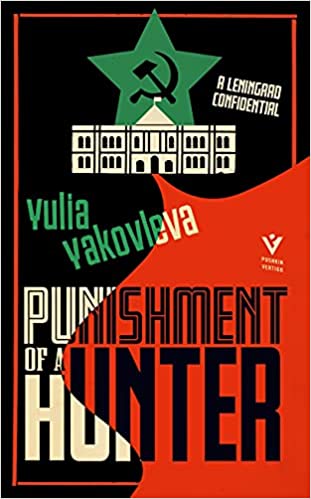
Review 2010: Punishment of a Hunter

When Zaitsev and his homicide team in 1930 Leningrad investigate the death of Faina Baranova, he knows there is something odd about it. Although all her clothing is practical, she is dressed in velvet and posed before red curtains the neighbors in her communal apartment say are not hers. There is something theatrical in the scene. However, after months, the team finds no clues.

In a meeting at work of the OGPU, Zaitsev is accused of hiding bourgeois origins. He claims he knows nothing about his father, having grown up in an orphanage. Pasha, his building janitor, shows up in support and claims to have known his mother; nevertheless, some days later he is arrested.

After a few months, he is released without explanation. Zaitsev soon figures out he is to solve another murder, this time of a group of people on the site of a new park planned by Kirov, head of the party in Leningrad. The unspoken message is solve the case or go back to jail. However, because he’s been released, his colleagues no longer trust him and won’t speak to him about work.

Aside from presenting an intriguing mystery, Punishment of a Hunter evokes 1930 Leningrad, beautiful but gray and tired, the atmosphere paranoid, citizens poorly clad and fed. I was convinced by this post-revolutionary world as I was not by the popular A Gentleman in Moscow. I hope Pushkin Press will be publishing more books by Yakovlevna.

Related Posts

A Gentleman in Moscow

Sofia Petrovna

The Revolution of Marina M.

If I Gave the Award

Having just reviewed the final shortlisted novel for the 2010 James Tait Black Prize for Fiction, it’s time for my feature where I decide whether the judges got it right. Most of the shortlist left me unsatisfied for this year, but it contains two wonderful books.

The novel I found least interesting was Strangers by Anita Brookner. The story of a lonely man and his unsatisfying relationships, I found it slow moving and repetitive, although it was well written.

I have loved some of Kazuo Ishiguro’s novels and applaud him for seeming to try different things, but I found his collection of short stories about music and fame, Nocturnes, unsatisfying. I also found some of the situations frankly unbelievable.

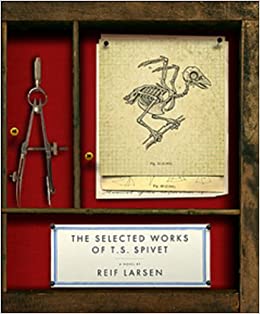
The Selected Works of T. S. Spivet by Reif Larsen is probably the most unusual of the entries. It is a boldly illustrated story about a boy genius and his trip to the Smithsonian to accept a fellowship. I found some of the aspects of the story unlikely, but my biggest problem with it was the narrator’s voice. There was no time that the voice sounded like a 12-year-old boy, genius or not.

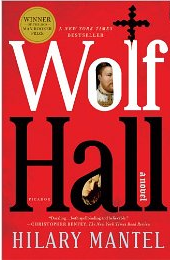
Cover for Wolf Hall

The winner of the prize that year was The Children’s Book by A. S. Byatt. I can understand why it won, because it is an ambitious novel that tries to paint a portrait of Victorian society against the microcosm of one family’s experience. It is also completely absorbing, so I think it deserves the award.

However, the other shortlisted book was Wolf Hall by Hilary Mantel, a fascinating novel about the life of Thomas Cromwell and one of my favorite novels of all time. I’m not saying that the judges got it wrong this time, but the choice between these two would be difficult for me. I’m guessing The Children’s Book won because of its larger scope.

Review 2009: The Selected Works of T. S. Spivet

Tecumseh Sparrow Spivet is a 12-year-old boy who spends most of his time on a Montana ranch mapping things. Not just making geological maps but mapping the everyday activities on the ranch—his sister’s technique of shucking corn, the regularity of his father’s sip of whiskey, as well as numerous scientific subjects. In fact, his mentor, Dr. Yorn, has encouraged him to submit drawings to various journals, and he has had some published.

T. S. does not feel comfortable at home. He is mocked by most of his schoolmates. He feels he is a disappointment to his rancher father, and his scientist mother, whom he calls Dr. Claire, seems to be completely obsessed by the search for a particular beetle. Worse, his oldest brother has recently died.

One day he gets a call from the Smithsonian. It appears that Dr. York submitted one of his diagrams as an entry in a prestigious fellowship and he has won. Dr. Jibsen, unaware of his age, informs him he is expected at the Smithsonian on Thursday to give a speech.

At first T. S. hesitates about accepting the award, but then he decides to go to Washington. He packs up some things and hops a freight train east.

Liberally decorated with T. S.’s drawings and musings, this novel is inventive and sometimes funny. In a way, it is meant as a wild romp with a philosophical dint, so maybe we’re meant to overlook the truly implausible aspects of the story, such as that a recipient of an important award would have someone on the Smithsonian end immediately organizing his flight.

I was drawn along at first and ready to suspend my disbelief, but first, what can your hero do while he spends several days on a freight train getting to Chicago. Nothing, right? If you are expecting a picaresque series of adventures like I was, you’ll be disappointed. But T. S. has brought along one of his mother’s notebooks, which is how he discovers she is writing a novel about one of his father’s ancestors. Larsen inserts the entire contents of the notebook into the middle of the novel, with a few interruptions. At first, it was interesting, but after a while I sighed every time I saw the typographic clue that the novel was restarting.

This is all fairly unimportant, though, against the criticism that T. S.’s voice is never convincing as that of a 12-year-old, genius or not. Yes, he is childish at times, but then his voice is much too young for a 12-year-old. But most of his musings and concerns are those of an adult.

Is the book fun to read? Yes, mostly. But I tired of it after a while.

I read this book for my James Tait Black project.

Related Posts

The Sweetness at the Bottom of the Pie

The Invention of Hugo Cabret

The Case of the Missing Marquess

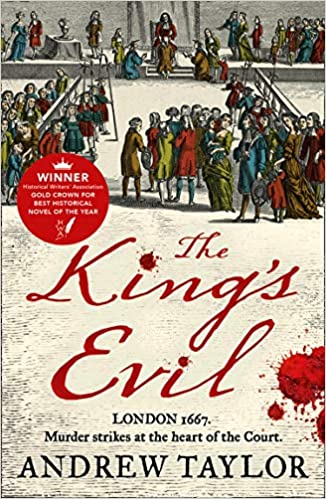
Review 2008: The King’s Evil

This third book in the James Marwood/Cat Lovett series begins with James hearing that Cat’s cousin, Edward Adderly, has found out where she is hiding. Since the first novel, in which Edward raped her and she put out his eye, she has been hiding at the office of Mr. Hakesby, an architect, and working for him as a drafter and maid. James finds Cat on Saturday and warns her she must go into hiding. She finds refuge with Dorcas, a connection of Mr. Brennan, a draftsman she works with.

However, on Sunday Edward Adderly is found drowned in the well at Clarendon House, where Cat was working with Hakesby on a project. Clarendon has recently been removed from his offices at court, and his enemy, Buckingham, has been trying to stir up the public against him. One of James’s bosses, Mr. Chiffinch, tells him to dispose of the body. Cat is accused of murder and a warrant put out for her arrest.

James is charged with finding out who murdered Adderly, but he is also dispatched by Charles II to accompany Lady Quincy, Cat’s aunt, to Cambridge. This errand has to do with fetching a child back to court, but in both his investigation and his trip to Cambridge, James keeps encountering a mysterious man called the Deacon and his fat friend. James begins to believe both his errands are related.

I think this series is proving every bit as good as Sansom’s Shardlake series, and perhaps doesn’t have such a heavy feel to it, although neither main character seems to have much of a sense of humor. James finds himself pulled helplessly into the affairs at court while Cat into the arms of Mr. Hakesby, who has offered marriage. The plots are interesting and complex and the characters believable.

Related Posts

The Ashes of London

The Fire Court

The School of Night

Review 2007: The Book of Mirrors

I searched for Romanian authors on Google because I was interested in reading more books from other countries and came up with the name E. O. Chirovici. What was my surprise then to find that The Book of Mirrors is set in Princeton, New Jersey. I don’t know why this should have been a surprise, it just was.

Literary agent Peter Katz receives as a submission the fragment of a manuscript purporting to tell the true story of the murder years ago of a renowned Princeton professor, Joseph Wieder. When he attempts to contact the author, Richard Flynn, who at the time had been a student suspected of the murder, he finds Flynn is in the hospital, and he soon dies. Searches by Flynn’s partner for the complete manuscript turn up nothing, so Katz hires a journalist friend to try to find the truth.

The friend, John Keller, finds that all the witnesses seem to have their own ideas of what happened. Although Flynn, for example, kept his housemate Laura’s name out of the investigation, Keller comes to believe that she was manipulating him. Laura claims that Flynn murdered Wieder out of a mistaken jealousy. Wieder’s caretaker claims that Laura was at the scene of the crime.

Keller isn’t able to either find the manuscript or get to the truth, so the task falls from one person’s hand to another until it is finally solved.

It’s hard to describe this book. Because of its basis in the past, it doesn’t have much action—it’s just a series of interviews. Chirovici has a broader sort of philosophical point to make here, but it’s nothing very profound. I found the novel somewhat clever and interesting, but my attention flagged at times.

Related Posts

4321

Magpie Murders

The Seven Deaths of Evelyn Hardcastle

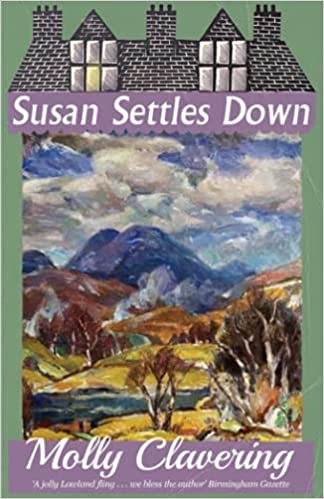
Review 2006: Susan Settles Down

Susan Parsons has been leading a wandering life keeping house for her naval officer brother Oliver, but Oliver was badly injured in a fall months before and has left the Navy, still suffering a limp and not his old self. Then Oliver inherits a small estate in Southern Scotland. It’s not in good condition and the Parsons haven’t much money, but Oliver decides to make it their home.

While Susan struggles to get some help in the kitchen and repair the worst problems of the house, Oliver begins supervising the farm work and almost immediately meets Jed Armstrong, the farmer next door. Although they immediately become friends, Susan finds Jed rude and uncouth.

Soon, the two siblings become involved in village activities. Susan befriends Peggy Cunningham, the parson’s young daughter, who has been receiving unwelcome attentions from the organist. The Parsons become fast friends with the Cunninghams, and all try to avoid the Pringle sisters, three mischievous gossips.

This novel is a lovely tale of village life in pre-World War II rural Scotland, featuring two romances. The descriptions of the landscape are beautiful, the characters are attractive, and I enjoyed it very much. However, I continued to find problems with Furrowed Middlebrow blurbs. Twice now the main character’s name has been misspelled, and this time the blurb places the novel in the Highlands.

Related Posts

Apricot Sky

Music in the Hills

Five Windows

Review 2005: Rose Nicolson

It’s 1575. Mary Queen of Scots has been ousted from the throne of Scotland in favor of her young son James and a series of regents. This revolution has been mostly a religious one, with Queen Mary a Catholic and James (referred to as Jamie Saxe) being raised Protestant. But there is also a struggle between the Calvinists and milder forms of Protestantism.

This struggle is reflected in the home of young William Fowler, whose father is a Calvinist and whose mother, with contacts in Queen Mary’s court, is French and Catholic. However, William’s father is accidentally killed during a siege on Embra. Now William is off on the Sonsie Quine to school at St. Andrews. On the ship, he meets a red-haired boy who asks to borrow his dirk. This meeting proves fateful, as William finds out years later that the boy is Watt Scott of Buccleuch. (For Dorothy Dunnett readers, I believe this is the grandson of the man of the same name in the Lymond chronicles.)

William has an affinity for poetry, and at school he befriends another scholar, Tom Nicolson. He struggles within himself over the religious issue as he feels pressure to commit one way or the other. He also falls in love with Rose Nicolson, Tom’s beautiful sister, a fisher girl with a remarkable mind.

As the King gets older, the Catholics and Protestants compete to control him. The country remains Protestant with the Calvinists gaining power while the Catholic side gains strength at court with the arrival of a favorite from France.

As he approaches graduation, William wants to marry Rose, but she is betrothed to a fisherman with the influence to protect her. She needs this protection because her remarks have been misunderstood as evidence of witchcraft.

William, despite himself, is forced closer to deciding between the two religions and finally decides that Protestantism is the least bad alternative. He also meets Scott again and is drawn into political intrigue.

This is not dry stuff. Greig is great at depicting the realities of living in this difficult time and place. I was fascinated from page one. This novel became part of my Walter Scott prize project by getting on the shortlist, but being a fan of Greig, I had already read it.

Related Posts

Fair Helen

The Ringed Castle

When They Lay Bare

Review 2004: Classics Club Spin Result! Phineas Finn

When I put Phineas Finn on my Classics Club list, I was just looking for a book by Trollope that I hadn’t read. I didn’t realize it was the second of the Palliser novels, so now I’m going to have to go back and read the first.

Against the advice of his father and his mentor, Mr. Low, Phineas Finn has been persuaded by friends to run for Parliament even though he has just recently finished his law studies. The difficulty is that he has no money and Parliamentary representatives aren’t paid, so his father, who is a country doctor, will have to continue to support him unless he can get a paid government position.

Nevertheless, he goes ahead and gets “elected” as member for an Irish pocket borough, where the lord who awards it has feuded with his son, the incumbent. So, Phineas begins his career.

One of his friends who has encouraged him in politics is Lady Laura Standish, a young woman who takes a great interest in politics. Although she had some fortune, she gave it away to her brother, Lord Chiltern, to pay off his debts in the hopes he can reconcile with his father, the Earl of Brentford. Both the Earl and Lady Laura are encouraging about Phineas’s career, and Phineas finds himself in love with Lady Laura. However, he has a rival, Mr. Kennedy, who is stiff and formal but very rich.

The novel details Phineas’s Parliamentary career as well as his friendships with several young ladies as he looks for a wife. It is thoughtful about the choices for women at this time and deals with the consequences when Lady Laura makes the wrong choice of husband. Another character, Laura’s best friend Violet Effingham, is wealthy in her own right and wants to remain single and run her own household but finds she is not allowed to. Finally, there is Marie Max Goesler, an intriguing character. She is a wealthy widow who is known for her select parties. She is an admitted social climber, but she takes a great interest in Phineas’s career.

Phineas himself is a likable fellow who sometimes seems a little suggestible but by and large works hard and leads an ethical life. I enjoyed this book very much. The only thing I found disappointing was that of the four women he considers marrying, he ends up with the least interesting and most insipid.

Related Posts

Barchester Towers

Doctor Thorne

Framley Parsonage