
The Best Book for this period is The Mercies by Kiran Millwood Hargrave! Also highly recommended is The Grand Sophy by Georgette Heyer!
Reviews, reviews, and more reviews

The Best Book for this period is The Mercies by Kiran Millwood Hargrave! Also highly recommended is The Grand Sophy by Georgette Heyer!

It’s been so long since I read Cheerfulness Breaks In that it wasn’t as I remembered. Still, it was funny and affecting. It is also the first of Thirkell’s Barsetshire series to be set during the war.
The novel begins with the wedding of Rose Birkett, whose shenanigans occupied Summer Half, set three years earlier. Rose is still as selfish and stupid as she is beautiful, and her parents are terrified until the last minute that the wedding won’t go off. Thankfully, it does, due to the efforts of the groom, Lieutenant Fairweather. During the wedding, we encounter many of the characters who have appeared before in the series, particularly Lydia Keith.
No longer a bouncing 16-year-old, Lydia at 20 has stayed at home to help her father run his estate and to care for her mother, who is in poor health. As the novel begins in the summer of 1939, she is soon also involved in other activities related to the war. However, unlike her friends Geraldine and Octavia, she is too bound by her home situation to join the nursing profession.
Many of her friends, including her good friend Noel Merton, view her efforts with sympathy and concern. He notices how she has worked to become kinder and not quite so utterly frank, but appears not have noticed that she is in love with him.
This novel is full of the many activites that evolve from the war, but the amusing conversations and other events continue, as the full brunt of the war does not seem to have hit the community yet. Other couples get engaged, but in the romance department, the novel is mainly concerned with Lydia and Noel, each of whom thinks the gap in their ages is making the other uninterested.
I remembered Cheerfulness Breaks In as one of my favorite of this series, and although its plot is somewhat different than I remembered, it is lovely, funny, and touching. As an homage to Trollope’s series set in the same fictional county, I have been noticing more and more last names from the older series as I read along.

I haven’t read much by Australian writers, so when I noticed that Jane Harper seemed popular, I thought I’d give her a try. The Survivors is set in Tasmania, and I am attracted to books set on islands.
Kieran Elliott hasn’t returned to his small home town for 12 years, not since the storm. But his father has Alzheimer’s and his mother is trying to move them, so he has brought his partner Mia and their baby daughter back to the beach town in Tasmania to help with the move.
It is late in the season, and most of the summer people have gone home. One of Kieran’s high school friends, Olivia, has had a house mate for the summer, Bronte, and Olivia is glad that Bronte will soon be leaving, because there has been friction. Bronte has been working late at the local bar and restaurant, and after Kieran was there late with his friends, Bronte is found dead on the beach.
The storm years ago has been an elephant in the room, but it’s not until about page 75 that we find out Kieran had been in some sea caves that day and came out too late for the storm rise. His older brother Finn and Finn’s partner lost their lives in the storm trying to rescue Kieran. Some townspeople blame him for their deaths, including his own father.
Although this incident would appear to have nothing to do with Bronte’s death, we don’t learn until about page 120, as if it’s not important, that a girl disappeared on the day of the storm, Gabby, Olivia’s 14-year-old sister. When her backpack appeared in the surf, the police assumed she had drowned in the unprecedented storm surge.
Of course, Bronte’s death is related to Gabby’s disappearance.
I found a few things about the novel a little irritating. One is slight—that Harper remarks on the physical fitness of practically every male character. Maybe this is an Australian thing or maybe it’s supposed to reflect Kieran’s profession as a physiotherapist, but it seemed silly and unnecessary. Then there is a continuity problem—if Kieran’s rescuers died, how did he get rescued? There is no explanation of that. It also bothered me that Harper took so long to tell us what happened during the storm, as that delay didn’t seem to serve a purpose, and even more so that Gabby’s disappearance was treated like an afterthought.
Things get going slowly, but they seemed to be building to a satisfying and exciting conclusion, but no. Without giving away the ending, let me just say that the promised thriller ending sort of fizzles out. That being said, there are some interesting developments at the end of the novel, causing it to improve considerably.
I don’t mean to give this novel a bad review. It was interesting enough to keep me engaged; there are just ways in which it doesn’t quite deliver.
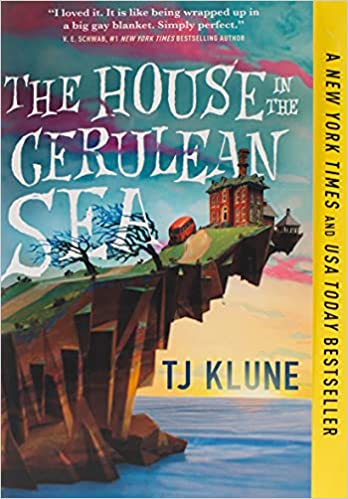
I have to confess to having picked this book out because of its cover and title. What a great word “cerulean” is.
Linus Baker is a caseworker in the Department in Charge of Magical Youth. He goes completely by the book, which may be why he is selected for an unusual task—to investigate the orphanage on the island of Marsyas where seven magical orphans live under the tutelage of Dr. Parnassus. He is instructed to report everything.
On the island, he meets Dr. Parnassus as well as Ms. Chapelwhite, a sprite who helps with the cooking and care of the house and children, and the seven orphans. These unusual children include Lucy, the six-year-old Antichrist.
This novel is well written and occasionally amusing, but I don’t read much fantasy, and when I do, I have high requirements for it. This isn’t really my genre. But my biggest problem with it was trying to decide who it was written for. It reads like a children’s book and its sense of humor is juvenile. However, Linus and Dr. Parnassus have conversations on such topics as Kant and I think it was Schopenhauer that would certainly be above most kids’ heads, and he uses vocabulary (like “self-flagellation”) that seems aimed at adults. In addition, the novel features a love story between two middle-aged men, which doesn’t seem as if it would appeal to even gay children, so more for adults. But the tone of the piece smacks of children’s literature, and not necessarily good children’s literature.
Finally, though, the novel was just too saccharine to appeal to me. I ended up reading about 2/3 of it but eventually decided that I wasn’t invested in the outcome. The kids were cute but kind of one-dimensional, although I thought the concept of Lucy was clever and sometimes funny.
Miss Peregrine’s Home for Peculiar Children
Good Omens: The Nice and Accurate Prophecies of Agnes Nutter, Witch

It’s 1945, and London is in blackout during the period of the Blitz. Nevertheless, Bruce Malling is out for a stroll in Regent’s Park. He is sitting quietly on a bench near a footbridge when he sees a man pop over the railing and hide under the bridge. A few minutes later, another man strolls onto the bridge, calling out to ask if anyone is there. By the brief flicker of matchlight as the man lights his cigarette, Bruce sees another face above his. Then he hears a thud. Bruce runs up to find the man dead and then catches the other man as he comes up from under the bridge and tries to run away.
A police constable arrives on the scene as does a doctor, who pronounces the man dead. His ID identifies him as John Ward, but when Inspector MacDonald inquires about him, he can find no one who knows anything about him except that he was Irish, was charming, and had no visible means of support. Inquiries at his previous residence then reveal that he was not John Ward at all.
This novel is full of colorful characters that MacDonald meets at the victim’s boarding house. It is an interesting puzzle with lots of secrets. Being part Irish myself, I didn’t appreciate the aspersions cast on them in one passage, but otherwise I enjoyed this mystery.
I received a copy of this novel from the publishers in exchange for a free and fair review.

When Mr. Partridge decides he needs a holiday, he just walks off from the Peters Lending Library, leaving it closed. He may be an older man with a shape like an egg, but he is lawless. Wandering around the seaside town of Dormouth Bay, he spots Lisbeth Campion and follows her. Lisbeth is the type of girl that men are always following. He not only follows her, he has tea with her and her aunt.
Later that night, he sees Lisbeth getting into a car with a man. He gets in the back. Finding they have landed in London at midnight, he learns that Lisbeth has been looking for her brother, Ronnie, who through a misunderstanding, of course, has been in prison for delivering cocaine and is just out. Ronnie claims he thought it was baking powder.
Although Lisbeth is engaged to a fine, upstanding captain in the army, Captain Brocard wants to ship Ronnie to Canada with a small pension, as he has never successfully kept a job. Lisbeth has other plans, though: to rehabilitate Ronnie so that the captain returns to find him an upstanding citizen with a job.
Using Mr. Partridge’s five pounds, the three find a modest lodging in Paddington and set out to find jobs. And they find very odd ones.
Harlequin House is a charming, silly comedy. It made me laugh.
A freakish storm kicks up one day in 1617 and drowns all the men on the island of Vardø who are out fishing. Only young boys and old men are left. There is no one to help the women, so they have to learn to fend for themselves, including fishing, which is considered unwomanly. Maren’s fiancé and her father and brother are all gone, so she must try to take care of her mother, her brother’s Sámi wife Diina, and her little baby nephew.
In Bergen, Ursa’s father has made one poor decision after another since her mother died, leaving the family relatively poor. She is happy taking care of her invalid sister, but soon she learns her father has betrothed her to Absolom Cornet, a Scot he hardly knows, who has been appointed the Commissioner of Vardøhus, the rarely occupied fort on Vardø. Her father thinks he has done well for her, but they have no idea that Cornet is being sent to root out witchcraft.
Ursa is taken aback at the primitive conditions she finds in Vardø, in remote Finnmark, and she knows nothing about keeping house. When Maren brings her some skins the villagers have prepared to keep the cold from coming up from the floor, Ursa asks her to teach her how to take care of the house and cook. Thus begins a deep friendship.
But Ursa’s husband has already begun looking for witches. The first names that come up from a vicious bunch of pious women are Maren’s Sámi sister-in-law, an older woman whose large house is a target of envy, and Maren’s bold and unconventional friend Kirsten.
The Mercies is a deeply involving fictionalization of true events in early 17th century Norway. Seldom have I felt such a growing feeling of dread as when I read this novel. It is truly gripping. It seems well researched and has believable characters.

In the Afterword to Beheld, TaraShea Nesbit says she wrote it because she wanted to hear the women’s voices she missed in reading about Plymouth Colony. Certainly, the voices we hear in the novel are mostly those of the women or the dispossessed.
Beheld focuses on some of the stories we never heard about Plymouth, particularly the divide between the Puritans and the other residents—indentured servants, farmers, carpenters, and the other people meant to do the work and who do not share the Puritans’ beliefs.
Alice Bradford is the second wife of the governor, William Bradford. His first wife was her beloved friend Dorothy. But Dorothy died upon her arrival in Plymouth under circumstances Alice doesn’t understand, and shortly after Alice’s own first husband died, William sent for her to be his wife.
John and Eleanor Billington signed contracts to work for seven years as indentured servants in exchange for a parcel of land for each male in their family in the proposed colony in Virginia. But first the Puritans’ boat The Speedwell sprung a leak and the Puritans forced themselves onto The Mayflower. Then the boat went north to Massachusetts instead of Virginia. The Puritans took charge of the colony, not allowing the same rights to other men, not allowing anyone but themselves to trade with the natives, giving themselves the best parcels of land, and finally cheating John out of his son’s parcel.
This is an interesting novel that depicts the Puritans as self-righteous and self-serving. Of course, most of us who have studied this period and place since grade school know this, but perhaps not how much. Miles Standish is shown as greedy and violent. I felt this novel was quite eye-opening.

In Five Windows, D. E. Stevenson uses the metaphor of windows to reflect her main character’s growth, or change in mental outlook.
David Kirke (his last name again misspelled on the back cover of my Furrowed Middlebrow edition) begins his story as a young boy during World War II, the son of a rector of a small Scottish village. He comes from a happy home and loves rambling the countryside with his friend Malcolm, a shepherd, or Freda, a girl from a nearby farm.
David grows up a bit naïve, even after he goes to live with his uncle Matt in Edinburgh so that he can attend a better school. His eyes are opened to a less salubrious life when he moves to a London boarding house while he works as a clerk in a law office. That’s when he begins to learn that people aren’t always trustworthy or likable.
Five Windows follows David from childhood until just before he is married. It is pleasant, light reading about a likeable hero.
I received this book from the publishers in exchange for a free and fair review.

In this last of the Jack Irish novels, Linda has just left Jack for a position in London when he accepts a job from his ex-law-partner Drew. Sarah Longmore, an artist, has been accused of murdering her ex-lover Mickey Franklin. Sarah says she didn’t do it, but the prosecution has a witness placing her near the scene, and the murder weapon was a gun Mickey loaned her. Drew wants Jack to look for evidence that she is innocent.
Jack begins poking around but is unable to find out much except that three of Mickey’s former associates are missing. Against his own instincts, Jack and Sarah become lovers, but later when Jack goes to her studio to meet a witness, the building explodes, killing Sarah and badly injuring Jack.
Now that Jack’s client is dead, Jack is more determined than ever to find out who killed Mickey. The novel does not neglect Jack’s sidelines of learning cabinet making, hanging out with the old men Jack calls the Fitzroy Youth Club, and helping Harry Strang and Cam with horse-racing projects.
Again, Temple has produced a suspenseful and exciting novel in his Jack Irish series.
Book reviews of mainly modern & contemporary fiction
Writer and Historian
There is nothing more satisfying than reading a book while sipping a hot cup of tea.
A historical fiction book blog
Emerging as an artist
Liz Dexter muses on freelancing, reading, and running ...
For mostly adult, literary, fiction; focusing on historical, contemporary, biographical, and women.
"Well, there’s so much to read, and I’m so far behind." Wallace Stegner
Read to live and live to read
A bookish blog (mostly) about women writers of the nineteenth and twentieth centuries
A Celebration of Russian Literature
Reading: it's personal
Based in Romania, reading all over the world. Mostly fiction, some memoires and a little bit of poetry.
Adam Burgess
"Vivre le livre!"
"History is a vast early warning system." Norman Cousins
Scottish Book Blogger
"She had read novels while other people perused the Sunday papers" - Mary Elizabeth Braddon
A word after a word after a word is power. --Margaret Atwood
Books • Opera • Art • History
FOR DISCERNING READERS
Your online source for Jane Austen and her legacy
A Community of Classics Lovers
A blog about Irish books, writers, writing and everything in between.
 What? Me Read?