Review 1791: The Lighthouse

Hapless Futh is recently separated from his wife and is taking a vacation that he is ill prepared for—a walking trip in Germany when he hasn’t been hiking in decades. This holiday, like many things in his life, he has chosen because it reminds him of one of the few happy times with his father. Personally, he seldom picks up on nuances and misses many things.

After a series of odd encounters on the North Sea ferry and in the Netherlands, Futh arrives at the starting point of his walking tour—Hellhaus. There, a misunderstanding at his hotel results in his being ejected before breakfast. He has arranged his tour in a circle with his luggage being transported day by day to the next hotel, so he must return to Hellhaus.

As he proceeds on his tour, contemplating his mother, who left him and his father when Futh was a young boy, and the history of his marriage, we check in periodically with Ester, the landlady of the hotel in Hellhaus. Even though her husband is jealous, she occasionally sleeps with the guests. Years ago, she left her fiancé for his brother Bernard, but now she feels unappreciated.

These are sad, gray lives. Even so, this novel is oddly compelling, and my feeling of dread built with every step back toward Hellhaus. It is also elegantly spare in style.

I read this novel for my Booker project.

Swimming Home

Hot Milk

Umbrella

10th Anniversary Post! Top Ten Books of the Year!

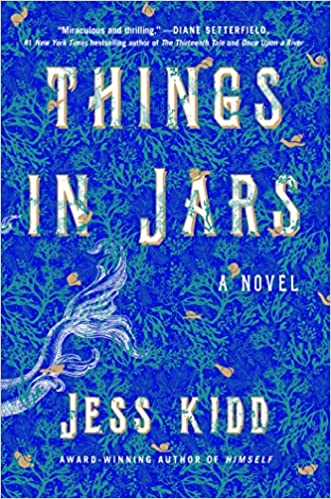
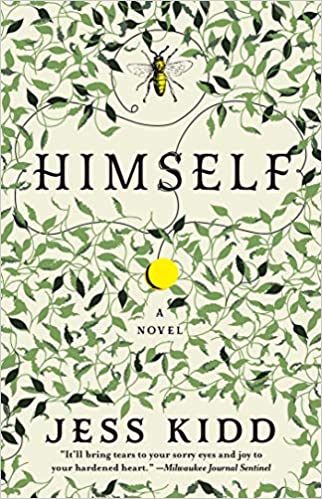
Whoo hoo! It’s my 10th blogging anniversary! As is my habit, I am posting my Top Ten of the Year for this post. I make these selections from the Best of Ten lists throughout the year, and this year, some things stand out about those selections. For one thing, I had several repeat authors this year, Jess Kidd, Rumer Godden, Claire Fuller, and Maggie O’Farrell. Since I limit my Top Ten of the Year list to only one book by an author, that makes for some more difficult picking.

This year’s list is another mixed bag. Three of them are classic novels, written in the first half of the 20th century. Two are set at least partially in the future, and both of them strongly feature trees. One is a reworking of the Oedipus myth. One has a touch of the fantastic. Two are historical novels, and two are partly historical. One is a Pulitzer Prize winner. One is set in Kashmir, one partially in the Orient, one in Washington state, and one in Malaya and Australia. It was a great reading year.

Anyway, here they are, in order of when I reviewed them:

Review 1790: Mrs. Tim of the Regiment

I accidentally read Mrs. Tim Gets a Job first, but when I discovered it was third in a series, I decided to read the rest in order. Mrs. Tim of the Regiment is the first.

Hester Christie (Mrs. Tim—I didn’t discover her first name until I read this book) leads an active and happy life where her husband’s Scottish regiment is based in Southern England. However, her life is upended when her husband is temporarily transferred to Westburgh, Scotland. She must find a house, move, and then try to create a new social life. She feels especially close to her neighbor, Mrs. Loudon.

It isn’t long, though, before her husband gets his majority, which means they must move right back to where the regiment is stationed. Tim is sent back almost immediately, while Mrs. Tim prepares for the move. Before she leaves, though, she is invited to see the real Scotland by staying with Mrs. Loudon farther north.

At first, with its diary entry format, this novel was so full of little everyday events that, even though amusing, it began to seem too like the Provincial woman series. However, it eventually develops more of a plot, in particular, Hester’s attempts to help Mrs. Loudon, whose son Guthrie has fallen for an unsuitable young lady.

Although written in 1940, Mrs. Tim of the Regiment is set earlier. The exact year isn’t stated, but the soldiers all have relatively recent memories of World War I. This is a charming novel, although it does have some snobbery toward some wealthy acquaintances. However, Hester is a lively, likable heroine.

Mrs. Tim Gets a Job

Miss Buncle’s Book

Miss Buncle Married

Review 1789: The Postscript Murders

This second Harbinder Kaur novel begins with the apparently natural death of 90-year-old Peggy Smith. Peggy was a sprightly old lady with an interest in crime fiction who used to record everyone who passed her apartment.

Her carer, Natalka, thinks there might be something wrong about Peggy’s death. When she and a neighbor, Benedict, are packing up some of Peggy’s things, they notice that several mystery writers have thanked Peggy for her help. Then someone holds them up with a gun and takes a copy of an old murder mystery.

Dex Challoner is one of the writers who thanked Peggy. Natalka, Benedict, and Peggy’s friend Edwin talk Harbinder into attending a book event for Dex, and he admits that Peggy used to help him come up with interesting murders. He makes an appointment to meet with them later, but the next day he is found dead, shot in the head in his home.

This novel was certainly a page turner, so much so that I read most of it in one day. It has a light cozy feel to it, and clues galore. I found it an enjoyable read.

The Stranger Diaries

The Stone Circle

The Dark Angel

Review 1788: Miss Plum and Miss Penny

At 40, Miss Penny leads a full life in the village. She has her village activities and her two close friends, Hubert, the vicar, a timid widower with a son, and Stanley, a self-pleasing fussy man. Miss Penny always receives a birthday letter from George, the suitor her parents disapproved of, but this year it doesn’t arrive. Miss Penny is hurt and begins to wonder what her life would be if she had left with George.

On her way to the movies, Miss Penny stops a woman from drowning herself in the duck pond. When she finds out the woman has no money and nowhere to go, she takes her home and is soon nursing her through an illness. Miss Plum turns out to be a whiny neurotic who bursts into tears and complains about her hard life. She also shows a tendency to hero-worship Miss Penny.

This darkish comedy shows an insight into human character, for you needn’t make the mistake of thinking Miss Penny’s efforts are rewarded with gratitude. In fact, she is soon consumed by only one thought—how to get Miss Plum out of her house.

This fun novel is filled with eccentric characters. I enjoyed it a lot and was happy to read it for my Classics Club list.

O, The Brave Music

The Stone of Chastity

All Done By Kindness

Review 1787: The Girl from the Channel Islands

I selected this book mostly because of its setting. That it is based on a true story sounded intriguing, too.

About a hundred pages in, I began to think about not only why I wasn’t buying this novel but also why it it made me uncomfortable. Perhaps this is a politically incorrect statement these days, but for me to accept the idea of a Jewish girl having a romance with a German officer during World War II, I had to feel the love. But I wasn’t feeling it or reading about it. I was reading about sex, and I didn’t think a Jewish girl who knew what was going on in those times would risk everything for sex.

This is down to the author, I’m afraid, whose writing is merely workmanlike. I didn’t believe this story, true or not, so I stopped reading it.

Salt to the Sea

To Bed with Grand Music

Lilac Girls

Review 1786: The Unforeseen

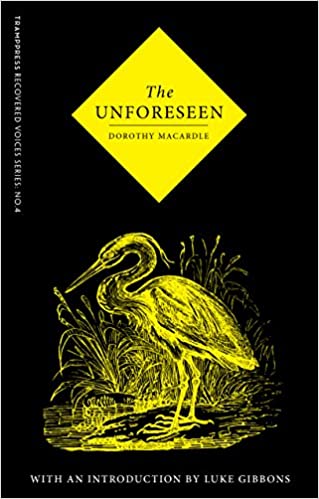
Although I haven’t yet read Dorothy Macardle’s The Uninvited, the movie based on it remains one of my favorites for Halloween. I didn’t realize that The Unforeseen is not a sequel to it but a follow-up and that a few of the characters make a reappearance. So, I’m reading and reviewing out of order.

Virgilia Wilde cannot afford to live in the city while she is sending her daughter Nan to art school in London, so she buys a cottage in the wilds of Wicklow. There she enjoys herself rambling the countryside and working on a children’s book about birds. However, she begins having strange experiences. First, she thinks she is seeing ghosts—a shadow in the doorway when no one is there, a telegram being delivered when one isn’t. She fears she is losing her mind so consults Dr. Franks, a psychiatrist. But he thinks there is nothing wrong with her. He consults his son Perry, who is a doctor with an interest in parapsychology, and eventually they realize that Virgilia is having visions of the future.

In the meantime, Nan has a frightening encounter with a sculptor and decides to come home for the summer while she works on illustrations for a book. Virgilia doesn’t want Nan to know about her visions, but soon she has some frightening ones.

This is a good little thriller with a supernatural angle to it. It has convincing characters and beautiful descriptions of the Irish countryside, reflecting the relative peace of Ireland during World War II.

Dark Enchantment

The Uninhabited House

The Victorian Chaise-Longue

Review 1785: The Half-Crown House

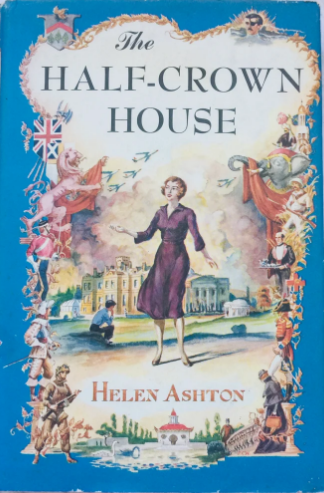
The Half-Crown House is Fountain Court, a once-stately home that has fallen into disrepair after years of money and estate mismanagement and crippling death taxes. Its heir is Victor Hornbeam, a little boy who is coming to live there for the first time, his widowed mother preparing to marry. The property has been supported for years by Victor’s young aunt, Henrietta, who opens the house for viewing, and her cousin Charles, wounded during the war, who runs a market garden. They are struggling to support the estate so that they can hand over something to Victor when he comes of age. The only other family member living in the house is their grandmother, now bedridden, whose ferocious spending and mismanagement has bankrupted the family.

As the novel opens, Victor is arriving on one of the visitor’s days. Henrietta has a wealthy American suitor who wants to buy one of the valuable paintings, and she is hoping to sell it. However, that morning her grandmother tells her that it, along with many of the other paintings and jewels in the house, is a worthless copy that she had made when she needed to sell the original to pay her debts.

The household is wondering if Henrietta will marry the American, but it was apparent to me early on that her heart lay elsewhere. That only increases the little bit of suspense around this decision.

This novel is a meandering one. At times, it is much more concerned with the past elegance of the house and the events of the long-dead Hornbeams than with the living, for it goes off into little vignettes either through the memories of its inhabitants or during the descriptions of its current state. Thus, it particularizes the postwar state of the country, when many large homes were being dismantled or sold.

It’s an odd little book that reminded me a bit of Lady Rose and Mrs. Memmary and a couple of Rumer Godden novels that center around a house over the generations.

Lady Rose and Mrs. Memmary

China Court

A Harp in Lowndes Square

Review 1784: Death in Oslo

I began reading this Norwegian series after watching the Swedish TV show Modus that is based on it. I mentioned that connection before, but while reading this novel, I thought about it a lot.

Helen Bentley, the American president, disappears from her hotel room during a state visit to Norway. Adam Stubo isn’t involved in the case at first, but then FBI agent Warren Seifford requests Adam as a liaison. When Adam’s wife, Johanne Vik, hears this, she demands that he refuse to work with Warren even though she won’t explain why. Then she leaves home with her baby when Adam reports to work.

Perhaps it’s because I watched the Modus version of this book first, which made significant changes, but I found it much less plausible than I have Holt’s other books in the series. I have already noticed, though, that her character Johanne Vik tends to be a little hysterical at times, unlike the calm counterpart in the TV series.

First, I felt that Holt had little grasp of the way politics between the Norwegians and the Americans would play out. Most of the time, she just shows them spinning their wheels in power plays. She, or perhaps the translator, also gets things wrong about American speech. The mistake I can think of offhand has an American on the news call gas “petrol.” Americans don’t use that word. I would think the book was simply translated for a British audience except the word was used in a supposedly verbatim news report from the States. I also noticed a similar error when Warren’s thoughts are revealed.

The TV program has the President stashed in the closet of an abandoned building, but in the novel she is in an apartment basement and just happens to be found by the servant of the woman Johanne Vik goes to stay with. That coincidence is bad enough, but that they don’t immediately call the police is wholly unbelievable.

Finally, there’s the big climax. I don’t want to give too much away, but I have to say that since the person the president thinks is guilty isn’t, what happened to the danger that she was supposedly in? They handled this much better in Modus by having there be actual danger.

So, a bit disappointed here. I’m ahead of the series on the next book, so we’ll see if that makes a difference.

Punishment

The Final Murder

The Water’s Edge