Review 1766: China Court

Old Mrs. Quin dies, leaving her beloved house, China Court, dilapidated from lack of money and her even more beloved garden tended only in a few places. Her descendants gather, assuming the house and contents will have to be sold to pay for the taxes and the leftover money divided. Among them is Tracy, her only grandchild, who loved the house as a child but was taken away by her mother to lead a wandering existence. Mrs. Quin’s children are indignant about the presence of Peter St. Omer, who abandoned an aimless life four years ago to work the estate farm at Mrs. Quin’s encouragement.

When the will is read, there is a surprise for all, as Mrs. Quin has left the house to Tracy and the farm to Peter with an unusual proviso. But can they find the money to save the properties?

China Court was the novel I chose to read for Rumer Godden Week, hosted by Brona at This Reading Life. With a great deal of fluidity, it tells the story of the lives of several generations of Quins in their home of China Court. It moves back and forth among generations, the shifts triggered by an object or a smell, as it tells what happened to the family—the smart girl denied an education because of her sex, the wife madly in love whose husband was unfaithful at the first opportunity, the girl in love with one brother who married another.

Godden does this skillfully, inserting the seeds of the stories into the first chapter so that readers want to find out about them. She structures the novel by dividing it up like a book of hours, beginning each chapter with a description of the page of that hour from a specific book. I was perplexed about the reason for this device, but all is eventually made clear.

Godden uses a similar technique in A Fugue in Time (written in 1945) but less successfully there, I think. In this novel I became very involved in the stories of some of the characters and the fate of the house. Godden has perfected this approach to fiction by the time she published this book in 1961.
A Fugue in Time

The Lady and the Unicorn

A Harp in Lowndes Square

Review 1765: Brooklyn

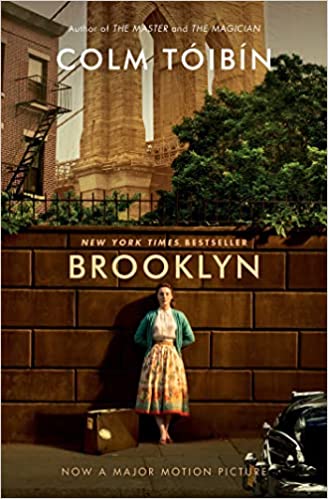
It wasn’t until I finished reading Colm Tóibín’s latest novel on Sunday that I noticed no review for Brooklyn, which I was sure I had read. I looked back at my old records, and sure enough, I read it in March 2016, but mistakenly removed the flag from my notes that indicates I haven’t reviewed it yet. So, here goes.

Brooklyn is a quiet story set in post-World War II Ireland and New York. It is about the tension between yearning for home and desiring to make your own way in the world.

Eilis Lacey has finished a bookkeeping course and is eager for work, but the only job she can find in her small Irish home town is clerking at Miss Kelly’s store on Sunday mornings. Her brothers have emigrated to England for work, and the family is supported by her older sister Rose, who works as a bookkeeper. Rose wants more for Eilis, so she arranges for Father Flood, a visiting priest, to find Eilis a job in Brooklyn.

The best he can do for her is a clerk’s job in a department store, Bartocci’s. Eilis enjoys her job, but she is frightfully homesick and does not much enjoy living in Mrs. Kehoe’s boardinghouse. Reasoning that being busy will make her less homesick, Father Flood signs her up for courses at Brooklyn College.

Soon, she is making a new life for herself, doing well in her courses, and even finding a boyfriend, a cheerful Italian plumber named Tony. She is finally settling into her new life when something unexpected occurs that takes her back to Ireland and a choice between her two lives.

Written in Tóibín’s graceful prose, Brooklyn is a quiet but powerful character study and exploration of the immigrant experience in post-World War II America.

Nora Webster

The Empty Family

Galway Bay

Review 1764: Literary Wives! The Summer Wives

Today is another review for the Literary Wives blogging club, in which we discuss the depiction of wives in fiction. If you have read the book, please participate by leaving comments on any of our blogs.

Be sure to read the reviews and comments of the other wives!

Eva of Paperback Princess
Lynn of Smoke and Mirrors
Naomi of Consumed By Ink

* * *

In the summer of 1951, young Miranda Schuyler arrives on Winthrop Island for her mother’s wedding to Hugh Fisher. There, she is immediately drawn to the young fisherman, Joseph Vargas, one of the lower class full-time population of the island that is in summer also occupied by the wealthy elite. She doesn’t care about his social position, but her new stepsister, Isobel, claims him for her own despite being engaged to someone else.

In the summer of 1930, a very young and naïve Bianca Medeiro falls madly in love with Hugh Fisher. She does not understand how he views their relative social positions and believes that having sex with him means they are spiritually married, despite his engagement to another girl.

In the summer of 1969, Miranda, now a movie star, returns to the island, where she has been a pariah since the events of 1951. Slowly, we learn what happened back then and what led to Joseph’s imprisonment for the murder of Hugh Fisher.

My Review

Literary Wives logo

First, I have to say that this is absolutely not my kind of book, so I only read it because it was a selection for Literary Wives. I have read one other book by Beatriz Williams, but I’m guessing it was improved by being a collaboration with two other writers, Lauren Willig and Karen White. The Summer Wives is definitely chick lit, which I do not read, so I will attempt to comment on the other aspects of it.

The plot develops so slowly that I considered quitting about page 50, when nothing much had happened except girls swooning over boys. I was about at page 5 when I thought I knew every secret that was going to be revealed, and I was just about right, barring that by then only a few of the characters had appeared. I also expected more of a sense of what the island looked like and who the characters were, but they were very much one- or maybe two-dimensional.

The dialogue was uninteresting, and the writing was either fairly mundane or overstated. For example, Bianca is stunned at being given gin to drink, not surprised, not startled, but stunned.

The novel picked up a little at the end, but had a frankly unbelievable ending. And what is this fascination chick lit books seem to have with wealth? The novels all seem to be about rich people or poor girls brought into worlds of wealth. So, of course, Miranda’s mother marries a wealthy man and despite Miranda having been ostracized from the family at a young age, she doesn’t become just an actress but a movie star.

What does this book say about wives or the experience of being a wife?

Well, really not much. Despite its title, the novel isn’t really about wives so much as a series of illicit relationships and love affairs. In fact, the word “wives” is used ironically, I think. Bianca considers herself married to Hugh despite his engagement to another woman and is shocked when he actually marries her. The marriages that are depicted are all in some sort of dysfunction. Hugh Fisher and Bianca Medeiro marry others but cheat their spouses throughout their marriages. Miranda has just left her abusive husband who, of course, is a movie director. Another middle-aged wife has been seducing the young men on the island. These are not sincere depictions of marriage but stereotypes, and I find nothing much to say about them.

The Forgotten Room

War of the Wives

An American Marriage

Review 1763: Jack

Jack tells more fully the story of Jack Boughton, whose tale was first alluded to in Robinson’s Gilead and whose fate was more fully explored in Home, which takes place chronologically after Jack. Jack is the hapless ne’er-do-well prodigal son in Home, but Jack explores his relationship with Della Miles, a romance with a young black woman that is forbidden in 1950’s Missouri.

Jack is living in St. Louis at the beginning of the novel, just barely hanging on to the fringes of society. He is drunk part of the time and owes money that he can’t repay. He is fresh out of jail and living in a cheerless rooming house.

He has already met Della at the beginning of the novel and has fallen instantly in love with her, but he is minutely aware of himself and his unsuitability. She is a young woman, educated, a schoolteacher, and she is black. It’s against the law for him to consort with her, and just being seen with him will ruin her reputation. For his part, he’s an older man, an ex-con, a bum.

Della gets accidentally locked in a cemetery one night where he sometimes sleeps. So, the first part of the novel is a long conversation at night.

Robinson is finely tuned to the condition of the human heart, as becomes obvious as we watch Jack, overly sensitive to every nuance of a situation. True to his upbringing by a devout Presbyterian minister, Jack frequently engages in theological discussions odd for an atheist. We watch Jack try to defeat his feelings for the sake of his beloved and fear that any small disappointment will send him on a downward spiral, for he is so fragile.

Robinson is a wonderful writer with a deep understanding of human nature. Although these Gilead books can be difficult, they are rewarding.

Gilead

Home

Lila

Review 1762: The Christmas Wish

Last year, I saw pictures from The Christmas Wish on TV and thought they were so beautiful that I bought a copy of the book. This little children’s story is illustrated with photos, some of which have been doctored to create the effects. This book is written by Lori Evert, and the photography is by Per Breiehagen.

Anja is a little girl who wants to be Santa’s helper for Christmas. So, after doing her chores and helping out a neighbor, she puts on her skis and heads north. On the way, she is helped by a cardinal, a draft horse, a musk ox, a polar bear, and a reindeer, each giving way to the next as she goes farther north.

The little girl is dressed in a traditional Norwegian outfit, and the photos are just wonderful. The story is simple but sweet. This is a book that could be passed down as a family heirloom.

Snow

Premlata and the Festival of Lights

Red Knit Cap Girl

Reading Thirkell’s Barsetshire Series in Order: #7 The Brandons + #6 Pomfret Towers Wrap-Up

It’s time for the wrap-up of Pomfret Towers and to introduce the next book. I hope everyone enjoyed reading Pomfret Towers. The following people either posted their reviews or made comments. Thanks for your participation:

  • Penelope Gough
  • Historical Fiction Is Fiction
  • Yvonne of A Darn Good Read

The next book, The Brandons, is one I read long ago but before I began blogging. I am looking forward to rereading it as I can’t remember it at all. I will be posting my review on Friday, December 31. I hope some of you will join me in reading it.

And here is our little badge.

Review 1761: #ThirkellBar! Pomfret Towers

Cover for Pomfret Towers

It’s time to talk about the sixth book in Angela Thirkell’s Barsetshire series, Pomfret Towers. Who read it and what did you think?

This novel is another one that I reviewed several years ago, so I will not repeat the plot synopsis and review but simply supply a link to the original review.

What struck me this time around was how sweet a story this is, with Thirkell creating characters we like tremendously but not forgetting a couple we can dislike. Yet, she’s subtle about all of this and shows a little sympathy for one of the most irritating characters.

Little Alice, so young and shy, is both a sympathetic character and one who provides some good-natured comedy. For example, her reaction to being invited to Pomfret Towers for the weekend—a terrifying prospect—is to hope the house burns down overnight before she has to go. She is silly and adolescent in her attachment to the odious Julian Rivers and very brave when she finally sees through him.

On the other side is Mrs. Rivers, so full of herself as a Writer of popular novels that sound dreadful, so managing in a house where she is not the hostess, and so irritating in her attempts to throw together her daughter Phoebe and the mild-mannered Gillie Foster, the heir to the earldom. But when she is humiliated by her son at the end of the novel, Thirkell deftly makes us feel sorry for her (but not for Julian).

I liked practically everyone in this novel, even Lord Pomfret, known for his rudeness. Another charming novel by Thirkell.

Summer Half

August Folly

The Demon in the House

Review 1760: The Turning Tide

I’ve started to feel as though Catriona McPherson’s approach to a mystery is to throw clues at you until you’re impossibly confused. That’s probably why I prefer her cozy thrillers. Still, I like her characters Dandy Gilver and Alec Osborne, so I keep reading.

Dandy’s daughter-in-law has given birth to twins when Dandy and Alec finally decide to respond to a third letter asking for help. One reason they decide to come is they have just heard of the death of a family friend, Peter Haslett, that seems to be connected with the case. The Reverend Hogg has asked them to find out what is wrong with Vesper, the Cramond Ferry girl, who appears to have gone mad and now blames herself for Peter’s drowning.

When they arrive in Cramond, they are confused by a meeting with three people who seem to have different agendas, Reverend Hogg, Miss Speir, who runs an uncomfortable inn, and Miss Lumley, who owns a local pub. They also hear different versions of Peter’s death. Most say he fell off the ferry and drowned, but one person says he came off the path and had his head crushed in the mill race.

He supposedly was visiting some friends, agricultural students doing an experiment with potatoes, but when Dandy and Alex meet them, the students make nothing of the fact that they have planted the potatoes upside down. When Dandy and Alec meet Vesper, she certainly seems mad, half naked and babbling about Mercury and snakes. But soon, Vesper too is dead.

I think I defy anyone to figure out McPherson’s crime novels. Still, they’re fun to read.

Dandy Gilver and a Spot of Toil and Trouble

Dandy Gilver and the Unpleasantness in the Ballroom

The Reek of Red Herrings

Review 1759: White Tears

You may think you know what’s going on in White Tears, but you don’t. Kunzru provides a few clues to that effect, but it’s easy to glide right over them.

Seth is a nerdy outcast in college when he meets Carter Wallace, a good-looking, popular rich kid. The two bond over sound and music. Seth has been immersing himself in techno when Carter introduces him to the gritty sounds of old-time Black country soul on vinyl and even older 45s.

After college, the two form a recording company, with Carter as the face and Seth doing the creative work and sound engineering. They are beginning to become famous for an old-fashioned sound, produced entirely by analog instruments. But Seth notices Carter losing focus and becoming more engaged with collecting.

One day, Seth is indulging his hobby of walking around New York recording noises when he catches someone singing part of a blues song, “Believe I buy me a graveyard of my own.” He plays it for Carter, who becomes obsessed with it. Carter uses the fragments from Seth’s recording to make what sounds like an old-time record, complete with cracking noises. Then he mocks up a picture of a 45, invents a singer, Charlie Shaw, and advertises the fake record on a collectors’ website.

What starts out as a seemingly harmless prank has serious consequences. Soon, apparently meeting a collector who wants to buy the fake record, Carter is severely beaten and left in a coma. Seth finds out his company and their apartment are both owned by the family corporation, and he is immediately dispossessed, the family claiming he is just a hanger-on. But Seth and Carter’s sister Leonie want to know what happened to Carter.

This novel is dark and unexpected. At first, I wasn’t so interested in the story about Carter and his fanboy Seth, neither of whom are that likable, but eventually I got sucked in. Again, it’s a novel I wouldn’t have chosen for myself, but I read it for my James Tait Black project.

Utopia Avenue

Telegraph Avenue

Mortal Love