Day 787: The Hunchback of Notre Dame

Cover for The Hunchback of Notre DameWhen I was making my list for Classics Club, I thought I should finally read something by Victor Hugo. The obvious choices were Les Miserables or The Hunchback of Notre Dame, but I had tried Les Mis some years ago only to put it down in disgust when Jean Valjean hits the priest who has tried to help him over the head with the candlesticks he wants to steal. So, it was Hunchback for me.

I was interested to read in the Introduction that the French title of this novel was Notre-Dame de Paris and that Hugo hated the English title. And truly, the focus of the novel is more on Notre Dame and 15th century Paris than it is on the story we’re familiar with. In fact, one entire chapter just describes Paris as it looks from the tower of the cathedral in 1482, street by street. I have to say, though, that the chapter was almost meaningless to me, since I found myself unable to visualize what he describes, at least not in that detail.

The novel has many characters, not just the three emphasized in all the movies. It begins with Pierre Gringoire, a hapless poet who is attempting to put on a play he wrote in celebration of Epiphany and the Festival of Fools. This great (and long) production is supposed to pay tribute to the betrothal of the Dauphin with Margaret of Flanders. The problem is that the people have been waiting since dawn to see it. It is past noon, when the play is supposed to have started, but the Cardinal and the Flemish ambassadors haven’t arrived yet. The crowd, egged on by the student Jehan Frollo du Moilin and his buddies, is getting disruptive.

Gringoire decides to start the play, and the crowd settles down, but the actors are still reciting the prologue when the Cardinal and the Flemish arrive, making a lot of noise. The students turn their attention to making rude remarks. Soon the crowd begins trying to select the Pope of Fools instead of watching the play. They choose the hideously deformed hunchback Quasimodo, the bellringer at Notre Dame, and everyone leaves. Poor Gringoire will not be paid, so will not be able to pay his lodging, and he goes off homeless to wander the street.

So, we meet Quasimodo, who was taken in as a child by Claude Frollo, the severe Archdeacon of Josas and older brother of Jehan Frollo. Claude Frollo is obsessed by his studies of alchemy until his eye lights on Esmeralda, a young gypsy dancer and street performer. He becomes infatuated and lustful and so (with the typical logic of zealotry) decides she must be a witch who has enchanted him. On the other hand, when Quasimodo is sentenced to the stocks simply because he is too deaf to hear the judge, the only person who is kind to him is the gypsy dancer. So are sewn the seeds of tragedy.

And make no mistake, there is tragedy in store for most of the characters in this novel. Justice is solely dependent upon the whims of powerful men, and the more powerful they are, the more scathingly Hugo treats them. We even spend some time with the king, Louis XI, who is depicted as grasping, arbitrary, and vicious. Hugo pretty much skewers everyone except Quasimodo and the gypsy girl, who are basically cardboard figures.

Hugo is interested in many things in this novel—the cathedral itself, its own architecture, and the architecture of Paris are strong presences. The transmission of culture from century to century is a preoccupation, as are the themes of the nature of love, loyalty, and not judging by appearances. As a son of the revolution, he also has an axe to grind about the aristocracy and the corruption in the church.

I have to confess, though, that I only mildly enjoyed this gothic novel. The only highly developed character is Claude Frollo, and he is a sickening person.

Related Posts
La Reine Margot

The Lily and the Lion

The Rhetoric of Death


Day 753: Blood & Beauty

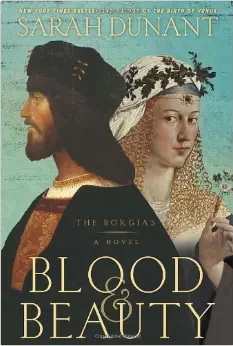
Cover for Blood & BeautyBest Book of the Week!
Blood & Beauty is a historical novel about the Borgia family that shows meticulous research, examining in light of modern findings the legends that have surrounded the family for centuries. It also powerfully evokes the period.

The novel begins with the election of Rodrigo Borgia as Pope Alexander VI. He is clever and ruthless but sentimental about his four illegitimate children. Although historically there is some debate about the birth order of the oldest two sons, Dunant firmly places Cesare as the oldest, followed by Juan, Lucrezia, and Jofrè.

Although the pope loves his children, especially Juan and Lucrezia, their value is largely in the alliances he can make through their marriages. Cesare’s value, on the other hand, is to back up his father on the religious front. He begins as a cardinal, although he is unsuited to his religious profession and eventually throws it off to become a commander of armies.

Juan’s marriage is first, but the novel is mostly concerned with the relationship among Pope Alexander, Cesare, and Lucrezia. It is much more complex than and different from what you may have heard. It is Lucrezia’s misfortune to be married into families that become enemies of the Borgias because of shifting alliances. This is particularly true of her second marriage to Alfonso of Aragon, whom she loves.

Dunant remarks in the afterward that the Borgias have not deserved their evil reputation. Certainly they were rapacious and ruthless—and more interested in the good of the Borgias than anything else—but so too were most of the great families of Italy at that time. In this novel, alliances are made and discarded at will by most of the great families.

This novel is historical fiction at its best. None of the characters are invented or romanticized, and we become immersed in the world of Renaissance Italy.

Related Posts

The Malice of Fortune

A Folly of Princes

Worldly Goods: A New History of the Renaissance

Day 704: Henry VI, Part I

Cover for Henry VI, Part 1Henry VI Part I is my book for the latest Classics Club Spin! Enjoy the review.

The only one of Shakespeare’s history plays I’ve ever read previously is Richard III, although I once saw Peter MacNicol perform Richard II in Central Park (with Martin and Charlie Sheen two rows down in the audience). Henry VI Part I is Shakespeare’s first play as well as one of his Wars of the Roses plays, of which Richard III is the last.

As a history play, Henry VI Part I is more about the events at the beginning of Henry’s reign than about Henry’s life. In fact, he is very young through much of the play and only appears occasionally. The play depicts the discord among the powerful men surrounding Henry, culminating in the Wars of the Roses (although the seeds of the discord can be traced back earlier, to when Henry of Bolingbroke (later Henry IV) deposed Richard II). Henry IV and Henry V, in their turns, have held the country together, but Henry V’s young son shows no such ability. Although Shakespeare himself (and many historians) seems to be disposed toward the Yorkists, it is clear by the end of the play that the Lancastrians will prevail during Henry’s reign.

Painting of scene
The choosing of red and white roses, a scene from the play

The other main event of the play is the war in France. I should not have been surprised to find Joan of Arc (referred to in the play as Jean La Pucelle) the villain of this plot, since the English burned her, but it was a shock nonetheless. The gallant Lord Talbot is the hero, while Jean fights with the aids of demons.

The play is not as dramatic as some others, but it has its moments. I thought it was most interesting as showing the Tudor view of this great series of conflicts.

Related Posts

The Wars of the Roses

Macbeth

Lords of Misrule

Day 466: Literary Wives: The Inquisitor’s Wife

Today the Literary Wives blog group members all review The Inquisitor’s Wife. Be sure to check out the other reviews at the links at the bottom of this review. We encourage you to participate by submitting your comments or a link to your own review to any of our blogs, or you can submit a comment or link on our new Facebook page! For more information, see my Literary Wives page.

Cover for The Inquisitor's WifeThe Review

The Inquisitor’s Wife is a historical novel with a promising concept that is not fulfilled. Although set in an interesting era and place, its characters behave as they need to just to drive the plot.

Marisol Garcia is the daughter of Diego, a respected Old Christian of 15th century Seville, and Magdalena, a converso, or Jewish woman forcibly converted to Christianity. Although as a child Marisol observes her mother’s celebration of the Sabbath on Friday nights without understanding what it means, when she is 11, she is ridiculed by the neighborhood children for being a Jew. Humiliated, she turns against her mother and refuses to take part in her rituals.

This, aside from a complete lack of a sense of their household and daily life, was my first problem with this novel, because Marisol’s loyalties and feelings about her heritage shift back and forth throughout the novel. Having adored her mother, she turns against her in an instant after one incident. Later, she changes her mind several times, and in general her behavior as a young woman is more like that of a spoiled adolescent.

As Queen Isabella gains power, the conversos of the city hope she will protect them, as she herself has married one of them, King Ferdinand. They are about to be gravely disappointed.

Eventually, everyone hears rumors of an Inquisition, and Magdalena becomes terrified that the horrible events of her childhood will recur. She urges Diego to move the family to Portugal, but secure in his own innocence and unaware of his wife’s activities, he is firm in his belief that they are not in danger. Marisol follows her mother outside one night to the river and sees her drown herself, apparently from despair.

Marisol has been in love with her neighbor Antonio since they were children. They are engaged while he is away studying, but after she does not hear from him for over a year, she believes he has abandoned her. Shortly after her mother’s death, she finds out her father has made some kind of deal with another neighbor, whom she detests, Gabriel Hojeda, who is a civil administrator for the Inquisition. She is forced to marry him, and her father renounces her.

Of course, he is trying to protect her as the Inquisition is going after him (for no apparent reason but that his wife was a converso), but it takes her awhile to figure this out. She continues to be clueless throughout the novel, not picking up on any of the hints that are strewn everywhere. Then, on her wedding night, Gabriel’s intimidating brother Fray Hojeda asks for a promise that the two will not consummate their marriage for a month. There is no apparent reason for this request either except the plot’s need to save Marisol for Antonio and to introduce a sadistic sex scene toward the end of the novel.

I can go on and on about the unlikeliness of the plot as Marisol and her father fall deeper into danger. But one tiny spoiler reveals how poorly thought out this novel is. Marisol and Antonio don’t hear from each other in a year. Why? Because jealous Gabriel is stealing their letters. How he does this is not explained, but mail is not exactly sitting out in the mailbox. Oh, let’s have another example. In a late scene in the novel, Marisol and Antonio swim to safety—this in a time when most Europeans didn’t swim, even sailors, not to mention gently born Spanish ladies dressed in enveloping and heavy garb. She would have sunk immediately.

As I mentioned before, there is no sense of the characters’ daily lives except for Magdalena’s time spent painting ceramics, and that is in service of the plot. When Marisol gets married, instead of taking over the household as a well-trained wife of her class would do, she asks her husband what she should do and since he gives her nothing to do, apparently does nothing except run around town unchaperoned. Except for Marisol, all of the characters are completely undeveloped. Everyone is either good or bad. Although this novel has the opportunity to say something about the Inquisition, it disintegrates into a messy damsel in distress story that becomes more absurd as it continues. If it was purely a romp, I wouldn’t judge it so harshly, but it seems to have pretensions to something more serious.

Literary Wives logoWhat does this book say about wives or the experience of being a wife?

Marisol’s marriage to Gabriel is just a plot device. Even its motivation doesn’t make sense, because if she and her father are in danger just because of her mother, Gabriel’s having married Marisol would logically put him in danger. He would not be able to protect her and in fact, does not really try to. As to the other marriage, her parents’ is warm but only scantily depicted. The only true family, that of Marisol’s uncle, comes to the novel late, and we don’t see much of it.

In what way does this woman define “wife” or is defined by “wife”?

This novel doesn’t really concern itself with wifehood. Gabriel’s definition of a wife is someone who is in his power. Other than being another threat to the damsel and a way to keep her and Antonio apart, Marisol’s status as a wife is hardly even regarded or treated with. In fact, in another unlikely plot twist, she is asked to keep her marriage a secret, even though she is living in her husband’s house unchaperoned and would have her reputation damaged if she was not thought to be married. Diego and Magdalena love each other, but Magdalena deceives Diego in continuing to observe her religion, and we don’t see much of them together.

Be sure to view the posts of the other “wives,” as follows:

Ariel of One Little Library
Audra of Unabridged Chick
Carolyn of Rosemary and Reading Glasses
Cecilia of Only You
Lynn of Smoke and Mirrors

Day 363: The Captive Crown

Cover for The Stewart TrilogyAt the beginning of this novel, the third in Tranter’s Stewart Trilogy, Jamie Douglas has fled to the highlands after being declared an outlaw following the disastrous battle of Homildon. That no Scot who fought in the battle would so call him is no concern to Robert Stewart, Duke of Albany and the Governor of Scotland.

Jamie is living with his family on the estate of Alexander Stewart of Badenoch, acting Justicaire of the Highlands. Although King Robert III is still alive, he has handed over the government to his brother Robert of Albany. His young son James, heir to the throne, has been captured by the English on his way to France, where his father sent him for safety after the death of his older son, David, at the time in Robert of Albany’s custody.

Jamie, who has always believed that the Duke of Albany plotted the murder of his chief, the Earl of Douglas, also believes that David Stewart was starved to death at Albany’s order. Jamie is content to stay away from the Lowlands and serve with Alexander.

The plot of this novel is a lot more difficult to describe than that of the other two, as it covers the significant events of several years in Alexander Stewart’s life, including battling the invasions of Donald of the Isles, forming an embassy to the British to treat for the release of King James after Robert III’s death, privateering against the British, and so on. This is a fault with the novel, constrained as it is by actual historical events to seem disjointed. It is definitely the weakest of the trilogy and does not make a satisfying ending for the series.

Day 358: People of the Book

Cover for People of the BookBest Book of the Week!

I read People of the Book several years ago and remembered that it was good, but when re-reading it for my book club, I enjoyed it even more. The novel is based on the history of a Hebrew codex known as the Sarajevo Haggadah. Part of the novel is envisioned based on what is known of the book’s history, while the rest is invented.

In the immediate aftermath of the Bosnian war, Hanna Heath, an expert in the restoration of old books, is asked to restore the priceless Sarajevo Haggadah, a famous book believed twice to have been destroyed by war that was both times rescued by Moslem museum curators. The book is especially important because of its beautiful illustrations, as before it was discovered, scholars believed that old Hebrew books did not contain such illuminations.

While Hanna is working on the book, she makes observations and collects artifacts that will help trace its history. She notes that the book once had clasps that are now missing, collects an insect wing, and scrapes residue from staining.

Hanna also becomes involved with the man who rescued the book, Ozren Karaman, whose wife was killed during the war and whose baby son is in the hospital with a brain injury. As Hanna was raised by an aloof and competitive mother, though, she is poor at forming attachments.

When Hanna finishes restoring the book, she follows up with research into the clasp and the artifacts she collected. As she finds out about each item, the novel goes farther back in time, explaining what happened to the book and telling the stories of the people involved with it, until the creation of the book in 15th century Spain.

A poor Jewish girl named Lola works for the partisans in the forest outside Sarajevo during World War II after the Jews are expelled from the city by the Nazis and her family is shipped off to camps. Later she is helped to safety by the Moslem curator of the museum, who also has a book to hide. A 19th century Viennese bookbinder who is dying from syphilis steals the beautiful silver clasps from the book to exchange with his doctor for treatment. In 1609 Venice, a priest working for the Inquisition saves the book from burning but confiscates it from its owner. A young girl saves the book as the Jews are expelled from Spain in 1492.

These are just the bones of some of the absorbing stories that draw you along as Brooks imagines the history of the book. Each tale is vividly imagined and skillfully told, and they are all held together by Hanna’s experiences. People of the Book is a gracefully written and imaginative novel that emphasizes the contributions of multiple cultures and religions to the book’s creation and safety.

Day 354: Worldly Goods: A New History of the Renaissance

Cover for Worldly GoodsWorldly Goods promises a new look at the European Renaissance from a different point of view. Lisa Jardine, a professor of English at the University of London, proposes an interpretation of the period in terms of the growth of commerce and a new consumerism and multiculturalism.

However, the information offered does not seem new. Rulers and wealthy men have always been conspicuous consumers. Jardine attempts, for example, to turn around our view of the flowering of art as merely a series of demonstrations of the wealth of patrons who commissioned the works, a sort of competition to show who is most wealthy or powerful. But simply providing examples of patrons who specified expensive materials or the inclusion of their goods in pictures doesn’t prove this point.

Jardine does a better job of showing how the development of printing made the exchange of ideas easier, thus affecting the advances in many different fields, including the arts and the sciences. However, her argument that the policy decisions of the period were all driven by the dictates of commerce is taking things too far, I think.

The book is well written and lively. It does not back up its assertions with footnotes or a bibliography, however, indicating that it is written for the general public but frustrating those who would like to look further. At some point, I felt that the examples were becoming too repetitive and no new points were being made. For example, Chapter Three is about the proliferation of books and printing, but Jardine continues to make the same points about printing and the sharing of scientific and technical information repeatedly throughout the rest of the book.

Although the history provides an interesting discussion of commerce during the Renaissance, it is oversold as a complete history of the period.

Day 337: A Folly of Princes

Cover for The Stewart TrilogyIn the sequel to Lords of Misrule, Prince David Stewart is now a young man ready to challenge his ruthless uncle Robert Stewart for the Governorship of Scotland, under the weak rule of David’s father, Robert III. Jamie Stewart, our hero, who has always suspected Robert Stewart of having his lord, the Earl of Douglas, murdered, has declared himself David’s man.

But the Stewarts are an unruly bunch. David’s governorship is more fair and less corrupt than his uncle’s, and he puts in place reforms, but he takes no care in dealing with the proud nobles of Scotland and behaves wildly and promiscuously in his private  life. Although Jamie continues to support him, he is disappointed in his prince and fears that all will not be well.

While this is going on, changes in the Plantagenet monarchy in England threaten the border. At the same time, Donald of the Isles is making his own forays farther north. This northern threat gives Jamie an opportunity of renewing his acquaintance with Alexander Stewart of Badenoch.

Again, Nigel Tranter does a wonderful job of explaining the complicated politics and alliances of early 15th century Scotland, while spinning an absorbing adventure story.

Day 89: The Wars of the Roses

Cover for The Wars of the RosesThe Wars of the Roses were a series of complex events involving numerous significant figures. As such, when I have previously read about them, I’ve found it confusing to keep track of events and people.

In The Wars of the Roses: Through the Lives of Five Men and Women of the Fifteenth Century, Desmond Seward presents the clearest and most interesting explication I have read. He organizes the material and infuses interest by following the effects of the wars on five people–William Hastings, Edward IV’s best friend and one of the most powerful men in the realm during his (Yorkist) reign; John de Vere, Earl of Oxford, head of an ancient family and a loyal Lancastrian; Lady Margaret Beaufort, Henry Tudor’s mother; Dr. John Morton, a loyal Lancastrian clergyman who turned Yorkist; and Jane Shore, mistress of Edward IV and daughter of a successful London businessman.

A series of battles between rival factions of the Plantagenet family for the throne, the Wars of the Roses lasted 32 years. The roots of the dispute lay in Henry IV’s usurpation of the crown from Richard II years before. Henry IV and his son, Henry V, were strong rulers, but Henry V’s heir, Henry VI, succeeded at the age of 15. He proved a weak and ineffective ruler who was dominated by his favorites and his wife’s rapacious relatives. Henry also managed to lose the portion of France that his father had so arduously and expensively won back, and England’s state of law and order had almost completely broken down.

The shift in government began when Henry VI had a son who replaced Edward Duke of York (later to be Edward IV) as heir to the throne. This made Edward’s position precarious and he had to flee to Europe. His subsequent battles against Henry’s adherents were only the beginning of years of instability that resulted in the end of the Plantagenet dynasty and the beginning of that of the Tudors.

History can be written with too much detail or in a too academic and dry style, or it can be so lightly researched as to seem like fluff. Seward hits the perfect balance with a terrifically interesting book that is wonderfully well written.