Day 558: La Reine Margot

Cover for La Reine MargotIf you’ve been following my reviews of Maurice Druon’s Accursed Kings series about medieval France, you’ve probably seen me use the phrase “nest of vipers.” La Reine Margot, set a couple of centuries later, is just as full of intrigues, infidelities, betrayals, and even poisonings.

It is 1572, and the French court is celebrating the inexplicable marriage of Marguerite of Valois (Margot) to Henry of Navarre. France is at the height of the wars between Catholic and Huguenot, and Charles IX has proposed the union between his sister and the leader of the Huguenots purportedly to further peace.

Soon, though, we find out that the wedding is a trap for the leading Huguenots planned by Charles and his evil mother Catherine de Medicis. (Note that throughout I spell names as they were in the book.) For that evening of St. Bartholomew’s Day, troops are sent out all over Paris to massacre the Huguenots, who are in town for the wedding.

Thinking to rid himself of an enemy in Henry of Navarre, Charles has not considered his sister. Even though she and Henry are not romantically attached, the two have sworn to support each other. When Henry is trapped in the Louvre with the royal family, a combination of Margot’s support and his recanting saves his life. Margot has also rescued a young wounded Huguenot, La Mole, from the slaughter, providing a romantic subplot for the novel.

So begins the novel about how Henry of Navarre, aided by Margot, survives the machinations of the Valois family. The rumor is that Catherine recently murdered Henry’s mother by poisoning her, and Catherine also works in charms and horoscopes. Charles IX is unstable, first mistrusting Henry and then treating him like a brother. Henry d’Anjou, Charles’ brother, detests Henry of Navarre and thinks he is a threat to d’Anjou’s own right to the throne after his brother. François d’Alençon, the other brother, wavers in his decision to ally with Navarre.

Dumas was a writer of the Romantic movement, which de-emphasized rationality and emphasized emotion. The romantic plot involves the love affair between Margot and the naive and gallant La Mole, who is drawn into danger because of his love and religion.

My Oxford World Classics edition was fortified with copious notes, including information about which events were true and which were invented. Dumas is prone to using real people in his historical romances, and it was just a little off-putting to discover, for example, that the real La Mole was not a gallant Huguenot but a fundamentalist Catholic who was responsible for many murders during the massacre. Still, I found the real stories as fascinating as the novel.

If you like a fast-moving adventure that also involves political maneuvering, this is a good book for you. I was more interested in the nerve and political agility of Navarre than I was in the romance, but I still enjoyed the novel.

One caution—an abbreviated version of this novel is available as Marguerite of Valois. I have not read it, but if you want the more complete novel, look for La Reine Margot. (Yes, it is in English but also in French, so be careful if you order it online.)

Just a side note. I have written much about Dorothy Dunnett’s excellent historical novels. One of her Crawford of Lymond novels, Queen’s Play, is also partially concerned with the massacre.

Day 354: Worldly Goods: A New History of the Renaissance

Cover for Worldly GoodsWorldly Goods promises a new look at the European Renaissance from a different point of view. Lisa Jardine, a professor of English at the University of London, proposes an interpretation of the period in terms of the growth of commerce and a new consumerism and multiculturalism.

However, the information offered does not seem new. Rulers and wealthy men have always been conspicuous consumers. Jardine attempts, for example, to turn around our view of the flowering of art as merely a series of demonstrations of the wealth of patrons who commissioned the works, a sort of competition to show who is most wealthy or powerful. But simply providing examples of patrons who specified expensive materials or the inclusion of their goods in pictures doesn’t prove this point.

Jardine does a better job of showing how the development of printing made the exchange of ideas easier, thus affecting the advances in many different fields, including the arts and the sciences. However, her argument that the policy decisions of the period were all driven by the dictates of commerce is taking things too far, I think.

The book is well written and lively. It does not back up its assertions with footnotes or a bibliography, however, indicating that it is written for the general public but frustrating those who would like to look further. At some point, I felt that the examples were becoming too repetitive and no new points were being made. For example, Chapter Three is about the proliferation of books and printing, but Jardine continues to make the same points about printing and the sharing of scientific and technical information repeatedly throughout the rest of the book.

Although the history provides an interesting discussion of commerce during the Renaissance, it is oversold as a complete history of the period.

Day 345: The Chalice

Cover for The ChaliceI am not sure why I found this novel so irritating. Possibly it is because it is a sequel, but nowhere on the cover is that indicated, and this novel is definitely one that requires knowledge of the previous book, which I have not read.

Joanna Stafford is a former Dominican novice after the dissolution of the monasteries by Henry VIII. At the beginning of the novel she is in Canterbury with some ex-monks about to commit some serious act, but then the action turns back several months.

Joanna is living in Dartford with her young cousin and her friends Brother Edmund and Sister Winifred, a former monk and nun who are sister and brother. Some of the townspeople are suspicious of the former residents of the priory, but Joanna has plans to continue there and set up a loom to weave tapestries.

Soon, however, her cousins Gertrude and Henry Courtenay arrive to invite her and her cousin Arthur for a visit. Little does Joanna know that Gertrude is aware that Joanna is the subject of a prophecy, which a group of Catholics believe will save Catholicism in England. Apparently, in the previous novel she received a prophecy and was told she would learn it in full after she received three prophecies. Since her family was destroyed as the result of a prophecy, however, she has promised never to dabble in it again. She is soon subject to immense pressure from Gertrude Courtenay and others, including the Lady Mary Tudor and the Spanish ambassador Chapuys, to see a seer.

The novel does not seem very coherent. Joanna is told she must hear the prophecies of her own free will, yet all kinds of pressures and threats are applied to make her hear them. She is refusing to hear the prophecy, then she isn’t. Then we go through the same thing with the next prophecy. Some of her decisions seem completely unlikely for a person who is extremely religious and was previously a novice. At one point in the book she throws herself at two different men within the space of weeks.

It takes an incredibly long time to feel certain that we’ve learned of everything revealed in the first book–new facts keep popping up until nearly halfway through the volume. This is not a stand-alone novel by any means. Whether it would be more satisfying for someone who has read the first book I cannot answer.

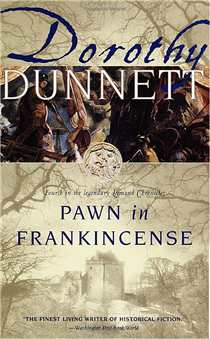
Day 334: Pawn in Frankincense

Cover for Pawn in FrankincenseBest Book of the Week!

In the fourth exciting book of the Lymond Chronicles, Francis Crawford of Lymond sets out to find his two-year-old child by Oonagh O’Dwyer, hidden somewhere in the vast Ottoman Empire. He disguises his personal mission with the official one of delivering an elaborately decorated piano from the King of France to the Sultan in Constantinople. Another goal is to find and kill the traitor Graham Mallet Reid, who has the child in his power. The problem of the child is complicated because Lymond doesn’t know which of two boys, one Reid’s by his sister Joleta, is his own. Another complication is that if any harm comes to Reid, the boys, under the protection of Sulieman, will both be murdered.

Accompanying him and his household are a couple of merchants, including the mysterious Marthe. Raised in the household of the Dame de Doubtance, Marthe, except for her sex, could be Lymond’s identical twin.

After some disastrous adventures, Lymond believes he has sent home the redoubtable fifteen-year-old Philippa Somerville, who foisted herself upon him thinking he would need her help to care for the child. However, she is actually on her way to join the seraglio to find one of the boys, Kuzum, while Lymond searches in the stews of the city for the other one, Khaireddin. Philippa’s role in this novel is a major one, with her character and her opinion of Lymond changing and maturing as their adventures continue.

Aside from the intrigues taking place in an empire that is Byzantine in its complexity (not to make a pun), Lymond is hampered in his activities because of sabotage by a member of his own household staff. He also suffers from his usual problem of failing to explain his actions to his adherents, such as Jerrott Blyth, so that they become angry and occasionally work against him.

In action that moves from Marseilles across Europe to North Africa and finally to Constantinople, Lymond’s concerns grow to involve the fate of nations.

Day 320: The Malice of Fortune

Cover for The Malice of FortuneThe Malice of Fortune follows a current trend of mystery fiction to use actual historical people as detectives. In this case, the novel is set in 16th century Italy, and the historical detective is Niccolò Machiavelli, assisted at times by Leonardo da Vinci.

It is 1502 in the Papal States of Italy, and the infamous Pope Alexander VI, the former Rodrigo Borgia, has received word of his beloved son Juan, who was murdered years before. A woman was found butchered in Imola, and with her body was an amulet Juan always kept with him. The Pope summons the courtesan Damiata, whom he suspects of complicity in Juan’s death, and takes her little son hostage while he dispatches her to investigate.

In Imola, Damiata finds that someone has been murdering and butchering women and then leaving quarters of their bodies around the city. When she travels out to the scene of the latest discovery, she finds that Juan’s brother, the dangerous Duke Cesare (nicknamed Valentino) Borgia, has Leonardo da Vinci on the scene as his investigator. Da Vinci thinks that the killer is playing a game by constructing puzzles for him. At the scene some masked men provide an additional clue by fleeing the investigators.

Damiata also meets Niccolò Machiavelli, who is in town representing the city of Florence, which is afraid that Duke Valentino and his condottieri, or mercenaries, are planning to attack the city. Damiata suspects one of the three condottieri generals of being the murderer, but she does not know which one.

Machiavelli provides a different insight into the murderer. He has made a study of what he calls “the necessity” for each man–what drives him–and he begins trying to discover the murderer’s necessity. Machiavelli and Damiata team up to find the murderer.

This novel has interesting characters and situations, but at some point I felt as if the characters are chasing around too much with little result. Instead of building suspense, the plot seems unplanned and disorganized.

Michael Ennis is a historian, and the historical background is convincing and seems accurate. Compared to his previous novel about medieval Italy, The Duchess of Milan, a straight historical fiction novel about the powerful d’Este family, The Malice of Fortune is a little disappointing.

Day 265: Here Was a Man: A Novel of Sir Walter Raleigh and Elizabeth I

Cover for Here Was a ManI don’t think I’ve read anything by Norah Lofts before, but even though she was a prolific historical novelist, I would rate this effort as mediocre.

Here Was a Man attempts to draw most of Raleigh’s life in a short space and does so by a series of vignettes illustrating important events. Although I am not completely familiar with his career, I know that Lofts  has chosen to portray a couple of apocryphal events, in particular the cloak in the mud story, which I believe has no basis in fact. The other serious lack of the novel is any depth of characterization.

The novel begins with Raleigh as a teenager, listening to sailors’ tales and dreaming of traveling the seas. He is also full of ambition for worldly success, an ambition that sometimes works to his disadvantage.

We are told many times about Raleigh’s sense of adventure, but we don’t really feel it. In fact, he seems to spend more time in prison than on his adventures. It is curious, too, that although he has many enemies at court, at least in this novel he has done nothing to earn their enmity. I would doubt that was really the case.

Raleigh is probably a character who could support an interesting and exciting novel, but this is not it. To be fair, it looks like it may have been one of Lofts’ first works.

Day 251: The Disorderly Knights

Cover for The Disorderly KnightsBest Book of the Week!
The Disorderly Knights is the third novel in Dorothy Dunnett’s rousing Lymond Chronicles series. I previously reviewed the first two novels, The Game of Kings and Queen’s Play.

Upon his return to Scotland from his adventures in France, Francis Crawford of Lymond establishes a small fighting force of independent knights and begins training them. As their reputation spreads, the band begins to attract more knights, and he hears that they are to be joined by a renowned fighter, Sir Graham Reid Mallett, Knight Grand Cross of the Order of St. John. Many of the men who know Reid Mallet consider him almost a living saint. In disposition and talents he seems to be a perfect foil for Lymond, but they clash, and some of Lymond’s men begin to turn against him. As usual, Lymond’s behavior appears to put him in the wrong, and Reid Mallett seems to want to usurp the fighting force.

This conflict eventually leads to Malta, where Lymond arrives just before the Ottoman Turks attack. During the siege, Lymond becomes involved in the political maneuvering and feuds among the various national factions of the declining Order of St. John. He also hears that Oonagh O’Dwyer, the beautiful Irish rebel he encountered in Queen’s Play, is captive in another city on the island. After the siege, he follows her to North Africa in an attempt to free her.

It is difficult to write more about this novel because of spoilers, but also because the plot becomes increasingly complex from this point on, with threads that are not all explained until the sixth book. Suffice it to say that, although this is a slow-starting series, if you get this far, you will be hooked. The novel is suspenseful and exciting, and Lymond makes a complicated and compelling main character, almost an anti-hero at times. These books were written in the 1960’s and 1970’s, and I think the only series to compare with them might be George R.R. Martin’s Song of Fire and Ice or Dunnett’s own House of Niccolo series.

Day 230: The Candlemass Road

Cover for The Candlemass RoadBest book of the Week!
At first The Candlemass Road seems like it will be a romantic adventure story similar to Lorna Doone, but George MacDonald Fraser was an expert on the border counties of England and Scotland and far too cynical for that, so it is an adventure certainly, but not a romance.

Lady Margaret Dacre has not been home to Askerton Hall in Cumberland since she was four years old, but now her grandfather Lord Ralph Dacre has been murdered and rumor has it that Lady Margaret has been sent away from court by Elizabeth I herself. At the beginning of the novel, all of the hall’s servants, including the narrator Frey Luis Guevara, a Catholic priest, are frantically preparing for her arrival.

Young and beautiful, she arrives in a temper. She has been accosted on the road by George Bell, one of her tenants, who has come to complain that he has received no help from her bailiff about the dreaded Nixon clan, who has demanded blackmail. None of Lord Dacre’s tenants have had to pay blackmail because he protected them, but after his death, his men at arms all departed.

When Lady Margaret asks Land Sergeant Carleton for protection for her people, he says the problem lays outside of his purview–he has merely come to pick up a prisoner. Incensed, Lady Margaret refuses to give him the prisoner, who was caught stealing bread and cheese from the kitchen.

The thief is a broken man–that is, one who has no master or clan–named Archie Noble the Waitabout. Lady Margaret is about to let him go free when she finds he got his horse from a famous villain, who tried to murder him in his camp. Already angered by Archie’s impudence, Lady Margaret declares him a murderer and threatens to hang him unless he goes by himself to aid the Bells, whose blackmailers return that night.

The short novel is beautifully written with dialog in a northern dialect that is still understandable, with Elizabethan expressions thrown in. The novel is an exciting yet chilling and occasionally humorous picture of the time and place.

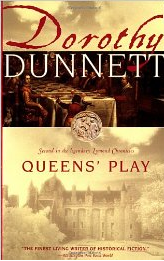
Day 176: Queens’ Play

Cover for Queen's PlayBest Book of the Week!

Queens’ Play is the second book of Dorothy Dunnett’s excellent historical fiction series, the Lymond Chronicles. Although it is not absolutely necessary to read the first book, Game of Kings, you will enjoy the other books more if you do. If you decide to continue this series, it is important to read them in order after this one.

Francis Crawford of Lymond enters the scene disguised, and it is some time before we figure out which of two characters he is. Francis has been asked by Mary de Guise, Queen Dowager of Scotland and mother of Mary Queen of Scots, to travel to France and protect Mary. Although Mary is still a little girl, plots revolve around her, and her mother is afraid her life is at risk.

The Irish prince Phelim O’Liam Roe’s arrival into France is a spectacular one, as his ship almost crashes into another one when entering the harbor. This incident is perhaps not an accident, as evidence mounts that someone is trying to kill the prince. To the French court, O’Liam Roe is unbelievably provincial, and he is immediately the butt of ridicule. He is attracted to Oonagh O’Dwyer, an Irish woman living on the borders of society, but she disdains him. In fact, she is the mistress of the Irish rebel Cormac O’Connor.

O’Liam Roe has brought with him Thady Boy Ballagh, an ollav, or trained master poet. Untidy, fat Thady Boy is gaining popularity with the decadent French court through a series of reckless deeds and his brilliant musical performances.

It seems that the Queen Dowager’s fears are correct. During a hunt that employs the king’s leopards as hunting animals, someone lets Mary’s pet hare out in front of the cat near her pony. As she struggles to save her pet, the cat turns its sights on Mary.

As always, Dunnett combines heart-stopping action and suspense with a detailed knowledge of the period. This book begins some of the plot threads that will continue throughout the series.

Day 141: Shadow of Night

Cover for Shadow of NightAs with most second books of a trilogy, Shadow of Night is transitional and therefore harder to describe than the first book.

At the end of the A Discovery of Witches, the first book of Deborah Harkness’s “All Souls Trilogy,” Diana Bishop, an Oxford scholar and nonpracticing witch, and her husband Matthew Clairmont, a geneticist and vampire, were forced to flee because a union between a witch and a vampire is forbidden. Using Diana’s newly discovered time-travel skills, they have arrived in Elizabethan England so that Diana can find a witch to help her learn her powers. Even more importantly, they want to look for Ashmole 782, an enchanted manuscript that Matthew believes may hold the secret to the existence of witches, vampires, and daemons. This decision proves potentially hazardous, though, as the age they’ve chosen is one of persecution of witches and Diana has a tendency to draw attention to herself.

In Tudor England Matthew of the past is part of an intellectual group called the School of Night, the members of which include Sir Walter Raleigh and Kit Marlowe. Kit is a deeply disturbed daemon who is insanely jealous of Diana. Another hazard is that Matthew’s acquaintances may realize he is not the same person as the person from the past. In the meantime, both Diana and Matthew’s friends and enemies back in the present time watch for clues to their existence in the past.

Although this novel is a great sequel that propels you to the next book, it has the typical middle book problem of furthering the plot without arriving anywhere. Strictly because of personal taste, I could also have done without some of the heavy romantic passages, although other readers will like them. Nevertheless, I am extremely interested to see how Diana and Matthew will resolve all their problems in the final book.