
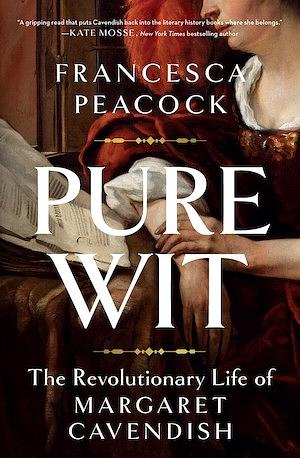
I’m not sure what possessed me to read two biographies about Margaret Cavendish so close together. I think I moved Pure Wit up in the pile without really looking to see what it was about, just remembering I had wanted to read it.
While Katie Whitaker’s Mad Madge is more of a biography for the general public, Peacock’s biography is the more scholarly and more concerned with Cavendish’s ideas and legacy.
Certainly, it traces Cavendish’s own concern with her legacy and her difficulties in being taken seriously in her own time. Although Cavendish was not the first woman writer to publish her work, she was pretty much the first to publish not only poetry and plays but her ideas on science and philosophy. Of her earlier work, some claimed that her husband, William, had written it, but by the last decade of her life, she had been invited to attend the Royal Society to see their experiments despite a reputation for eccentricity.
Peacock explores how Cavendish’s work, which made her famous during her lifetime, after her death quickly began to be denigrated and made hard to find so that scholars couldn’t make up their own minds about it. Biographers and critics began to fasten on a few contemporary remarks to claim she was unstable and to discuss only her poems about fairies and her biography of her husband, whereas she wrote widely on a multitude of subjects. For a while, she was depicted as a dutiful wife—which she probably wasn’t—and then the Mad Madge badge was pinned on her. Even Virginia Woolf made her the butt of jokes instead of trying to understand what she had done.
But actually, Cavendish was very much an early feminist and a ground-breaking writer. She was self-contradictory, but Peacock points out that other philosophers and poets of her time with the same faults—if it is a fault to change your mind about your ideas as you reconsider them—were not being criticized for them.
It’s pretty clear that the reputation Cavendish accumulated over time is a matter of misogyny.
If you want an easier-to-read biography, I’d recommend Whitaker’s, but if you are interested also in an in-depth analysis of Cavendish’s works and legacy, this is the book for you.

