Review 1415: The Poison Bed

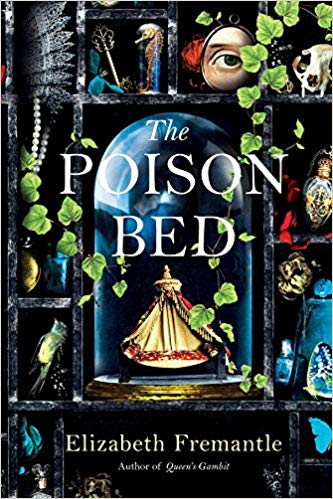
In 1615 London, a glittering couple was imprisoned in the Tower for murder. They were Robert Carr, long a favorite of King James, and his wife Frances of the powerful Howard family. The victim was Thomas Overbury, a friend of Robert’s who was poisoned while imprisoned in the Tower.

The narration of this novel is split between Frances in the third person and Robert in the first person. It tells the story of their meeting, when Frances was married to the Earl of Essex, and their subsequent struggles to be married, which resulted, almost as collateral damage, in Overbury’s death. One of these narrators is undoubtedly unreliable, however.

This novel was based on a scandal in Jacobean England, and Freemantle proposes a theory of its solution, although the truth is still not understood. A few reviewers have criticized it as being historically inaccurate. Based on my very little research, I can’t speak to that, but I can say that, considering the subject was interesting to me, the novel dragged curiously at times. Perhaps this was a result of the he said, she said format. It got a little more interesting when the truth about one narrator came out, but then it dragged again.

Related Posts

Viper Wine

Merivel: A Man of His Time

The Journal of Mrs. Pepys

Review 1385: The Miniaturist

Best of Ten!
I so enjoyed The Miniaturist that I was only disappointed at knowing all its secrets, since I had first seen it televised on Masterpiece. Jessie Burton’s novel is set in the 17th century, and what a difference from the previous novel I read (Widdershins) also set in the 17th century. Burton’s novel evokes the bustling city of Amsterdam, ruled by commerce but also by a harsh Calvinism, a city where people are constantly watched for misbehavior.

Nella arrives from the country to take up residence with her new husband, Johannes Brandt, a wealthy merchant. Although she brings a good family name to the marriage, she brings nothing else, for her father was a poor businessman.

Nella isn’t warmly received. Johannes’s sister Marin is cold, and Johannes hasn’t bothered to be home. When, after a few days, Johannes hasn’t consummated the marriage and Marin continues with the housekeeping, Nella fears that she has no role in her new life.

Johannes’s marriage gift to her is a miniature copy of their house that she can furnish. Although Nella thinks he is treating her like a child, she eventually sends a note to a miniaturist asking for three items: a lute, because Marin will not allow her to play the ones in the house; a block of marzipan, because Marin disapproves of sugar; and a marriage cup, which Nella should have received from Johannes but did not. When the items arrive, they are exquisite, but she also receives things she did not order. And more arrive. They so closely match what is going on in the house that Nella first thinks the family is being spied upon, later that the items foretell the future.

This novel is really good. The story and characters are compelling. Life both within the claustrophobic household and the city is evocatively evoked. It has a delicate touch that reminds me very much of Tracy Chevalier’s The Girl with a Pearl Earring. And there is that tantalizing touch of the supernatural.

Related Posts

The Last Painting of Sara de Vos

Corrag

The Weight of Ink


Review 1378: Widdershins

Widdershins presumably takes place in the 17th century, when Puritan elements began to go after the local wise women and midwives and accuse them of witchcraft. The novel follows two characters, John, who was raised by his mother’s midwife after her death, and Jane, whose mother is a midwife.

When John is a boy, he is sent to live with his uncle, a woman-hating Puritan. He casts off his affection for his foster mother and begins to imbibe his uncle’s beliefs. As Jane approaches womanhood, she is being taught midwifery and the use of herbs by her midwife mother and Mag, a wandering wise woman. She also falls in love with her best friend, Tom.

It’s clear from the beginning that these two characters are on a collision course. However, for me, it was taking too long to get there. I’m not a reader who requires a lot of action from a novel, but I do require something. I didn’t find these characters particularly compelling, and when I reached the halfway point, I decided to stop.

Related Posts

The Daylight Gate

Religion and the Decline of Magic

The Witches: Salem, 1692

Review 1373: The Queen of the Caribbean

I was intrigued enough when I wrote my Classic Author Focus article on Emilio Salgari for The Classics Club that I ordered one of his books. Salgari was an early 20th century adventure novelist whose work inspired other writers and film makers.

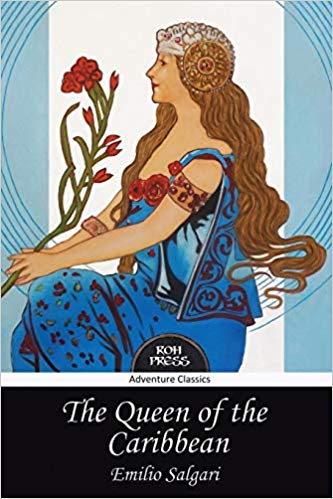
Unfortunately, I didn’t really do my homework and ended up picking a book with an appealing cover and title. The problem was that it is the second in Salgari’s Black Corsair series. Unlike many old adventure series—I’m thinking of, for example, Tom Swift—The Queen of the Caribbean depends heavily on its predecessor, The Black Corsair, which I had of course never read.

I was a bit taken aback when I opened the book to find a modern map of Southern Mexico and Central America labeled “West Indies, 1600.” The only concession to the 1600’s was a hasty label “New Spain.” Panama, which wasn’t even a country until a couple of years before the book was published in 1905, was delineated. Apparently, Salgari or his publishers (assuming this was a map that appeared in the original publication and not a creation for the republished copy) chose to use modern place names, some of them even in English.

Other than that, Salgari appears to have some knowledge of pirates, sea-going, and the flora and fauna of Mexico and Florida. Unfortunately, he sometimes stops the action dead in its tracks to tell us about some plant or animal. In a way, this book reminds me of those of W. H. G. Kingston, which I had a small collection of that never reappeared after our move. However, Kingston was better at working his facts into the story.

The Black Corsair is pursuing his enemy, Van Guld, who betrayed his followers in battle. Later, after the Black Corsair and his brothers turned pirate in pursuit of their enemy, Van Guld was responsible for the deaths of the corsair’s brothers. All this apparently happened in the first book. In The Queen of the Caribbean, this pursuit leads them to attack Vera Cruz, an event that actually happened. During the search in Vera Cruz for Van Guld, the Black Corsair hears rumors that his lady love, who he thought was dead, may be alive.

Although the Black Corsair behaves nobly, he doesn’t seem at all disturbed by the mayhem wrought upon innocent people by his pirate friends. Perhaps Salgari was attempting to portray pirates more realistically than is usual in adventure fiction. He seems, however, to have an admiration for what are essentially bloodthirsty cutthroats. I don’t think I’m applying my 21st century standards here, because I’ve managed to enjoy many other adventure novels, including ones about pirates. The characters in this one are cardboard figures being put through their paces.

Related Posts

Captain in Calico

Treasure Island

Men Against the Sea

Review 1327: Brief Lives

Cover for Brief LivesAlthough John Aubrey has been criticized as a historian, he was actually a collector, of documents, stories, and little bits of information. For a project in the late 17th century undertaken by Anthony Wood, he began collecting short biographies of Oxford scholars of his time but then expanded his collection to include other notables of the 16th and 17th centuries. From 426 lives, this book has collected the most significant 134, some as short as a few sentences while others are several pages long.

These lives do not necessarily list their subjects’ accomplishments, although most of them begin with a short biography included by the editors. Aubrey’s talent was for telling something about each person that defines him or her, makes the person seem more knowable, whether it be a physical description or a story about the person.

Aubrey was apparently a rather disorganized person, so sometimes we are amused by a story or comment that seems to have nothing to do with the subject. Although well written and entertaining, his lives sometimes use pronouns confusingly, so that you’re not always sure who he’s talking about.

Just as entertaining as the original subject matter is the 100-page introduction about Aubrey’s life and milieu. I have to say that he seldom says anything really negative about anyone, even if you can tell he didn’t like that person. He was plainly a good-natured man who also sometimes likes to tell bawdy stories. Centuries after his lives were written, they make a living document, bringing exceptional people back to life. I was interested to see that one of them was Venetia Digby, the main character of Hermione Eyre’s Viper Wine.

Related Posts

Viper Wine

Samuel Pepys: The Unequalled Self

Queen Anne: The Politics of Passion

Review 1326: The Coffin Path

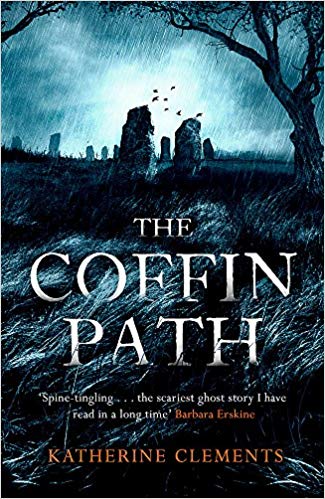
Cover for The Coffin PathIt’s 1674, and Mercy Booth helps her aging father work a sheep farm in remote northern England. She feels that at 28, she is beyond marriage, but she really only cares about the farm.

In early spring, she is out on the moor when she feels that someone is watching her with enmity. After that, strange things begin happening in the house. Three old coins disappear from her father’s drawer. She hears noises upstairs when no one seems to be there. She catches glimpses of a pale face. The home is believed to be cursed after the three prior inhabitants were all murdered, their mouths covered with those missing coins.

Early in spring the head shepherd hired Ellis Ferreby, a wandering shepherd. The novel is narrated by him in alternate chapters as he observes what is going on. He, too, has seen and heard strange things.

Also key to the story is Sam, the young son of Ambrose, the head shepherd, who lately lost his twin brother after a fall. He is a favorite of the house but begins to behave strangely.

This novel is truly atmospheric, and although I had glimpses of its secrets, I could not figure everything out. I found myself interested in the characters and involved in what was happening to them. This is a real page-turner.

Related Posts

Corrag

The Haunting of Maddy Clare

All the Birds, Singing


Review 1321: Samuel Pepys: The Unequalled Self

Cover for Samuel PepysYears ago, I attempted to read Samuel Pepys’s diary, but I didn’t make much headway. However, I was reading it without any context. Now that I’ve read Claire Tomalin’s excellent biography of Pepys, I am interested in trying it again.

For one thing, I was not aware that Pepys worked his way up, by his great energy and organizational skills, from a poor beginning to an eminent position in the British admiralty. He was responsible for setting up many of the procedures used today. In the diary’s beginning, he is just a lowly clerk who seems to go out drinking a lot.

But Tomalin’s admiration is for Pepys’s unstinting truthfulness, even when it makes him look bad, as well as the literary and historical value of the diary. In short, he was a marvelous writer who documented significant events in a tumultuous period of British history.

Tomalin’s talent as a biographer is in giving her readers a true feeling for the personality of her subject. Pepys was a pleasure seeker, a womanizer, and not always an honest man, but he was curious, cultured, highly intelligent, dedicated, and faithful to his patrons. Although he had a poor opinion of both Charles II and James II, he served them faithfully, even when it was against his best interests. Pepys turns out to be a very interesting person.

Related Posts

Thomas Hardy

Jane Austen: A Life

The Journal of Mrs. Pepys

Day 1297: The Weight of Ink

Cover for The Weight of InkThe Weight of Ink is a dual time-frame novel set in the current time and the 17th century. At first, I wasn’t as captured by the present-day sections as I was by the past, but eventually the entire novel absorbed me. There is a big revelation at the end that I anticipated, but that did not lessen the power of the novel.

In the present day, Helen Watt is an English university professor of Jewish history who is elderly and ill. Requested by a previous student to examine a cache of papers he found in a wall of his 17th century house, Helen does not expect any great finds. What she discovers is a genutza, the hidden papers of a 17th century rabbi, and on one page, a mention of Spinoza. Understanding that this could be a major discovery, she requests help and gets that of Aaron Levy, an American graduate student.

One of their first, startling discoveries is that Rabbi HaCoen Mendes’s scribe, identified only by the Hebrew letter aleph, is a woman. Having reported her initial findings to Jonathan Martin, the head of the History Department, so that he could buy the papers from the owners, Helen is dismayed to find her place on the investigation usurped. She can continue working with the papers, but Martin has also given Brian Wilton access. He arrives with four graduate students to beat Helen and Aaron to any discoveries and immediately publishes an article about one of the topics in the letters.

In 1657, Ester Velasquez is a young Jewish woman who has been allowed an unusual education. In these dangerous days of the Inquisition, her family fled Portugal for Amsterdam, where her parents were killed in a fire. She and her brother Isaac are part of the household of Rabbi HaCoen Mendes, who travels to England to educate the British Jews in their heritage, these people having been hiding there pretending to be Protestants during hundreds of years when Jews were not allowed in England. Rabbi Mendes’s difficult job is made harder when Isaac, his scribe, leaves. But the rabbi lets Ester take his place.

Offered an opportunity of knowledge, Ester comes to know that she does not want to return to a woman’s life. So, she sets about a daring deception.

Aside from covering some key events of its time—the Inquisition, the return of Jews to England, the plague, and the Great Fire—The Weight of Ink offers us an intrepid, determined heroine in Ester as well as an interesting modern story. I was really touched by this novel. It’s terrific—the kind of novel I look for in historical fiction.

Related Posts

The People of the Book

The Bookman’s Tale

The Last Painting of Sarah de Vos

Day 1261: The Last Painting of Sara de Vos

Cover for The Last Painting of Sara de VosBest of Five!
In 1957 New York, Ellie Shipley is a graduate student in art history who also does restorations. A contract for restoration work asks her to make a copy of a 17th century painting, “At the Edge of a Wood” by Sara de Vos, her only known work, for the owner. Soon, however, Ellie understands that she is creating a forgery, but she is too interested in the work to stop.

Marty de Groot, the painting’s owner, notices that his painting has been stolen. He determines he will find out who took it.

In 1631 Amsterdam, Sara de Vos and her husband are poverty stricken after the death of their young daughter. Because they have sold paintings without the permission of the guild, they have temporarily lost their membership. Sara has been painting flowers for a catalog and her husband has been working for a bookbinder. But secretly, Sara has been painting a symbolic memorial for her daughter, “At the Edge of a Wood.”

In 2000 Sydney, Ellie is now a respected academician and museum curator. She has discovered that both of the de Vos paintings, the original and the copy, are being sent to her museum for an exhibit on 17th century Dutch women painters. Now, after 40 years of strict integrity, she is afraid her past is catching up with her.

Although I found the story interesting, I was not at first that involved with this novel. Soon, however, I was totally captivated by all three stories. At first seemingly a crime novel, it goes much deeper. I really enjoyed it.

Related Posts

How to Be Both

Let Me Tell You About a Man I Knew

Burning Bright

Day 1051: The Bookman’s Tale

Cover for The Bookman's TaleIt was difficult for me to decide how much I liked The Bookman’s Tale. Parts of it were very interesting and just up my alley, while other parts of it struck me as unnecessary.

Peter Byerly is a young seller of antiquarian books. His beloved wife Amanda died unexpectedly, and since then, he has been taken over by grief. He has moved from the States to the cottage in the Cottswolds that they bought just before she died, because their previous home held too many memories.

Peter finally becomes interested in something when he finds a watercolor of a woman who looks like Amanda in a book in an antiquarian book shop. In trying to track down more information about the artist and his subject, he gets onto the track of a document that could be the holy grail for antiquarians—something that proves Shakespeare wrote his own plays. This document is in the form of the Pandosto, a play written by Robert Greene that formed the basis for Shakespeare’s The Winter’s Tale. This play seems to have Shakespeare’s annotations in it. Later, there is a murder.

Periodically, we go back in time to trace the course of this document. We know there was a real Pandosto, because we see that a man lends it to Shakespeare with some trick in mind.

We also periodically look back to Peter and Amanda’s romance. Peter trains as a book restorer, so we learn something about this field, which I found fascinating. However, although I was interested in Peter and Amanda’s relationship at first, after a while I started to wonder why we were getting so much detail about it, since it didn’t have that much to do with the rest of the book.

So, a mixed review on this one. It has a good mystery about two feuding families and a lot of interesting detail about books, but the romantic storyline slows it down after a while.

Related Books

The Secret Life of William Shakespeare

The School of Night

The Forgotten Garden