Day 962: The Red Queen

Cover for The Red QueenThe Red Queen is a novel split in two. The first half is a narrative written by the ghost of an actual 18th century Korean princess, Lady Hyegyŏng. The second half follows a modern British academic, Dr. Barbara Halliwell.

“Lady Hong” relates her difficult life as the girl chosen at the age of nine to be the bride of Crown Prince Sado. This role is already a perilous one, and she and her parents are terrified. It is made more terrifying, though, by the fraught relations between Prince Sado and his demanding father King Yŏngjo.

When it slowly becomes apparent that Prince Sado is mentally disturbed and somewhat dangerous, his wife’s life becomes even more one of stress and fear. The princess’s story eventually builds to the climax of her husband’s horrible death.

The Crown Princess’s story is interrupted occasionally by the comments of her ghost, who provides an acrid note informed by writings of thinkers like Voltaire and Freud. Obviously, this ghost has been doing a little reading since she died. I found these interjections odd, but they did little to disturb the flow of what was a fascinating story.

Then I got to Barbara’s half of the book. Barbara has received the princess’s memoirs anonymously and takes them along with her on a trip to an academic conference in South Korea. The ghost makes clear that she sees Barbara as a host whose purpose is to extend her legacy. Barbara is fascinated by the memoir and goes to visit some of the settings of the princess’s life, but she is also engaging in an affair with a famous Dutch sociologist who is the keynote speaker for the conference.

Here is where I thought the narrative broke down. Despite the occasional presence of the ghost and some similarities of taste and experience between Barbara and the ghost, I felt that there was only a flimsy connection between the two halves of the novel. And I wasn’t really interested in Barbara and her fascination with Jan Van Jost.

Additionally, the second half is narrated by some sort of pixie-like guardian angels who have no apparent role. What’s wrong with third-person limited? She’s writing in that anyway with an occasional lapse into second person plural. This seems like a pointless device that becomes even more wink-wink when Drabble introduces herself as a minor character. So, with a little sleight-of-hand, the novel becomes postmodern, but it does not contain any of the cleverness of technique and approach of other postmodern novels I’ve read. This novel is introduced as a tragicomedy, but I didn’t find it comic. Whimsical, perhaps, ironic, certainly.

Related Posts

The Thousand Autumns of Jacob de Zoet

Empress of the Night

The Orphan Master’s Son

Day 956: The Black Moon

Cover for The Black MoonThe Black Moon is the fifth book in Winston Graham’s Poldark Saga. It is now 1794.

Ross and Demelza Poldark have weathered the difficulties of their marital breach, and the result is that Demelza is again pregnant. The feud between Ross and George Warleggan has been in abeyance, but in this novel George shows that he is even more of a villain.

The difficulty begins with a friendship. George Warleggan thinks that Geoffrey Charles Poldark, his stepson, is spoiled from spending too much time with his mother. He wants to send Geoffrey Charles to school or failing that, get him a tutor, but he compromises with Elizabeth by allowing her to hire her cousin, Morwenna Chynoweth, as Geoffrey Charles’s governess. While Geoffrey Charles and Morwenna are out on the beach, they meet Drake Carne, one of two of Demelza’s brothers who have come to the area looking for work.

Although there is quite a distance in their stations, Drake being the son of a miner and Morwenna the daughter of a vicar, Drake and Morwenna’s friendship gradually turns to love. Morwenna has no idea that George has been plotting an advantageous marriage for her—at least one that allies him with an established family of the area.

In the meantime, others are interested in the news from France. Ross hears that Dwight Enys’s ship has been sunk after a naval battle. He goes to some trouble to find out if Dwight is alive, both for his own sake and that of Dwight’s fiancée, Caroline Penvenen. Eventually, Dwight’s plight leads Ross into an even more hazardous venture.

Some foreshadowing of future events, possibly, comes with the birth of George Warleggan’s son Valentine. He is born under a black moon (an eclipse), which the local people believe is an ill omen. And perhaps there are small indications that he will not be a normal child. I don’t know, but I am interested to find out.

Related Posts

Demelza

Jeremy Poldark

Warleggan

Day 936: Valiant Ambition: George Washington, Benedict Arnold, and the Fate of the American Revolution

Cover for Valiant AmbitionAlthough he has written on other subjects, Nathaniel Philbrick has made a specialty of writing about events and industries that affected New England, including the Revolutionary War. His latest book concentrates on the forces and personality flaws that resulted in Benedict Arnold’s betrayal of his country.

I haven’t read much about Benedict Arnold, only one novel, Rabble in Arms by Kenneth Roberts. That novel painted him in surprisingly sympathetic colors, blaming his treachery largely on the rapacious demands for money of his wife Peggy. Philbrick’s view is more nuanced.

Certainly, at the beginning of the war you can sympathize with Washington and with Arnold. For his part, Washington was hamstrung by the ineffectiveness and bickering of the Continental Congress. He had very little power over such decisions as which of his officers would receive promotion, which lead to the initial difficulties with Arnold.

A key to the British strategy of cutting off New England from the rest of the country was the chain of lakes leading down from Canada to the Hudson. So, Fort Ticonderoga was an important target. Benedict Arnold and a rag-tag collection of boats prevented the British from approaching the fort in the fall of 1776, before the lakes could freeze up to keep the British out.

As the hero of this engagement and the senior Brigadier General in the Continental Army, Arnold expected a promotion. But the Congress devised an idiotic scheme that awarded the promotions not on merit but according to what state the person was from. Since Connecticut already had two Major Generals, Congress awarded the promotions to other Brigadier Generals who were junior to Arnold, some of whom were only mediocre in ability. Washington protested this decision, to no avail. Even after he got his promotion, Arnold was forced to defer to these men who were promoted before him.

link to NetgalleyIt was this kind of bickering about states’ rights and even local rights versus the rights of a national government that hampered the Congress. In addition, there were plenty of people out for what they could get. I was shocked to read that while no one was interested in supporting the Continental Army, to the point where they were starving and dressed in rags, the rest of the country was doing very well financially. Arnold joined into this self-enrichment when he was made military governor of Philadelphia after it was captured back from the British. He was actively engaged in all kinds of corruption.

Philbrick’s book is really interesting and sometimes quite exciting as it revisits key scenes from the war and leads up to Arnold’s big betrayal. His conclusions about the results of the betrayal are startling.

Related Posts

Away Off Shore: Nantucket Island and Its People, 1602-1890

Mayflower

Abigail Adams

Day 925: Warleggan

Cover for WarlegganIt seems that the more books I read in Winston Graham’s Poldark Saga, the more interesting I find it. In the fourth book, Warleggan, we get more insight into whether George Warleggan is the villain Ross Poldark thinks he is. Short answer—yes.

Ross and Demelza’s marriage undergoes serious tests in this novel. First, at a party, Elizabeth, Ross’s first love, lets him know she made a mistake when she married his cousin Francis instead of him. Ross is no fool, and he realizes that this inability of Elizabeth’s to know her own mind has poisoned her own marriage to Francis, because Francis has realized that Elizabeth prefers Ross, too. Ross is sure that his betrayal by Francis, now forgiven, is at least partially because of this perception.

Early in the novel, though, Francis has an accident in the mine and dies. Demelza becomes more worried about Ross’s feelings for Elizabeth, especially since there is a new distance in her marriage with Ross.

The mine that Ross placed his hopes on, based on Mark Daniel’s comment after spending a night in it while hiding from the authorities, is not panning out as expected. Ross and Demelza are struggling financially, and the money to mine won’t last much longer. So, Ross decides to involve himself more directly with the smuggling trade by going along with the smugglers to see Mark, in hopes of finding out where he saw the ore. But there is an informer in the village.

Dwight Enys has finally decided to elope with the rich heiress Caroline Penvenen, because her relations won’t agree to her marriage with a penniless doctor. However, he must agree to leave Cornwall to marry her, and he is not happy to leave his patients.

Finally, the situation in Europe has become more unstable. Soon there will be a war with France, and no one knows how that will affect the country.

So far, this novel is the one in the series that has most involved me. I don’t know if this is because of my sympathy for Demelza or my ability to finally divorce this series from the new television series, which I saw before I began reading. I think there are eight more novels to go, and I’m looking forward to them.

Related Posts

Ross Poldark

Demelza

Jeremy Poldark

Day 899: Jeremy Poldark

Cover for Jeremy PoldarkThis third novel in Winston Graham’s Poldark series begins with Ross and Demelza Poldark in trouble. They are still grieving over the death of their baby daughter, and Ross is soon to come to trial for the incident of the shipwreck.

Although he certainly summoned the villagers to the wreck, some of the charges are trumped up. He never assaulted anyone or took any of the wreckage for himself, and he offered hospitality to some of the shipwrecked sailors. The worst looting and killing was done by unemployed miners.

Ross and Demelza soon have a misunderstanding that affects their marriage for months. This situation is not helped by a rapprochement between Ross and his cousin Francis, which brings Francis’s wife Elizabeth back into their orbit. Demelza is insecure around Elizabeth and envies her for her beauty and poise.

As all the Poldarks are suffering financially, Ross gets involved in some risky ventures. One could put him at odds with the law, and another could ruin him.

This novel is the first in the series that hasn’t been overshadowed for me by seeing the recent programs on Masterpiece. I think it is a good, solid series, with interesting characters and a well-researched historical background. The scene at the beginning of the novel of the election and its resulting chaos was particularly startling. I am enjoying this series.

Related Posts

Ross Poldark

Demelza

The Lake House


Day 864: The Necromancer

Cover for The NecromancerIt’s been more than six months since I reported on my progress in reading the “horrid novels” mentioned in Northanger Abbey, but I have finally read another. This one is The Necromancer, published in 1794 by Carl Friedrich Kahleut under the pen name Ludwig Flammenberg. Its publication date makes it one of the earliest novels in this genre.

However, it is not a novel as we understand it. The Editor’s Note explains that it was originally a collection of tales, the equivalent of contemporary urban legends. Its translator, Peter Teuthold, actually “novelized” the tales by presenting them as a fairly incoherent story.

The novel starts with the story of boyhood friends Herman and Elfrid, who are separated after school for many years by life’s events. Eventually, Elfrid seeks out his friend Herman. During this visit, Elfrid tells Herman about an incident in Germany. When staying at an inn, he was robbed repeatedly of his possessions, but they were mysteriously returned. When he wants to find out what happened, he agrees to meet his neighbor at the inn for an explanation. At the meeting place, he experiences a confusing event that ends with his being rushed off in a coach and breaking his leg.

After Elfrid tells his story, Herman has one of his own. But Herman begins a nested series of tales that end up being linked by a single person, an army sergeant with a knowledge of necromancy named Volkert.

I hope I’m not giving too much away when I say that the apparent supernatural occurrences turn out to be cheats. In a sense, I’m not sure if that makes this piece a gothic novel or not. Once we hear Volkert’s lengthy confession and an explanation of all his tricks, you might think the novel would close. But it does not. We still have to be subjected to a tedious confession by the chief of a gang of thieves.

Perhaps I’m just not getting into the spirit of these novels. But so far, I have really only mildly enjoyed The Castle of Wolfenbach, which has a relatively straightforward plot. The others I’ve found full of digressions, with meandering plots. A sense of characterization doesn’t seem to exist yet in these early novels. When I reflect that Jane Austen, with her rich characterizations, begins publishing books in less than 20 years, it seems truly amazing.

Related Posts

The Castle of Wolfenbach

The Mysteries of Udolpho

Dracula


Day 854: Demelza

Cover for DemelzaAgain I had difficulty separating this novel from the Masterpiece series televised a few months ago, which covered the first two of the Poldark novels. The focus of this novel is Demelza Poldark, the kitchen maid whom Ross Poldark married at the end of the first novel.

At the beginning of the novel, Demelza is in labor with the couple’s daughter Julia. Ross has engaged Dr. Choake, who takes the situation more casually than Ross would like. The doctor checks Demelza and goes away, saying she won’t deliver until the next afternoon. But Julia arrives before the doctor does, and Ross makes yet another enemy of his own class.

Demelza has come to believe that Ross’s gentle cousin Verity should have been allowed to marry Captain Blamey. She sees Verity’s sadness and feels she has aged ten years in only a few. So, without Ross’s knowledge, she begins plotting to draw them together.

Ross is striving to avoid the Warleggans’ financial takeover of the whole district. He is pressured to take the lead in forming a business to purchase and smelt copper in an effort to bring up the price of copper for the mine owners, as smelters are bidding low to keep the profit in their own pockets. Since several of the business partners are in debt to the Warleggans, they are concerned to keep their participation secret. However, the secret comes out, in a way that destroys Ross’s relationship with his cousin Francis.

Since the Masterpiece series so closely follows the books, it will not be until I read the third book that I will be able to tell how well the book series stands on its own. However, it seems well grounded historically and is particularly interesting when dealing with the problems of ordinary people of the time, when poverty was threatening many. I also like Ross and Demelza and feel sympathy with their struggles.

Related Posts

Ross Poldark

Harvest

Castle Dor

Day 835: Ross Poldark

Cover for Ross PoldarkYears ago I used to enjoy the odd Winston Graham novel, but it was his crime novels rather than his historical novels I read, Marnie and The Walking Stick. I didn’t get interested in the Poldarks until the recent Masterpiece rework of the series.

Ross Poldark returns to his home in Cornwall from the war in America to find nothing as he expected. His father has died, and his slovenly servants have not kept up the house or the farm. Someone has set about a rumor that he died, and the girl he loves, Elizabeth Chynoweth, is engaged to his cousin Francis.

Ross sets about trying to put his property in order and to deal with his feelings about Elizabeth. He investigates whether he can get one of the mines on his property back into order. He also involves himself in the problems of his tenants.

While he is at a fair to buy livestock, he plucks an urchin out of a fight about a dog. Although the child is dressed as a boy, she is a girl, Demelza. When Ross finds her father has abused her, he agrees not to return her to her family and takes her as a kitchen maid.

Ross Poldark is an interesting historical novel dealing with the problems of the time in Cornwall. I don’t know much about Cornwall, which is associated in my mind with many of the novels of Daphne du Maurier. Although this novel certainly involved me, I found myself unable to separate it from the Masterpiece series. For example, although Demelza is described as dark, I still kept picturing her as a redhead. Since the Masterpiece series is based on the first two books, I’ll have to wait until the third book before I can begin to separate it in my mind. Certainly, the first novel seems just as effective as the series, which has so far followed the novel closely.

Related Posts

Castle Dor

Daphne du Maurier: The Secret Life of the Renowned Storyteller

Treasure Island

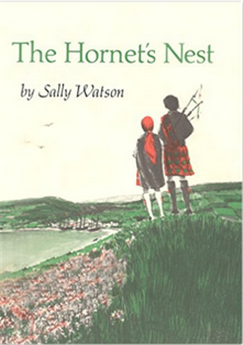
Day 817: The Hornet’s Nest

Cover for The Hornet's NestIt is 30 years after the Battle of Culloden, but Highland Scots are still forbidden by their English overlords to wear the plaid, play bagpipes, or honor their heritage in other ways. Rebellious Lauchlin MacLeod and her brother Ronald, teenage children of Laird Kildornie, are always finding themselves in trouble.

So it is on the day they meet their cousin Matthew Lennox, a gentleman from Virginia journeying to visit his English and Scottish relatives. Lauchlin is marveling that this Sassenach is related to her family and doesn’t realize he has been escorted there by a troop of redcoats. She just barely avoids being caught wearing a kilt while her brother hides in the bushes with his bagpipe.

In town showing Cousin Matthew the sights, Ronald and Lauchlin attack some boys who are torturing a kitten. Later Sergeant Tucker arrives at their home to tell them that the boys are the children of Captain Green, the new area commander. The boys have lied about the cause of the attack, and Captain Green isn’t as likely as the previous commander to overlook their behavior. The next incident could be serious.

Cousin Matthew has a solution. Lauchlin and Ronald can travel to Virginia and live with his sister Lavinia until things calm down. Secretly, he enlists them to send news and drawings, for Lauchlin is a gifted caricaturist, about doings in the colonies for a paper he is founding in London called The Gadfly.

So, Lauchlin and Ronald set out for the colonies accompanied by their kitten Haggis. They arrive in Williamsburg in 1773, just in time to witness the lead-up to the American Revolution. It’s not too difficult to imagine where their sympathies lie.

This novel effortlessly mixes the viewpoints from both sides of the revolution, for their Lennox relatives are Loyalists, and some are charming characters. Lauchlin is an ebullient scamp, Ronald a boy who must learn that all Sassenachs are not the same. Their many Virginian cousins dislike them at first but then most of them learn to love them. And Haggis has his own distinctive personality.

This novel is one of my favorites so far of the Watson books I’ve newly discovered, because it is less unlikely than some of them and has really enjoyable characters. Plus, it provides an unusual viewpoint of the American Revolution. Young teens and tweens should love this book.

Related Posts

Witch of the Glens

Lark

Mistress Malapert


Day 801: Wolf Winter

Cover for Wolf WinterBest Book of the Week!
It is 1717. A few days earlier, Maija and her family arrived at their new home on the side of Blackåsen Mountain in the Lapland area of Sweden. They moved away from Finland because Maija’s husband Paavo, formerly a fisherman, began to see dead men in the water. But here on the mountain he is ineffective and frightened.

Maija’s daughters Fredericka and Dorothea are out with the goats when they find the body of a man. Although the nearby settlers are quick to claim an animal attack, it is clear to Maija that the man, Eriksson, was killed by a person using a lance. She has already felt an unease on the mountain and believes they must find the murderer. Unfortunately for the search, Eriksson seems to have been disliked by all.

Maija’s family has had some experience with the older ways, even though they are forbidden by the church. Fredericka, however, was being instructed in them by her grandmother without her mother’s knowledge. Fredericka finds herself being haunted by Eriksson, who wants her to find his murderer, and tries to seek help in the supernatural from the Lapps.

Another important character is the new priest for the region. He comes to visit the area and tries to help with the investigation. At first, he seems cold and unready for a position in such a wilderness. But he is actually bewildered. He was a court priest and a friend to the king until he was abruptly sent away from court.

When the snow comes early and kills the harvest, Paavo decides to travel to the coast to earn some money. Maija is left to struggle through a particularly harsh winter with the girls. There are wolves on the mountain, and some of the settlers believe the mountain itself is evil. No one has found Eriksson’s killer, but Maija is still looking.

link to NetgalleyThis novel creates an atmospheric, fully realized world that captured me from the first words. Although it is centered around a mystery, it is just as successful as a historical novel, with a touch of the mystical, set in an unusual place and time. You can easily imagine the cold and hardships. This novel is excellent.

Related Posts

Harvest

The Kept

Giants in the Earth