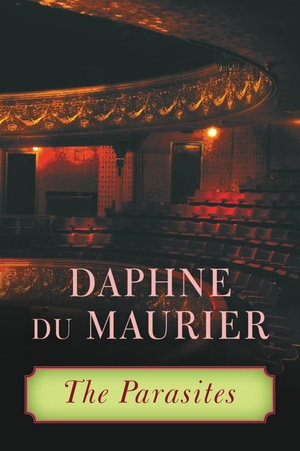
Review 2785: #1949Club! The Parasites

The Parasites is my last book for the 1949 Club.

The Delaney siblings are lying around and messing up their sister’s home, as they do every weekend, when Maria’s husband Charles tells them they are parasites. Although Niall is a successful songwriter and Maria a famous actress, Niall admits that it may be the case. The novel takes us back through incidents of their lives as the three consider whether Charles is right. A clue may be that the narrative sometimes changes from third person to second person plural, as if they were one organism.

Marie, Niall, and Celia are the semi-related children of the Delaneys, their father a famous singer and their mother a famous dancer (referred to solely as Pappy and Mama). The children run wild through hotels, and even though Niall and Celia are more subdued, they are clearly unruly, but at the theater, all three know to sit quietly. Celia plays with her dolls while Maria mimics her mother, and Niall watches the orchestra.

As we follow them, it becomes clear that Maria and Niall lead their lives with no concern for anyone else, except maybe each other, and Celia protects the two of them. In her young womanhood, she neglects her own talents as an artist to take care of Pappy after Mama dies and later do the same for Maria’s children.

Du Maurier herself struggled with some of the issues this novel brings forward. We don’t know what her childhood was like, but since her father was an actor-manager and her mother an actress, it may have been very much like the one depicted for Maria, Niall, and Celia. She lived separately from her husband for years, like Maria does with Charles, and she doesn’t seem to have felt a lot of connection with her children, also like Maria. (There’s a funny/dreadful passage where Maria is left alone for the day to care for her newborn daughter Caroline.) Did Du Maurier write this novel for readers to sympathize with her characters? I don’t think so. We don’t like them very much. To understand them, maybe. Not caring much about the children is also part of the plot of Frenchman’s Creek, a novel that is supposed to be romantic, but in which the heroine just blows off her family for long periods of time. Du Maurier herself admitted that she neglected her family for her writing. I think that in many of her books she has characters demonstrating some of her own traits.

It’s interesting also that there are three children and one of them is a boy. Du Maurier had two sisters, but she also stated that she had a sort of male alter-ego that she used in some of her books, so perhaps she saw herself in Niall.
Related Posts

I’ll Never Be Young Again

The Scapegoat

Rebecca

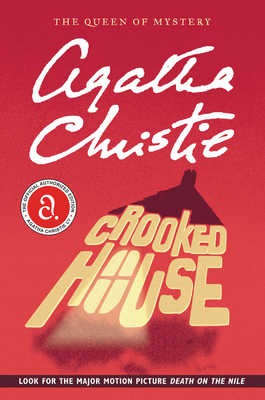
Review 2783: #RIPXXI! #1949Club! Crooked House

Crooked House is my second book for the 1949 Club and another one for RIPXXI. Some of Agatha Christie’s books are better than others, and Crooked House is pretty darn good. In fact, Christie commented that it was one of her favorites. It’s one of the few of her stand-alone books that I think is just as good as the best Poirot and Marple mysteries.

As the war is wrapping up in Egypt, Charles Hayward realizes he loves his friend Sophia Leonides and tells her that when he returns to England, he will ask her to marry him. Two years later, he cables Sophia to meet him for dinner in London and later reads that her grandfather, Aristide Leonides, a very rich old man, has died. Sophia joins him at dinner anyway and tells him that she fears her grandfather was murdered. Since most of the suspects are family members, she won’t marry him unless the murder is solved. She asks him to help.

Charles’s father is the Assistant Commissioner of Scotland Yard, and he thinks Charles could be helpful since Aristides was indeed murdered, poisoned when someone substituted eye drops for his insulin. So, the A. C. suggests that Charles accompany Chief-Inspector Taverner to the estate. The near-ninety-year-old Aristides has remarried Brenda, a much younger woman, and it’s clear that the whole household wants the murderer to have been Brenda or Laurence, the tutor whom the family believes is her lover.

Aside from them, the household consists of Sophia’s icy father Philip and her theatrical mother Magda, her emotional uncle Roger and arctic aunt Clemency, her younger siblings Eustace, crippled by illness and bitterness, and young Josephine, who likes to spy on people and brag about what she knows. Finally, there is Edith de Haviland, the sister of Aristides’ first wife.

Although everyone knows how the estate was left, there are unpleasant surprises. First, the will that was read to all of them a year ago is missing. Then, someone knocks Josephine unconscious. Finally, a totally different will is sent to his lawyer by one of Aristides’ old friends.

This one is twisty, and I had no idea who the evildoer was. Although Sophia seems like one of the least knowable characters, there’s a reason for that. This is a good one.

Related Posts

The Clocks

Endless Night

The Secret of Chimneys

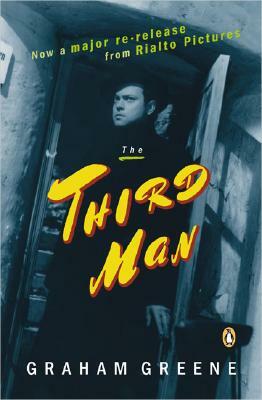
Review 2782: #RIPXX! #1949 Club! The Third Man

The Third Man is my first choice for the 1949 Club and also applies to RIPXXI. As usual for the club, I’ll start out by listing books written in 1949 that I have reviewed previously:

I think I’ve read some of the children’s horse books (Black Stallion, Chincoteague), too, but it’s too long ago for me to remember back when I was a child.

And now for my review.

For those like me who are more familiar with the movie, there are quite a few differences. However, Greene explains in the Preface to my Penguin edition that the book was written as a preliminary to the screenplay, because he found it almost impossible to write a screenplay without a book.

The narrator is British Detective Calloway, who sometimes speaks firsthand and other times secondhand from information received from the main character, Rollo Martins. Rollo is the author of several pulp Westerns who has been summoned by his friend Harry Lime to Vienna. But he arrives just in time for Harry’s funeral after he was hit by a car.

Martins is at a loss, because at the time, shortly after World War II, British citizens were only allowed to take £5 out of the country, so he’s broke. Furthermore, Calloway meets with him to discuss Harry’s illegal activities, which are serious. Rollo, who has been friends with Harry since school and hero-worships him, doesn’t believe him. At the same time, Calloway wants to try to determine how involved Rollo is in Harry’s activities. Rollo is so incensed at Calloway’s imputations that he tells him he’s going to prove him wrong.

Rollo starts with interviewing the witnesses to the accident, who apparently were both acquaintances of Harry. This seems odd, and what is odder is that another witness, Dr. Koch, who saw the accident from the window but didn’t talk to the police, tells him he saw three men at the scene of the accident rather than the two who were reported. Who was the third man? And doesn’t it seem sinister when Dr. Koch is killed shortly thereafter?

Another complication is Anna Schmidt, Harry’s girlfriend, a Hungarian actress who is hiding under a false name and papers from the Soviets. She also doesn’t believe Harry is guilty. Unfortunately, Rollo falls in love with her.

This novel is not as suspenseful as the movie, but it excels in its bleak descriptions of post-war Vienna and the complications of its subdivided governance. It’s really moody.

Related Posts

The Quiet American

The Spy Who Came in from the Cold

The Quiet Twin