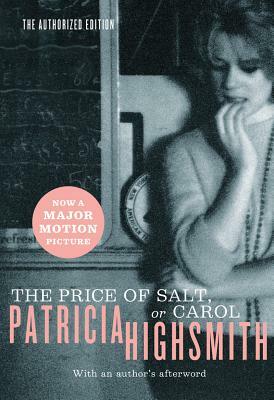
Review 2571: #1952 Club! The Price of Salt

Here we go with my last entry this year for the 1952 Club!

If you’re accustomed to Patricia Highsmith’s suspense novels, like the Ripley novels or Strangers on a Train, The Price of Salt may be a big change of pace. The W. W. Norton and Company edition I read tries to slant it more in that direction by using phrases like “sexual obsession” and “stalking” on the cover, but it’s not like that.

Therese Belivet is unhappy in her life. She is a set designer who can’t find a job, so she has taken a temporary Christmas-season job with a large department store. She hates that job. She dates a man who wants to marry her—Richard—but she doesn’t want to marry him, even though she likes him.

Then one day at work she sees a beautiful blonde woman about 10 or 15 years older than herself. She is immediately struck by her. After she sells her a doll, she puts a little thank you note into the package to be delivered, not signing it but using her employee number. To her surprise, the woman, Carol Aird, calls her at the store.

They begin a hesitant friendship, with Carol often picking her up to spend the night at her house. She lives alone because she is divorcing her husband, who is trying to get custody of their daughter. Therese, who is madly in love with Carol, can’t figure out how Carol feels, as she is cold at times.

Professionally, things are looking up a little for Therese. She gets a short-term job doing sets for an off-Broadway play and has the attention of a major director. Things are getting rocky with Richard, though, and she can’t figure out the situation with Carol. Then Carol invites her to accompany her on a cross-country driving trip.

If this book wasn’t written in 1952 or was about a man and woman, it would more or less be a standard romance with the entanglement of a 50s divorce. However, because of when it was published, it was a daring novel, especially for the United States. (I have read other similar books from English writers, published earlier.) Like many of Highsmith’s books, I wasn’t drawn to any of her characters, but I have never thought Highsmith cared about that kind of thing, in fact, may have preferred protagonists that readers don’t like.

I don’t know what I feel about it. I guess I admire Highsmith’s courage in writing it but otherwise felt sort of meh about it.
Related Posts

After Sappho

Nightwood

LOTE

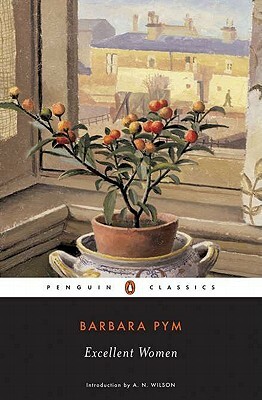
Review 2570: #1952 Club! Excellent Women

Entry #2 for the 1952 Club!

By “excellent women,” Pym seems to mean a type of English spinsters who occupy themselves with charity events and helping others, dress drably, and are taken for granted by men. That’s what Mildred Lathbury seems to think she is. She’s a clergyman’s daughter of limited means, mild-mannered and religious but observant of others’ characters while not wishing them any harm. In Excellent Women, she gets a surprising amount of attention from men, but then she’s always picking up after them.

Mildred lives upstairs of a vacant flat, and she’s curious about what her new neighbors will be like. She knows they’re named the Napiers by the sign at the doorbell. She meets Helena Napier on page 2, a young, stylish woman, and sees her around with a man, whom she assumes is her husband, Rockingham (known as Rocky). But he is not. He is Everard Bone, an anthropologist, and he and Helena, also an anthropologist, are writing a paper together. Rocky is off serving in Italy.

Mildred is good friends with Julian Malory, the vicar of her rather high church, and his sister Winifred. It is the expectation of several characters in the book that Julian will marry Mildred, but she doesn’t seem to expect it. Or does she? It’s hard to tell. Certainly, he is very friendly with her, but she thinks he is not the marrying kind.

Mildred meets Everard before she meets Rocky. Although he seems not to notice her at first, after a while he begins seeking her out. He is abrupt and serious, and she doesn’t think she likes him. Or does she? It’s hard to tell.

Once he shows up, Rocky is utterly charming and handsome. He is very friendly to Mildred and keeps popping up for tea. Mildred senses friction in the Napier home—well, she can hear them arguing. Rocky does all the cooking and cleaning in their home, because Helena is completely undomesticated. (She sounds like my kind of gal, even though she isn’t depicted particularly positively.) Mildred distrusts Rocky’s charm. She understands from Everard that Helena thinks she’s in love with him (Everard).

It being post-war London, it is still hard to find a place to live, so the Malorys decide to lease their upper floor. Soon, it is taken by Mrs. Gray, a beautiful clergyman’s widow. Mildred finds both Julian and Winifred transfixed by her, so she steers clear. It’s pretty evident what Mrs. Gray thinks Julian’s fate should be.

Mildred isn’t at all liberated. She is constantly cleaning up after men or doing ridiculously involved favors for Rocky and Helena, and all take her for granted. Yet, this is a lively, amusing social comedy. It is also a tale of the rapidly disappearing lives of upper- and middle-class English people.

Related Posts

The Camomile

Alice

My Brilliant Career

Review 2569: #1952Club! Mrs. McGinty’s Dead

It’s time for the 1952 Club, for which participants review books written in 1952 on the same week. What would a year club set between the 1930s and the 1960s be without an Agatha Christie? So, this book became one of my choices for the 1952 Club, especially good because I hadn’t read it before.

However, first, as usual, I have a list of the books I’ve reviewed previously that were written in 1952:

And now for my review.

Hercule Poirot is retired, and the days are passing slowly. So, he is happy to look into a case for an old acquaintance, Inspector Spence. An old cleaning lady was apparently murdered for her savings by her lodger. All the evidence points that way, and the lodger was found guilty. But Inspector Spence isn’t satisfied that he did it, and there is little time to investigate before he is hung.

So, Poirot journeys to a small village—only four houses and a post office. He meets a few people and seems to be getting nowhere when a chance remark gives him an idea. Mrs. McGinty had purchased ink at the post office, which meant she intended to write a letter, and she was so unaccustomed to writing letters that she had no ink. Who was she writing to?

Going back to look through some of her things, he finds a newspaper with an article ripped out. When he finds the paper at the archive, he sees the article is a “Where are they now?” piece about females connected with four infamous crimes, with old photos from 20 years before. He reckons that Mrs. McGinty, in her work as a cleaner, saw one of those photos at the home of a regular client. Someone in the village has a relationship with one of those women, but what kind of relationship? The field broadens as he considers. Is it the woman herself? A relative or spouse? With the range in age of the original females, the woman could now be anywhere from her 30s to her 50s.

And that was the problem. There are too many people in this book, many of them suspects, and Christie didn’t do her usual job of making them instantly specific. I couldn’t keep track of them by their names. The only distinctive villager at first is Maureen Summerhayes, Poirot’s incompetent hostess, who can’t cook and is completely disorganized, but I soon thought of her as Maureen, so that by the time there was a reference to Mr. Summerhayes, I had forgotten he was Maureen’s husband.

Fairly early on, Poirot meets his old friend the author, Ariadne Oliver. She is staying with the playwright Robin Upward while they try to adapt one of her books for the theater. Mrs. Upward is another of Mrs. McGinty’s clients, and thus a suspect.

I never thought of the murderer as a suspect, but I also felt I wasn’t given much of a reason to. I just didn’t think this was one of Christie’s best.

I was also struck by how little any of Mrs. McGinty’s clients cared that she was dead. There’s some real classism going on here (including the idea that she had to buy ink because she never wrote any letters; even if it happened to be true; anyone might have to buy ink).

Related Posts

The Mirror Crack’d from Side to Side

Sparkling Cyanide

Sad Cypress