Review 2450: The Lotus Eaters

I’ve had The Lotus Eaters on my TBR list for a long time, so I finally decided to get a copy. Unfortunately, it turned out to be a DNF for me the first time. (But read on, because I eventually finished it. My review is in two parts.)

The novel begins with the fall of Saigon in 1975. War photojournalist Helen has left it late to try to get herself and her wounded husband, Linh, out of the country. Torn between trying to get photos of the fall and getting out safely, after a long, dangerous struggle to get to the American embassy, Helen gets Linh into a helicopter and then returns to the city.

The novel then moves back in time to 1965, when Linh has just been forced to rejoin the South Vietnamese army. On his first day back, he meets photographer Sam Darrow, who gets him appointed as his assistant. But on the same day, friendly fire destroys his village, including his parents and his pregnant wife. Linh deserts.

After months in Saigon, Linh gets a job with Life magazine by claiming to be Darrow’s friend. He ends up being Darrow’s assistant again. Then the focus of the novel shifts back to Helen and her arrival in Saigon as an inexperienced photographer.

First Review

I gave this novel 100 pages, but although I was interested in the setting, I just didn’t care about these characters. And although Soli does a good job of describing some things, I just wasn’t feeling the setting or getting engaged in the story. This seemed like a mediocre attempt at historical fiction. Things didn’t come to life.

I realized later that this book was part of my James Tait Black project, so I should have tried to finish it, but I didn’t.

Second Review

I gave The Lotus Eaters another try after I realized it was not only part of my James Tait Black project, but it had won the award that year. When I quit reading, it was because I assumed that the novel was mostly going to be about Helen’s romantic relationships with married photographer Sam Darrow and then with Vietnamese photographer Linh, and I wasn’t at that point that interested in them. However, it turned out to be more about Helen’s growing love for the country and whatever it is that makes people risk their lives to get photos of dangerous events.

Soli is good at evoking the landscapes and scents of Vietnam, as well as the dangers. Although I became interested enough in the story to finish it, I still felt a considerable distance from the characters. I was most interested in Linh, but we only see from his point of view briefly at the beginning and end of the novel, and after all he goes through, his most defining characteristics are loyalty and love for Helen.

So, I still only liked this novel somewhat. I couldn’t help contrasting it with the recent movie Civil War, also about photojournalists and much more gut-wrenching.

Related Posts

Lyndon Johnson and the American Dream

In the Lake of the Woods

Perfume River

Review 2312: Bright Young Women

Bright Young Women is a novel centering around the true story of a famous serial killer, whose last killings took place in a sorority at Florida State University in Tallahassee in 1978. Apparently, Knoll believes as I do that men commit such acts at least partially for the attention so she calls the killer The Defendant throughout the book instead of his name. So will I.

The novel is narrated by two different people in three different time frames. In 1978, Pamela is the president of a sorority and is about to become an important witness. In 2021, she is still trying to track down evidence that will lead to the body of one of his earlier victims.

That victim is Ruth, the second narrator, who in 1975 had the misfortune to meet The Defendant at the beach in Issaquah, Washington.

This novel doesn’t want to focus on The Defendant so much as on the girls he was after. The novel sticks with Pamela from the day before the crime through the days after she sees a strange man fleeing the sorority house, but it focuses on Pamela’s self-development afterwards. At the beginning, she is living an expected life as head of the sorority with the brightest girls on campus, engaged to Brian and planning to attend law school, only an inferior school even though she was accepted to Columbia because Brian couldn’t get in. Pamela is obviously in shock after the event because she doesn’t realize for hours that two of the girls are dead. But she clearly tells the sheriff that although she at first thought the man she saw was Roger, her best friend Denise’s boyfriend, she realized the man was a stranger. Nevertheless, the sheriff focuses on Roger, and this is only one instance of the incompetence of the law enforcement work on the case. Pamela is disregarded and patronized time and again in this novel.

One of Knoll’s themes is her idea that The Defendant, having performed poorly at college and not having been accepted into law school, was picking out successful, attractive women to kill. Then the media fed into his own view of himself by depicting him as smarter and more handsome than he was, despite his ridiculous performance when he eventually defended himself. Basically, they admired the killer while denigrating his victims.

Ruth’s self-evolution takes her from a lesbian woman dominated by an unloving mother who doesn’t want the neighbors to know her “shame” to a confident, lovely girl who has found a place for herself, largely because of the help of her friend Tina. It is Tina who later comes to Pamela and tells her she thinks The Defendant murdered Ruth as well as the sorority girls. Although Tina is right about everything, law enforcement disregards her and warns Pamela against her.

Knoll’s late 1970s certainly sound more like the 60s to me. In Michigan, I didn’t know any girls who were interested in sororities or still used hair spray or dressed as described in the novel anymore. Then again, it was Florida.

I found this a fascinating novel with a strong feminist message. I am looking forward to what Knoll does next.

Related Posts

The Shining Girls

The Broken Girls

Killingly

Review 2308: One Afternoon

One afternoon Anna Goodhart, a widow in her mid-thirties with three daughters, runs into Charlie, a young actor whom she met years ago at some event of her husband’s. He invites her to a party. She agrees to go but almost backs out. However, she goes and they soon begin an affair. Although she doesn’t expect it to last, she is wild with joy and makes no secret of their relationship.

This is the story about a woman who begins to rebuild her own life after her husband’s death, to realize things about her marriage, and to identify what she wants her life to be. Although attitudes had begun to change for women in 1974 when this book was published, it reads like a much more modern novel. I was surprised how the people in Anna’s life, with a couple of exceptions, take her affair and her subsequent decisions.

This is a lovely book filled with mostly kind people. It explores memory and how it tangles with reality as well as the complexities of love.

Related Posts

Four Letters of Love

The Transit of Venus

The Women’s Room

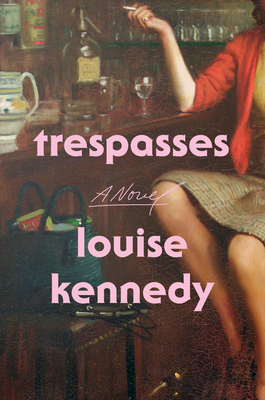
Review 2302: Trespasses

I read somewhere that Kennedy inserted the romance into Trespasses to make the political and social environment of her childhood palatable to readers. If that is so, I personally found the political and social parts more interesting, although the romance seems to take over the novel. However, the addition of the romance helped create the extremely touching ending.

Cushla is a Catholic schoolteacher who helps out at her brother’s pub in 1970’s Northern Ireland. One day Michael Agnew comes into the pub. He is nearly twice as old as she is, a Protestant, married, and a lawyer. She is immediately attracted to him even after she finds out he’s known as a womanizer. Soon he invites her to teach a group of his friends Irish, which leads to an affair.

At school, the children pick on one of her students, an eight-year-old named Davy McGeown, who is poor and who has a Catholic father and a Protestant mother. The family is threatened at home, and soon after Davy’s father finally gets a job, he is beaten mercilessly and left a cripple. Even the principal of the school treats Davy and the family badly, and there are hints of potential child abuse in the attentions toward Davy from the local priest. Cushla begins trying to help out Davy and his family, including his sullen older brother, Tommy.

Although Cushla’s family has successfully stayed out of the internecine conflict and serves people of both religions at the pub, things begin to change for them.

For quite a while that I was reading this novel, I was only mildly interested in the main story line but fascinated with the other things that were going on. However, towards the end, I was completely drawn in and found the ending particularly touching.

Related Posts

Milkman

The Last September

Troubles

Review 2264: Tom Lake

On the farm in Northern Michigan that has been in her husband’s family for generations, Lara has been coaxed by her three grown daughters to tell them about her relationship with Peter Duke, a now famous movie star. There has been a triggering event for these stories, but we don’t learn about it for a long time. In any case, these stories take place between sessions of cherry picking and other hard work.

Lara becomes an actress without planning to. When she is in high school helping with auditions for Our Town, the girls trying out for Emily are so bad that she tries out herself and gets the part. Later in college, she takes the part again, and it happens that Ripley, a movie producer, has been persuaded to attend to see his niece. Instead, he decides that Lara is perfect for an upcoming role.

Lara makes a movie, but there is a long delay before it comes out, so she ends up taking the part of Emily again at a summer stock theater in Michigan called Tom Lake. At Tom Lake, she is swept into an affair with Peter Duke, a young, charismatic actor, on her first day. The summer starts out magical, but Lara has a lot to learn about acting, herself, and Duke.

The present-time novel is set during the pandemic, but even though the story has some heart-wrenching parts, its overall atmosphere is so cozy, so happy in its setting, that it feels like the family has its own little nest. You want to go and live with this fictional family. I was born and grew up in Michigan, and although I never lived on a cherry farm, this book made me nostalgic.

Patchett is also a terrific storyteller. This novel is paced brilliantly. The sections where she tells her story seem just about right in length while the rest portrays a warm family life and hard work on the farm. I loved this book.

Related Posts

Commonwealth

State of Wonder

Once upon a River

Review 1472: Daisy Jones & The Six

Daisy Jones & The Six, about the rise and demise of a 70’s rock band, is written like the script for a documentary. I got the impression at first that it was trying to accomplish something like Jennifer Egan’s amazing A Visit from the Goon Squad.

In the beginning of the novel, we see the separate starts of Daisy Jones and of the band that became The Six. Daisy, a neglected 14-year-old, begins as a rock and roll groupie, while the band works its way up through the usual dances and bars. When they are each beginning to get a little attention, a record executive thinks it would be a great idea if they record a song together. They are a hit. The only problem is that Daisy and the band’s lead singer, Billy Dunne, don’t seem to like each other.

This novel does a pretty good job of depicting the drug- and sex-fueled 70’s rock scene, but I felt it was about 100 pages too long. It also signals where it is going a little too early. The format has its problems. It makes the reader separate from the book even while amusingly showing how different people’s versions of the same event can be.

Taylor Jenkins Reid seems to have ambitions to write more than chick lit, but this novel is essentially chick lit.

Related Posts

A Visit from the Goon Squad

The Flamethrowers

The New Sweet Style


Day 1215: The Flamethrowers

Cover for The FlamethrowersSet in the mid-1970’s, The Flamethrowers evokes two distinct but frenetic movements. In New York, it is the art scene, where performance art is coming to the fore and artists are trying to live their art. In Italy, it is revolution and the Red Brigade, where common people are rising up against business and political corruption.

The heroine, Reno, has grown up in Nevada ski racing and has a fascination with motorcycles and speed. She moves to New York to become an artist (although we never see her making any art) and eventually becomes the girlfriend of Sandro Valera, a well-known, older artist.

Sandro’s family in Italy made its money in motorcycles and tires, and when Reno travels to the Great Salt Flats to do a time trial on her Valera motorcycle, she accidentally gets involved in the family business. As a result, Sandro reluctantly brings her to Italy during a time of great instability and confusion.

Kushner evocatively depicts both the New York art scene and the seething streets of Rome, although often the artists seem like poseurs to me. I don’t think the depiction is meant to be satirical, though.

However, Reno as observer seems to be a different person than the risk-taker who went to New York. Further, the narrative, which occasionally jumps to the story of Sandro’s grandfather, who started the company, feels disjointed and as if it doesn’t really add up. Although I was entranced by long passages of this novel, I ended up wondering what it really was about. In particular, the novel relies on Reno’s relationship with Sandro to tie it all together, but that relationship is barely touched on.

This is the first book I read specifically because it is part of my James Tait Black Fiction Prize project.

Related Posts

Suzanne

The Blazing World

How to Be Both

Day 1204: The 1977 Club! The Women’s Room

Cover for The Women's RoomThere’s nothing subtle about The Women’s Room. It’s a book I reread for the 1977 Club, and I was curious about whether it would affect me the way it did the first time, years ago.

It is the story of Mira and her awakening consciousness of the role of gender in our society. In its time, the novel was an important feminist work that profoundly affected the thinking of many women and perhaps some men. I remember vividly watching the movie on TV with a male coworker. He was astounded at the examples of sexism but even more astounded because I kept saying “That’s happened to me,” pretty much for every example.

French uses the vehicle of the novel to tell the stories of many women. First, it focuses on Mira’s suburbanite girlfriends when she is a young wife and mother in the 1950’s. Without fail, they are all treated poorly by their husbands. She prides herself on being the perfect wife and mother even though she finds life unfulfilling, but that doesn’t save her from a divorce when she is in her late 30’s.

The bulk of the novel focuses on the women she befriends as a graduate student at Harvard. These women are awakening to paternalism in our society. Still, they, too, are all betrayed in some way by their husbands or boyfriends.

I’m struggling now to express my many thoughts with some kind of coherency. One is about the crudeness of it all. First, I was struck by some of the things the men said to their wives in the early portions of the novel and by how the wives accepted this kind of stuff without being outraged. I’m talking about terrible name calling and reducing everything to sex. These women were more my mother’s age than mine, so I have no way of telling whether these scenes were exaggerated.

But overall, I feel that French makes a lot of generalizations and stereotypes men as badly as the men stereotype the women in her novel. I was always confused in the 70’s by some men who seemed to equate feminism with man-hating, but rereading this novel, I can see where that idea comes from.

Finally, it is just plain crude. I understand that women were taking pride in being able to discuss sex and use words that were only allowed to men before, but the language really grated on me. Moreover, there is free use of ethnic slurs. Maybe we’re supposed to know that they are used ironically, but there’s no overt indication that this is the case.

1977 club logoI think The Women’s Room is important as a historical document but not as literature. There are, for example, many places where the story is interrupted by little polemics by a narrator who is unnamed until the end of the novel (although it’s not too difficult to figure out who she is). I found these interruptions, where the narrator has to overtly draw conclusions about the events, irritating and unsubtle, as if French thinks her readers are too stupid to come to the right conclusions. Same with many of the discussions between her characters, although that’s a better way to handle the subjects.

Although my memory of my first reading of this book, when I was in my 20’s, was that I was struck by how much of it mirrored some of my experience, I do remember that French wrote another book, which I also read. And I remember thinking, oh, more of the same stuff, and putting it aside.

Related Posts

The Kreutzer Sonata Variations

The Invention of Wings

Sweet Tooth

Day 1203: The 1977 Club! The Honourable Schoolboy

Cover for The Honourable SchoolboyI actually read this novel before the 1977 Club was announced, but I was pleased to find that it was published in that year. I have a couple of other books I’m reviewing this week that I read especially for the club.

Here are my previous reviews of some other books published in 1977:

* * *

I wasn’t aware that there was a sequel to John Le Carré’s Tinker Tailor Soldier Spy until I picked up The Honourable Schoolboy and started reading it. It is truly a worthy successor.

In summarizing the plot, I have to give away a key point of Tinker Tailor Soldier Spy, but a point revealed toward the beginning of the novel. In that novel, of course, George Smiley uncovered a mole for the Russians high up in British intelligence. Because of the mole’s position, as The Honourable Schoolboy begins, all of the service’s spy networks are compromised and must be dismantled.

With a small staff of personnel who were dismissed during his predecessor’s reign, Smiley must figure out a way to make the service viable again. He has the idea that they can look for intelligence in the lacunae of his predecessor’s work, that is, look for promising leads that were suppressed.

1977 club logoThey find one, payments by the Russians to an account in Hong Kong, first small ones but later very large. Since the “spook house” in Hong Kong has been closed, Smiley recalls a journalist, an “occasional” agent, Jerry Westerby, from retirement in Tuscany to investigate this lead. A tangled path leads him from a Chinese businessman in Hong Kong to the man’s former prostitute English mistress, a Mexican drug courier in Vientiane, and some ugly dealings.

It is always amazing to me that Le Carré can evoke as much excitement from a paper chase as from an action sequence. Once again, he is in top form with a taut thriller. This novel is set against a backdrop of Southeast Asia exploding into chaos with the end of the Vietnam War. Westerby’s investigations take him to Hong Kong, Shanghai, Phnom Penh, Vientiane, and Saigon.

Related Posts

Tinker Tailor Soldier Spy

A Perfect Spy

A Delicate Truth

Day 1032: Strangers in Company

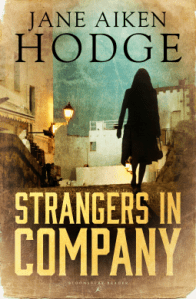
Cover for Strangers in CompanyWhen I was in my teens, I loved reading Jane Aiken Hodge’s historical romantic suspense novels, so when a novel I hadn’t read became available on Netgalley, I thought I’d see if I still enjoyed her. Strangers in Company, unlike the Hodge novels I read when I was young, is set in the time it was written, the early 1970’s.

Marian Frenche married a famous rock star when she was very young, but he deserted her when he learned she was pregnant with twins. Now that the twins are 18, they have in turn deserted her to go live with their father. Mark Frenche has abruptly stopped paying support, so when a tour company contacts her with a job offer, she takes it. All she has to do is accompany Stella Marten on a tour of Greece. Her doctor thinks this is a good idea, because she has been feeling nervous lately, as if someone is watching her. She is warned that Stella may be difficult.

Stella certainly seems to have an uneven temper, but Marian finds they get along most of the time. But almost immediately, things begin to go wrong with the tour. The originally scheduled courier is injured, so they get a history teacher with no experience. On the first expedition, a Mrs. Hilton complains that someone was following her and a boulder nearly hits Marian.

Later, another member of the tour is almost run over by the tour bus, and Mrs. Hilton is killed in a fall. Two schoolteachers fall ill, and one is injured in a fall.

Stella is behaving oddly, too. When Marian finally gets her to confide in her, she is shocked at what she hears.

link to NetgalleyThe novel is set against the backdrop of a recent Greek revolution, during which the country apparently underwent a military coup. I was not really familiar with these events, but not very much was explained.

This novel is clearly an homage to some of the work of Mary Stewart. It has resemblances in its plot line to My Brother Michael, which Marian just happens to be reading. I still much prefer Stewart, but Strangers in Company made an enjoyable light read.

Related Posts

This Rough Magic

Nine Coaches Waiting

Touch Not the Cat