Review 1584: Milly Darrell

When Mary Crofton attends a charmless school to learn to be a governess, she is befriended by an heiress, Milly Darrell. Milly is a beautiful and good-natured girl whose life becomes complicated when her widowed father remarries.

Augusta Darrell doesn’t like Milly, but the situation changes for the worse with the reappearance in the area of a neighbor, Angus Egerton. Before he returns, the girls hear the story of his falling out with his mother after he fell in love with a girl of low birth. When his mother prevented the marriage, he swore never to return while his mother was alive and was said to have lived dissolutely. His mother dead, he returns to try to repair his dilapidated estate.

It is easy to guess that Mrs. Darrell has something to do with this story but not so easy to see how that will affect the plot. This thickens when Milly and Angus fall in love with each other.

This novella is a typical sensation work of its time. It is short and fun to read. For some reason, though, the publisher has chosen to add an alternate ending which, while not materially different from the original, is a travesty of purple prose—an indication of a lack of discrimination on their part.

Related Posts

Aurora Floyd

The Mystery of Mrs. Blencarrow

Diana Tempest

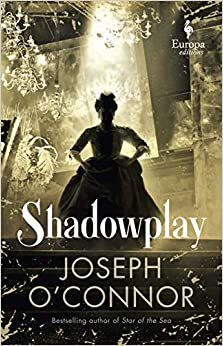
Review 1572: Shadowplay

Joseph O’Connor’s Ghost Light dealt with a relationship in the life of the playwright John Millington Synge. Shadowplay deals with a period in the life of another Irish literary figure, Bram Stoker.

In a novel that shifts back and forth over a 30-year time period, Stoker goes to work as general manager for the Lyceum Theater in London, having been hired by Henry Irving, the greatest Shakespearean actor of his time. Stoker has taken what he believes is a part-time job that will allow him to work on his fiction, but he finds himself assuming responsibility for everything in the theater, an overwhelming position. Further, he has to cope with his employer’s extravagance and his occasional wild rages. Worse, Irving is dismissive of Stoker’s literary efforts. Nevertheless, they form a lasting friendship.

Also involved in the theater is the famous actress Ellen Terry. Shadowplay is primarily about the enduring relationship between these three. However, it reflects other events of its time, particularly Jack the Ripper and the trial of Oscar Wilde. It deals with Stoker’s struggles to earn a living as a writer, a feat he never accomplished. And it has a ghost.

Shadowplay, which I read for my Walter Scott project, was involving and interesting.

Related Posts

Ghost Light

Dracula

The Children’s Book

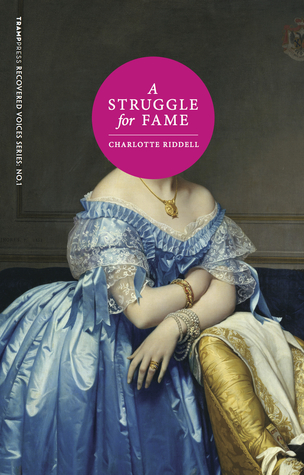
Review 1565: A Struggle for Fame

After reading The Uninhabited House, I looked for more books by Charlotte Riddell and came across the Recovered Voices series published by Tramp Press and this book, A Struggle for Fame. A Struggle for Fame is Riddell’s semi-autobiographical novel about the publishing industry.

Although Glen Westley is the main character in the novel, it follows the progress of two Irish young people who meet on the ship from Ireland and both end up in London’s literary milieu. Through poor investments, Glen’s father has lost the family home and all his money. She determines that they will travel to London so she can try to make a living as a writer.

On the ship, they meet Barney Kelly, a young chancer who is looking for a way to make money.

Glen works hard at good literary fiction and is repeatedly rebuffed by editors even while being told she has promise. Barney, on the other hand, falls into an opportunity to write articles for a journal. The novel makes clear that Glen has much more ability than Barney, but he is able to make a living at writing much earlier than Glen. It is clear from the beginning that the novel is about Glen’s rise and fall, but we are drawn in to see what happens.

A lot of characters are vividly drawn and quite Dickensian in their idiosyncrasies. It is fairly obvious that Riddell is depicting, sometimes satirically, publishers and authors she knew. Although written in 1883, the novel has observations about gender and ability that still apply today.

Related Posts

The Uninhabited House

The Blazing World

The Muse

Review 1561: #1956 Club! Sprig Muslin

Seven years ago, Sir Gareth Ludlow’s fiancée died tragically. Since then, he hasn’t met any woman who would make him forget her. He knows it’s his duty to marry, though, so he decides to propose to his shy friend Lady Hester Theale.

On his way to Lady Hester, he meets a beautiful young lady in some difficulty. He learns that in trying to force her grandfather to let her marry, she has run off with the aim of becoming a governess. When her supposed employer turned her away, she presented herself at the inn where he meets her proposing herself as a chambermaid.

Gareth is afraid that Amanda is too inexperienced to know what dangers she may encounter, but she will not tell him her grandfather’s name, so he takes her to Hester. Hester’s family assumes he has brought along his mistress, and her roué uncle spirits Amanda away the next morning.

Sprig Muslin is Heyer at her most ridiculous and fun, as Amanda’s fibs land her and Sir Gareth into serious trouble, requiring, of course, more and more fibs. As usual, her characters are lovable and her wit engaging. I always love reading Heyer, This one, I reread for the 1956 Club.

Related Posts

The Talisman Ring

Cotillion

Cousin Kate

Review 1525: Manga Classics Les Misérables

I never wanted to read Les Misérables after seeing an old movie that started out with Jean Valjean bashing in the head of a kindly priest who had taken him in, all during an attempt to steal the church silver. That made me turn it off. However, just for grins, I decided to give the Manga Classics version a try.

This, of course, is the story of the redemption of the escaped prisoner Jean Valjean and his pursuit by the policeman Javert, set against the background of the Paris Uprising.

Obviously, I can’t tell how faithful it is to the original even though I have also seen the musical, but there are a lot of characters, so I’m guessing they made a good attempt. The art is not as beautiful as I’ve found in a few graphic novels (although it’s classic Manga style), but the characters are well drawn and easy to tell apart, and the story is easy to follow. I haven’t read any other Manga, so I can only compare it to other types of graphic novels, and it is definitely more dependent upon text than some that I have read (but not all).

As to the quality of the edition, there were some pages in which the tops of the letters were chopped off, although you could still read them.

Did I enjoy it? It was okay. The story seems full of schmaltz, but it was interesting enough for me to consider putting the original on my next Classics Club list.

Related Posts

Agatha: The Real Life of Agatha Christie

Adamtine

The Ukrainian and Russian Notebooks

Review 1519: Perdita

On holiday from his university job, Garth Hellyer takes on a task for the Longevity Project by calling on Marged Brice, who is supposed to be 134 years old. Garth can hardly believe she can be as old as she says she is, and although she has a birth certificate, she has no other form of identification. Marged says she would like to die, but she has to find someone to take care of Perdita.

Marged gives Garth her journals, and he begins to read the fascinating story of a girl attuned to nature, in particular to Georgian Bay off her home on the Bruce Peninsula of Ontario. The journals begin in 1887 and tell the story of the girl’s love for the bay and for George Stewart, an artist.

Meanwhile, Garth becomes reaquainted with Clare, a neighbor on the bay. She, it appears, has cared for him since they were teenagers, but he has never paid attention to her.

This novel is atmospheric with a strong sense of place, particularly the older story, and interesting, although I sometimes wondered when we would get to Perdita. It’s a long novel at 400+ pages, and it takes a long time to get to Perdita, but it kept my interest. If anything, the explanation of Perdita seemed a little unclear. I almost think I would prefer this as a ghost story, which it is not. It does have a faint ecological message.

I’ve said I’m getting tired of the split timeframe novel, but it didn’t bother me for this one and was, in fact, necessary. On the other hand, the historical portion of the novel was definitely the more important.

Related Posts

The Luminous Sea

Mortal Love

Melmoth

Review 1489: The Water Dancer

Hiram Walker is a slave on a Virginia plantation with a photographic memory and a talent for mimicry. As a boy, he attracts the attention of the master, who is also his father. His father has Hiram educated for a year, and the naïve boy imagines he might take an important place on the plantation, but the master’s intention is simply to have Hiram keep his heir, Maynard, out of trouble.

One day on the way back from town, the carriage, being driven recklessly by Maynard, goes into the river. Maynard is drowned, and Hiram wakes up in a field far away from the river. Hiram begins to fear he’ll be sold off to Maynard’s fiancée, Corinne. So, he plots an escape for himself and his master’s brother’s concubine, Sophia.

The Water Dancer has aspirations to literature, and that was one of my problems with it. Occasionally high-flown prose runs from the lyrical to the clichéd. Some of the conversations are absurdly unlikely. One of Coates’s affectations was for the slaves to call themselves the Tasked, which seems to be hardly authentic; in any case, I could find no other such use of the word.

Sometimes, the action slows almost to a halt. For example, Hiram falls into the water on page one and doesn’t come out until about page 100, during which Coates provides background. I’ve run into approaches like this before lately, and all I can say is that something like this that works in a movie doesn’t translate well to fiction, where you are reading for hours over a time that is supposed to be a few minutes.

Coates’s goal here isn’t to tell about the cruelties of slavery so much as to put his tale on a higher plane. He also introduces an element of speculative fiction.

I struggled with this book for about a week and decided to quit halfway through. At that point it was becoming clear that Sophia would have a bigger role, but her character was so little defined that I felt she was almost a MacGuffin. I just couldn’t get on the same wavelength with Coates.

Related Posts

A Most Extraordinary Pursuit

Homegoing

Washington Black

Review 1482: Grace

In the midst of the Irish famine, Grace’s mother awakens her in the middle of the night and hacks off her hair. She tells her she must go out as a boy to get money for the family. Besides, Boggs, who lets the family stay in their house in exchange for sex with her mother, has been eyeing Grace lately. So, Grace is cast out to fend for herself, wandering through a country thronged with starving people, a country that’s becoming more and more desolate.

From the first words of this novel, you know you are reading something different. The prose is beautiful, mesmerizing, occasionally hallucinogenic, as Grace goes through one experience after another, haunted by the people she loses along the way.

What an experience it was to read this book. I read it for my Walter Scott project. It’s a book I probably wouldn’t have come across except for that, and I’m grateful to have read it.

Related Posts

The Mermaid’s Child

Neverhome

The Wonder

Review 1476: Immortal Wife

Irving Stone was extremely popular in the mid-20th century for mostly biographical fiction. His most famous novels are The Agony and the Ecstacy about Michelangelo and Lust for Life about Vincent Van Gogh. Immortal Wife is his second book, about the life of Jessie Benton Fremont, the wife of explorer John C. Fremont.

Jessie Fremont certainly had an exciting life, even though a lot of her time was spent waiting. She was actively involved in her husband’s professional life. The work she did of helping her father write his reports when she was unmarried, she continued with the reports Fremont submitted after his explorations. She lived on an Indian reservation during his second expedition. She was one of the first white women to travel to San Francisco via a trek across Panama. She lived in untamed San Francisco and later Mariposa during the lawless days of the Gold Rush. When Fremont lost a fortune through unwise partnerships, she supported the family by writing stories.

Fremont was a controversial figure, and Jessie was partly to blame for a lot of the controversy. Upon his first command, she prevented him from receiving orders that would have made him turn back, and he was courtmartialed later partially because of this incident. Her advice resulted in more than one incident like this. Partially because of an attitude that the couple knew best, their fortunes underwent many ups and downs. Jessie was quite interfering in her attempts to help her husband, and they made many enemies.

I wanted to like this book a lot more than I did. Part of my problem with it wasn’t fair, because I don’t believe in judging a book out of its time. But it was so accepting of Manifest Destiny, the right of the United States to the lands of the west. Fremont essentially starts a war as an excuse to steal California from Mexico, stating that Mexico wasn’t doing anything with it. Comments after an expedition that he had stood on top of a mountain in the Wind River region where no one stood before obviously meant no white men. This kind of thing grated on me for the first quarter of the novel.

On the positive side, the novel is interesting and well researched. On the negative side, at 400 dense pages, it is a bit longer than it needs to be through many episodes of Jessie’s heart-rendings about her marriage. Finally, although Stone clearly meant Jessie to be a sympathetic character, I didn’t like her much.

Related Posts

The 19th Wife

One Thousand White Women

Red Water


Review 1471: Homegoing

Writers seem to be experimenting with the form of the novel these days, not always successfully. Yaa Gyasi uses the form of linked short stories to good effect, however.

In paired stories, the novel follows two half sisters and their descendants through 300 years of history. In 18th century Gold Coast, Effia is being courted by the son of a king, but her mother, Baaba, tells her to hide the fact that she has reached womanhood. Her suitor eventually marries someone else, and Effia is married to a white man, James Collins, the governor of Cape Coast Castle. The Castle is where slaves are kept before being shipped to the colonies.

Esi is the daughter of Big Man and Maame, a former slave to Effia’s family. In her attempts to befriend Abronoma, her family’s slave, she sends a message to Abronoma’s family to tell them where she is. Thus, she herself becomes a slave when her slave’s family attacks and captures her village.

The novel checks in with each of eight characters of the girls’ descendants, sometimes telling the entire stories of characters’ lives, other times dealing with significant moments. Both families are affected by this great evil in their lives, slavery and its aftereffects. This structure allows Gyasi to explore some of the key events in the histories of Ghana and the United States.

At first, I thought I might get frustrated with the format, because I often want more from short stories. But because the stories are about two families, some of the characters are present in more than one, and you can at least find out what happened to them. Many of the stories are grim, but the novel ends hopefully. Gyasi’s voice is a fresh one, and I found this novel captivating.

Related Posts

Sugar Money

Washington Black

Beloved