Review 1460: The Story Keeper

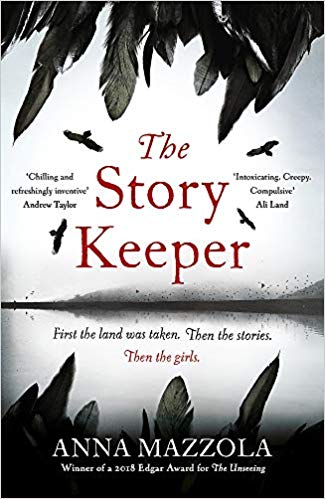
Audrey Hart arrives on the Isle of Skye to take up a position as an assistant to a folklorist in 1857. She has fled her family because of a situation that occurred during her volunteer work and because her father doesn’t believe a girl of her upbringing should work. She has taken a job on Skye because her mother, who died when she was a child, loved it there.

Upon her arrival in Skye, Audrey notices a croft girl who appears to be ill. The local people believe she was taken by fairies. The Buchanans, her employers, aren’t interested in what happens to a girl of her class. The minister thinks even Miss Buchanan’s story-collecting activities encourage superstition.

Audrey is worried, because she hasn’t been able to get the locals to tell her any stories so can’t do her job. But then she begins hearing about other young girls who have disappeared. No one seems to want to listen to her ideas that the disappearances may be related, not even the kind nephew of Miss Buchanan, Alec. While all this is going on, Alec’s father is enclosing his land and evicting tenants.

This is an atmospheric novel that nicely blends the folklore of the area with more sinister themes. Although I almost immediately figured out what was going on, if not the motive, I enjoyed the journey. This is an entertaining historical suspense novel.

Related Posts

The Good People

The Sea House

At the Water’s Edge

Review 1459: The Charterhouse of Parma

I found a nice hardcopy edition of The Charterhouse of Parma a while back and finally decided to read it. I have to conclude that I am not a fan of Stendahl. I read The Red and the Black a few years ago and deeply disliked its hero, who is essentially a sociopath.

The Charterhouse of Parma is about the life of a young Italian nobleman, Fabrizio, the second son of the Marchese and Marchesa del Dongo. When Fabrizio is a boy, the region where he lives, near Lake Como, goes back and forth between occupation by the French and rule by Austria. Although Fabrizio’s father is a conservative devoted to the Austrian king, Fabrizio grows up with romantic stories about Napoleon’s exploits. When he is a young man, extremely naïve and stupid, he runs off to fight for Napoleon just in time for Waterloo. He doesn’t even know how to join the army so ends up being mistaken for a spy and having so many ridiculous exploits that I thought I was reading a comedy. I wasn’t. In any case, this adventure results in his being accused by his elder brother of being a spy for the French so that he can no longer reside in Austria, which includes portions of Italy.

Meanwhile, his beloved aunt, the Countess Pietranara, is widowed. She eventually meets Count Mosca, a powerful person in the government of Parma, who falls in love with her. He offers to quit his position and move to Milan to be her impoverished lover (he is married) or to have her marry Duke Sanseverina in name only so that she can respectably move to Parma and be at court—and also be his mistress. She chooses the latter plan.

After Fabrizio’s return from the front, Duchess Sanseverina and Count Mosca try to help Fabrizio gain some position worthy of his birth. They choose the church and advise him how to behave. But Fabrizio is struggling between his instincts and his conscience and consistently falls into one mishap after another.

When I tell you that Tolstoy modelled his description of Waterloo—the least interesting part of War and Peace, which I consistently skipped over—after Stendahl’s, and when I say further that Waterloo, to me, was one of the most interesting parts of this book, you will guess how much I enjoyed it. Actually, I should say the first half of the book, because I finally stopped reading. I did not find Fabrizio interesting and didn’t really care what happened to him.

Related Posts

Vanity Fair

Don Quijote

The Kreutzer Sonata Variations

Review 1428: The Children’s Book

I have an inconsistent reaction to Byatt. I find her novels either completely absorbing, as I did Possession, or perplexing, as I did A Whistling Woman. The very long novel, The Children’s Book, nevertheless falls into the first category.

Byatt’s novel takes on the late Victorian and early Edwardian periods, a time when, she says, adults seemed to be trying to prolong childhood, when, for example, Peter Pan made its appearance. Fittingly then, a major character is Olive Wellwood, a writer of children’s tales. She has many children, and aside from her authorly output, she writes a continuing story for each one of them. It’s her oldest son, Tom’s, misfortune that she confuses fiction with reality.

The novel begins when, on a visit to a museum with his mother, Tom notices a ragged boy and follows him to find he is living in a closet in the museum. This boy is Philip Warren, a worker in a pottery factory who has run away because he wants to make pottery, not feed fires and do other mundane tasks. Major Prosper Cain, the museum keeper Olive is visiting to consult, thinks he may be able to find a place for Philip, and Philip ends up working at Prospect House for the brilliant but disturbed potter Benedict Fludd.

But first we have the Wellwood’s elaborate Midsummer play, where we meet all of the important characters of the novel. The Wellwood’s guests are artists, anarchists, socialists, fellow Fabianists, and even a banker in the person of Basil Wellwood, the host Humphry’s brother. Of course, other guests are these people’s children, who eventually become important characters in their own right.

The novel covers the time from 1895 to the end of World War I, although the war is covered only briefly. Over this time period, Byatt not only tells us the stories of her many characters but also checks in to events in the lives of actual figures of the time, for example, Oscar Wilde, Emma Pankhurst, H. G. Wells, and Rupert Brooke.

This novel is interesting both on an intimate level, as the children discover their parents’ secrets and have their own, and on the broader, more ambitious level of a portrait of the age. There are casualties in this novel, and it is at times very dark, the way Olive likes her stories.

Related Posts

A Whistling Woman

C

Mrs. Engels

Review 1418: Sister Noon

I found the first two books I read by Karen Joy Fowler slight, but then she blew me away with We Are All Completely Beside Ourselves. So, I thought I’d give Sister Noon a chance.

In 1890’s San Francisco, Lizzie Hayes is a spinster who spends her time doing good works. In particular, she is treasurer for the Ladies Relief and Protection Society, or the Brown Ark, a home that takes in orphaned children or children whose parents can’t keep them. To Lizzie comes the notorious Mary Ellen Pleasant, a woman about whom there are many rumors. She brings Lizzie a child, Jenny Hijab, who needs shelter.

After Lizzy calls on Mrs. Pleasant in the House of Mystery to report on Jenny, her friends go to great lengths to warn her about the acquaintance. Lizzy is fascinated by this household, where Mrs. Pleasant seems to be in charge of Mrs. Bell’s house even though Mr. Bell was previously her lover, and Mr. Bell is never present. Mrs. Bell has told her some bizarre stories but not more bizarre than the ones she’s already heard. Actually, although Lizzie is not inclined to pursue the acquaintance, she finds there are things she needs to know.

This novel moves back and forth in time to tell its stories about the wild days of early San Francisco, but this doesn’t help with the lack of focus I felt when reading the book. I found myself losing patience as it slowly meandered to its point. It finally begins getting somewhere about 20 pages from the end. Normally, a book that develops slowly doesn’t bother me, but this one made me impatient. I think this was because I wasn’t that interested in the characters.

Related Posts

We Are All Completely Beside Ourselves

The Jane Austen Book Club

Wit’s End

Review 1417: The Web of Days

I think it is interesting to reread a book I read long ago to see if or how my reaction to it has changed. This can work both ways—I can appreciate a book I disliked the first time or see the flaws in a book I loved. I remember reading the gothic romance The Web of Days when I was a teenager, borrowed from a neighbor’s house for whom I was babysitting. After the kids went to bed, I would pull it out for the next installment. I liked the book and had a crush on its romantic hero. So, what did I think this time? More about that later.

Hester Snow arrives from the North at Seven Chimneys, a ruined plantation on one of the sea islands of Georgia just after the Civil War. She is to be a governess for Rupert LeGrand, the son of the owner of the plantation, Saint Clair LeGrand. At the house she finds an indifferent master; his mother Madame, who cares only for her food; and his wife Lorelei, who drinks too much. The house is slovenly, the fields are ruined, and the servants are insolent.

Hester believes that with hard work and oversight, Seven Chimneys could be made profitable again, and she soon seeks permission from LeGrand to see to it. When she begins to find herself successful, she becomes obsessed with seeing the plantation thrive and making a home for herself. What she doesn’t see is the truth behind the relationships between the family members at Seven Chimneys.

She is attracted to Roi, Saint’s dashing bastard half brother, but he offers a life in a cabin in Missouri. Hester thinks that will be a harsh life of drudgery and wants nothing to do with it.

First of all, this novel is so racist it took my breath away. It’s hard to tell if Lee was trying to depict the time as it was or was racist herself. However, Hester herself is racist. Even though she comes to like a couple of the African-American characters, she treats more than one of them despicably, and they are all stereotypical.

Second, in other ways Hester is not at all likable, being so obsessed with succeeding on the plantation and feeling herself so superior to the southern characters. In many ways, except for not being evil, she reminds me of the main character in one of Philippa Gregory’s early series, Wideacre. She acts fairly reprehensibly up to the very end of the novel, when she has a change of heart. Frankly, she does not deserve her happy ending.

Did I like the book? It is well written and atmospheric. It has some suspenseful scenes, and Hester finds herself in a corner. But no, not only is the racism too much for me, but the regionalism is, too, because Lee depicts most southerners as loafing crackers (she even uses the word), greedy vulgar businessmen, or effete, elitist aristocrats. This is not at all the book I remembered reading.

Related Posts

Varina

Days Without End

This Godforsaken Place

Review 1388: Aurora Floyd

The heiress Aurora Floyd is the apple of her elderly father’s eye. At 19, she is dark and high-spirited, with a flashing eye and an air of pride. She has just returned from finishing school in Paris when Captain Talbot Bulstrode notices her.

From a family that prides itself on its blemishless past, Bulstrode is looking for a pure and wholesome wife. He is disdainful of Aurora’s interest in horses and racing. Altogether, he feels he would like his wife to be more like her cousin, Lucy Floyd. Nevertheless, he can’t take his eyes off Aurora even though there seems to be a shadow over her.

Aurora has another admirer, John Mellish, a large, bluff Yorkshireman who worships her at first sight. In the beginning, Aurora pays little attention to either man. Then she seems to favor Captain Bulstrode.

Aurora has a secret, however, that will threaten her happy future. It is not a difficult secret for the reader to guess, but when a murder is committed, she finds that it must come out.

Mary Elizabeth Braddon was a writer of popular Victorian sensation novels, combining melodrama, intense emotion, and crime. Her best-known work is Lady Audley’s Secret, so if you are familiar with that, you know what to expect. The story evokes some true suspense, and the main characters are either likable or despicable, as intended. Occasionally, Braddon departs into little lectures, some of them loaded with literary allusions. They reminded me of some of Dickens’s writing, only I found them a little cumbersome and overbearing. Still, this novel is readable and generally moves forward at a good pace. I enjoyed it.

Related Posts

The Mystery of Mrs. Blencarrow

Diana Tempest

The Shuttle

Review 1370: Unsheltered

Unusual for Barbara Kingsolver, Unsheltered is a dual time-frame novel, changing centuries every other chapter. The setting is the same, though, the odd town of Vineland, New Jersey.

In the present time, Willa’s family has discovered that the house she inherited in Vineland is no asset. Both she and her husband, Iano, have recently lost their jobs through no fault of their own. Willa’s magazine failed, and so did the college in West Virginia where Iano was tenured. When he finally got hired in an inferior level for a one-year position, the inherited house nearby had seemed like a godsend. But now she has found that it is falling down, with part of the old house not even on a foundation, and too expensive to fix.

To make matters worse, they are the only people in the family who offered to take in Iano’s ornery dying father. Their daughter, Tig, has also unexpectedly returned from a year in Cuba. Finally, their son Zeke’s partner has committed suicide, leaving him in an apartment he can’t afford with a baby son. Willa and Iano offer him a place to stay, but what he wants is to leave his son with them.

In mid-19th century Vineland, Thatcher Greenwood has moved his new bride, Rose, back into the house she grew up in. They are also living with her mother, Aurelia, and young sister, Polly. Thatcher is delighted with his wife but is soon to find that they don’t share the same values. His position as a science teacher pays very little, but Rose and her mother continue to demand elegancies that belong to their former life, before Rose’s father went broke.

Next door, Thatcher meets Mary Treat. Rose knows her as the poor woman who was deserted by her husband, but Thatcher learns that she is a scientist, whose correspondents include Charles Darwin.

Vineland was founded as a sort of utopia by Captain Landis, but Thatcher begins to see the cracks in that utopia. One of them is his employer, who will not allow him to teach anything more than rote memorization and hates most recent scientific theories, particularly Darwin’s.

Both of these main characters are concerned with keeping shelter over their families’ heads, but while Kingsolver links the stories through Willa’s growing interest in Mary Treat, she is also able to draw many parallels between the two times. The present uncertainty in the poor economy of the Eastern Seaboard she compares to the uncertainty in the lives of Vineland’s population, of workers promised much by a man who can repossess their property if they fail. An unmistakable political figure in the present day, nicknamed by Willa The Bullhorn, bears a metaphorical resemblance to Landis, who is essentially a conman. The main characters’ housing insecurity stands for the insecurity of the entire population as a result of climate change and the death of the American dream. Kingsolver has lots to talk about.

I’m not so sure how much I liked the dual narrative. I was far more interested in the present-time story than I was in the older one. Kingsolver seemed to want to write about Mary Treat, but Treat features more as an important secondary character. And I have to say that some of Willa’s discussions with her daughter and her ruminations about those discussions border on the didactic (which we know has been a fault of Kingsolver in some other books).

Still, it is great to have another book out by Kingsolver. She can be hit or miss, but I have very fond memories of some of her books.

Related Posts

The Lacuna

The Weight of Ink

Maddaddam

Review 1367: See What I Have Done

See What I Have Done is an interpretation of the famous Borden murders in 1892. It is absolutely seething with undercurrents and is occasionally very creepy. I think most people don’t know that Lizzy Borden was not found guilty of the murders of her stepmother and father. Somehow, this novel maintains suspense by creating uncertainty about that.

The novel concentrates most of its energy on the day before and the day of the murder, but it goes backward and forward in time and changes point of view from one character to another.

Schmidt depicts Lizzy as a childish 30-year-old who has been alternately indulged and oppressed by her father. Fatefully, on the day before the murders, Mr. Borden slaughters Lizzy’s pet pigeons with an ax. Then, instead of telling her what he has done, he leaves her to discover it.

There are other people in the house who have motives for the murders. Lizzy’s uncle, John, has hired a ruffian named Benjamin to make Mr. Borden pay attention to his demand that his nieces be treated better. Benjamin is lurking around and inside the house the day of the murders, which made me wonder whether the warning was to go awry. Also, the day before the murders, Abby Borden, who was killed first, confiscated from the maid, Bridget, all of the money she saved to get her back to Ireland.

The narrative style, from Lizzy’s point of view, is feverish. In all, I found this novel to be really interesting, imaginative in its approach and unsettling in effect.

Related Posts

The Wicked Boy: The Mystery of a Victorian Child Murderer

The Killer Inside Me

Famous Trials

Review 1364: Madame de Treymes

If you have read Edith Wharton’s The Age of Innocence, the situation in her novella, Madame de Treymes, will seem familiar. As Madame de Treymes was written before The Age of Innocence, perhaps Wharton was trying out some ideas in this novella that she developed more fully in the later novel.

John Durham is in love with Madame de Malrive. He knew her as Fanny Frisbee in their younger days in New York, but now she is separated from her husband and has a young child. He proposes to her, expressing himself willing to adapt to any conditions she may make, but she says her husband’s family will never agree to a divorce. She has used her leverage because of her husband’s dissolute life to keep her son and does not want to jeopardize her custody.

Fanny says that the family never explicitly states its intentions, and she never knows what they are going to do. Her sister-in-law, Madame de Treymes, seems to be sympathetic, however, and she asks John to try to discover from her the family’s intentions.

Durham arranges a meeting with Madame and is first inclined not to believe the stories he’s heard about her. However, the meeting goes badly wrong.

This novella is about the inability of the aristocratic French and the Americans of the same class to comprehend each other. A misunderstanding on both sides results in unforeseen circumstances. This novella is subtle and more of a character study than a plotted piece, about the gulf between two very different cultures. I read this interesting novella for my Classics Club list.

Related Posts

The Age of Innocence

Obscure Destinies

Someone At a Distance

Review 1344: Minds of Winter

Cover for Minds of WinterBest Book!
By coincidence, Fay Morgan, who has traveled to Tuktoyaktuk, within the Arctic Circle, to track down information about her missing grandfather, meets Nelson, a man whose brother Bert has also disappeared. Fay’s search has been jump-started by the discovery of an old chronometer disguised as a carriage clock. This instrument was carried into the Arctic by Commander Crozier, a member of Franklin’s ill-fated expedition of 1845. Fay remembers the clock, however, in her grandmother’s house when she was a child. Oddly, Bert Nilsson, Nelson’s brother, was investigating the disappearance of his own great-uncle, whose tracks seem to intersect with those of Hugh Morgan, Fay’s grandfather.

Mixed in with the story of Fay’s investigations is the track of the chronometer, beginning in 1841 in Van Diemen’s Land, to which the ships Terror and Erebus are lately returned from Captain Ross’s exploration of the Antarctic. They will be going to the Arctic in Sir John Franklin’s search for a Northwest Passage. With him goes Commander Crozier.

This is an absolutely riveting book, following the course of a series of polar explorations up through the years to post-World War II, and finally to the present with Fay’s search. This novel does not so much document their physical hardships but explore the state of mind that leads men to return to these harsh regions again and again. It also follows the mystery of the chronometer. What path brought it back to England after it disappeared into the Arctic? What happened to Commander Crozier, last seen traveling with an old one, a race of men known by the Inuit to have been there longer than they?

O’Loughlin has done a beautiful job of intermingling history and fiction, reality and mysticism to write this novel, an exploration in itself. This novel is wondrous.

Related Posts

The Orenda

River Thieves

Fatal Journey: The Final Expedition of Henry Hudson