Review 1364: Madame de Treymes

If you have read Edith Wharton’s The Age of Innocence, the situation in her novella, Madame de Treymes, will seem familiar. As Madame de Treymes was written before The Age of Innocence, perhaps Wharton was trying out some ideas in this novella that she developed more fully in the later novel.

John Durham is in love with Madame de Malrive. He knew her as Fanny Frisbee in their younger days in New York, but now she is separated from her husband and has a young child. He proposes to her, expressing himself willing to adapt to any conditions she may make, but she says her husband’s family will never agree to a divorce. She has used her leverage because of her husband’s dissolute life to keep her son and does not want to jeopardize her custody.

Fanny says that the family never explicitly states its intentions, and she never knows what they are going to do. Her sister-in-law, Madame de Treymes, seems to be sympathetic, however, and she asks John to try to discover from her the family’s intentions.

Durham arranges a meeting with Madame and is first inclined not to believe the stories he’s heard about her. However, the meeting goes badly wrong.

This novella is about the inability of the aristocratic French and the Americans of the same class to comprehend each other. A misunderstanding on both sides results in unforeseen circumstances. This novella is subtle and more of a character study than a plotted piece, about the gulf between two very different cultures. I read this interesting novella for my Classics Club list.

Related Posts

The Age of Innocence

Obscure Destinies

Someone At a Distance

Review 1344: Minds of Winter

Cover for Minds of WinterBest Book!
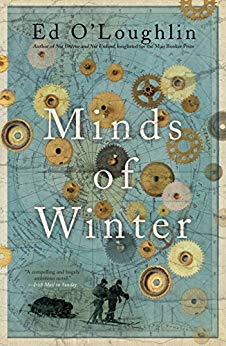
By coincidence, Fay Morgan, who has traveled to Tuktoyaktuk, within the Arctic Circle, to track down information about her missing grandfather, meets Nelson, a man whose brother Bert has also disappeared. Fay’s search has been jump-started by the discovery of an old chronometer disguised as a carriage clock. This instrument was carried into the Arctic by Commander Crozier, a member of Franklin’s ill-fated expedition of 1845. Fay remembers the clock, however, in her grandmother’s house when she was a child. Oddly, Bert Nilsson, Nelson’s brother, was investigating the disappearance of his own great-uncle, whose tracks seem to intersect with those of Hugh Morgan, Fay’s grandfather.

Mixed in with the story of Fay’s investigations is the track of the chronometer, beginning in 1841 in Van Diemen’s Land, to which the ships Terror and Erebus are lately returned from Captain Ross’s exploration of the Antarctic. They will be going to the Arctic in Sir John Franklin’s search for a Northwest Passage. With him goes Commander Crozier.

This is an absolutely riveting book, following the course of a series of polar explorations up through the years to post-World War II, and finally to the present with Fay’s search. This novel does not so much document their physical hardships but explore the state of mind that leads men to return to these harsh regions again and again. It also follows the mystery of the chronometer. What path brought it back to England after it disappeared into the Arctic? What happened to Commander Crozier, last seen traveling with an old one, a race of men known by the Inuit to have been there longer than they?

O’Loughlin has done a beautiful job of intermingling history and fiction, reality and mysticism to write this novel, an exploration in itself. This novel is wondrous.

Related Posts

The Orenda

River Thieves

Fatal Journey: The Final Expedition of Henry Hudson


Review 1341: The 1965 Club! Frederica

Cover for FredericaThe Marquis of Alverstoke is known for his elegance, athletic skill, and selfishness. He never does anything that causes the least inconvenience for himself. So, when his sister, Lady Buxted, tries to persuade him to give a coming out ball for her daughter Jane, he does not hesitate to refuse. Mrs. Dauntry, his heir’s mother, hears a rumor about the ball and asks Alverstoke to include her daughter Chloë.

Then Miss Merriville comes to call. Frederica Merriville is a distant connection of Alverstoke’s who has come to London hoping to introduce her beautiful sister, Charis, to society with the object of making her a comfortable marriage. Since she has no acquaintance in London, she hopes Alverstoke can help her.

Alverstoke has little interest in helping Frederica until he sees Charis. Then he decides to throw a ball for Jane and Chloë out of maliciousness toward his sister, making it a condition that Lady Buxted sponsor Frederica and Charis. He knows that she will be furious when she meets the beautiful Charis.

Soon, Alverstoke finds himself embroiled in the affairs of the active Merriville family, which includes two younger boys—Jessamy, a serious sixteen-year-old, and Felix, a scamp of twelve. After a few weeks and several scrapes, Alverstoke realizes he hasn’t been bored in ages.

Frederica is one of the delightful novels by Georgette Heyer, a writer full of wit and a recognized expert in the period. As is frequently the case with Heyer, I found it funny and touching with a cast of amusing and likable characters.

This was a book I read for the 1965 Club. Here are some previous reviews that also qualify for the club:

Related Posts

The Convenient Marriage

Cotillion

Friday’s Child

Review 1334: Jamrach’s Menagerie

Cover for Jamrach's MenagerieBest Book!
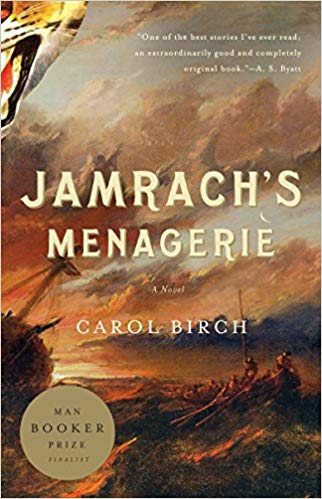
Jaffy Brown and his mother are eking out an existence in the slums of 19th century London when, as a very young boy, he meets a tiger coming down the street. Not knowing enough to fear it, he walks up to pet it and it picks him up in its mouth. The tiger is an escapee from the animal importer, Mr. Charles Jamrach, that has fortunately just been fed, so Jaffy isn’t harmed. Jamrach gives him a job taking care of his animals, and his fortunes materially improve.

Jaffy befriends two twins, Ishbel and Tim. As he gets older, he learns to love Ishbel, although she is alternately affectionate and aloof. With Tim, he develops more of a love/hate relationship.

When Jaffy is 15, Jamrach decides to send an expedition to the East Indies to look for a reported dragon. He picks Tim to go with Dan Rymer on the expedition, but Jaffy signs as a sailor. He has always felt an affinity for sailors and the sea. They set off on their voyage.

Jamrach’s Menagerie is a terrific novel. It is simply a good story that pins you to the page. It is imaginative, evocative, and the writing is gorgeous. I read this for my Booker Prize project, and I loved it.

Related Posts

The Signature of All Things

The Rathbones

Ahab’s Wife Or, The Star-Gazer

Review 1329: Varina

Cover for VarinaVarina is one of those books that makes me wish Goodreads allowed half stars, because it is better than the books I’ve given three stars (my okay or ho-hum rating) but it’s not quite as good as many books I’ve rated four stars. It is interesting, though, the story of Varina Davis, Jeff Davis’s young wife.

The novel begins when Varina, or V as she is called, as an old woman meets James, a young African-American boy she raised with her own children. At the time of the fall of the Confederacy, Jimmy was taken from her after she was captured.

James comes to see V because he remembers very little of that time and has read some things in a book he wants to ask her about. She is happy to see him, because all of her children have died. He is the last one left. The novel skips backward and forward through incidents in her life as she and James hold a series of conversations.

I found this novel both interesting and touching. I know very little about Jeff Davis and knew nothing of his wife. V seems to have been an unconventional and spirited woman. She led a difficult and sad life.

Related Posts

Nightwoods

Neverhome

The Good Lord Bird

Day 1299: Flush: A Biography

Cover for FlushI admit to feeling rather perplexed by Flush, which seems to be a light-hearted biography of Elizabeth Barrett’s pet dog. It was clear to me that a lot more was going on than a story about a dog. The introduction to my Persephone edition by Sally Beauman draws parallels between Flush’s life and Barrett’s—and Virginia Woolf’s own life.

Flush is a cocker spaniel, a hunting dog, given to Elizabeth Barrett as a gift. Woolf is clear about how Flush’s life on Wimpole Street becomes one of constraint and even neuroticism as the lap dog of a constrained, restricted, and hypochondriacal Elizabeth Barrett.

The slant the novel puts on the famous romance between Barrett and Robert Browning is also very interesting. Flush is immediately jealous of Browning and tries to bite him twice. From being loved and terrifically spoiled by Barrett, he learns he has to take second place.

Now to get to the source of my perplexity. Just in terms of mistreatment of dogs, this novel was not, to me, the one fondly referred to by others over the years. Woolf’s doggy hero is restricted by Elizabeth just as she was by her father. To add interest, though, there are sly digs at social strata and Victorian life throughout.

Related Posts

Mrs. Dalloway

The Invisible Woman

The Call of the Wild

Day 1289: The Clockmaker’s Daughter

Cover for The Clockmaker's DaughterBest Book of Five!
The first character we meet in The Clockmaker’s Daughter is the ghost of the clockmaker’s daughter. Although she used the name Lily Millington, we don’t find out her true name, or why she haunts Birchwood Manor, until the end of the novel.

The novel begins in the present, though, with Elodie, an archivist. She is about to be married, but she is having trouble concentrating on the wedding. That is because, in going through the archive of James W. Stratton, a philanthropist, she has found the belongings of a Victorian artist, Edward Radcliffe, in particular, a sketchbook. This discovery is of interest because inside it is a picture that she realizes is of a house from a children’s story handed down in her own family.

link to NetgalleyWhile Elodie begins exploring this link between Radcliffe and her family, we slowly hear the stories of Lily Millington, of a beloved house, and of a long-lost family heirloom. We also learn the stories of a series of inhabitants of the house.

Although I love a good ghost story, I wasn’t sure whether I would appreciate the ghost being one of the narrators. And this is not a traditional ghost story, for the ghost is not one that frightens. Kate Morton is a masterful storyteller, however, so that I was engrossed as always. Although this is not my favorite book by Morton, which still remains The Forgotten Garden, I really enjoyed it.

Related Posts

The Forgotten Garden

The Secret Keeper

The Lake House

Day 1279: Harriet

Cover for HarrietHarriet is a novel written in 1934 based on a true crime that occurred in 1875. As such, it is suitable for the season as well as for the R. I. P. Challenge and the Classics Club Dare.

Harriet is a woman in her 30’s who has her own fortune of £3,000 with prospects of 2,000 more. She is a “natural,” which I take to mean having some sort of mental incapacity. Although her mother, Mrs. Ogilvie, cares about her, she boards her periodically with poorer relatives, allowing them to make a little money and giving herself and her husband a little break from Harriet, who can be difficult.

Mrs. Ogilvy sends Harriet to stay with her cousin, Mrs. Hoppner. Mrs. Hoppner lives with her spoiled daughter, Alice. Visiting her are her older daughter, Elizabeth, and Elizabeth’s husband, Patrick Oman, an artist. Also visiting is Patrick’s brother, Lewis, a clerk. Patrick and Elizabeth are devoted to Lewis.

Although the charismatic Lewis is courting the delicate and beautiful Alice, he turns his attention to Harriet. He is soon engaged to her and marries her despite Mrs. Ogilvie’s objections. In fact, Mrs. Ogilvie tries to get Harriet made a ward of the court to block the marriage, but this backfires when Lewis finds out and tells Harriet she wants to have her committed. Once they are married, Lewis proceeds to strip Harriet of her money and possessions.

After Harriet has a child, he boards her at his brother’s house and moves into a nearby house with Alice. Up until then, Lewis’s actions are marginally legal if morally repellent. It is after this that the behavior of the two brothers and two sisters becomes criminal.

This novel is chilling in its psychological depictions of the two sisters and brothers. Jenkins was fascinated by the case and uses people’s actual Christian names, imaging the thoughts and activities of the characters. This novel was one of the first fictionalizations of a true crime.

Related Posts

The Wicked Boy: The Mystery of a Victorian Child Murderer

The Invention of Murder: How the Victorians Reveled in Death and Detection and Created Modern Crime

The Fall of the House of Walworth: A Tale of Madness and Murder in Gilded Age America

Day 1276: The Haunted Hotel

Cover for The Haunted HotelWilkie Collins’s The Haunted Hotel was the spooky book I read for the Classics Club Dare that will also do for the R.I.P. Challenge.

* * *

His family is shocked when Lord Montbarry jilts his gentle cousin, Agnes, and marries the infamous Countess Narona. Agnes herself cannot explain the behavior of the Countess when she meets her in London. The Countess seems horror struck by Agnes and says she will be her undoing.

Lord Montbarry and his new wife go off with her brother, Baron Rivar, to live in Venice. It is not long before the family hears, first, of the disappearance of Ferrari, Lord Montbarry’s courier and the husband of Agnes’s former ladies maid, and then of Lord Montbarry’s death from bronchitis. Lord Montbarry’s fortune is entailed, but he leaves a large life insurance award to his widow. Although the insurance company conducts an investigation into the death, they can find nothing wrong.

Lord Montbarry’s younger brother, Henry Westwick, has been trying to court Agnes, but she is still in love with her former fiancé. In the meantime, he occupies himself with investments, including in the hotel that used to be the villa where his brother died. After the hotel opens, one family member after another stays there, in room 14, all having bad experiences. What happened in that hotel?

Frankly, this short novel has neither the entertaining narratives of The Moonstone nor the intriguing plot of The Woman in White. It is a potboiler, not one of Collins’s best. The hero and heroine aren’t much more than cardboard figures. The only character of interest is Countess Narona herself. The plot is predictable, the novel not scary, and the truth, although creepy, is not told to maximize the effect. On the scary scale, it gets a low mark.

Related Posts

The Moonstone

Hide and Seek

Basil

Day 1267: Alas, Poor Lady

Cover for Alas, Poor LadyBest of Five!
A Footman for the Peacock was a strange little book, so I didn’t quite know what to expect from the much longer Alas, Poor Lady. It turned out to be an astonishingly feminist novel for being published in 1937.

At the beginning of the novel, Miss Scrimgeour, an elderly woman, receives the charitable gift of a two-room flat and an annuity for life. One of the women involved in the charity realizes that Miss Scrimgeour is a gentlewoman, of the same class as herself, and that she previously had no income at all. She exclaims, “How did that happen?” This novel answers that question.

It begins in 1870, when Grace Scrimgeour is born into a wealthy family. She is the youngest of six sisters, born almost a generation behind her last sister, but she is not the youngest child. Two years later, the Scrimgeour’s only son is born.

All the girls are raised to become wives and mothers. At least the oldest girls are sent away to school, but after Charlie is born, Grace’s upbringing is neglected and she is left to be educated by a governess who is not very competent.

The two girls marry, but it becomes clear that Mary and Queenie will not. Mary attempts to be useful by offering to teach Grace and Charlie, but her attempts to find herself an occupation are rebuffed by her parents.

As biddable, affectionate Grace nears her debut, Captain Scrimgeour spends more and more of his money on Charlie, selling out of stable financial funds to do so. Grace’s unmarried sisters become a problem once she is “out,” because most hostesses don’t want to entertain six Scrimgeours, so they leave Grace off their invitation lists. Her parents are now too elderly to see she has proper opportunities to meet someone, and neither of her married sisters take her in hand.

The novel follows the downward trend of the family’s finances, especially after Mrs. Scrimgeour is left in charge, herself having never received any instruction about finances. Clearly, tough times are ahead for the three unmarried sisters.

This novel shows painfully the origins of the destitute lady spinster—how everything in her upbringing works against her ability to support herself. Painfully ironic for the reader, who can see where things are trending, is a scene in which the newly widowed Mrs. Scrimgeour, blithely pledging £500 for a bed in the hospital for children, money she cannot afford, ignores a plea to help indigent gentlewomen, thinking the women are shiftless.

This novel is touching and eye-opening. The two most sympathetic characters are Grace, even more so her valiant sister Mary. But there is also a delightful family Grace goes to work for later.

Although I found this novel sad, it was enthralling and affecting. I highly recommend it. Another great novel from Persephone Press.

Related Posts

A Footman for the Peacock

Dolly: A Love Story

Mrs. Palfrey at the Clairmont