Day 541: Cradle of Gold

Cover for Cradle of GoldA few years ago I reviewed The Lost City of Z, which told about Percy Fawcett’s search for a fabled city in the Amazon jungle. That book alleged that Fawcett was a possible model for Indiana Jones. It is a minor point of Cradle of Gold that Hiram Bingham III is much more likely to be the model. Bingham was the man who brought the world’s attention to Machu Picchu.

At the time, Bingham was hailed by the western world as Machu Picchu’s discoverer, despite its being known about all along by the nearby farmers. Bingham’s story also has other examples of chauvinism and controversy, including his removal of artifacts without the permission of the Peruvian government. (He more or less permanently “borrowed” them.) Peru has only recently won a law suit against Yale University for the return of the collection, including many human remains. Still, Bingham is recognized even in Peru for his contributions to Peruvian history and archaeology.

The book begins in Hawaii, where Bingham was born the son of missionaries who expected him to study theology. But Bingham did not see himself taking up his father’s mantle. He was still fairly young when he took the money saved for his education and tried to embark for San Francisco. Although he was prevented from leaving and eventually ended up attending Yale University, he soon after became an explorer.

The book is named Cradle of Gold after Choqquequirau, supposedly the home of the Virgins of the Sun, which was the first site Bingham visited. He found it had been looted long before. Instead of pursuing it further, he became interested in finding Vilcabamba, the residence of Manco Inca, one of the last rulers of the Inca who was captured and slaughtered by the conquistadors. Initially attracted because no one knew what happened to Manco Inca’s great treasure, Bingham eventually became more interested in Incan history and artifacts.

This book is the engrossing story of Binghams’ origins and expeditions, his contributions to science, and the controversy that followed. Author Christopher Heaney is a Doctoral Fellow in Latin American history at the University of Texas, Austin. He has written a clear and interesting account for the general public but supported by extensive documentation. If you are interested in stories of exploration, you will like this one.

 

Day 535: The Known World

Cover for The Known WorldBest Book of the Week!
I found The Known World disorienting for some time. I think this was because the standard blurb describes it as being about Henry Townsend, an African-American owner of slaves who is mentored by his white owner. The novel starts with Henry Townsend’s death, and I kept waiting for it to circle back around and cover his history. But it’s not so much about him as about the world around him. Once I settled in to the world Jones creates, I began to appreciate the novel.

Henry Townsend’s act of becoming a slave owner is so shocking to his parents that they refuse to stay in the house he built with his slave, Moses. His parents, Augustus and Mildred Townsend, worked hard to buy themselves and their son free. Augustus at one point muses that he may have made a mistake in buying Mildred first, leaving Henry too long under the influence of William Robbins, his white master and the richest man in the county. We actually don’t see much mentoring going on between Robbins and Henry, except when Robbins chides Henry for rough-housing with his new slave Moses.

Jones’ focus is on a larger story than that of one man. His story is about the life on Henry Townsend’s plantation and in the county and how it is affected by slavery—particularly by the decision of African-Americans to own slaves.

At first, I found it difficult to keep all the characters straight—or even the timeframe—for Jones has a habit of fixing on a character for a brief moment and telling about that character’s entire life. He also interjects facts and census details about Manchester County. These details are so convincing that he had me believing it was a real place. It is not.

This nonlinear narrative means we don’t fully know any one character. Henry himself is one of the biggest enigmas, and we see more of his slave Moses than we do of Henry himself. Certainly, a handful of characters are more important than others, but that handful keeps changing. Still, some threads of the people’s stories are captivating, and even surprising. Does Augustus, kidnapped by unscrupulous slave dealers when he is returning from a job, ever see his home again? Did Moses actually murder his wife Priscilla in hopes of marrying Henry’s widow?

If I had to state briefly the theme of this unusual novel, I would say that slavery corrupts. Characters who start out with good intentions do despicable things because they have absolute power over other people. When we see the effect of the “institution” of slavery on people, especially upon Henry’s blameless parents, it is sometimes shocking.

There are true villains in this novel but no heroes. Some of the characters are doing the best they can; others are not.

Day 524: Things Fall Apart

Cover for Things Fall ApartThis book is another one for my Classics Club list. It is the late 19th century, and at the beginning of Things Fall Apart the Nigerian villagers have only heard of white men. They lead their agrarian life, counting wealth in yams and cowrie shells, and occasionally go to war.

The main character of the novel is Okonkwo. He is a proud man, once a great wrestler, who is intent on accumulating wealth and honor. His father preferred playing his flute to cultivating yams. Okonkwo did not respect him and has a secret fear of ending like him. To compensate, he is occasionally brutal and rigidly observant of the village customs, especially the “macho” ones.

After a woman from their village is murdered while visiting another village, the elders go to negotiate a settlement. They return with a hostage, a boy named Ikemefuna. He is handed over to Okonkwo and becomes part of his household. Okonkwo grows to care for him like a son and thinks Ikemefuna is a good role model for his own son Nwoye, in whom he fears weakness. After three years, though, the elders decide to kill Ikemefuna. An old man advises Okonkwo not to take part, but he does not want to look weak.

After Ikemefuna’s death, things begin to go wrong for Okonkwo. First, he is banished from his village for seven years for accidentally killing a man. Although he fares well in his mother’s village, he just wants to return home. While he is gone, though, missionaries arrive in his home village and a colonial government is set up. Nwoye and others convert to Christianity. Tragic cultural misunderstandings ensue between the Europeans and the villagers.

I was sympathetic to Okonkwo at times, but I did not like him. He is not fleshed out as a character, because he is more of a symbol for his culture. His tragedy stands in for the clash of cultures between the whites and the villagers. Certainly, the colonial government is arrogant and more interested in enforcing European concepts of law and morality than in trying to understand the local customs.

Things Fall Apart is a sparely written novel that is one of the most widely studied in African literature. Although I recognize its merits, I sometimes had difficulty staying with it.

Day 518: The Fall of the House of Walworth: A Tale of Madness and Murder in Gilded Age America

Cover for The Fall of the House of WalworthJust a quick note before I get started about the Classics Club Spin #6. The spin selected #1, so I’ll be reading Herland, by Charlotte Perkins Gillman!

The Fall of the House of Walworth begins in the 1950’s with Clara Walworth living in a crumbling mansion in Saratoga Springs. She obsessively goes through the possessions of her once-eminent family, not realizing that its members have hidden from her a shocking truth. Her father was once imprisoned for the murder of his own father.

The book then returns to trace the history of the Walworths, a family of prominent figures who became New York state aristocracy. In particular, it looks at the career of Reuben Hyde Walworth, the last Chancellor of New York. It was his younger son Mansfield Walworth who was murdered in a New York City hotel room by Mansfield’s own son Frank, then only 19 years old.

The book relates the story of the marriage of Mansfield and Ellen Hardin. Ellen was Mansfield’s step-sister after the marriage of his father to her mother, Sarah. As a young girl, Ellen was apparently carried away by Mansfield’s streak of romanticism. But she did not realize he had already gained a reputation as a wastrel and a bully. O’Brien theorizes that the family may have hoped the love of a good woman would help him to reform.

The book examines the history of Mansfield and Ellen’s marriage and the reasons the situation reached such heights of drama, including a strain of mental instability in the family. Mansfield was an author of overblown romantic novels, who saw himself as a misunderstood genius. O’Brien’s comments about his dreadful writing and excerpts from his novels show us how deluded Mansfield was about his own talents, even in a sentimental age. They also provide a hint of amusement to the book.

Cultural historian O’Brien has written an interesting true story of an unusual crime that shocked the country. Frank Walworth’s trial provided the test case for the new concept in law of second degree murder. The book also provides insight into the views and treatment of epilepsy, at the time considered a mental illness.

Day 497: The Last Pre-Raphaelite: Edward Burne-Jones and the Victorian Imagination

Cover for The Last Pre-RaphaeliteYears ago in London I was wandering through the Tate with my friends, tired of seemingly endless rooms of Italian Renaissance paintings, when I walked into another room and was simply blown away. The room was full of life-size paintings of stunning beauty, with gemlike colors, exact details of greenery and complex woven fabrics, and narrative depictions from myth and legend. They were by the Pre-Raphaelite Brotherhood, and they must be seen in person to be fully appreciated. Ever since then I have been interested in the Pre-Raphaelites, so when I read a glowing review of The Last Pre-Raphaelite in the New York Times, I tracked it down.

Although all art movements go in and out of fashion, the Pre-Raphaelites seem to come in for more than their fair share of controversy. I have even now picked up art history books that don’t contain a single Pre-Raphaelite picture. Edward Burne-Jones was the youngest of this group of painters, although he was outlived by Holman Hunt. He was also a prolific designer of stained glass windows and even jewelry.

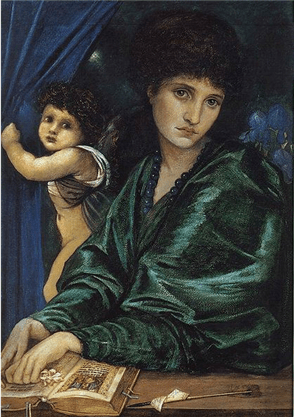
Portrait of Maria Zambaco
Burne-Jones Portrait of Maria Zambaco

MacCarthy’s biography is a fairly exhaustive study of Burne-Jones’ life and works, his marriage and family, life-long association and partnership with William Morris, his mentoring of younger painters and friendships with many important figures in art, literature, and politics and with a string of little girls, and his famous affair with Maria Zambaco. It discusses his association with the Pre-Raphaelites, the Arts and Crafts movement, and the philosophy of Aesthetics.

Burne-Jones believed strongly that beauty should be available to everyone. Hence, his involvement with William Morris in producing items of home decor, in illustrating manuscripts, and in designing stained glass windows for public venues. In fact, he is closely associated with the revival of the stained glass industry in England.

One surprise of this biography was to find the personality of a puckish jokester underneath Byrne-Jones’ ascetic, attenuated appearance. He continued throughout his life a schoolboy habit of drawing little caricatures of himself and his friends, particularly teasing ones of his good friend Morris. Although generally a moral person, he was understanding of the foibles of others and supportive of his friends, even those of whose habits he did not approve. He was beloved by many.

picture of Burne-Jones The Golden Stairs
Burne-Jones The Golden Stairs

I was interested throughout this book, even though much of it had to do with Burne-Jones’ struggles to finish work. He apparently had far more ideas than he could ever accomplish and was always working on many projects at the same time. The book is full of beautiful photographs of his art—although unfortunately most of them are too small to see the details—as well as of himself, his family and friends, residences, etc. The interiors of rooms are stunning examples of the Arts and Crafts movement.

A small quibble is the epilogue, which is concerned with the revival of interest in Burne-Jones. It is interesting up to a point, where it seems to be attempting to trace of ownership of every single work. Still, this is a fascinating biography.

Day 490: The Glass Palace

Cover for The Glass PalaceBest Book of the Week!
In the late 19th century, the kingdom of Burma was one of the wealthiest in southeast Asia. Its people were all literate, and no one in the country went hungry. Hundreds of thousands of Indians and people from other nearby countries traveled there to work on the waterways or the teak plantations.

In 1885, the Burmese government imposed a fine on a British trading company for avoiding taxes by under-reporting the amount of teak it was exporting. The British government used this incident as a pretext for invading the country and taking the royal family captive. King Thebaw and Queen Supalayat and their children, along with a few servants, were deported to India, where they were kept captive for the rest of the king’s life in a crumbling, poorly maintained house. Their personal possessions, including the king’s valuable jewelry collection, were confiscated and returned to England.

It is around this shameful incident that the beginning of The Glass Palace is constructed, an ambitious novel that tells the recent history of India and Burma/Myanmar through the stories of several related families. Rajkumar is a 10-year-old Indian orphan whose mother died in their attempt to reach Burma, and he is working at a small cooking stall near the palace when it is breached. He witnesses the removal of the queen and the princesses, and is struck by the beauty of Dolly, their young servant. Dolly is the only one of the lady’s maids who chooses to follow the royal family into exile.

Rajkumar goes to work for a Malayan businessman named Saya John Martins. With Saya John’s help and advice, Rajkumar eventually makes his fortune in the teak industry and finally travels to India to look for Dolly. She accepts his proposal and returns to Burma with her friend Uma, the recent widow of the first Indian Collector, the official in charge of the Burmese royal family.

These are just the bare bones of a dual story rich in characters and detail, on the one hand that of Rajkumar’s efforts to better himself, on the other hand that of the lives of Dolly and the royal family in exile. But this novel is not a love story, and that is just the beginning of this novel, which continues until the present. The novel follows the fates of Rajkumar and Dolly’s children and grandchildren and those of Uma’s nieces and nephews in India and Burma as the families intermarry with each other and with Saya John’s children. As we follow the fortunes of some family members in Burma and Malaya, other family members get involved in the Indian movement for independence from the British empire.

During the Japanese invasion and bombings of Burma and Malaya during World War II, various family members struggle to survive, one an Indian soldier in the British army, one a rubber plantation owner, one a photographer who disappears in Malaya. Rajkumar and Dolly and their daughter-in-law and grandchild are forced with thousands of other Indians to make the thousand-mile trek back to India.

Ghosh is interested in telling a complex story of culture and  history, so he keeps us at a remove from his characters, but that does not make the novel any less moving. The novel does an amazing job of exploring the roots of problems in Myanmar and India through its exposition of events and the varying points of view of its characters. This is a captivating and ambitious novel.

Day 479: Jane Austen: A Life

Cover for Jane Austen: A LifeIn Jane Austen: A Life, noted biographer Claire Tomalin has handily accomplished a difficult task. Because most of Jane Austen’s letters and papers were destroyed by well-meaning relatives, very little first-hand information about her life is available. As a 19th century unmarried woman, her experience was circumscribed, so the events of her life are ordinary ones. Descriptions of a life like this could be thin and lifeless, but Tomalin manages to provide us with a biography that is full of interest and lively and creates a convincing idea of Austen’s character.

From records, letters, the remaining few of Austen’s papers, and accounts of her by relatives, friends, and neighbors, Tomalin reconstructs the story of not only Austen’s life but of those who were important to her. Tomalin acquaints us with the members of Austen’s family and the bustling environment in the Steventon Rectory, where Jane’s father ran a small boys’ school. She describes friendships and visits to neighboring families. Even though Austen never used her own neighborhood in her books, it is easy from them to imagine the daily social calls and the housewifely tasks with which she and her female relatives were engaged.

It is not too hard to imagine the relationship between Jane and her sister Cassandra as close to that of Lizzie and her sister Jane in Pride and Prejudice, although Tomalin never mentions that either of these characters were based on real people. Still, the two sisters were extremely close.

Unlike Lizzie and Jane, though, both Jane and Cassandra were disappointed in love, Cassandra because her fiancé died, and Jane because her suitor needed to marry a woman with money. Tomalin makes the points that a married Jane Austen would probably have been too busy or too distracted to produce a body of literature and that later in life she seemed to understand some of the benefits of remaining single. As to the first point, it is certainly true that being removed without warning and against her will from Steventon because of the retirement of her father, and her family’s failure to settle anywhere for ten years afterward, completely cut off Austen’s literary production for that time period.

It seems that Austen’s status as a spinster with no money of her own gave her no control at all in her life about such questions as where she would live and even in one case when she could return home from a family visit. That is, she had no control until her late thirties, when she began to publish her novels. Even then, she ultimately earned very little money from them but enough to give her a small amount of autonomy.

Although most of the events of Austen’s life were relatively small, Tomalin’s book provides an absorbing account. I did not always agree with her interpretations of Austen’s novels, but I feel that this book allows me to know Austen and her family and friends a little better.

Day 478: Mr. Timothy

Cover for Mr. TimothyAlthough not typical holiday fare, Mr. Timothy picks up some of Dickens’ characters about 20 years after A Christmas Carol and has the added similarity of being set at Christmas time. The main character is Timothy Cratchitt, familiar to us as Tiny Tim.

Timothy is depressed and aimless. The patronage of Ebenezer Scrooge, or Uncle N as he is known in this novel, has had the unfortunate effect of making Timothy dissatisfied with his roots while not fitting him for much else. Most of his family has died or moved away, and he is depressed about the death of his father six months before. In despair, he has left his usual haunts and gone to live in a brothel, where he teaches the owner, Mrs. Sharpe, how to read. Although he has some desire to make his own way, he lacks purpose and initiative, still accepting an allowance from Uncle N. He seems to be on his way down in life.

Timothy goes out dragging the river for bodies one night with his friend Captain Gully, and they pull out a young girl. She has an odd brand on her back, like a G with eyes. Timothy realizes he has seen this brand before, on another girl the police were examining as he went by, who was found dead in an alley.

Timothy has several times spotted another young girl around the city and tried to approach her, but she has always run away. With the help of a street urchin named Colin, he finally tracks her down. Philomela is Italian and has had something traumatic happen to her of which she will not speak. When Timothy tries to take her home to safety, two different parties attempt to remove her from his custody on the street. A charity worker insists she will take Philomela to a home, and a mysterious man in a coach tries to kidnap her. Philomela and Timothy get away, but now Timothy is determined to find out what is going on.

This novel is a slow starter and fairly depressing at the beginning. Although it is feasible to theorize that Scrooge’s help could result in such unhappiness (ala Great Expectations), I wasn’t sure I wanted to think of the original story in these terms. However, the novel successfully invokes a Dickensian atmosphere, including the comic characters and character names, and it picks up its pace as Timothy gets involved in the mystery. After the first 50 pages or so, I was involved and trying to figure out the mystery, which is as entangled as any Dickens effort.

Day 468: The Invention of Wings

Cover for The Invention of WingsBest Book of the Week!

When I began reading The Invention of Wings, I thought it was purely historical fiction. It wasn’t until later in the novel, when some names rang a few bells, that I realized I was reading biographical fiction about two women whose accomplishments have been forgotten—Sarah and Angelina Grimké. A third important character, the slave Hetty, is fictional, except that Sarah was given a slave by that name when she was 11 and they both got into trouble when Sarah taught her to read.

The novel tells a remarkable story, narrated alternately by Sarah and Hetty (known as Handful), beginning in 1803. Sarah was born into privilege in Charleston, South Carolina. When she is given Handful as an 11th birthday present, slavery is already so abhorrent to her that she tries to free her slave. But legally doing so has been made more difficult, and her parents won’t allow it. Sarah is her father’s pet, and he takes pride in and encourages her intelligence, but when he finds out she thinks she can become a lawyer, he firmly rebukes her and bars her from his library.

Handful’s mother Charlotte is a strong and rebellious figure and a wonderful artist. She is the best seamstress in town and keeps the history of her life in a quilt she is sewing. By earning money hiring herself out behind Mrs. Grimké’s back, she is trying to save enough to buy the freedom of herself and her daughter. After Sarah’s mother has her brutally punished, she takes whatever liberties she can get away with, including sneaking away to have an affair with a freedman named Denmark Vesey.

As Sarah gets older, her sense of injustice deepens to the point where feels she must leave Charleston to move north to Philadelphia and become a Quaker. She is eventually followed by her much younger sister Angelina (Nina), where they become infamous for their lectures and articles on abolition, racial equality, and feminism.

http://www.netgalley.comFor the first half of the book, I was fascinated most by Handful, a character with a distinctive voice and personality. She becomes as gifted with her needle as her mother and loves to hear Charlotte’s stories of her African homeland. More subtly subversive then her mother, after Charlotte disappears, Handful visits Denmark Vesey’s household and assists with his attempted slave revolt. Later when Sarah and Nina find their purpose in life, I found both stories equally interesting.

This novel is remarkable. The Grimkés’ story is amazing, especially for their time, which was years before Uncle Tom’s Cabin. But Handful’s story is evocative, compelling, and touching.

Day 463: The Luminaries

Cover for The LuminariesBest Book of the Week! Year!

This last year I read several books that played wonderfully with structure. I’m thinking particularly of A Visit from the Goon Squad, a series of stories linked by their characters that somehow forms a whole, and Life After Life, in which the heroine’s life is repeated, with slight changes that lead to significant ones. I loved both of these inventive approaches to structure, and now I add to this list The Luminaries, the latest winner of the Man Booker Prize. This book is also my second recently reviewed novel set in New Zealand.

Walter Moody is newly come to the gold fields of the South Island of New Zealand in 1866. He has arrived in rough seas and is shaken by an apparition he has seen in the bowels of the ship. Seeking warmth and comfort, he checks into a seedy waterfront hotel and enters the parlor, where he accidentally interrupts the meeting of 12 other men.

After some initial hesitancy, the men begin telling him a series of tales, all interconnected, but the whole of which they cannot make out. The tales concern a missing trunk, a fortune found in a dead man’s cabin, the disappearance of a prominent citizen, the apparent attempted suicide of a whore. Each man at the meeting has his own part of the story to impart. Moody is able to make some sense of the story, but all go away from the meeting knowing that pieces are missing.

This section of the book is the longest, making up almost half its length. The cover of the novel, showing a waning moon, gives you a hint to its structure. It is divided into 12 sections, each one shorter than the one before but each one adding to the revelations of the original tales, until the final very short slivers of sections reveal all.

Each of these sections is also headed with an astrological chart that shows how the heavenly bodies are positioned within the signs of the 12 initial characters. This I did not understand at all, but Catton provides some indication at the beginning of the sections about what the astrology predicts.

The chapters of the novel are charmingly headed with old-fashioned descriptions of what happens in the chapter. Over time, the descriptions themselves begin to drive the narrative.

In The Luminaries, we’re presented with a novel that embodies a puzzle, a complex tale of villainy and foul crimes but also of love and loyalty. I was completely engrossed in  entangling the threads of this story. Despite its beginnings as a tale of cheats and chicanery, you may be surprised to find that you are reading a love story about two characters connected by their stars.