Day 425: The Gods of Gotham

Cover for The Gods of GothamBest Book of the Week!

New York in 1845 is a turbulent city. The political campaign between the Democrats and the Whigs is crooked and violent, and the recent influx of Irish poor is causing some Protestant leaders to preach against Papists. The recent establishment of a police force has been fought against by those claiming it impinges on their civil liberties.

Timothy Wilde is a bartender who has managed to save up $500 and intends to ask the woman he loves, Mercy Underhill, for her hand. A huge fire that ranges more than twenty blocks changes his plans, for his home is burned down with all his money in it and so is his place of work. His face is badly scarred as well, so Timothy believes his future is ruined.

His older brother Valentine, with whom he has a rocky relationship, has plans for him. Val has just been made a captain in the new police force and believes the copper stars–for that is what they are soon called because of their badges–is the place for his brother. Timothy is distrustful of Val’s intentions. His brother is a popular and charismatic leader of the firemen and the Democratic party, but Timothy also knows him as an opium addict and a wild man who hangs out with thugs. Timothy soon finds that the job suits him, however.

He is not long on the job before a child runs into him late one night, hysterical and covered with blood, saying “He’s going to tear him to pieces.” Wilde sees that she is a kinchin mab, or a child prostitute. He brings her home to the Dutch widow who is his new landlady instead of taking her in for questioning. When the girl recovers herself, she identifies herself as Bird and tells him a pack of lies. He soon finds out what she was talking about, however, when the body of a young male child prostitute is found in a trash receptacle.

Timothy’s investigation results in the discovery of a field full of bodies on the edge of the city–a total of 19 dead children with a cross carved into their torsos. Although the authorities try to keep this a secret, the word soon gets out. Then someone begins writing letters blaming the deaths on the Irish. Soon the city is a powder keg.

This novel is even better than Faye’s acclaimed first, Dust and Shadow. It depicts New York in all its grit and dissension and feels historically grounded. It introduces an honest, kind, and clever hero whom I hope we’ll see more of. The plot is full of twists, and although I managed to spot a perpetrator well in advance, the story was much more tangled than I expected. I thoroughly enjoyed this novel.

Day 421: The Ghost of the Mary Celeste

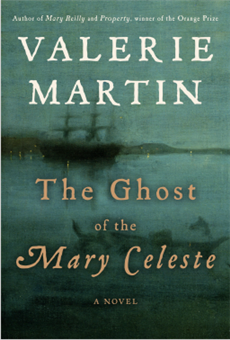
Cover for The Ghost of the Mary CelesteI haven’t read anything by Valerie Martin since her creepy Mary Reilly, which of course was a reworking of Dr. Jekyll and Mr. Hyde. I understand her novel Property won the Orange Prize, however, and The Ghost of the Mary Celeste was certainly worth reading, so I will look for some of her others.

This novel is based on the mysterious history of the Mary Celeste, a merchant ship that is famous for having been discovered in 1872 completely abandoned in the Atlantic Ocean. The captain, Benjamin Briggs, had his wife Sarah and two-year-old daughter Sophie aboard the ship, which had no other passengers, just the crew. No explanation has ever been found for the disappearance of everyone on board.

Martin’s book doesn’t so much attempt to offer us an explanation as add to the mystery surrounding this event.

The novel begins, though, with an earlier maritime tragedy. Captain Joseph Gibbs and his wife Maria go overboard in 1859 during a fearsome storm while she is trying to board a lifeboat.

Back at home after their deaths, Sallie Cobb is concerned about her younger sister Hannah, who claims their cousin Maria wants to take away her son Nathan, the little boy Hannah has been caring for since his parents were lost at sea. Maria’s family, the Gibbs, have been very unlucky at sea. Many of them having died there, including, of course, Maria. Sallie is worried about Hannah’s well-being, as she also claims that their mother, who died when Hannah was young, has been coming to talk to her.

Nathan only lives another few months, and Sallie is concerned about Hannah’s sorrow and her insistence that she has talked to both Maria and their mother. Sallie thinks that Hannah, who has always been fanciful, may be deranged from grief. Sallie is self-absorbed, however, for she is being courted by her childhood friend and cousin, Benjamin Briggs, Maria’s brother and also a sea captain, with whom she is in love.

The next section of the book leaps ahead in time to 1881 to follow Arthur Conan Doyle on a trip to Africa, where he is working as a ship’s doctor. It is during this trip that he decides to write a story about the Mary Celeste. Unfortunately, the story, which proposes a lurid explanation for the mystery, is understood by many to be true, even though he didn’t bother to research it and has almost all the facts wrong. Although he is taken aback by the response, especially of the victim’s families (whom he never considered), this story begins his writing career. Later he meets a spiritualist who has a connection with the Mary Celeste.

http://www.netgalley.comThrough such meanderings, including documents, newspaper clippings, journals, a journalist’s memoir, and visits with spiritualists, we eventually find ourselves back on the Mary Celeste by means of Sallie’s journal. This journal has found its way into the hands of Conan Doyle.

This story is haunting and melancholy, and Martin is not so much interested in what exactly happened aboard the Mary Celeste as in the event’s repercussions. Evocatively written, this novel will carry you along with it.

Day 412: Stone’s Fall

Cover for Stone's FallBest Book of the Week!
Ever since Iain Pears wrote the stunning An Instance of the Fingerpost, I have been waiting for him to come out with something that could match it for complexity and interest. He has finally achieved this with Stone’s Fall.

Did he fall or was he pushed? might be the question journalist Matthew Braddock is asked to answer when Elizabeth Stone hires him after her husband falls to his death from his office window. Instead, she asks him to find the child John Stone mentioned in his will. Stone’s estate is tied up during the search for this unknown heir, but Elizabeth says she has no ulterior motives except a sincere wish to follow her husband’s wishes. As Stone was an extremely wealthy but private arms manufacturer and the only person who could understand the complex structure of his inter-related companies, many are concerned in his affairs, even the British government.

Completely infatuated with the older woman and feeling wholly unqualified to find the child, Braddock instead concentrates on investigating the last days of Stone’s life and the state of his corporations. In doing so, he finds evidence that Stone’s net worth was not nearly as large as everyone thinks. He also has questions about the involvement of Henry Cort, a mysterious figure believed to work for the Foreign Office. Braddock relates the tale of what he discovered quite some time after his 1909 investigation, in 1953 after Elizabeth Stone’s funeral.

Braddock’s story does not answer many questions even though he believes he has found some facts, but after his narrative, he includes a manuscript sent to him by Henry Cort. Cort takes his own story back further, to events in Paris of 1890, when he befriends Elizabeth after having known her years before.

The final section of the novel takes us to Venice in 1867, when as a young man John Stone meets Cort’s parents and the man who invented the torpedo that began Stone’s empire. It is in this final section of the novel that we begin to understand the answers to the mysteries of John Stone’s life and death.

This series of narratives is like a set of nested gift boxes–as we unwrap each one, we learn more and go deeper into the story, finally beginning to understand the mysterious Stone. The novel is impeccably plotted and beautifully written–a great reading experience for those who appreciate a mystery that is not formulaic.

Day 411: Bellman & Black

Cover for Bellman & BlackWhen I heard that another book by Diane Setterfield was coming out, I was really excited, having enjoyed The Thirteenth Tale immensely. Although the previous novel was about a teller of fables, I enjoyed other aspects of the novel more than the fables themselves. Bellman & Black is actually an extended fable with a vaguely 19th century setting rather than a more traditional novel, and as such, I did not enjoy it as much.

William Bellman is a capable boy, liked by all, with a golden future. But one day when he is fooling around with his friends, he takes what seems to be an impossible shot with his slingshot and kills a rook without actually intending to. The boys go to bury the rook but end up desecrating it instead. They have no idea how these actions will affect their futures.

Bellman goes on to work at his uncle’s mill, where he proves himself more than capable and earns his uncle’s trust. He begins a career that eventually brings him great wealth, and his attention to the details of his enterprises is phenomenal. In his personal life, however, he is not so lucky, as he loses most of those closest to him to death. After a particularly wrenching loss, he is so grief-stricken that he can barely function, and at that point he makes a bargain with a Mr. Black, the details of which he can’t quite remember.

As I mentioned before, the story is told as an extended fable, in the style of a folk tale. Most of the characters are emblematic of a single characteristic rather than fully developed. Even Bellman, in his single-mindedness, seems one-dimensional. The writing is gorgeous and replete with detail, the setting atmospheric. It is easy to imagine the scenes Setterfield describes, but her characters remain enigmas.

http://www.netgalley.comPeriodically, a chapter ends with a few paragraphs about rooks, their appearance, habits, mythology. When we are told that the rooks in the tree by Bellman’s house are descended from the rooks in Norse mythology named Thought and Memory, this information is vital for understanding the story.

Even at the end of the novel, I did not feel I fully understood everything about the bargain Bellman made. In any case, beautifully written as the novel is, I sometimes found my attention wandering.

Day 410: Inheritance

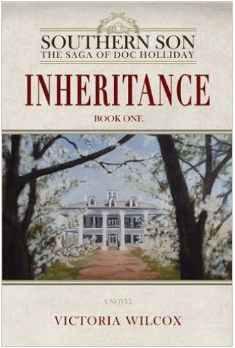
Cover for Southern Son: InheritanceIt seems extremely difficult to write a novel about an actual historical person. The writer must strike some kind of balance between doing justice to the person and to actual events and inventing details and dialogue to make the novel interesting. As well as having to invent huge swaths of the subject’s life, I am guessing that the author sometimes has to struggle with whether to include all the known events, especially if they don’t fit in with the author’s view of the subject’s character.

Inheritance, the first book of a trilogy about John Henry (Doc) Holliday, shows evidence of a great deal of research. It begins when Holliday is ten years old, shortly before he finds out his mother is dying from tuberculosis, or consumption. The novel follows his life until his departure from his home state of Georgia for Texas when he is twenty-one.

The engaging Doc by Mary Doria Russell, which I read a few years ago, revealed Holliday as a much-misunderstood individual, demonstrating how his reputation as a gunslinger was exaggerated by the press from a few incidents, showing his innate courtesy and all his contradictions. Despite its obvious intentions, Inheritance had the opposite effect on me, at times making me lose a considerable amount of my sympathy for him.

One false step is taken, I think, by starting the story so early in his life. He is supposed to gain our sympathy as a motherless boy with a stiff and judgmental father, but the depiction of children in this novel is not convincing. In fact, at the beginning of the novel I was troubled by flat characterization, as most of the main characters’ relatives and acquaintances have only one quality. His cousin Robert is competitive, his mother and cousin Mattie are loving, and so on. Only very slowly do some of the characters develop a few other dimensions.

The novel is written in a workmanlike style, a little too given to clichés, but certainly fluent enough except for a tendency to use “refugee” as a verb. There is some evidence of this usage as a colloquialism, especially during the Civil War, but it is used here in the narrative as well as in the dialogue.

Although the point of view appears to be third-person limited, at times it slips into third-person omniscient, which causes some confusion and a problem. Certainly, I do not hold with changing a person’s views to make that character more acceptable for the current time. Even when a fictional historical character has too modern a viewpoint, that bothers me. Holliday is definitely depicted as a racist who treats African-American characters even worse than I would expect from a character self-described countless times as a “gentleman.” So, when the reader cannot always discern the attitudes of Holliday from the attitudes of the narrator, the effect is unfortunate.

Overall, Inheritance is a novel that balances a great deal of knowledge of its subject with some inexperience in writing.

I received this book through a giveaway from Unabridged Chick.

Day 407: This House Is Haunted

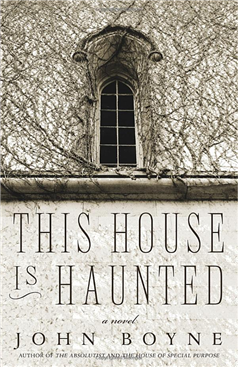
Cover for This House Is HauntedThis House Is Haunted fittingly begins when Eliza Caine and her father decide to attend a reading by Charles Dickens of his ghost story A Christmas Carol. Unfortunately, Eliza’s father takes a chill as a result of this outing and dies.

It is not long before the landlord informs Eliza that, rather than owning the house she has lived in all her life, her father had been leasing it, and the rent is exorbitant, too much for a schoolteacher to afford. Grief-stricken Eliza rather hastily decides that she wants to change her life, so she applies for a job as governess at Gaudlin Hall.

With this Dickensian beginning and the title of the novel, it is no surprise that Eliza will soon find herself living in a haunted mansion.

In fact, things become strange before Eliza even arrives at the house. In the station at Norwich, she feels someone push her in front of a train, and she only survives because a Mr. Toxley pulls her back. When Mr. Toxley and his friendly wife learn of her destination, however, they react oddly.

Eliza is especially taken aback by her reception in her new home. After being dropped at the house by Heckley, the surly and taciturn coachman, she is received by the children, Isabella and Eustace Westerley. No adults but Heckley are anywhere to be seen. She was engaged by an H. Bennet, whom she believed to be the master, but no one by that name resides at the Hall. When she finally gets a chance to talk with the Gaudlin solicitor, Mr. Raisin, he is evasive. The villagers behave oddly when they find out who she is. And the situation soon gets a lot worse.

All of this is a lead-in to a pleasantly creepy ghost story of a Victorian nature, with reminders of Jane Eyre and The Turn of the Screw. The narrative style is convincingly appropriate, more inclined to the descriptive than the conversational and old-fashioned without being difficult for the modern reader.

image for NetgalleyIf I have any complaint at all, it is that the title itself telegraphs a little too much too early. I did not feel the chill that I sometimes feel when a ghost story takes me by surprise. In addition, the style of writing itself promotes a lightness of tone that never led me to dread. In general, though, I found the novel entertaining and endearingly old-fashioned in style and tone.

Day 403: The Town

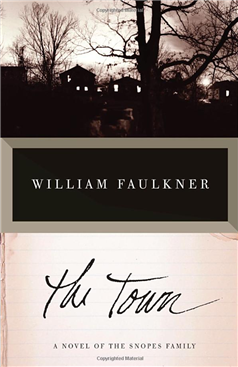
Cover for The TownThe Town is the second of Faulkner’s “Snopes” novels about the rise to power of Flem Snopes in Jefferson, Mississippi. Written in a style that is remindful of a bunch of old Southern men sitting on the porch swapping stories, it is narrated by three different alternating voices. As a pioneer in novels with multiple narrators, Faulkner is a master.

One of the narrators is a character we met already in The Hamlet, V. K. Ratliff, the itinerant sewing machine salesman who is most knowledgeable about Snopes’ true character, having been deeply scorched by him. Ratliff enlists the Jefferson city attorney, Gavin Stevens, in his observations of Snopes. The third narrator is Charles Mallison, Stevens’ nephew, who tells us himself that he wasn’t even alive during the times of his first tales but was told the stories by his cousin Gowan.

The novel covers the events of nearly 20 years, from the arrival of the Snopes family in Jefferson to the events shortly following the death of Flem’s wife Eula. Although some of the events are tragic, the tone of The Town is more comic than that of The Hamlet, perhaps because the lives of the folks in Jefferson are not as grim as those of the poor sharecroppers in the first novel.

The novel focuses first on the young Gavin’s infatuation with Eula Snopes. Rumor has it that Snopes’ appointment as power-plant supervisor–highlighted by his attempted theft of all the plant’s brass fixtures accompanied by an effort to frame the plant’s two black firemen for the theft–is in return for him closing his eyes to his wife Eula’s affair with Manfred de Spain, the town’s mayor. Young Gavin, newly returned from university at the time, is incensed by this rumor and determined to protect Mrs. Snopes’ reputation. Later, as Eula’s daughter Linda grows up, Gavin tries to save her from “Snopesism” by helping educate her and trying to get her a place in an eastern university.

These two novels are fascinating because of Faulkner’s ability to make central a character who barely has a line of dialogue in either book. He effectively makes Snopes the major presence in the novels by having the other characters observe the results of his actions while endlessly speculating about what he actually does and why he does it. As always with Faulkner, the prose is beautiful.

Day 402: Dust and Shadow

Cover for Dust and ShadowIn Dust and Shadow: An Account of the Ripper Killings by Dr. John H. Watson, Lyndsay Faye combines a great deal of research into the Jack the Ripper killings in 1888 with a vast knowledge of Sherlock Holmes literature to offer an entertaining solution to the crimes. The novel begins nearly 50 years after the events, when Dr. Watson places his narrative of the murders into a safety deposit box on the eve of war.

Inspector Lestrade comes to consult Holmes after the second murder, when police begin to realize the two deaths may be linked. Holmes immediately begins pursuing his usual means of detection–inspecting the body and the scenes of the crimes, trying to find out where the victims were last sighted, questioning the victims’ friends–and he very quickly figures out that another murder is related. He even hires an alert young prostitute, Mary Ann Monk, to make her own enquiries and observations after she identifies the body of her friend, Mrs. Nichols. However, he is soon frustrated by his lack of progress. The only lead Holmes has come across is the story of an elusive sailor, being sought by a friend who thinks he may have been involved in the first murder, that of Mrs. Nichols.

Soon Holmes and Watson have something else to worry about, for a member of the press is printing details of the crimes unknown to but a few. He has been alleging that Holmes himself may be the murderer.

Faye’s novel is atmospheric and absorbing. Its greatest accomplishment, though, is in successfully capturing the narrative style of Doctor Watson, making us believe that this could be a Holmes story. Although I was about 100 pages ahead of Holmes in solving the murder (which would never happen in a real Holmes story), I still found the solution ingenious as well as the reason why the crimes are recorded in history as unsolved (when, of course, Holmes solved them). This novel is a very good first effort. I have Faye’s next book awaiting me in my pile.

Day 401: Literary Wives: Ahab’s Wife Or, The Star-Gazer

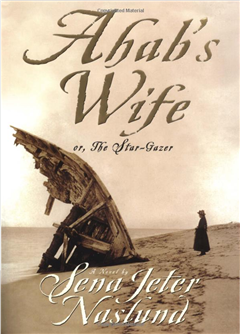
Cover for Ahab's WifeToday I am doing something a little different–participating in a virtual book-discussion group with Literary Wives. Literary Wives is a group of bloggers who are wives and are reading books about how wives are depicted in fiction. Toward the end of my normal review of this month’s choice, I will answer some specific questions that appear in every Literary Wives review. Be sure to check out the other reviews by Audra of Unabridged Chick, Ariel of One Little Library, Emily of The Bookshelf of Emily J., Carolyn of Rosemary and Reading Glasses, Cecilia of Only You, and Lynn of Smoke and Mirrors.

I have quite got to like what appears to be a newish fashion of rewriting works of fiction from a different viewpoint. Although it has produced some mediocre results, it has also produced some gems, a few of which are Wide Sargasso Sea by Jean Rhys, The Solitary House by Lynn Shepherd, and now, Ahab’s Wife by Sena Jeter Naslund.

I was somewhat put off by Naslund’s writing style in her most recent novel, The Fountain of St. James Court; however, it is imminently suited to her most well-known novel, this one, which is a reworking of Moby Dick. This novel is truly an adventure. It begins with a brief look forward to Una Spenser’s delivery alone in a cabin in the wilds of Kentucky of Ahab’s child, which does not live long, and the subsequent discovery that her mother has died in the snow while going for help. If this isn’t enough going on, while she is in labor, Una also has an encounter with bounty hunters looking for an escaped slave. Later, she helps the slave girl escape.

After this glimpse ahead in time, the novel returns to take a relatively straightforward path, beginning with twelve-year-old Una’s banishment from this same cabin in Kentucky. Una has faced some abuse at the hands of her father because of a difference in religious beliefs, so her mother sends her to her Aunt Agatha and Uncle Jonathan, where they live on a lighthouse island off Massachusetts. So begins Una’s fascination with the sea.

Although not every 19th century woman would think life with a loving, thoughtful, intellectually curious family confining, Una eventually finds it so, when she is sixteen. Her feelings are complicated by the arrival of two young men who come to prepare for the installation of a new light for the lighthouse. They are best friends Giles Bonebright and Kit Sparrow. Una knows she likes them both but is not at first sure which one she likes best. This fateful meeting is to affect the rest of Una’s life.

But I am writing nothing here that reflects how unusual this novel is. First, it documents the extraordinary life of an extremely uncommon character. If some of the other characters are not so fully drawn, you really feel as if you know Una. Next, in its occasional long asides and fits of oratory, it is a fitting companion to Moby Dick, with its dissertations on bits of whaling gear and its exhortations by Ahab. If any woman is a match for Ahab, Una is. Finally, its language and ideas are lyrical and soaring, as Una grows intellectually, meets her own life full on, and becomes acquainted with historical figures from her time and place.

If I have a caveat, it is that I feel the exceptional Una would have had more problems of acceptance in the actual 19th century American setting. In keeping with a theme about the enjoyment of life, not only does Una throw off debillitating experiences with little trouble or regret, but she also finds warm friends and acceptance everywhere she goes. It would give away too many plot points to discuss why I find this unlikely.

For Literary Wives: What does this book say about wives or about the experience of being a wife?Literary Wives logo

This novel does not draw on a conventional idea of a wife, particularly for the time it is set. For Una, being a wife seems to mean giving unstinting loyalty up to a point, but this loyalty can vanish fairly quickly if the relationship becomes disrespectful, and Una’s natural ebulliance takes her over some terrible difficulties with relative (and perhaps unlikely) ease.

I don’t think Una lets the conventional notions of wifehood affect her at all. She just does what she wants and what she thinks is right, but her ideas of right are different from other people’s. For her, a husband seems to be the more modern idea of a partner. Certainly, mutual respect, sexual attraction, and love enter into this equation but not so much the typical 19th century idea of duty.

In what way does this woman define “wife”–or in what way is she defined by “wife”?

I don’t think Una is defined by “wife” at all. I think “person” is more what Naslund is interested in. In a review of this book, it was referred to as a feminist, earth mother, reinterpretation of Moby Dick. I don’t see the earth mother so much, but the feminism is certainly there. “What was a promise? A way to enslave the future to the past,” Una thinks at one point.

Day 397: Sylvester, or the Wicked Uncle

Cover for SylvesterOn occasion, I reread a few of Georgette Heyer’s Regency romances, which have been some of my favorite reading for many years. Just recently, I reread Sylvester, which in some editions is titled Sylvester, or the Wicked Uncle.

The extremely eligible bachelor Sylvester, Duke of Salford, has decided to take a wife. His only difficulty is in deciding which of five eligible girls to marry. When his beloved mama mentions that she and her best friend made a plan for their children to marry many years before, he decides to go inspect the girl, his godmother’s granddaughter, to see if he might like her. Although he is warm and thoughtful to those he cares for, since his twin brother’s death, he has been aloof to others and comes off as haughty.

Sylvester’s visit is disguised as a hunting party, but Phoebe Marlow is informed by her detestable stepmother that the duke is coming to make her an offer. Unfortunately, Phoebe has already met Sylvester and took such a dislike to him that she used him as the villain in a novel she wrote. That novel is going to be published, despite all expectation. Normally, she would not expect him to recognize himself in a silly gothic romance that pokes fun at various society figures, but for the mention of Sylvester’s very distinctive eyebrows.

Fearful of her stepmother’s pressure and not understanding that Sylvester has no intention of proposing, Phoebe talks her childhood friend Tom into escorting her to her grandmother’s house. However, an accident and a snowstorm strand her and Tom with Sylvester in a small country inn.

After Phoebe gets to know and like Sylvester, she is horrified to find out that he has a nephew, since in her silly romance his character is a wicked uncle who wants to steal his nephew’s fortune. Another horror lurks, because Phoebe’s book proves to be a smashing success, much read by society members, who are all trying to identify their friends. Since Phoebe has never brought herself to admit to Sylvester that she wrote a book, she soon fears that people will find out she is the author.

Heyer creates delightful, engaging characters and puts them into silly and unbelievable situations, which is part of the pleasure of reading her novels. They are very well written, with entertaining and sparkling dialogue and a complete understanding of the customs, dress, and speech of the period. If you decide to read Sylvester, get ready for some fun. Many of Heyer’s novels have been re-released in the past few years, so they should not be hard to find.