Day 313: Murder on the Eiffel Tower

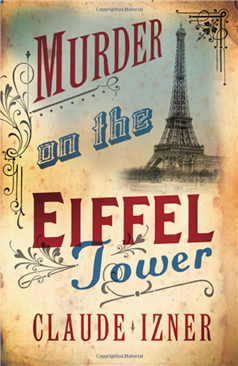
Cover for Murder on the Eiffel TowerThis mystery set at the opening of the Eiffel Tower has a nice sense of history and is well written, but like mysteries written early in the genre (which it is not), it depends almost entirely upon determining opportunity. There is no indication of motive until the lengthy written confession at the end of the novel–standard early detective fiction nonsense–that is, charming in earlier fiction, but not so much now. This novel was published in 2009.

People begin being killed by “bee stings” on or near the Eiffel Tower the day before Buffalo Bill arrives in Paris for the opening of the 1889 World Exposition. Bookseller Victor Legris starts looking into these incidents after he notices that Kenji Mori, his father figure and business partner, met with more than one of the victims near the time they were killed. He also begins to fear that the woman to whom he is attracted, Russian illustrator Tasha Kherson, could be involved.

I found Victor to be silly, not very good at investigating, and prone to overlooking clues. Many secondary characters are only sketchily drawn and therefore difficult to keep straight. So for me, despite all its promise and its setting in an exciting period of time, Murder on the Eiffel Tower was not a success.

Day 309: Parrot and Olivier in America

Cover for Parrot and OlivierBest Book of the Week!

Peter Carey’s Parrot and Olivier in America is a fictional riff upon Alexis de Tocqueville’s trip to America in the early 19th century, from which resulted the classic Democracy in America. Olivier de Garmont is the character meant to be Tocqueville, an aristocrat with liberal leanings who is nevertheless an elitist snob.

Parrot is his servant, a man who has lived a colorful but frustrating life. An Englishman, he has had his life disrupted since he was a boy by another French aristocrat, the Marquis de Tilbot, who spirited him away from England after his father, a typesetter, was arrested as an accomplice to forgery.

In dangerous post-revolutionary France, Olivier’s mother has decided it would be wise for Olivier to leave the country, as his liberal leanings have offended the conservatives, but he is unacceptable to the liberals because of his aristocratic birth. She ends up shipping him off to America with Parrot as his secretary, on loan from Tilbot and instructed to report back Olivier’s movements.

But America inflames Parrot’s own democratic leanings. He believes himself to have a talent for engraving that he has never been able to develop while working as Tilbot’s servant, and he resents his status as a “vassal.” While Olivier feels that their rocky start has developed into a relationship that is almost love, Parrot affectionately? calls him “Lord Migraine.”

This novel is narrated in alternating chapters by Olivier and Parrot. It is entertaining–wittily and robustly written–although sometimes we seem to have stumbled into a Dickens novel, especially when reading about Parrot’s early life. In fact, I read recently that Carey wrote an earlier book, Jack Maggs, based on Magwich of Great Expectations, so that feeling is probably not too far off.

Day 305: The Dark Enquiry

Cover for The Dark EnquirySome elements of Deanna Raybourn’s Lady Julia Grey romantic mystery series sometimes get old, such as the debate between Lady Julia and her husband Brisbane about how involved she is allowed to get in his investigations. This debate begins The Dark Enquiry, and eventually Brisbane reluctantly agrees that she can be a partner in his investigations, but not before she discovers for herself that her own proper, conservative brother, Lord Belmont, is being blackmailed. As a government official, he should have known better than to get involved with a lady, but especially to send her love letters. The lady turns out to be working for a foreign government.

In following up her investigation into her brother’s difficulties, Lady Julia disguises herself as a man to go to the Ghost Club, where Madame Séraphine holds nightly séances. There she is discovered by Brisbane. As they sneak back into the club together later in the evening, they are just in time to see Madame Séraphine be murdered by poison.

This novel is peopled with Lady Julia’s eccentric family, but it also features blackmail, gypsies, and spies. Raybourn’s novels are lively, and the dialog is entertaining. If we can just get over the endless debate about Julia’s part in the investigations, the series will continue to be fun to read.

Day 304: Flashman

Cover for FlashmanHaving enjoyed Fraser’s The Candlemass Road, I thought I would give his satirical Flashman series another try. I read one years ago but wasn’t prepared to be met with such an unmitigated scoundrel as the main character.

Flashman is the first of the series, and it begins when Flashman is expelled from Rugby. Apparently, the character is based on a bully who appears in Tom Brown’s School Days, a novel I have never read but which is frequently referenced in other literature.

Flashman at a young age is already a complete scoundrel, cheat, and poltroon, so the comedy in the novel centers around his ability to be successful and eventually to be lauded as a hero despite his true nature. Having set his sights on a position as officer in the Eleventh Light Dragoons, a unit he selects as unlikely to see combat, Flashman is getting along swimmingly under the ridiculous Lord Cardigan until he makes the mistake of seducing a Scottish merchant’s daughter and being forced to marry her. To the snooty Lord Cardigan this fraternization with the middle class is unacceptable, so Flashman is forced into an Indian regiment.

Flashman is not happy to be consigned to what was then regarded as second class service, but once he arrives in India he finds he enjoys bossing around the natives and discovers in himself a facility for languages. Unfortunately from his point of view, this talent gets him assigned to Afghanistan as an aide to Lord Elphinstone just before the infamous and harrowing 1842 retreat.

This satire of the army and society reminds me of Thackeray’s more subtle Vanity Fair. I think you have to be in the mood for Flashman’s antics, but the novel is based on solid historical research and is certainly entertaining. Fraser’s prose is incisive as he cuts swaths through Victorian society and skewers the ineptitude of the British army.

Day 299: Moriarty

Cover for MoriartyI thought the idea of a novel written from the point of view of Sherlock Holmes’ nemesis, Professor James Moriarty, was an interesting one, but since I always found the Moriarty plot tedious, I now wonder why I thought so. When I opened the book cover to find that John Gardner is the author of many, many series novels and Moriarty is one of them, I was further dismayed, not generally being a fan of series writing (although I have a small number of favorites) and being even more skeptical of someone who writes many different series. Moreover, don’t be mislead into thinking this is a Sherlock Holmes mystery–this novel is missing Sherlock Holmes entirely and it isn’t really a mystery.

The novel opens with two introductions, both putting forward the pretense that the novel  is based on newly discovered diaries of Moriarty, which cannot be reproduced because of their vile content. I suspect the truth is that Gardner found himself unable to sustain a convincing 19th century writing style, this hunch seeming to be confirmed by the modern writing style of the book and the dialogue.

The plot concerns Moriarty’s attempts to re-form his criminal empire after an absence of several years following the Reichenbach Falls incident, in which, if you’ll remember, Conan Doyle attempted to kill off both Holmes and Moriarty. In Moriarty’s absence, other criminals have taken over his various enterprises.

Although not badly written, the novel completely failed to capture me. I was not interested in any of the characters and in fact thought they made unconvincing and boring criminals. One incident early in the book that is artificially spun out by going back and forth in time and place is confusing, and such a device seems totally unnecessary.

All in all, I found the novel tedious and only finished about a third of it before quitting.

Day 297: Persuasion

Cover for PersuasionMost people have probably read Pride and Prejudice, which is a wonderful book, but if I had to pick my favorite Jane Austen heroine, it would be hard to decide between Elinor Dashwood of Sense and Sensibility and Anne Elliot of Persuasion. Probably fewer people are familiar with Persuasion.

Anne is no longer in the bloom of youth. Seven years ago she fell in love with a young naval officer named Frederick Wentworth, but Sir Walter, her superficial, supercilious father, did not approve. Perhaps the gentle Anne would not have been dissuaded from marriage, but her older friend and mentor, Lady Russell, talked her out of the engagement because of Wentworth’s lack of wealth and social position. Anne listened because she viewed Lady Russell as a surrogate mother, and she hasn’t heard from Wentworth since.

Now the family has fallen upon hard times, and Sir Walter is forced by his profligacy to lease their house and take rooms in Bath. He and Anne’s fashionable sister Elizabeth care very little for Anne, and they leave her to close up the house and make all the arrangements for its occupation by an Admiral Croft. Much harassed, she readies the house and tends to her hypochondriac, selfish sister Mary Musgrove. At least she enjoys the company of the children and Mary’s genial in-laws, with their two daughters Henrietta and Louisa and Anne’s brother-in-law Charles.

Anne meets the friendly Admiral and Mrs. Croft, and between their society and that of the Musgroves, begins to find a little pleasant enjoyment. However, she is soon dismayed to learn that Frederick Wentworth is Mrs. Croft’s brother, and he will be arriving soon. Wentworth is now wealthy and has retired from the service.

When he arrives, Wentworth pays little attention to Anne; in fact, she overhears him saying that she has changed so much he would not have recognized her. This remark distresses her very much, as her feelings have not altered. Soon he appears to be courting Louisa Musgrove. Anne finds it easiest to send Mary off into company while she stays home with her nephews.

After Louisa has a fateful accident on an outing in Lyme Regis, Anne finds herself taking charge and summoning help. Then she returns with Wentworth to notify Louisa’s parents. Feeling superfluous after the Musgroves leave with Wentworth for Lyme Regis, Anne decides she has no choice but to join her unpleasant father and sister in Bath.

What I love about Anne is her understated good will. Despite the insults by her family members and their general bad treatment of her, she tries to help them and to be a true sister and daughter to them. Despite Wentworth’s slights and attention to Louisa, she hides her feelings and remains faithful in her heart. Anne has much in common with Elinor Dashwood, except that Elinor is well regarded by her family and Anne is not. There is something delicate and understated in this novel, and in all of Austen’s work, that I appreciate in this more tempestuous modern world.

Day 292: Russia Against Napoleon: The True Story of the Campaigns of War and Peace

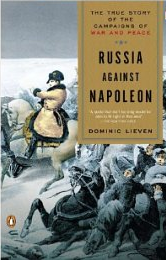
Cover for Russia Against NapoleonDominic Lieven explains in the introduction to Russia Against Napoleon that the popular conception of Russia’s role in the battles with Napoleon in 1812-14 is mostly derived from Tolstoy’s War and Peace. Tolstoy posited that the fate of Napoleon’s army was mostly a result of luck on the part of the Russians and the brutality of the Russian winter. Lieven also explains the reasons why most scholarship on this subject has been done from French, German, Austrian, or British records.

However, Lieven is able to convincingly show that the Russian victories, although of course partially due to luck, were mostly because of the understanding of Russia’s Emperor Alexander I and his field marshall, Mikhail Barclay de Tolly, of the kind of war Napoleon was good at and their refusal to give it to him. That is, Alexander and Barclay de Tolly planned from the beginning for a long, drawn-out war that would lure Napoleon deep into Russia, to be followed by a second campaign in Germany and France.

Lieven is a professor of history with the London School of Economics and an acknowledged expert on Russian history. Interestingly, he is also the descendent of three of the generals at the Battle of Leipzig.

Lieven’s book explains in the clearest terms the details of every campaign in those three years, taken from the Russian letters, diaries, and records that have not been readily available until recent years, as well as from the records of British observers and others of the combatants. He provides insight into the political jealousy and maneuverings and even to the details of staffing and provisioning the armies and maintaining the long supply lines needed when the Russian army entered western Europe.

Lieven’s analysis of war is comprehensive, and even though it is very detailed, it never seems to get bogged down in minutia. It introduces us to some colorful characters and vividly and suspensefully describes the battles.

The book’s only weakness for me was that it assumed a little more knowledge of the events immediately preceding these years than I had and knowledge also of the functions of the vast numbers of different types of troops. However, that lack of knowledge on my part did not really impede my understanding or detract from this very interesting history.

Day 283: My Alsace

Cover for My AlsaceDuring a visit to Alsace several years ago, I was fascinated by this book, especially by the pictures, but I could only find it in French. Then, awhile back, I found it on Amazon in English.

My Alsace was written by Hansi (Jean-Jacques Waltz), a beloved Alsatian poster and children’s book artist who grew up in the late 19th century under German occupation. In the 19th and early 20th centuries, the region of Alsace, which identifies itself as French, changed hands between Germany and France four times. In the German school at Colmar as a boy, Hansi only learned about the great Prussian victories and the defeat of Alsace in his history classes. He deemed this period the worst in his life and wanted Alsatian children to know that Alsace has a prouder history.

My Alsace is a selection from the history he wrote in 1912 and some writings from after World War I. The latter section of the book goes on to tell about the trouble he got into with the German authorities during World War I because of his jokes about Germans in the earlier book. He was originally fined and later he was given a year’s prison sentence for insulting a German officer. He published the latter part of the book in 1919 to celebrate the region’s liberation from the Germans.

Hansi’s drawings are wonderful. He was well known for his pictures of Alsatian villages, people in traditional costumes, and celebrations of Alsatian life from an earlier time. The text is amusing, although it is full of anti-German satire. Written for children about eight years old, it is also entertaining for adults.

Day 281: Gilead

Cover for GileadBest Book of the Week!
Gilead is the novel that precedes Marilynne Robinson’s Home, although it is set in the same time frame and covers some of the same territory. This novel won the Pulitzer Prize for fiction.

John Ames is an elderly Congregationalist minister in 1956 who believes he is dying. He has a much younger wife and young son, a surprising blessing in his old age. The novel is in the form of a diary addressed to his son in the expectation that he will not live long enough to personally pass on his family history and advice.

Ames lives in Gilead, a small Iowa town on the prairie near the border with Kansas. The town was founded by abolitionists during the Free State wars in Kansas as a refuge for slaves and fighters the likes of John Brown. Ames’ grandfather, also a minister of the warrior-for-God ilk, had visions of God and once preached a sermon in a bloody shirt with a gun in his belt. With that upbringing, his son was naturally a pacifist, who left the church for awhile after that sermon to worship with the Quakers. One of Ames’ most powerful memories is of the journey he made with his father to Kansas, in terrible conditions, to retrieve the body of his grandfather, who had returned there.

Although Gilead is certainly about the history of the town–the wars, the Depression, the Dust Bowl years–it is more about the relationship between fathers and sons, both from the secular and religious points of view. Not only does it explore the relationships within Ames’ own family, but it also looks at that between Ames and the son of his best friend the Presbyterian minister–Ames’ surrogate son–John Ames Boughton.

The story of John Ames Boughton is the one more thoroughly explored in the sequel Home, although interestingly enough, Gilead tells Boughton’s story more explicitly, while Home, narrated by Boughton’s sister Glory, only hints at some of the facts.

The novel, a celebration of life and faith, is beautifully written and full of ideas to ponder. That being said, as I do not particularly have a religious background or bent, I did not fully understand some of the narrator’s ideas and preoccupations. I found Home, although told from the point of view of the same goodness and piety, a more accessible novel than Gilead.

Day 274: Red Water

Cover for Red WaterBest Book of the Week!
I read this book on the recommendation of friend Dave Palmer. Thanks, Dave!

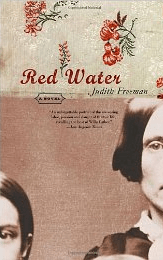
In Red Water Judith Freeman has accomplished something difficult–created characters whose beliefs I have no sympathy for, and who I’m not sure I even like, and made me want to read about them.

The novel is about the aftermath of the Mountain Meadows massacre of 1857, when 120 Arkansas emigrants on their way to California were slaughtered in southwestern Utah. This event is one for which the Church of Latter-Day Saints has never to this day admitted responsibility. In particular, this novel is about John D. Lee, the Mormon bishop who was eventually hanged for his part in the event, from the points of view of three of his wives.

Red Water begins with Lee’s execution in 1877, as Emma Lee looks back at her conversion to the religion in England, journey to Utah, and acceptance of Lee as a husband. Although he is twice her age and she will be his eighth wife, he is charismatic and commanding, and she marries for love.

Once she arrives in southwestern Utah, a barren and harsh landscape, she begins to hear things that disturb her. The initial version she is told of the massacre is that the settlers were slaughtered by Indians. But Lee has their stock in with his, and the settlement has a room stuffed with men’s, women’s, and children’s clothing, some of it badly stained. Other versions of the story come out, ones that point the finger partially, or wholly, at the Mormon men, some alleging her husband was a leader. But Emma feels she must trust her husband.

Emma finds she has other hardships. She is not Lee’s eighth but seventeenth wife, although the other nine have left him. There is jealousy among some of the remaining wives. Lee’s families are so far-flung that Emma often goes days without seeing him. The land is bleak and unforgiving, and the work is hard. But Emma decides to face every hardship cheerfully.

Ann is Lee’s child bride, married to him at the age of 13 shortly after his marriage to Emma. Her narrative begins after Lee’s death as well, when she has long been separated from the family. On a pursuit of a horse thief from Idaho to southern Utah, she finds herself back in Lee’s old territory and reflects upon her life with him.

Ann marries Lee to keep her mother, who has lost faith and criticized the Mormons, under Lee’s protection. Despite their age difference, she is also attracted to him. After an initial rough start with Emma, the two became the closest of friends.

However, by the time Brigham Young sends Lee away from the southern settlements that he helped found and banishes him from the order as a scapegoat for the massacre, Ann has made some disillusioning discoveries and decides that Lee’s driving forces are greed and the pursuit of power. She leaves the family to wander on her own, often dressed as a boy.

Once Lee is thrown off by the Mormons, Emma and Rachel keep faith with him, but only Rachel willingly shares his prison. Her narrative is the last. As an old, bitter woman, she fights to survive in a remote area of northern Arizona where Lee has sent her.

This novel is fascinating for the details of the characters’ beliefs and the hard lives that they must live in settling these wild parts of the country. I also find fascinating the ability of men to rationalize as the will of god whatever foul or greedy things they want to do. Freeman’s portrayal of her characters, however, is amazingly unjudgmental and perceptive.

On a side note, for those who are interested in this subject, an excellent nonfiction source about modern fundamentalists, whose beliefs and rationalizations are strikingly similar to those depicted in this novel, is Jon Krakauer’s Under the Banner of Heaven.