Day 272: Moby Dick or, The Whale

Cover for Moby DickThose who know me well will be surprised to see me reviewing this book, because one of my stories is of my horror, when first trying to read it, to find an entire chapter about one rope. At that point, Moby Dick became the first book I ever stopped reading. However, I got interested in trying it again by listening to the Moby Dick Big Read. I listened to the beginning chapters and finally picked up a copy to finish it.

The plot, of course, is about the sailor Ishmael, who decides to go whaling for the first time, the people he meets, and his experiences–and about the obsession of his captain, Ahab, to kill the whale that took his leg.

Moby Dick is not for everyone. The novel is not simply an adventure tale about whaling but also a dissertation on whaling history, a series of philosophical essays, an explication on types of whales, on the different parts of a whale, on pieces of whaling equipment (hence, the chapter on the rope), even a musing on the color white.

The novel also has a sort of schizophrenic narration, starting out as first-person limited from the point of view of Ishmael, but then at other times taking the point of view of Ahab. The writing style rips back and forth from simple story telling to a kind of heightened, bombastic oratory. Characters do not so much speak as give speeches.

The novel is immense, but it is meant to be immense–the way Melville saw America and its possibilities. I have over the years read different interpretations of this work (the whale as a symbol of evil, etc.), but one that strikes a chord with me is that it is a reflection on some of the American political ideas of the time, particularly Manifest Destiny. While seeming to admire the grandiosity of such ideas, Melville is, with one whaling story, also warning of their possible effects and ramifications.

I can see why some academics have devoted their careers to this work, because it can be endlessly examined and interpreted. I finished reading it this time, but I can frankly admit that it is still a bit too much for me and is probably better suited for someone who is more contemplative in his or her reading.

Day 271: The Abyssinian Proof

Cover for The Abyssinian ProofIn 19th century Istanbul, the magistrate Kamil Pasha  is assigned to find out who is stealing valuable relics throughout the city and selling them to London. He is instructed to find the relics and bring them back to where they belong. One of the relics is contained in a reliquary that has been guarded since the last days of the Byzantine Empire by a sect of Abyssinian descent called the Melisites. The relic is called the Proof of God.

Kamil is an upright and dedicated civil servant. While he is investigating, he learns about the history and beliefs of an odd group of people, the descendents of Abyssinian slaves who live in an abandoned cistern and are part of the city’s underworld.

In pursuit of the relic thieves and in investigation of some apparently related murders, we follow Kamil through the subterranean passages under Istanbul.

Kamil is also attracted to Elia, a refugee artist who lives in his sister’s house. Elia has suffered terribly, though, and is not really prepared to pursue more than friendship.

As with Barbara Nadel’s more modern Turkish mysteries, I find novels set in this exotic locale interesting, and the history presented in The Abyssinian Proof is fascinating. Sometimes, I wish that Kamil Pasha wasn’t quite such a serious man, however.

Day 264: The Ballad of Tom Dooley

Cover for The Ballad of Tom DooleySharyn McCrumb has written several series of light mysteries, some better than others. I have usually enjoyed her “ballad” series–atmospheric, sometimes ghostly mysteries set in Appalachia and each named after a traditional folk ballad. The Ballad of Tom Dooley, despite a background of historical research (because this folk ballad is based on a true case), is not her best, however.

According to McCrumb’s notes at the end of the novel, she got interested in the story after researching it for an article and decided that the prevailing theories of the crime are not satisfying. So, she reconstructed her theory of the crime in this book. As such, it is not so much a mystery as an explication.

Most people vaguely know the story, that Tom Dooley (actually Dula) met Laura Foster “on the mountain/stabbed her with [his] knife.” Another defendant, Ann Melton, was let go. But McCrumb says most people in Wilkes County, where the crime occurred, will tell you Ann did it. To McCrumb, knowing that Ann was Tom’s long-time married lover, Tom being guilty didn’t make sense.

The novel is narrated by two characters who were actually involved in the incident: Pauline Foster, who was Ann Melton’s cousin and servant girl; and Zebulon Vance, the ex-governor and senator of pre-Civil War North Carolina who defended Tom. Pauline is an interesting character–McCrumb depicts her as a sociopath who manipulates the others and wants revenge for Ann’s slights.

The biggest fault in the novel is the narration of Zebulon Vance. At first, I thought McCrumb’s intent was to depict him as a maundering old bore, possibly even senile, as his section is so repetitive and adds so little to the narrative. It is mostly about himself and has little to do with the story. But then I read that Vance’s career was one reason McCrumb wanted to do the story. Instead of adding to it, it detracts from and drags against the impetus of the plot.

The fact is that none of the characters are likable people, and the crime isn’t particularly interesting. From the author of some haunting stories, this novel is a disappointment. If McCrumb wanted to write about Vance, she may have done better to write a biography.

Day 262: River of Smoke

Cover for River of SmokeA month or two ago I reviewed Sea of Poppies, Amitav Ghosh’s riveting first book in his Ibis trilogy. I have been waiting since then for a good opportunity to post my review of River of Smoke, the second book in the trilogy.

The various passengers and crew members of the Ibis have been separated and now several of them travel toward China on three different ships. Paulette Lambert has been taken on the Redruth by Filcher Penrose, a nursery man for a major botanical garden who hopes to exchange New World plants for those of China. He has hired Paulette, whose father was a renowned botanist, to help take care of the plants.

En route to China with a shipment of opium, the merchant Bahram Moddie, Ah Fat’s father, takes on the disgraced Raja Neel as a munshi, or clerk. Neel travels on the Anahita to Canton in Bahram’s entourage under the name of Anil Kumar.

The Ibis, now containing the owner Benjamin Burnham, is also on the way to Canton.

In Macao, Paulette meets a friend from her childhood, Robin Chinnery, the unacknowledged illegitimate son of a famous painter. As a woman, Paulette is not allowed into Canton. She can only go as far as Hong Kong, then a desolate, almost uninhabited island, where she searches for plants. But Robin goes on to Canton with a mission to try to find out for her and Penrose who painted a picture of a golden camellia and possibly to trade for such a plant.

Robin is in town during the unsettled days before the beginning of the Opium Wars, when the Chinese Emperor is trying to halt the opium trade into China, while the opium traders are purposefully trying to instigate war so that they can call for the intervention of the British navy. Robin’s entertaining letters to Paulette keep us informed about the political debate as he is befriended by Charles King, the only merchant of stature who believes China is in the right.

Bahram Moddie, a well-meaning man who loves Canton on sight, has unfortunately invested his entire fortune in this shipment of opium. He is caught between his conscience and his need to be successful as the Chinese government tries to keep the foreign ships at bay.

As rich in language and storytelling as the first book, this novel is completely engrossing, showing the American and British opium dealers as the venal, hypocritical men they are, with their self-serving arguments about Free Trade and their arrogant disdain for their Chinese hosts. I’m afraid it may be two or three years of waiting before I can read the final book in the trilogy.

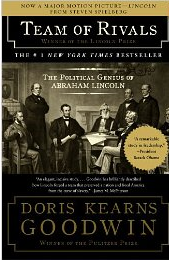
Day 260: Team of Rivals: The Political Genius of Abraham Lincoln

Cover for Team of RivalsBest Book of the Week!

Doris Kearns Goodwin begins her examination of Lincoln’s administration by remarking that because so much has been written about him, everything might be thought to have been said. However, by examining his career in terms of the team he put together to run the country, she found much more to write about.

This team consisted of his rivals in politics. Edwin Stanton, who treated Lincoln with contempt on their first meeting and who Lincoln made Secretary of War, was griefstricken at Lincoln’s death. Salmon P. Chase, eternally Lincoln’s rival for the presidency and a frequent undercutter, was an extremely competent Secretary of the Treasury. William H. Seward, the favorite for the Republican presidential nomination that Lincoln won, was at first inclined to underestimate Lincoln but became his closest friend and advisor as Secretary of State. Edward Bates, the Attorney General, was a homebody who was not sure he wanted a public life and at first looked upon Lincoln as well-meaning but incompetent, but ended up thinking he was very nearly perfect.

Team of Rivals begins on the day of the Republican convention of 1860, in which, of the rivals who had some expectation of winning the nomination of the party, Lincoln would seem to have the least. Seward was the odds-on favorite, but he had made many enemies in the party. Chase’s overwhelming ambition for the presidency lead him on several occasions to ignore the warning signs that he would not be the nominee. Bates was willing to act if nominated but made no extraordinary efforts because he preferred his home life.

Goodwin’s narrative then turns farther into the past to trace the men’s respective careers. In this examination she shows how Lincoln cleverly set himself up to be everyone’s second choice for the Republican nomination.

The book follows Lincoln’s nomination, campaign, and stunning victory, but the bulk of it concerns the compelling story of how he put together a cabinet containing these men, who were not only rivals for the office but who were from different regions of the country and who had different views on the important issues of the day. He then managed to work with these men and run the country during one of its most difficult times. It was frequently rumored that Seward actually held the power, but Goodwin shows us that Lincoln was always in charge.

Through an examination of the diaries of the men, letters, and other sources, Goodwin provides us with the fascinating details of political machinations, the conduct of the war, the fights among the generals, the alliances and friendships, and the story of how several men, who began with no esteem of Lincoln at all, grew to respect and love him.

Goodwin’s book is one of the most absorbing history books I have read. Although it is long and takes awhile to read, it explains each issue in completely lucid terms and interesting detail. The most important thing I got from the book was a fuller understanding of Lincoln’s greatness, his humor, kindness, and magnanimity–and what a disaster for the country his death was.

Day 257: Galore

Cover for GaloreA whale comes ashore at the remote coastal town of Paradise Deep, Newfoundland, in the early 19th century. The people, who have been starving all winter, come out to scavenge what they can of the meat. When Devine’s Widow, an old Irish “wise woman,” cuts open the belly of the whale, a man falls out, pale as an albino, mute, but still alive. Although he stinks like a fish, the Devine clan gives him room in a shed and calls him Judah. Nevertheless, he is treated with dread and superstition until he goes out fishing one day with Colum Devine and they take a huge load of fish in waters that have been barren that season.

The Devines have been at odds with the powerful King-Me Sellers since he proposed marriage to a young Irish bondswoman years ago and she refused him rudely, then went off to marry Devine, practically the first young man she met. Their relationship was not improved years later when King-Me’s daughter Lizzy married Colum Devine.

When King-Me’s spite turns against Judah, the only way the Devines can save him is by marrying him to Mary Trephyna Devine, Colum and Lizzy’s daughter and King-Me’s granddaughter.

Michael Crummey’s multigenerational novel captures the relationships between these two families along with the history of the town, with all its eccentric characters, ghost stories, myths, and tall tales. The novel is fascinating, unusual, and beautifully written. I don’t usually enjoy magical realism, but in this novel it is handled so well that I accepted it and was engrossed in the story. Galore is probably unlike any novel you are going to read, although in its focus on a sea-going people and its occasional feel of a sea tale, it reminds me a bit of We, the Drowned  by Carsten Jensen.

Day 241: True Grit

Cover for True GritBest Book of the Week!
After the Coen brothers version of True Grit came out a couple of years ago, I became curious about the book. If you have seen that version of the movie, it is almost identical to the book and is much more faithful to it than the version from 1969 starring John Wayne.

For those who are not familiar with the plot, 14-year-old Mattie Ross travels into Indian Territory intending to track down her father’s murderer, Tom Chaney, a hired man who killed Mr. Ross for his extra horse. She looks for the U.S. marshall with the most grit and is pointed to the drunken Rooster Cogburn, who is reluctant to take on the job. She also meets a Texas Ranger named LaBeouf who is after Chaney for the murder of a Texas judge. Mattie is determined that the villain will hang for the murder of her father.

What makes True Grit unusual is the portrait of Mattie through her own words. She is indeed a unique character in fiction, scrappy, opinionated, tight with her money, not to be cheated, not to be turned from her self-imposed task, and tough as nails. Her narration drags us into the story and won’t let us go until it is over. This will be a quick read, because you won’t be able to put the book down.

The characters also speak in a stylized way using old-fashioned dialect that seems oddly formal and elaborate to our ears. It is expertly reproduced in the more recent movie.

If I can combine a book review and movie reviews, I have to say, “Sorry, John Wayne fans.” The Coen brothers movie starring Jeff Bridges is much better. I rented the 1969 version shortly after seeing the other movie and was surprised to see the contrast. Not only has the 1969 version been bowdlerized a bit, but the difference lies principally in the atmosphere created and the acting. The older movie is shot in standard western territory, probably in the hills of California, while the newer one is shot in a bleak landscape that makes us feel the danger and solitude.

As far as acting is concerned, Glenn Campbell as LaBeouf is pathetic as an actor, stiff and awkward. LaBeouf in the more recent version is played by Matt Damon, and I didn’t even recognize him for quite some time, so much does he submerge himself in his role. Although years ago I thought Kim Darby was good as Mattie, Hailee Steinfeld, acting at a younger age, is amazing. The older movie also minimizes but still fails to carry off the unusual style of dialog, coming off as stilted, whereas the newer movie embraces it.

Day 237: Neverland: J.M. Barrie, the du Mauriers, and the Dark Side of Peter Pan

Cover for NeverlandDuring the past year I read Margaret Forsters’ biography of Daphne du Maurier, and I find that Neverland makes a fascinating contrast with it. Piers Dudgeon traces the history of the du Maurier family and speculates how their relationships with J.M. Barrie, the author of Peter Pan, adversely affected them. Several members of the family were indeed disturbed, but the question is, how much, if anything, did that have to do with Barrie?

Dudgeon paints Barrie as a sociopath without exactly calling him one. Barrie grew up unloved by his hypochondriac mother, who took to her bed with the death at fourteen of her favorite son David. Barrie was six at the time and was never able to attract much of her attention, even resorting to dressing up as his brother and imitating him to try to get her to love him. This behavior is indeed bizarre, but Dudgeon makes the first leap by alleging that Barrie must have somehow caused his brother’s death to have been so neglected.

The early life of George du Maurier is not similarly examined (George being Daphne du Maurier’s grandfather); instead, Dudgeon zeroes in on du Maurier’s experiences as a young bohemian in Paris. Du Maurier is best known as the author of Trilby, a novel in which Svengali takes over the life of a young woman by means of hypnosis and eventually ruins her. This novel is based at least in part on the experiments of du Maurier and a group of friends during which they repeatedly hypnotized a young artist’s model. Du Maurier apparently regretted this episode in later life, although he did not give up “mesmerism,” and what he called “dreaming true” (self-hypnosis) until he married, and he later returned to his experiments.

Dudgeon uses this background to weave the theory that Barrie–who admired du Maurier’s first book, Peter Ibbetson, a story about a man who can escape the bounds of space and time by “dreaming true”–was somehow rejected by du Maurier and took his revenge by purposefully befriending and dominating members of du Maurier’s family, causing changes in their behavior. There is actually no proof that du Maurier and Barrie ever met, although Barrie certainly befriended Sylvia Llewellyn Davies, George’s daughter, and her children. It is also clear that he “stole” her children. Both Sylvia and her husband Arthur died when the boys were quite young, and Barrie copied the letter that Sylvia wrote during her last illness requesting the children’s nanny and her sister Jenny to take charge of the children, changing “Jenny” to “Jimmy,” and thereby co-opting the children. Oddly, none of the du Mauriers seems to have objected to that, to which Dudgeon ascribes more sinister goings-on. Of those boys, only one seemed not to be at all disturbed by their upbringing with Barrie.

Modern minds will think sexual abuse, of which there are indeed some indications, but Dudgeon thinks Satanism, if that’s not an exaggeration. And here we get to Peter Pan, who was not intended to be everyone’s picture of innocent, irresponsible boyhood, but who Barrie intended to be a villain, a Pan or “demon boy” figure, a pixie who stole other people’s children, who hated mothers, and who killed without compunction. Barrie was good at hiding the antisocial nature of his work behind saccharine sentiments, but this depiction is indeed what he intended, and Dudgeon of course sees Peter Pan as a self portrait of Barrie.

Dudgeon presents a great deal of information about the various fates of the Llewellyn Davies boys, but he spends his final chapters on Daphne du Maurier, their cousin. Margaret Forster’s view is that du Maurier’s tendencies toward homosexuality (borne out by some affairs and statements by du Maurier herself) and possible affair with her own father colored her life and affected her relationships with her husband and children–that and an appalling degree of selfishness. But Dudgeon doesn’t think she was homosexual at all. He believes that she and her father Gerald, a well-known actor who appeared in several Barrie plays, were so overshadowed by Barrie that her “demon boy” self came out in adolescence and dominated most of her life, until she suffered a breakdown in her 50’s.

I am not criticizing this book for lack of interest–it is indeed engrossing. But Dudgeon hangs a great deal too much of his tale on the assumption that most of Barrie’s and both the du Mauriers’ writings were autobiographical in some way. Even if they were, many of the quoted passages can be interpreted in more than one way. Barrie’s submersion of the children into a fantasy life certainly doesn’t seem to have been good for them, and as I said before, there is some indication in his own writings of the possibility of child sexual abuse, but I don’t know what else can be said with authority.

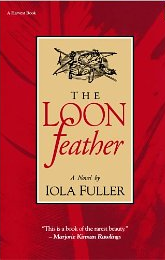
Day 236: The Loon Feather

Cover for The Loon FeatherBest Book of the Week!
The Loon Feather by Iola Fuller is one of my favorite books from when I was a girl, and I still read it every few years. A fascinating story set on Mackinac Island, it compelled me to visit every spot mentioned when I was on the island during a vacation.

Set in the early 1800’s, the book starts with the birth of its heroine Oneta. She is Ojibway and the (fictional) daughter of Tecumseh, the famous Shawnee leader. A prophecy at her birth says that she will bring a husband to her people who will be more powerful than a warrior. No one knows what that means, but prophecies are apparently always right.

The beginning of the book traces the seasonal nomadic life of her people, followed during her early childhood. Tecumseh is killed fighting for the British against the Americans in the War of 1812 when Oneta is young, and she is raised by her mother and her grandfather. A wise woman, Marthé, is also important to her as a young child, but Marthé leaves them all to marry a French trapper.

The Ojibway make a yearly trip to Mackinac Island, where part of the settlement from the war is payment of reparations from the Americans. The island is a fascinating mix of Native American, French, and American cultures. Here Oneta and her mother encounter Marthé, who lives on the island with her husband and young daughter, and they gladly visit back and forth. But before the tribe departs for the year, Oneta’s mother becomes ill, and Oneta is left there to care for her until her grandfather returns the next year. After Oneta’s mother recovers, she works as a maid up at Fort Mackinac and meets a French accountant for the Astor Fur Company, Pierre, who marries her.

At first we see things only from Oneta’s point of view as a Native American. As Pierre’s fastidiousness and different tastes clash with his bride’s customs, misunderstandings arise. However, Oneta is eventually sent away to a convent school to be raised as a French girl.

When she returns to the island as a proper young woman, she is at first inclined to disdain her true heritage and must find a balance between it and what she owes to Pierre and Madame, his mother. She also witnesses the struggles of Pierre and her younger brother Paul, who prefers his Native American roots and envies Oneta her heritage.

The colorful setting is populated by French voyageurs, American soldiers and capitalists, and the Native American tribes, who begin to become aware how the workings of history are fundamentally changing their way of life.

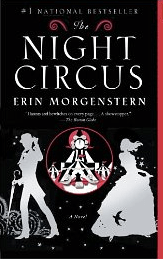
Day 228: The Night Circus

Cover for The Night CircusIt is the mid-19th century. Prospero the Enchanter raises his daughter Celia Bowen as if she were an apprentice magician, only it is not magic she is working. Continuing an ancient disagreement, Prospero challenges the man in the gray suit to a competition–his daughter against any opponent. So, the man in the gray suit takes a young boy out of an orphanage.

Both children grow up training for this elusive competition, and when they are adults, the man in the gray suit collaborates in creating the Night Circus and sends his protégé Marco to work for its designer. Soon Celia is employed by the circus as an illusionist, and Celia and Marco take up the competition with no understanding of its rules. Celia doesn’t even know who her opponent is.

The Night Circus is a marvelous place, all white and black and gray, constantly growing and changing. It becomes the venue for and creation of the competition.

The Night Circus has been extremely popular, and it seemed like it was right down my alley. However, although it is entertaining enough and is certainly based on an original idea, at some point my interest began flagging.

I think one major problem of the novel is that we are constantly told how wonderful the circus is, but Erin Morgenstern fails to describe it in a compelling way. Descriptions are vague instead of specific enough for readers to imagine a scene. In two or three consecutive pages, for example, I just happened to notice that Morgenstern used the word “elaborate” five or six times with no attempt to describe each object beyond that word. The details she does divulge don’t sound as if they would be that interesting, and frankly, a black, white, and gray circus seems to be the invention of a person more concerned with style than enchantment. An important part of a circus is the vibrancy of color. I felt no sense of wonder, was never surprised or beguiled, and I was occasionally confused, especially concerning the “wonderful coalescence” described in one scene. What does that mean? Although the competition turns out to be about life and death, I also never felt any sense of danger.

Another problem for me is the fable-like quality of the novel, which treats the characters more emblematically than as real people. You feel some sympathy for Celia and Marco, but you don’t know what they are like. Overall, I found the novel mildly disappointing.