Day 222: The Hare with Amber Eyes: A Hidden Inheritance

Cover for The Hare with Amber EyesBest Book of the Week!

In 1994, the world-class ceramics artist Edmund de Waal inherited a collection of 264 netsuke from his great uncle Ignace (Iggie). De Waal decided to trace the history of the netsuke from the time they came into his family, and in doing so, to trace the history of the family itself and the times they lived in. The result is a fascinating combination of memoir, history, art history, and collection of musings on related topics, The Hare with Amber Eyes.

Charles Ephrussi originally purchased the netsuke in Paris during the second half of the nineteenth century. The Ephrussis were at that time a wealthy family of bankers, originally from Odessa, who in previous generations had expanded their offices to Vienna and from there to Paris. Charles Ephrussi was not a banker but a noted art collector and critic, friend of Impressionists such as Degas and Manet, and one of the two models Proust used for his character Charles Swann.

De Waal attempts to understand Charles through an examination of his writings and possessions and through events in his time, particularly the effect of the Dreyfuss case on antisemitism in France. Charles’s work in art was an important part of his life, and in this section of the book I was struck by the connection de Waal makes between Japonisme–the interest in and collection of Japanese artifacts, with their focus on nature and everyday life–and the rise of Impressionism, which was considered revolutionary partly because of its focus on nature and everyday life instead of “noble” subject matter such as historical scenes or stories from the Bible or mythology.

In 1899, Charles sent the netsuke to Vienna as a wedding present for his younger cousin Viktor Ephrussi, de Waal’s great grandfather and eventual head of the Ephrussi bank in Vienna. De Waal traced what he could of the life of Viktor and his family, this story culminating shortly after the dual terrors of the Anschluss and Kristalnacht. During this time, everything that this branch of the family owned was confiscated by the Gestapo. In these pages of the book, de Waal does a better job of conveying the fears and anxieties of those times than any of the recent books I have read.

De Waal’s grandmother Elisabeth recovered the netsuke after the war. How they returned to the family is an incredible story that I will not reveal. Shortly after she returned to England with them, where some of the family had made their home, they traveled to post-war Japan with de Waal’s great uncle Iggie.

I have just supplied the barest outline of the fate of the netsuke, which provides a focus for de Waal’s investigations and musings, but the family’s story and the story of their times is fascinating and imaginatively reconstructed. The book is at once a meditation on and enthralling depiction of the life and times of an extraordinary family.

Day 218: Sea of Poppies

Cover for Sea of PoppiesSea of Poppies is an absolutely enthralling historical novel, the first of a trilogy. Set in India in the 1830’s, it is centered around the opium trade, which the British East India Company forced upon both India and China. The novel is an ensemble piece, following the fates of several characters who all find themselves by the end of the book on the Ibis, an old slave ship bound for Mauritius.

The novel begins with Deeti. Like the other Indian farmers in her area of eastern India north of Calcutta, she has been forced to replace her food crops with poppies, destined for the Ghazipur Opium Factory. Now she can barely grow enough to feed her family, while the price for poppies sinks. As a girl, she was tricked by her husband’s family into marrying a hopeless opium addict. Soon fate will cause her to leave her home and flee down the Ganges.

Zachary Reid is a mulatto sailor who ships out from Baltimore on the Ibis as an ordinary seaman. A series of misfortunes onboard leave him without officers to sail the ship to Calcutta from Africa with only the help of Serang Ali and his fellow lascars. Once in Calcutta, his employer Benjamin Burnham hires him to help refit the ship and take the third mate position for the voyage to Mauritius.

Raja Neel Rattan Halder, the zemindar of Rashkali, is deeply in debt because of poorly timed investments in the opium trade. Although Neel is careful of the welfare of his hundreds of dependents, he is careless of business and expects to go on in his pleasure-loving ways. But the self-righteous Burnham wants the Raja’s estates for himself.

Paulette Lambert, the daughter of an eccentric French naturalist, has been left destitute by his death. Burnham has taken her into his family out of charity, but she is having a hard time adapting to his household. She is expected to behave like a proper young English lady, but she was primarily raised by an Indian woman, treats her son Jodu like a brother, and prefers to dress in a sari. Jodu has recently returned to Calcutta after his mother’s death and wants to be taken on as a hand on a sailing ship.

The fates of all these characters, and others, converge aboard the Ibis, which is scheduled to journey across the Indian Ocean to Mauritius with a load of indentured workers and then to sail to China to participate in the impending Opium Wars.

The novel is filled with entertaining characters and the colors, smells, and languages of India. It is beautifully written and crammed full of unusual words–Bengali words, sailor and lascar jargon, ornate oriental English, and various patois. The book has a glossary, but it is ironically intended. Comic, cruel, vivid, and deeply engrossing, the novel is rich and teeming with life. Amitav Ghosh’s novel, which was shortlisted for the Man Booker Prize, is wonderful.

Day 211: Affinity

Cover for AffinitySarah Waters is great at constructing compelling plots and characters who fascinate even if you dislike them. In Affinity, Margaret Prior begins visiting the woman’s ward of Millbank Prison as a volunteer in an effort to become more active after a year of depression. As with many Victorian charities, the point of this volunteer work is to set the inmates the example of a proper upper-class woman and to make sure they have religious training. Margaret is despondent because her father treated her like an equal and employed her as his assistant, but with her father’s death, she is left with a mother who apparently despises her and with no work or purpose.

Margaret becomes fascinated with a prisoner named Selina Dawes, a spiritualist found guilty of complicity in her sponsor’s death as well as fraud and assault. Although initially skeptical of Selina’s abilities, Margaret begins to experience strange, unexplainable events. Not only does she become convinced of Selina’s powers, but she believes she is innocent.

As Margaret’s obsession grows, she devises a daring escape plan for Selina.

Waters’ depiction of London in Victorian times is convincing, and the atmosphere of the novel is grim and foreboding. Although I was not at all sympathetic to Margaret, I was engrossed by the story and particularly interested in the explanation, if there was any, for the apparently psychic phenomena in the novel.

Day 210: White Heat: The Friendship of Emily Dickinson and Thomas Wentworth Higginson

Cover for White HeatBest Book of the Week!

White Heat is an unusual biography that focuses on the friendship between Emily Dickinson and Thomas Wentworth Higginson. The book is unusual because so little is known of the daily life of Dickinson and much is known of that of Higginson. Brenda Wineapple has pieced together the story of their relationship from what is left of letters (Higginson’s to Dickinson were destroyed with much of Dickinson’s correspondence, but there are letters to others) and from poems sent to Higginson by Dickinson. Wineapple is the author of an admired biography of Nathaniel Hawthorne.

Their relationship was almost entirely in letters. By the time they began their correspondence, Higginson was a well-known writer of essays on nature and politics but was even better known as an ardent and radical abolitionist and advocate of women’s suffrage. He ran guns to Kansas during the free soil days and helped encourage many women poets and got them published. Later, he formed the first African-American regiment in the Civil War. On the other hand, Dickinson had published one or two poems and frankly didn’t seem much interested in publishing more, but preferred to send them off to friends. She remained obscure and unknown, in her later years not even leaving the grounds of her father’s house in Amherst.

Dickinson initiated the correspondence by sending Higginson a flattering letter containing a few poems and asking him to be her preceptor–to tell her if her poems “sing” and to give her advice. Of course, she knew her poems sang and apparently had no intention of taking his advice, so it can be assumed that she wrote hoping to start a correspondence.

Although Higginson has been criticized as too conservative in his poetic tastes and as a bungler for his role in Dickinson’s legacy, part of Wineapple’s purpose is to rehabilitate his reputation, for he was in his own time a brave man of principle whose poetic instincts far surpassed his own abilities as a writer. He found Dickinson’s poetry both shocking in its unconventionality, especially of form, and breathtaking in its beauty.

The two remained friends for the rest of Dickinson’s life, although they only actually met twice. Their letters were sometimes flirtatious, but Wineapple convincingly suggests that most likely neither of them had any intentions beyond friendship and esteem. Higginson was married to a lifelong invalid and seemed to be too upright to consider the idea of dalliance. When his wife Mary died, he shortly remarried a younger woman in the hopes of finally having a family. Later, Dickinson became enamored with and probably engaged to a much older man who unfortunately died.

One purpose of Wineapple’s book is to show what actually happened to Dickinson’s poems after her death, when they were published in two volumes in an edited form, with grammatical, punctuation, and even wording changes by Higginson and Mabel Todd. Higginson has been excoriated for this, but Wineapple suggests that Todd did most of the editing, some of which Higginson strenuously objected to. Certainly Todd alone released a third volume of poetry that was even more heavily edited. Higginson seemed unaware that Todd was handling Dickinson’s poems (with her sister’s permission) as an act of both self-aggrandisement and of petty revenge against Sue Dickinson, Emily’s good friend and sister-in-law, and the wife of Todd’s lover.

Wineapple’s biography is engrossing and occasionally poetic in its own right. It is an excellent analysis of this unusual friendship.

Day 208: The Quiet Twin

Cover for The Quiet TwinThe Quiet Twin by Dan Vyleta seems to start out as a standard mystery, but it turns out to be something else entirely. I was attracted to it because in reviews it was compared to Rear Window, one of my favorite movies.

In a 1939 Viennese neighborhood, there is a rumor of a serial killer. A man was murdered not far away, and someone has killed Professor Speckstein’s old dog in a similar manner.

The courtyard behind Dr. Beer’s more respectable apartment building is shared by some tenements occupied by poverty-stricken tenants. The view that some apartments have into others sets up the situation reminiscent of Rear Window.

Dr. Beer is called to treat Professor Speckstein’s niece Zuzka, a college student who suffers from periodic paralysis. Speckstein is a disgraced former college professor who was once accused of child molestation but has hung onto his social position by becoming a Nazi party informant. Dr. Beer, a student of Freud, diagnoses Zuzka with hysteria.

Zuzka is bored and sleepless, so she watches the courtyard from the window in the middle of the night. She has seen a man across the way washing off makeup and what appears to be blood, so she decides to investigate whether he is the killer.

Also living in the courtyard is a drunken man and his little girl Lieschen, whose body is badly deformed from an accident. Zuzka befriends Lieschen while Dr. Beer worries what may happen to her under the Nazis, having heard about some of their ideas.

A brutish police detective named Teuben appears to investigate the murders, but his actual plan is to pin them on some hapless person.

Although Vyleta has tried to depict the atmosphere among the common people of Vienna under the Nazis, I am not so sure he succeeds. Dr. Beer seems to be one of the few characters who is aware of any threat. An aura of dread persists, but it seems more dependent upon my knowledge of coming events than on any feeling from the novel, although the novel is certainly bleak. Perhaps because I read In the Garden of the Beasts only a few weeks before, I expected an atmosphere that was much more fraught with peril.

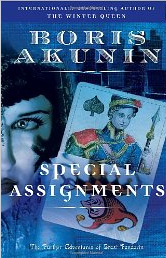
Day 206: Special Assignments: The Further Adventures of Erast Fandorin

Cover for Special AssignmentsI have been following Boris Akunin’s Erast Fandorin series for several years. At first I liked Akunin’s shy, skinny, intellectual young hero. But then Fandorin transformed himself into a muscle-bound Putinesque superhero wannabe, so I lost most of my affection for him.

Set in Tsarist Russia, Special Assignments is actually two novelettes about Fandorin cases. The first, “Jack of Spades,” is a silly case where Fandorin is pursuing a clever con artist. It is supposed to be funny, I think, but I mostly missed the humor and found it ridiculously overcomplicated.

The second story I did not finish once I grasped where it was going. Called “The Decorator,” it is about Jack the Ripper moving his operations to Moscow. However, it becomes quickly obvious that Jack is supposed to be not only a woman but one who is murdering prostitutes because they are defiling their bodies. The whole idea was so abhorrent to me that I refused to read any more of it.

Day 181: Clara and Mr. Tiffany

Cover for Clara and Mr. TiffanySusan Vreeland’s Clara and Mr. Tiffany is a novel about Clara Driscoll, a real artist who headed a woman’s workshop designing the most complex lamps and screens for Louis Comfort Tiffany. The novel details the ups and downs of a long professional relationship, including Driscoll’s frustration at not being recognized as the designer of some of Tiffany’s most famous pieces. A lot of the interest in the novel resides in the tension between the women’s division and the men’s division, which was only allowed to work on the more mundane pieces.

Right now I am reading some of Vreeland’s own comments about the captivating woman she found depicted in Clara’s own letters. Unfortunately for the novel, Vreeland does not do a great job of making her characters interesting in this book or of conveying the woman she found in those letters. Several important but minor characters are so undefined that I couldn’t keep them straight.

I believe that Vreeland is hindered rather than helped by the fact that she is fictionalizing the lives of real people whose relatives are probably still alive. She has written more successful books about artists who lived farther in the past–Monet in Luncheon of the Boating Party and Artemisia Gentileschi in The Passion of Artemesia, for example. There are certainly interesting aspects to the story–Driscoll had an unusual life featuring at least one bizarre event–but the novel is written more like a series of incidents than a narrative with an arc.

Day 174: Pauline Bonaparte: Venus of Empire

Cover for Pauline BonaparteI didn’t know anything about Pauline Bonaparte before I read Pauline Bonaparte: Venus of Empire. I picked it up because it was by Flora Fraser, a noted biographer who specializes in 19th century women. (She is also the daughter of Antonia Fraser, the famous biographer.)

Pauline Bonaparte was Napoleon Bonaparte’s youngest sister, renowned for her beauty. She lived a colorful life and is immortalized by a life-sized, nude statue by Antonio Canova that resides in the Villa Borghese in Rome.

The connection with the Borghese family is not one that they cherish. Pauline’s second husband was Prince Camillo Borghese. During their long marriage, they lived mostly apart, and Pauline entertained herself with numerous flagrant affairs.

In fact, Pauline’s reputation was dreadful. Napoleon’s enemies spread numerous rumors about her, even stooping to claim that her relations with her brother were incestuous. Not only did she not care, she encouraged that particular rumor to show how powerful she was.

Although she could be very charming, she spent most of her career manipulating infatuated men and intimidated women. Stories abound of her using generals as footstools, turning people our of their own houses, and so on. A particularly odd one was that when she was visiting an officer of the church, she made him cut a hole in the ceiling of his bathroom over the tub so that someone could stand on the floor above her and shower her with milk.

Although extremely jealous of the prerogatives granted her sisters (as they were of hers) and generally hateful to the Empress Josephine (she and her sisters held onto Josephine’s train during her coronation so that she could not move forward), Pauline’s most positive trait was her loyalty to her family. She was devoted, although not faithful, to her first husband, General Victor Emmanual Leclerc. When Napoleon fell out of power, she was persistent in trying to improve his living conditions and tried to get permission from the British to share his exile.

Fraser’s biography is interesting and well written. I found Pauline to be a fascinating subject, although not an admirable person.

Day 166: We, The Drowned

Cover for We, The DrownedBest Book of the Week!

We, The Drowned is an unusual novel by Danish writer Carsten Jensen that has become an international best seller. It relates the history of the author’s home town, the port of Marstal, Denmark, from 1848 to 1945. Although it picks principal characters to follow during these times, large portions of the novel are written in the first person plural, as though the entire town is the Greek chorus in a play. The novel follows the fate of the town as it rises to become a major shipping port to its near demise just before and during World War II.

The narrative style of the novel feels like a series of seafaring tales. Ships sink, sailors are never seen again, but the townsmen of Marstal continue to be lured out to sea. We follow them as the Danes go to war with Germany in the mid-19th century and the men of Marstal wonder why they are fighting men they traded with the week before. In this conflict, Laurids Madsen is shot upward from an exploding ship and lands again on his feet, unharmed, creating a legend about his boots.

Years later, his son Albert travels the South Pacific looking for his father, who went to sea when Albert was four and never returned. He finds him with a second family in Samoa.

As an old man retired from a prosperous career as a sea captain, Albert befriends a young boy, Knut Erik Friis, whose widowed young mother does everything she can to keep her son from going to sea. When she gains some economic power in the community, she undercuts the town’s shipping industry in an attempt to keep all the young men home.

These stories and many more, ending with Knut Erik’s experiences during World War II, tell the rich tales of the lives in this seafaring town. Although I was initially a little put off by the narrative style, I found myself barely able to put down this book.

Day 164: The Bone Garden

Cover for The Bone GardenThe Bone Garden is one of Tess Gerritsen’s Risoli and Isles series, but Isles only appears briefly, so it is more of a stand-alone mystery.

The novel takes place in two time periods. In the present day Julia Hamill has just purchased a 130-year-old house when she discovers an old skull in the overgrown garden. Medical examiner Maura Isles determines that the victim, a woman, was murdered long ago. Julia becomes fascinated with a box of newspaper clippings and letters that hold the key to the mystery.

In 1830’s Boston, Norris Marshall has joined the “resurrectionists,” grave robbers, in an effort to pay for his medical education. After a nurse and a doctor are murdered on the university hospital grounds, Norris finds he is a suspect. He seeks help from another student, Oliver Wendell Holmes.

I have only read a few Risoli and Isles books. I thought this one was passable, but I didn’t like it as well as others I have read. The attempt at 1830’s dialogue is awkward and painful to read, and in this case I didn’t see any reason to use a real historical person in the novel when a fictional one would have done just as well.