Day 161: Peony in Love

Cover for Peony in LoveI’ll start out right away by saying that after reading the touching and engrossing Snow Flower and the Secret Fan, I was disappointed by Lisa See’s Peony in Love. The innocuous description on the back of the book gives you no warning of the subject of the novel. I think that is unfortunate, because not very many readers of See’s other books will be prepared for it.

Peony’s sixteenth birthday is approaching. In six months she will “marry out” to the man who has been her fiancé since she was a child, although she only knows his name. She is excited because that night her family will begin hosting an epic opera by Tang Xianzu that she loves, and the secluded women will be allowed to watch it through a screen.

The story of the opera is important to the novel. It is about a girl who dies for love and haunts her lover until she is eventually brought back to life in honor of her steadfastness.

That evening, Peony peeps out from behind the screen and spots a handsome young man, with whom she falls instantly in love. Later in a brief absence from the performance she encounters him accidentally, and he begs her to meet him the next night. Such behavior is strictly forbidden. She has never been alone with a man outside her family, but she meets him anyway.

I usually try not to give away important plot points, but I will tell you one thing that happens in the first third of the book because I don’t think you can make a fair decision about reading it without knowing. So, this is my spoiler warning. Unfortunately, I don’t see any way to impart my objections without revealing this key plot point.

Convinced that she will be forced to marry a man she does not love even though she doesn’t know who her fiancé is, Peony starves herself to death, like the heroine in the opera. Just before she dies, when it is too late to save her, she finds out that her beloved actually is Ren, her fiancé (a twist that I found predictable). Presumably, she spends the rest of the novel as a ghost. I say presumably because after another 100 pages or so I quit reading.

I was already fed up with Peony because she wastes two opportunities to avoid the misunderstanding that causes her death. As in many movies, a few words could have cleared things up. That is, she and her lover never bother to exchange names. In addition, after the opera, when she is still in the audience, her father introduces her fiancé to the company. She is so convinced he is a stranger that she shuts her eyes. How likely is that?

Peony is already an extremely foolish girl even before she begins starving herself. I continued reading out of interest in Chinese beliefs about the afterlife, but when Peony begins manipulating Ren’s wife, I found this development too distasteful to continue. I regret that I cannot recommend this book, although I am still eager to try other books by Lisa See.

Day 152: The Master

Cover for The MasterThe Master, Colm Tóibín’s engrossing novel about Henry James, is virtually plotless. Over the course of five years, James works, visit friends, and remembers significant events in his life and people who are important to him. At the same time he muses on how the people, tales they tell, or incidents he has observed have informed or will inform his writing.

I have often found James’s work perplexing, feeling as if there is a lot going on under the surface that I don’t understand. A novel about him, therefore, is not an intuitive choice for me. Nevertheless, I found myself extremely involved in this story about a man who appears to have always stood back and watched. In Tóibín’s view, James lived a life of “pure coldness.”

The book delicately depicts a complex man, social on the surface but always at an emotional remove from others, homosexual but so concerned about propriety and public opinion that he never acts on it (perhaps–that is not entirely clear) and avoids situations where he may be tempted. He is sometimes very cold in his inaction, such as when he deserts his best friend, Constance Fenimore Woolson, because she has been too open for his taste about their completely innocent relationship, causing some friends to blame him for her subsequent suicide.

The most fascinating part of the novel, in my opinion, is how it illuminates the way that a writer may take a situation, a sentence, thoughts about how a pair of people interact, and turn them into a complete work of fiction. For example, a tale told to him about two children alone on an estate reminds him of his relationship with his sister Alice. As children, both of them had been abandoned as their family toured Europe and have never been fully included in the events and emotions of the family. These memories finally emerge in the ghost story “The Turn of the Screw.” Similarly, his memories of his intelligent, vivacious cousin Minny Temple are brought back to life in first The Portrait of a Lady and then The Wings of a Dove.

Meticulously researched and beautifully written, The Master is an evocative novel about the inner life of an emotionally crippled writer.

Day 143: West of Here

Cover of West of HereThis peculiar novel starts out as a straight intergenerational history showing how the building of a dam by a small town in 1890, which was meant to make the town prosper, ends up determining its future as a permanent backwater. The novel also tells the story of a nearly disastrous expedition into the Olympic Peninsula. The time alternates between 1890, when the dam becomes an idea of an early entrepreneur, and 2007, when the town is beginning to dismantle it. 

If there is such a thing as ensemble fiction, this is it, since the book has many characters, none of whom seem to be more important than the others. Because it has many characters, it has many stories, the oddest of which is that of a mute Klallam Indian boy in 1890 who somehow shares consciousness with a troubled Indian boy in 2007. In 2007, everyone assumes the boy is psychotic and he is admitted to a mental ward. In 1890, he starts his own cult.

Characters in the historical portion are an early feminist fleeing her lover; a prostitute who is fighting with the owner of the whorehouse; the Klallam Indians, already on their way to being destroyed; and an idealistic entrepreneur. Characters in the later story are a Bigfoot enthusiast, a seafood plant worker who longs for the days when he was a high school basketball star, an ex-convict who wants to live off the land, and an environmental scientist.

Evison has written a quirky, interesting book that is sometimes humorous, but I found it a little too diffuse, with too many characters, and too much going on. Although we may be meant to contrast the vigorous original settlers with the sad sacks of the present, the seeds of the area’s troubles are there right from the beginning. Perhaps that is the point. Still, I think the intentions of the author are unclear, and the novel is muddy as a result.

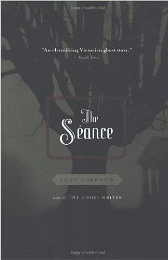
Day 136: The Séance

Cover for The SeanceThe Séance is a modern novel that is written like a Victorian gothic mystery. It features narrations by several different characters–a typical Victorian device that was used successfully in Wilkie Collins’s The Moonstone.

John Harwood’s novel is difficult to describe without going too far into the plot, because some important characters do not appear until later in the book. It begins with the story of Constance Langdon’s dreary childhood and young adulthood. Her mother has been depressed and nonfunctional since her sister died, and her father behaves as if he lives alone in the house. When Constance reaches the age of 11, her father withdraws her from school and abandons her and her mother to go live with his sister. Later, a disastrous experiment with spiritualism (very popular in Victorian times) in an attempt to help her mother results in her mother’s suicide.

Constance accepts her uncle’s invitation to live with him in order to avoid being thrust upon a father who doesn’t want her. But shortly after moving in with him, she finds she has inherited Wraxford Hall, an infamous house, old and crumbling, where two boys died; an old man mysteriously disappeared; and Magnus Wraxford was apparently murdered by his wife, Eleanor, who has also disappeared.

The next section of the novel is narrated by John Montague, a lawyer who visits Constance. He was involved in the experiment at Wraxford Hall that ended in the murder of Magnus Wraxford, and he tells the story of the experiment. This visit and Constance’s subsequent agreement to take part in a séance at Wraxford Hall lead us to Eleanor’s story, which is taken up by a diary that Eleanor wrote. Finally, we return to Constance. When she arrives at Wraxford Hall, she finds the experiment is to take place in a spooky gallery occupied by an odd-looking set of armor and a sarcophagus.

The novel is successfully creepy and mysterious. However, by the time of the séance I had figured out one character’s crucial secret identity, which made several other plot points clearer. Some readers may find it takes a long time to get to the crux of the novel, but I enjoyed the journey.

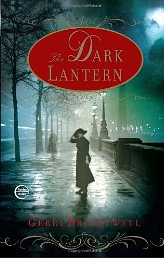
Day 131: The Dark Lantern

Cover for The Dark LanternI had mixed feelings about The Dark Lantern, Geri Brightwell’s novel of deception and intrigue set in late 19th century London. Although I found myself interested enough in what happens, I also thought that the odds of this much intrigue going on in one house were very low.

Jane Willred arrives in London for her first job in the city as a housemaid. Although Jane is a relatively blameless girl, she immediately finds herself caught in a web of deceit. In trying to put her past as the illegitimate daughter of a murderess behind, she has forged a letter from her mean, self-righteous former employer to omit the remarks the employer made about Jane’s past. In her first day at work, she is further embroiled when she breaks a dish and comes under the obligation of the blackmailing upper housemaid Sarah.

Upstairs all is not well, either. Mrs. Robert Bentley, Mina, newly arrived from Paris because of her mother-in-law’s illness, is hiding a shameful past. While her husband distractedly goes about his work trying to prove that an innovative system of taking body measurements of criminals is preferable to fingerprinting as a means of identification, she hides in the London house trying to avoid being recognized.

Odd things are certainly happening, as a stranger intrudes into the house on Jane’s second day claiming to be Mr. Robert and looks through his papers. How, Jane wonders later, did he know she would answer the door–as the only person in the house who hadn’t yet met Mr. Robert–since it wasn’t her job to do so?

Robert is waiting for the return of his brother Henry from India, hoping Henry will agree to sell the house after their mother’s death, as he and Mina are almost broke. Instead comes news that Henry’s ship has foundered off the coast of France and only his wife has survived–a wife no one knew existed.

Aside from the number of people hiding secrets in this novel, I also felt that few of the characters are likable. Jane is the most sympathetic, but she seems incredibly stupid at times. Nevertheless, the plot kept me interested.

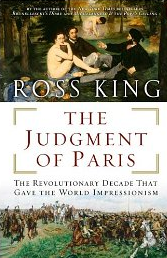
Day 123: The Judgment of Paris

Cover for The Judgment of ParisThe Judgment of Paris: The Revolutionary Decade That Gave the World Impressionism is Ross King’s account of the art and politics of the decade beginning in 1863 and ending in 1874 with the first Impressionist show. The book follows the lives and careers of several significant French artists in the years leading up to the introduction of what was eventually called “Impressionism.”

At that time in France, artists were taught that the proper subjects for art were scenes from history, mythology, or the Bible. The “best” paintings observed the minutest of details, colors were muted, and the surface of the painting was smooth so that brush marks could not be distinguished.

Although the book touches upon the careers of many artists, in particular it follows the fortunes of two–Ernest Meissonier, who was considered one of the greatest artists of his time and was certainly the highest paid, and Edouard Manet, an unofficial representative for the younger painters. Meissonier progressed from painting small, very detailed scenes from the 17th or 18th Century of “goodfellows” in ordinary domestic scenes, such as playing chess or smoking, to huge  historical paintings, several of events in Napoleon’s career. The younger painters were more interested in depicting scenes from modern life. At that time they were called Realists, not for their painting style but for their subject matter.

The book begins with the preparations for the Paris Salon of 1863. The Salon was the most important art show of its time, almost essential to getting an artist’s work viewed. King explains how changes in the rules affecting how the jury was selected resulted in most of the landscape painters and those with less traditional approaches being shut out of the show. So many artists were excluded and the outcry was so great that Emperor Louis-Napoleon authorized a second exhibition called the Salon des Refusés to show the paintings refused by the jury. Ross continues on from there to show how the new art moved slowly from the scorn and derision of the artistic community to acceptance and admiration. I was particularly surprised to find that the first place this new way of looking at the world was accepted was not France, but the United States.

King’s explication of the prejudices and politics surrounding the evolution of new approaches to painting is extremely interesting, as is his corollary discussion of the reign of Napoleon III, the disastrous Franco-Prussian War, and the subsequent shifts in the government of France, and how all this had its effect on the acceptance of the new art.

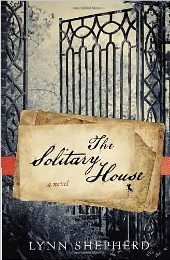
Day 118: The Solitary House

Cover for The Solitary HouseBest Book of the Week!

I had an ambivalent reaction to The Solitary House, which is sort of a riff on Bleak House. It is not exactly a retelling of Dickens’s book. Although some story lines are re-interpreted, most of the Dickens characters appear in the background of the novel. My ambivalence is because Bleak House is one of my favorite Dickens novels, and I have not been happy with some of the retellings of classics that have appeared lately, particularly those that seem to miss the point of the original works. I am also a little dismayed by what Shepherd has done to some of my favorite Dickens characters. However, I find I have to admire the masterful way Shepherd has worked the threads of Dickens’s novel into such a different story. On the whole, almost despite myself, I am giving this novel a big recommendation for its originality.

Charles Maddox is a former detective for the London police force who left under undesirable circumstances. He is hired by Edward Tulkinghorn, a mysterious solicitor who has an evil reputation. A client of Tulkinghorn’s has been receiving threatening letters, and Maddox’s assignment is to find out who is sending them. Charles descends into the squalor of London to discover the author of the notes, but when he turns the information over to Tulkinghorn, the author of the notes is brutally murdered.

Thinking that this is not a coincidence, Charles begins investigating Tulkinghorn himself, as well as his client, Julius Cremorne. In doing so, he comes upon evidence of a serial killer. He also runs up against Inspector Bucket, his former police supervisor.

Charles’s story is written in a jokey third-person omniscient narration that often addresses the reader directly and is interlarded with many references to Dickens and some quotes from Shakespeare. Imagine a style that is like a postmodern Dickens. This narration is interleaved with the first-person narrative of Hester, seemingly the same quiet, loving, capable Esther Somerset of Bleak House. It is not until the end of the novel that these two stories merge horribly together.

Ultimately, I am coming down on the side of strong admiration for this book. It is completely absorbing and inventive, well written and literate, and actually convincing as a twisted alternate vision of Bleak House minus the case of Jarndyce vs. Jarndyce. It made me want to return to Bleak House, which I have not read recently, and dig out all the references. It is a gothic novel that becomes a serious creepfest, and you know how I love those.

I see that Shepherd has also riffed on Mansfield Park. As much as I am dreading what she will do to my beloved Jane Austen, I think I’m going to have to read it.

Day 103: Dark Road to Darjeeling

Cover for Dark Road to DarjeelingMy interest in the Lady Julia Grey series by Deanna Raybourn waxes and wanes. Although it is unusual for me to like books that mix mystery and romance, I usually enjoy reading this series, but I enjoy some books more than others. The books have followed the relationship of Lady Julia Grey and Nicolas Brisbane–who solves crimes for a living and whose breeding makes him an unsuitable mate for Julia–since they first met when her husband was murdered. Now, after several books following the ups and downs of their relationship as they solve crimes and get each other into and out of danger, they are married.

In Dark Road to Darjeeling, Lady Julia and Brisbane have been persuaded to interrupt their honeymoon in the Mediterranean by Julia’s sister Portia, who is worried about her friend Jane. In a previous novel, Jane left Portia to be married, and she is now a widow on a tea plantation near Darjeeling. Portia has asked Julia and Brisbane to investigate the possible murder of Jane’s husband. Jane herself is obsessed by her own pregnancy and the mysterious death of her husband Freddy, who may have been murdered for his inheritance.

The Brisbanes take along part of her eccentric family, Portia and brother Plum. Upon arriving at the plantation, they get to know the potential suspects, including Freddie’s aunt, his cousin Harry, several neighboring families, and the mysterious White Rajah.

I was unable to guess the murderer but figured out which family the murderer belonged to. Although this series sometimes resorts to the typical conflict between romantic co-investigators about the danger of the job, a conflict that I find extremely tedious, the dynamic between Julia and Brisbane still holds my attention. If you are interested in this series, I recommend that you start with the first book, Silent in the Grave.

Day 100: Appaloosa

Cover for AppaloosaWoohoo! One hundred days of blogging! I hope you’re enjoying it. And now, on to the review.

I do not usually read Westerns but looked for Appaloosa after seeing the excellent movie starring Ed Harris (also the director) and Viggo Mortenson. I was surprised to find the book was written by Robert B. Parker, who I only know from the Spencer and Jesse Stone mysteries.

Virgil Cole and Everett Hitch clean up towns. The businessmen of Appaloosa hire them after the sheriff is murdered at Randall Bragg’s ranch when he goes out to arrest some of the hands. Bragg’s hands have been flagrantly breaking the law and terrorizing the town–taking merchandise without paying, assaulting women, and murdering men.

Cole works from a strict sense of law and duty, although he does it his way. He sets the laws in his towns and others must follow them or suffer the consequences. Hitch loyally backs up Cole.

Hitch and Cole get the town under control quickly, but the only witness to the sheriff’s murder, Deputy Whitfield, ran away after the shooting. However, under Cole and Hitch, the town feels safe enough for Whitfield to volunteer to testify against Bragg. Now Cole and Hitch must arrest Bragg and at the same time keep their witness safe.

In the meantime, an attractive widow named Mrs. French arrives in town and latches onto Cole, who is a bit naive when it comes to women. Hitch is skeptical of her, but after awhile, it looks like Cole may be planning to settle down.

The novel is full of action, but it stands out because of the friendship between Cole and Hitch and Parker’s ability to create distinctive characters using laconic dialogue and a bare minimum of description. And Parker has not omitted a twinkle of humor, such as when Cole marvels that Mrs. French takes a bath every single day. Although Appaloosa sounds like a traditional Western, it is unusual, especially in its denoument. I found it to be a quick, appealing read.

Day 97: The Mystery of Lewis Carroll

Cover for The Mystery of Lewis CarrollThe Mystery of Lewis Carroll: Discovering the Whimsical, Thoughtful, and Sometimes Lonely Man Who Created “Alice in Wonderland” examines modern ideas about Charles Dodgson (Lewis Carroll) and attempts to debunk them. Jenny Woolf does a good job of providing evidence that his friendships with children, rather than being pedophilic tendencies as is interpreted today, were regarded by Victorians as innocent and probably were innocent. She also shows that the modern interpretation of his pictures of nude children was not one held by people of his own time, and that they regarded this pastime and the resulting pictures as harmless because children were considered innocent.

In fact, Woolf provides evidence that his friendships with young women were much more subject to question and talk. She posits that he cultivated a persona of being older than he actually was so that they would not be questioned, even though these relationships were almost certainly innocent as well.

Woolf depicts the Reverend Dodgson as a sensitive, artistic man who cared for his family and loved entertaining children. His position at Oxford did not at that time allow him to marry. A number of years during the time he was a young man are missing from his diaries and he refers to feelings of guilt in later entries, leading Woolf to conclude that something happened, possibly with a woman, that he regretted. Her theory is that he cultivated relationships with young girls as a return to innocence.

The book is interesting, but with a caveat. It is very short, almost shorter than the subtitle, but Woolf is so focused on one or two ideas that it often seems repetitive. A good deal of information about Carroll’s life is missing because he or his relatives removed pages from his diaries and his relatives destroyed a great deal of material after he died. Although this has often been interpreted as the family’s attempt to hide nasty secrets, Woolf is not convinced that there was much to hide. She blames a good deal of the current perception of Carroll on the initial emergence and misapplication of certain theories of psychology in the infancy of the science.