Day 33: The Great Game: On Secret Service in High Asia

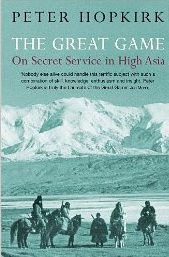
cover for The Great GameThe Great Game by Peter Hopkirk details the history of the 19th century shadow war for supremacy in Central Asia–that is, the spying, territory-grabbing, and general skullduggery accompanying the land grab of the Central Asian states and countries by Tsarist Russia and Victorian Great Britain. A great deal of the activity was centered around Afghanistan, which provides a lot of background about why the situation is so messed up today.

Investigations (exploring and snooping) were first begun in the area because of the British occupation of India. The greatest fear of the British occupiers was that the Russians would come swooping down on them through the Khyber Pass to take away what they had gained in India. So they sent small groups of men into the forbidding, wild regions to investigate the terrain, establish outposts, and try to make pacts with local war lords, khans, and other rulers.

This history is written by a Brit, so the Russians are the tacit bad guys. However, it would seem that often the Russians were more reliable partners to these states and countries than the British, who consistently let down their allies by doing nothing when the Russians invaded their territories. For their part, the Russians seemed often to be more brutal, but not always.

The book contains the enthralling stories of many young officers and civilians who took on dangerous missions into unknown, very wild territory with little or no backup from the British government, some of them simply to explore the areas but others to actively spy. Often these young men received no thanks from the British government for their efforts.

Note that a different edition of this same book is called The Great Game: The Struggle for Empire in Central Asia. I believe these are both the same book but that On Secret Service has been updated, taking into consideration recent events. I am not exactly sure which one I read because my edition was a special one from the Folio Society (just called The Great Game), but was published around the same time as the more recent book.

Day 25: Shiloh

Cover to ShilohIn Shiloh, the historian and novelist Shelby Foote has written an interesting fictional account that describes the battle from the points of view of several different narrators, some on the Union side and some on the Confederate. Each narrator has his own chapter. In these brief narratives you get a sense of the character while being able to trace the larger movements of the battle.

Foote manages to work into the narratives the major events, such as the death of General Johnston; the surviving Confederate leadership’s failure to follow Forrest’s recommendation of attacking again at night, which probably would have ended in victory for the Confederates; the 10,000 Union “shirkers” who hid along the riverbank after they became dispirited from having to pull back time after time; and the river crossing by Buell’s troops, which turned the tables in the Union’s favor.

Lieutenant Palmer Metcalfe is marching with the Confederate army under Johnston as it prepares for a surprise attack on the Union troops. He thinks back with satisfaction to the complicated plan he helped draft, as he is a staff officer under Johnson. The noisy troops may have lost the element of surprise, but Johnston insists upon attacking.

Captain Walter Fountain is a Union soldier writing a letter to his wife Martha during a Tennessee evening when the Confederate troops burst out of the woods and charge the Union army.

Private Luther Dade is wounded in battle and is sent to a triage area to wait for a doctor. After hours pass and no doctor shows up, Dade begins to show signs of infection. He stumbles around across a large swathe of the battle area and finds himself witnessing the death of the Confederate commander Johnston.

So the novel proceeds in short chapters that culminate with a return to Lieutenant Metcalfe as he reviews the results of the battle. The characters are briefly drawn but have distinct personalities. Through following the peregrinations of the various characters and with the assistance of the maps in the book, you can get a good understanding of the complex battle and why the initially successful attack ultimately failed.

Day Eleven: Snow Flower and the Secret Fan

Cover for Snow Flower and the Secret FanBest Book of Week 3!

Lisa See, the author of Snow Flower and the Secret Fan, explains that she was inspired to write the novel after learning about nu shu, a secret, simplified writing used by women in a remote area of China to communicate with each other for centuries. The writing was suppressed for years after the Japanese invasion of China and during the Cultural Revolution, so it is now known only by a few scholars who learned it from the last women who knew it.

Snow Flower and the Secret Fan is a beautifully written story about the love between two women in 19th century China. Near the beginning of the novel, Lily’s mother delays the date of her foot binding a year from the traditional age of six so that she can enter into a special relationship, called laotong, with another girl named Snow Flower. Laotong, or “old same” girls must match each other as closely as possible in birth date and time, height, and other qualities, including the date of their foot binding. Snow Flower sends Lily an invitation to enter into this relationship written on a fan in nu shu. This relationship is supposed to be advantageous to Lily, the daughter of a farmer, because Snow Flower comes from a family that is higher in status and can teach her to be more refined. The end purpose of all this is to find her the best husband possible when the time comes.

The foot binding itself is horrifically described near the beginning of the novel, when Lily’s short life as a free child is ended by this process of trying to bend the foot so that all but the big toe meet the heel and it ends up as close to three inches long as possible.

At lot of the novel is about suffering. The way of life was circumscribed in many ways, with the women spending most of their lives in one room. As children and young women they are considered worthless burdens to their family until they “marry out.” Then they are considered burdens by their husbands and mothers-in-law until they justify their existence by having sons.

Lily’s relationship with Snow Flower opens up her world a bit. They visit a shrine together every year. Snow Flower comes to visit Lily, and they spend days and nights whispering, telling their secrets and hopes. They send messages to each other on their fan.

The hardest thing for me to explain is the extent of the innocence of these girls, how they are full of good will, despite their difficult and painful lives. How they try to do their best even though they are constantly criticized. How even the aphorisms and songs that they hear every day tell them their purpose is just to serve others, yet they try to be cheerful.

Lily relates the story from the viewpoint of an old woman to explain something that she did that she will always regret. Eventually, Lily’s successful marriage and good luck and Snow Flower’s loss of status lead to a divide between the women and then an apparent act of betrayal. The story effectively explores the linkage between love, hurt, and jealousy.