Review 2479: Classics Club Spin Result! Merkland

I have read and enjoyed all of Margaret Oliphant’s Carlingford series as well as her first novel and one other. Merkland (which has different subtitles depending on where I look at it: in my eBook it says “A Story of Scottish Life” and in my hardcopy it says “or, Self-Sacrifice”) is her second novel and shows her inexperience. I read it for my Classics Club Spin.

Although the main character of the novel is Anne Ross, it has two plots concerning the fates of two disgraced young men. At the opening of the novel, Anne learns from her unsympathetic stepmother not only that her older brother Norman Rutherford, long believed dead, may be alive, but that he is believed to be the murderer of Arthur Aytoun, who was found shot to death 18 years before. Anne is horrified when she learns that her great friend, Mrs. Catherine Douglas, has invited this man’s daughter, Alice, to stay with her, for she thinks Alice must hate her family.

Mrs. Catherine, for her part, is facing a dilemma. She has unexpectedly inherited some money and, being already wealthy herself, had intended to give it to hard-working but poor young James Aytoun, Alice’s brother. However, two old friends have come to her to ask for help for Archie Sutherland, the young local laird, who has fallen in with bad companions and is badly in debt. She decides in Archie’s favor, but before she can send him the money, he loses his entire estate gambling.

Mrs. Catherine sets about rescuing Archie by bringing him home to recover and arranging honest employment where he might eventually earn enough to buy back his heritage.

For her part, Anne discovers a letter that indicates Norman may be innocent of the crime even though the circumstantial evidence against him is strong. She makes it her goal to try to clear her brother’s name, especially important because Alice Aytoun has fallen in love with Anne’s young stepbrother, Lewis.

So far, so good. Two interesting plots plus other subplots such as the identity of a mysterious child and the fate of Rutherford’s estate in the hands of his dissolute English ex-companions. However, this novel is much longer than it needs to be, containing passage after passage of moralizing and sermonizing. Modern audiences may also be dismayed at its strong message against women’s rights. Further, the novel takes several chapters beyond the crisis to wrap up its loose ends, and by the end I was just skimming the paragraphs trying to finish.

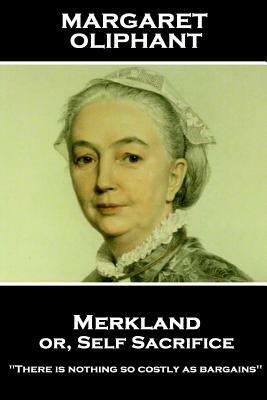
A final note about the edition I read. I dislike reading eBooks, so even though I have Oliphant’s complete works on my iPad, I looked for a paperback version. Drat these print-on-demand books! I ended up with the edition shown above, published by Horse’s Mouth, that had all the evils except that it was corrected for misreadings by machine reading, which I have encountered before. No page numbers, no copyright or any other kind of information except a short biography and a list of other works, no formatting (the text starts at the bottom of page 2). Worst of all, it is only in about 6 pt. type at the largest, when anyone who knows anything about it knows that about the smallest you can go and still be readable is 9 pt.

Related Posts

Passages in the Life of Margaret Maitland of Sunnyside

Hester

A House in Bloomsbury

Review 2474: North Woods

In early colonial days, a couple flees one of the colonies into the wilderness of Massachusetts. There, they settle in a valley.

A settler with a baby is kidnapped by natives. When she becomes ill with fever, they leave her with an old white woman, who cares for her. But when white men come after her and plan to kill the natives—the old woman’s friends—she murders them. Before this happens, one of the men gives the captured woman an apple, and she drops the seeds on the ground.

An apple tree grows.

After the French and Indian Wars, Major Charles Osgood gives up his uniform and decides to grow apples. His friends think he has lost his mind. He searches all over until a child leads him to an apple tree near a ruined cabin in the wilderness. The apple is marvelous. He builds a house and takes cuttings from the tree to make an orchard, producing an apple called Osgood’s Wonder.

So Daniel Mason goes on relating the history of this plot of ground, from one owner to another. People die, are murdered, are conned, become ghosts, run mad, the wilderness recedes and then returns, the house is ruined and rebuilt, added to, ruined, rebuilt. Each section is linked to others by characters, coincidences, and place. Some of the incidents are funny, some fates are sad, some characters get what they deserve. Tales are punctuated by songs written from the grave.

I can’t really convey how much I enjoyed reading this unusual novel. It’s steeped in the beauty of the forest. It somehow manages to involve you despite some quite short (some longer) stories of its characters. You get worried about the fates of apple and chestnut trees! I loved this one. It did exactly what a book is supposed to do, pulled me into a different world and made me reluctant to leave it.

Related Posts

The Overstory

The Orchardist

Ulverton

Review 2468: The New Magdalen

In The New Magdalen, Wilkie Collins has written a sensation novel that is by definition quite melodramatic. The subject, as you might guess from the title, is the reformed prostitute.

That’s what Mercy Merrick is, although she first appears as a nurse on the battlefield of the French/German war. An Englishwoman, Grace Roseberry, is stranded there on the way to England to live with her father’s friend, Lady Janet Roy, after her father’s death. Unfortunately, she was robbed on the way and has only her letter of introduction.

Grace confides in Mercy and then pressures her to confide in her, but she is not at all sympathetic to Mercy’s story of being forced by starvation into prostitution. Mercy reformed after hearing a sermon by Julian Gray, but every time she took a respectable position with the full knowledge of her past by her employers, she lost it once the servants or neighbors found out.

Mercy has loaned Grace some clothing. When after an attack, Grace is pronounced dead by the French doctor, Mercy takes her clothes and letters of introduction and assumes her identity, trying to get a better future.

Several months later, Mercy (now called Grace, confusingly) is Lady Janet’s adopted daughter and is betrothed to Horace Holmcroft. However, she can’t find it within herself to set a date without telling Horace the truth.

Then Julian Gray arrives. It turns out he is Lady Janet’s nephew. He has taken an interest in the case of a woman who has been hospitalized in Germany and claims to have been on her way to live with Lady Janet. Of course, this is the real Grace.

In Mercy’s absense, Grace appears and accuses her of stealing her identity. But Lady Janet doesn’t believe her and finds her offensive. And in fact, Collins depicts her as a horrible person.

That’s the message, really—the despicable virtuous woman versus the saintly ex-prostitute—for Mercy eventually decides to make things right.

Some of the Victorian values in this one are hard to stomach, but Collins knows how to keep readers interested in his story.

Related Posts

The Dead Secret

Hide and Seek

Basil

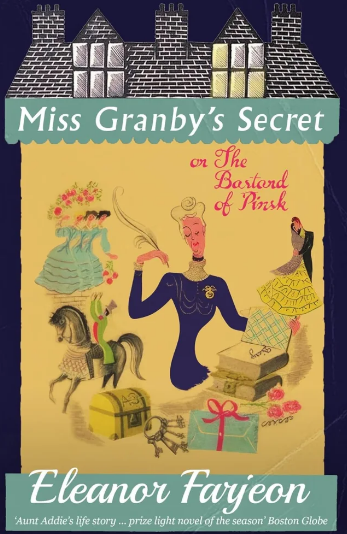
Review 2458: Miss Granby’s Secret or the Bastard of Pinsk

I was thrilled to learn that Dean Street Press was continuing its Furrowed Middlebrow imprint. This novel is an entertaining entry in that line.

In 1912, Pamela receives a bequest from her great-aunt Addie Granby of a house and a box of keepsakes and papers. Aunt Addie had been a well-known romance writer, but her modern great niece doubts that her spinster aunt ever understood the facts of life. Pamela finds hints that Addie had a romance when she was 16 with someone named Stanislaw. She also wrote her first novel.

The entirety of the novel, entitled The Bastard of Pinsk, is included within this novel. It begins with a conscientious list of terms that some polite young man has given her definitions for. As an example, “bastard” is given as “a very noble Hero of Royal Blood.”

The novel within the novel is made funny by the naïveté of its author, who writes in a Romantic, florid style and flings about words she doesn’t know the meaning or connotations of. Her Romantic upbringing and reading in the Gothic tradition are manifest in the ridiculous plot. If I have any criticism, it’s that it’s a bit too long. However, it picks up as it goes along.

Twenty years later Pamela learns that her friend Adey has been nursing an old man—her Aunt Addie’s Stanislaw! Now, she thinks, is her opportunity to find out about Aunt Addie’s past.

I received this book from the publisher in exchange for a free and fair review.

Related Posts

Beneath the Visiting Moon

Anne of Green Gables

My Brilliant Career

Review 2443: After Sappho

I read After Sappho for my James Tait Black project. It is experimental, written in short vignettes that jump around in time and from person to person. It tells the stories of lesbian women, mostly literary figures, trying to make a place for themselves. It begins in the late 19th century with women fascinated by the poet Sappho. Some of them study Ancient Greek, some dress like ancient Greeks or re-enact ancient plays, some travel to Greece.

The novel is vividly written in first person plural or in third person, at times slyly ironic, sometimes engaged in word play, often invigorating and with lots of sexual metaphors. It is interesting, telling of repressive laws against women, particularly in Italy, and reporting actual aggressively misogynistic “scientific” or political statements by men. It goes on to tell of the accomplishments and tragedies and love affairs of its protagonists, largely ignoring the men in their lives. For example, from this novel, you wouldn’t know there was a Leonard Woolf, just a Vita Sackville-West.

Although I found the novel very interesting at first, there were so many characters that I couldn’t keep track of them or remember which events happened to which ones. I could only track the ones I was already familiar with. For example, the novel begins and ends with Lina Poletti, even though she disappears about halfway through, so she is obviously important to Schwartz, but by the end I couldn’t remember her. I felt like I needed a chart.

And yet, I feel that with more character definition, I might have remembered all of them, but these short vignettes that tell of an activity or something they said didn’t really provide a cohesive picture to me of what the women were like.

So, I applaud this novel’s daring devices, but they didn’t really work for me.

Related Posts

The Hours

Crudo

LOTE

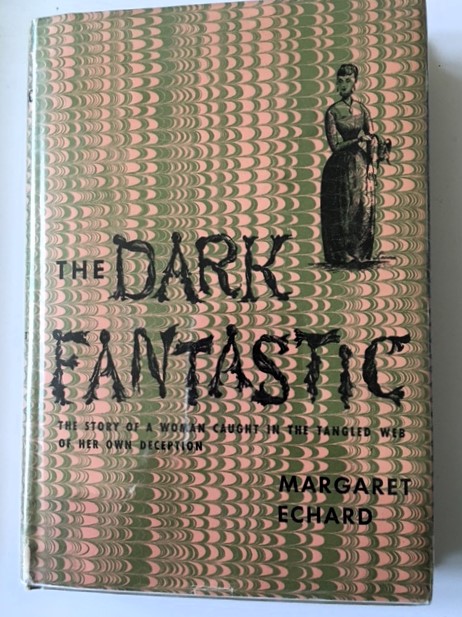
Review 2436: The Dark Fantastic

I was surprised by the direction that this novel took, but I would have been less surprised if I hadn’t missed a note from the author. It explained that although the characters were made up, the novel was inspired by events that took place at her great-grandparents’ home in rural Indiana.

In post-Civil War Terre Haute, Indiana, Judith Amory is defying convention by attending Macbeth without a male escort. She has recently been dismissed from her teaching position for being too advanced in teaching George Eliot, so she can’t really afford to go, but she thinks of herself as refined and cultured and is excited to see the performance of Edwin Booth.

At the performance, she ends up breaking convention again by speaking to her neighbor, a young man who has journeyed in from his farm just to see the play. Judith finds him handsome, prosperous looking, and eager to discuss literature, perfect for her idea of a husband—until he says he has a wife and three children. Then he mentions that the nearby town needs a teacher.

Judith is not dismayed. First, she intends to have that job even though it’s a bit beneath her. Then, she intends to have that man, Richard Tomlinson.

How she gets her Becky Sharpish way is one thing, but what happens afterward is quite unexpected. This is a pretty good, darkish novel that dabbles in the supernatural. Echard is good at setting her scene and presenting the dynamics of the Tomlinson family. She’s good at depicting the main characters, although I lost track of some of the secondary ones. This is a good one for those who like darkish tales. Warning for the politically correct—the one Black character is depicted stereotypically as isn’t surprising for a novel published in 1947.

Related Posts

Dark Enchantment

The Unforeseen

The Uninvited

Review 2430: The Other Side of Mrs. Wood

In 1873 London, Mrs. Wood is the most successful medium in society. She is worried about the future, though, because her patrons are getting older and at 40, she doesn’t seem to be appealing to the younger folks. To make things worse, Mr. Larson, who takes care of her money, has just informed her that a large investment in a mine has been lost. Things are going to be tight until some ships he invested in arrive.

Mrs. Wood cuts where she can, but unfortunately her profession requires her to have an appearance of respectable wealth.

A girl has been hanging around outside her meetings, which are invitation only. When Mrs. Wood catches her, a Miss Finch, she learns that Miss Finch would like to become her student. She says she has some talent. Without consulting her friend and assistant, Miss Newman, Mrs. Wood decides to take her on, thinking that as a young, attractive girl, she will attract younger patrons.

Miss Newman distrusts Miss Finch, but Mrs. Wood goes ahead with her plans, even excusing some costly mistakes that Miss Finch makes. What she doesn’t know is that Miss Finch’s intentions are bad ones and that she knows more about Mrs. Wood’s past than Mrs. Wood thought anyone knew.

Without remembering any synopsis of this novel, I immediately distrusted Miss Finch, getting a growing feeling of dread that stalled me a bit in my reading. I also felt that the middle part of the novel went on a bit too long. However, when Mrs. Wood pulls herself together, the culmination is very satisfying. I think the very end of the book, though, was a bit unbelievable.

If you read my blog, you know I’m a stickler for accuracy in a historical novel, although not an expert in the details. However, just as a side note, Barker uses the word “twee” on page two, not in conversation but in the main character’s thoughts. I thought that seemed like a modern word, so I looked it up. Sure enough, it was not in use until 1905. Oops!

Related Posts

The Séance

The Haunting of Alma Fielding

This House Is Haunted

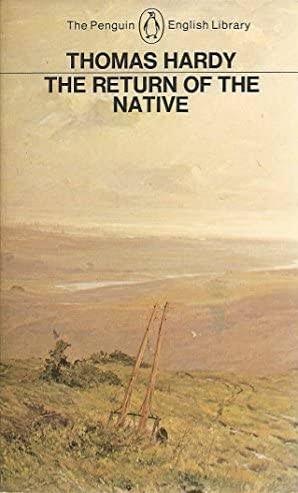
Review 2429: The Return of the Native

A love triangle—or rather a love pentagon—is at the heart of The Return of the Native. I put this novel on my Classics Club list because, although I read it years ago, I could remember nothing about it.

The Return of the Native is Hardy’s most contained novel, all of it taking place on Egdon Heath. The action begins on Guy Fawkes night with the lighting of bonfires. The occupants of one barrow are discussing the supposed marriage that day of Damon Wildeve and Tamsin Yeobright. But Tamsin returns home in distress and unmarried, saying Wildeve made a mistake with the license.

Wildeve has told Tamsin they can marry on Monday, but on that very night he goes to see Eustacia Vye, the girl he dropped for Tamsin. Eustacia is a vibrant, proud woman, and there is no doubt that she is tempted to get revenge on Tamsin.

Tamsin and her aunt view themselves disgraced if the marriage doesn’t come off, even though Wildeve lets weeks go by as he tries to court Eustacia. But Eustacia has heard of the return after years away of Tamsin’s cousin Clym, an educated man who works as a diamond seller in Paris, and sight unseen, she decides he’s the man for her. She hates the heath and wants to go to Paris. So, she misses a rendezvous with Wildeve and he marries Tamsin.

With this ill-conceived marriage, we are halfway set up for the tragedy. Then Eustacia marries Clym even after he tells her he plans to run a school for the poor on the heath, thinking she can easily change his mind after the wedding. The fifth point of the pentagon is occupied by Diggory Venn, a rettleman, or man who sells the red substance used to mark sheep and whose skin and clothing are dyed red from handling it. Although the Introduction to my edition explains that Hardy meant him to be a rather freakish figure about the heath, he ends up using him as a sort of deus ex machina, always in aid of Tamsin.

A strong theme of snobbery is inherent in the novel as we learn (1) that Wildeve was meant for better things but ended up owning the neighborhood pub, (2) that Tamsin turned down a proposal from Venn even when he was a respectable dairyman because he wasn’t good enough for her, (3) that the only suitable suitors for Eustacia in the neighborhood are the morally dubious Wildeve or the unambitious Clym. And Mrs. Yeobright clearly disapproves of both her son’s and niece’s choices.

So, we’re all set up for one of Hardy’s tragedies, in which he lays into the Victorian idea of marriage while making all his characters suffer. I usually like this stuff, but Hardy was forced by his publisher to add on the last section, thus providing a happier ending and making the story seem to last a little too long.

Related Posts

Far from the Madding Crowed

Tess of the D’Urbervilles

The Mayor of Casterbridge

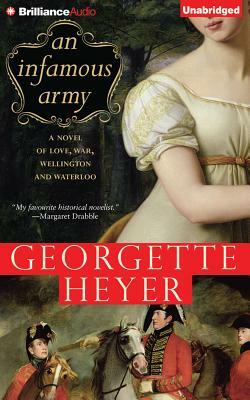
Review 2423: #1937 Club! An Infamous Army

I was planning to read Witold Gombrowicz’s Ferdydurke for the 1937 Club, but I got about 70 pages in and just wasn’t in the mood for it. I may never be.

Georgette Heyer is usually a good bet for me, and I conveniently had An Infamous Army on my shelf. I remembered, though, that it was not one of my favorites despite featuring characters from or related to those from some of my favorites. I decided to try to read the novel by pretending I had never read a book by Heyer, just judging it as a historical novel.

The novel is set in Belgium in the summer of 1815, so if you know your history, you know what’s coming up. The military of all the countries allied against Bonaparte are gathered in Brussels, as are the fashionable. Colonel Charles Audley, brother of Lord Worth of Regency Buck, is on Lord Wellington’s staff, so he is busy but occasionally has time to spend with Lord and Lady Worth. And everyone attends the frequent balls and parties.

Judith, Lady Worth, has found a girl she considers perfect for Charles, Lucy Devenish, a pretty, demure, heiress whose only detraction is a vulgar uncle. Society is being scandalized by the behavior of such young women as Lady Caroline Lamb and Lady Barbara Childe, a shocking young widow whose Alastair heritage (see These Old Shades and The Devil’s Cub) has given her quite a temper. Nevertheless, as soon as Charles sets his eye on her, he is in love. Unfortunately, thinks Judith, so is Barbara, and they are engaged in no time.

It’s no surprise that this is a rocky love affair. However, Heyer’s purpose is to depict the Battle of Waterloo and the frivolous months that led up to it.

Heyer was a serious historian, but her books aren’t often serious, and when they are, I miss the brilliant conversations and her humor. Sticking to my decision to try to forget about that, here are my observations. At the parties, there is too much enumeration as Heyer tries to list all the brilliant people attending. I felt like I was reading the beginning of The Iliad when Homer lists all the Greek commanders plus how many ships, men, and horses they brought.

Then, the social season seems to drag on a little too long. Things get going when the war starts, but when Heyer begins explaining troop dispositions and geography, I got lost. I could have used a map. Finally, although parts of the battle are brilliantly described, I felt as if Heyer was trying to include every anecdote she ever read about. There was just too much.

I have read battle scenes in other novels that were so clearly explained that I understood exactly what was going on. Here, there were so many different types of soldiers, so many leaders’ names, most of them only briefly described. There was too much going on for me.

As for the love story, while I didn’t much like Barbara, I was disappointed in how judgmental Judith, who had her own mishaps in her youth, was. It was nice, though, to have a brief appearance of Barbara’s grandparents, the Duke and Duchess of Avon, once Vidal and Mary of The Devil’s Cub.

Related Posts

Regency Buck

The Romantic

The Charterhouse of Parma

Review 2327: Chenneville

John Chenneville, a Union officer, awakens in a field hospital in Virginia to find that the Civil War is over and he has been lying in a coma for months. He has a healing wound on his head where a chain hit him after an explosion. The war is over, but it takes him months to be well enough for the journey home to Bonnemaison in Missouri on the Mississippi.

Once home, he can tell something bad has happened, but he has to wait for his Uncle Basile to arrive from New Orleans to learn what it is. In the meantime, he occupies himself with trying to restore his ravaged estates. Finally, his uncle tells him that on another one of the family estates further south, his sister, her husband and baby have been murdered. His mother has gone to live with Uncle Basile and has not spoken since the event. After waiting longer to improve his strength and coordination, Chenneville sets off to avenge them.

He finds it is an open secret that they were murdered by a man named Dodd. Dodd was a deputy, and it’s clear that the sheriff is going to do nothing about it but has warned Dodd that someone is after him. After going on a wild goose chase, Chenneville learns that Dodd has fled southwest to Texas. He is killing people on the way, and Chenneville eventually finds himself a suspect for one of the murders.

Jiles seems to like writing about people on journeys, and she likes the setting of post-Civil War Texas. Chenneville finds in East Texas an area once more populous and prosperous, now wild and desolate. This novel is involving and eventful as you wonder how Chenneville can avenge his family without destroying his own life.

Related Posts

The Color of Lightning

Simon the Fiddler

News of the World