Review 2116: The Unseen

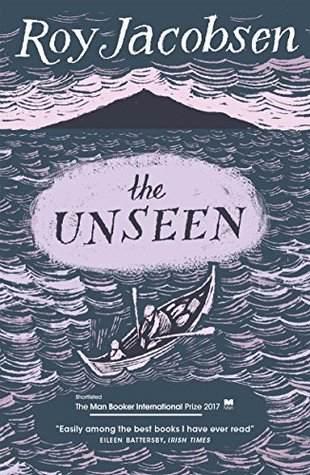
I have to admit to buying The Unseen because of its cover. I’m glad I did, because before I was halfway through, I was ordering the second book in the Barrøy trilogy. Although I’m not reading the shortlist for the Booker International prize, this novel was shortlisted for it.

After reading much of Halldor Laxson’s Independent People under the belief that it was describing Icelandic life in Medieval times, only to find out it was set in the 20th century, I don’t make assumptions about the times in which novels are set anymore. The Unseen describes a similarly primitive existence, with not many hints to its timeframe, but I finally figured out it begins a few years before World War I.

Ingrid’s family lives on Barrøy, one in an archipelago of many small islands in northern Norway. Each island is occupied by one family, and although the islands are in sight of each other, visits are rare, so the family has to be fairly self-sufficient.

Ingrid’s father, Hans, works hard and dreams of a different life for his family. His immediate dream is for a quay to make it easier for boats to land, so that when Uncle Erling arrives with his large fishing boat each January to pick up Hans for the yearly fishing, he can get off the boat. The novel relates the everyday events of the family’s life—the four-month fishing trips, the haying and fish drying in summer, milking cows, moving livestock from one small island to another for grazing, collecting and cleaning down from the eider ducks. And the big events—births, deaths, expansions and contractions of the residents of the islands.

Written in spare, crystalline prose with an occasionally very dry humor, The Unseen is fascinating. I loved this novel. And here I am reading about islands again.

Related Posts

Independent People

A Place Called Winter

The Rathbones

Review 2115: Summer Lightning

I intended to read Summer Lightning for the 1929 Club last fall, but it didn’t arrive in time from the library. It is one of the Blandings books, and I have not read many of those.

The country is buzzing at the news that Galahad Threepwood, that old reprobate, is planning to publish his memoirs. Old men up and down the country are terrified of what he might reveal.

At Blandings Castle, where Galahad has repaired to write, both Mr. Ronald Fish, Lord Emsworth’s nephew, and Miss Millicent Threepwood, a niece, are in love, unfortunately not with each other as their daunting aunt, Lady Constance, intends. Millicent has fallen for Hugo Carmody, Lord Emsworth’s secretary, and Ronnie for Sue Brown, a chorus girl.

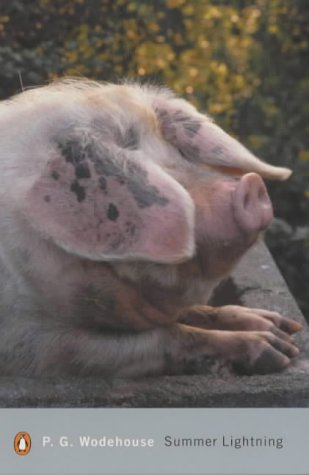
As usual, Lord Emsworth is besotted with his pig, the Empress of Blandings. Ronnie gets the idea to steal the Empress and hide her away then pretend to find her, thereby winning Lord Emsworth’s regard.

In the meantime, Hugo has to run up to town and takes the opportunity to go dancing with Sue. Unfortunately, he has promised Millicent he will do no such thing. Mr. Pilbeam, an oily detective, has just accepted a job from Hugo to find the Empress (which he only accepted because someone is paying him a lot of money to steal Galahad’s manuscript) when he comes upon Sue waiting at their table for Hugo. He has been calling her and sending her flowers, to which she hasn’t responded, so he sits at her table uninvited. At that moment, jealous Ronnie appears.

As if this isn’t enough silly fun, Sue impersonates a wealthy American so she can visit Blandings and make things up with Ronnie. The novel also features the reappearance of Baxter, Lord Emsworth’s previous secretary, whom Lord Emsworth thinks is batty. And he’s on the tail of the Empress, too.

I enjoyed this book, but I think the Blandings series is missing something compared to Jeeves and Wooster. That something is Bertie’s insouciant, dim-witted yet witty and kind narrative style.

Related Posts

Berry and Co.

Tea Is So Intoxicating

The Stone of Chastity

Review 2111: #ThirkellBar! The Duke’s Daughter

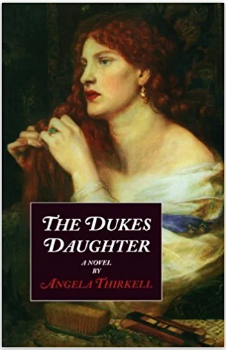
This entry in the Barsetshire series opens with characters’ realization that Lucy Adams is carrying a child, but then it jumps forward. Around about the same time, Tom Grantly meets the dreadful Geoffrey Harvey and begins to have doubts about his farm work. He has been happy working on Martin Leslie’s farm with Emmy Graham, but he doesn’t think there’s a career in it. So, he takes a job working for Harvey in the Red Tape and Sealing Wax Department. However, Harvey is known for making his underlings’ lives miserable, and within a year, Tom is ready to quit but doesn’t know how to explain to his father that he wants to change his career yet again.

Commander Cecil Waring has returned to the Priory to take up residence in his part of the house after taking in some shrapnel that the Navy doctors couldn’t find. It is floating around in his body and will either emerge or kill him. In the other part of the house, Philip White and his wife Leslie, Cecil’s sister, are having such success with their prep school that they are looking around for a bigger building.

Cecil meets Lady Cora Palliser, the Duke of Omnium’s daughter, and is much struck by her. However, he thinks she’s paying too much attention to Tom.

The new Lord Lufton makes everyone’s acquaintance. He is young, shy, and overwhelmed by his new responsibilities. He is also very kind and is at first attracted by Clarissa Graham until he sees her behaving rudely to Charles Belton.

Fans of the series may be pleased to find that this novel features the reappearance of almost every character who has ever appeared, with the added attraction of no less than four betrothals. Mrs. Morland, the author of a popular series of novels, always says they are all alike. Perhaps the Barsetshire novels are, too, but their charm is in finding out what happens to characters we know and in meeting new ones.

Related Posts

County Chronicle

The Old Bank House

Love Among the Ruins

Review 2104: The Other Side of the Bridge

Mary Lawson’s milieu is the tough life in remote northern Ontario. In The Other Side of the Bridge, she examines the relationships between parents and children and between brothers.

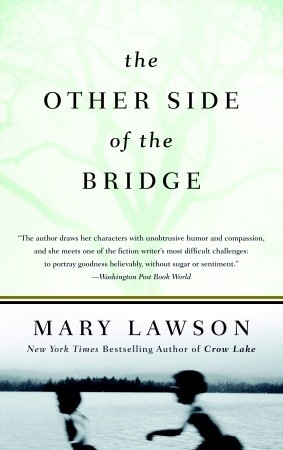
In the late 1930s, Arthur and Jake Dunn are a farmer’s sons. Jake was born after their mother had several miscarriages, and she has been so worried about him that he has not been made to work the farm, while Arthur works hard to help his father. Jake gets by on charm and recklessness, while Arthur tries to protect his mother by lying about the various fixes Jakes gets himself into. Arthur, who is quiet, solid, and dutiful, realizes at one point that Jake is purposefully making trouble for him.

Although his mother loves only Jake, Arthur has the moral high ground until a fateful accident on a bridge.

In the 1950s, Ian Christopherson is a high school student whose mother has left him and his father. He is harboring hatred for his mother for leaving and a disinclination to become a doctor like his father just because it’s expected. He also has a crush on Laura Dunn, Arthur Dunn’s wife, and asks for a summer job on the farm just so he can sometimes be around her. The couple seems content, but their relationship is more complex than he realizes until brother Jake comes home after having been gone for 15 years.

This novel is deeply affecting, dealing with long-suppressed emotions and intricate relationships. It is written in beautifully spare prose. Another great book from Lawson, who deserves a lot more attention than she seems to be getting.

Related Posts

Crow Lake

A Town Called Solace

Family Furnishings

Review 2098: Yoked with a Lamb

After reading several Clavering books, I’ve decided that one of her strengths is in depicting a warm family and village life. It comes slowly in Yoked with a Lamb.

The village of Haystown in Southern Scotland is shocked and excited to learn that the Lockharts are returning to the area—all of them, including Andrew, who ran off with another woman several years ago. Andrew and Lucy are trying again and moving back to his beloved home. Lucy Lockhart has asked Andrew’s cousin, Kate Heron, to oversee preparations to open the house.

Although Lucy and the children are supposed to arrive there before Andrew, one day he stops by on his way north. Kate spends some time with him and his good friend Robin Anstruther. She begins to be attracted to Robin when she learns that he also was madly in love with the woman Andrew ran off with.

Kate thinks Andrew has treated Lucy abominably, but as the family gathers, she sees that Lucy constantly finds fault with him and throws his past in his face. She also tends to boss her children around and deprive them of small pleasures for no apparent reason. As Andrew and Lucy try to work out their problems, Kate tries to deal with her feelings for Robin.

I am enjoying the Furrowed Middlebrow reprints of Molly Clavering’s work very much. She was a neighbor and friend of the better-known D. E. Stevenson, but I have found Clavering’s books slightly more substantial.

Related Posts

Mrs. Lorimer’s Quiet Summer

Dear Hugo

Touch Not the Nettle

Review 2096: The Raven’s Children

I thought Yulia Yakovleva’s Punishment of a Hunter was an excellent 1930’s-era Russian mystery, so I looked for more. But all I could find was The Raven’s Children, a children’s book.

In Stalinist Soviet Union, seven-year-old Shura lives with his older sister Tanya, his baby brother Bobka, and his parents. All of them are patriots, but one night his father disappears. The next day, their mother behaves oddly, packing a suitcase, saying she quit her job, but she doesn’t tell them anything. The family unusually has a two-room apartment with Shura and Tanya’s bedroom accessed by a wardrobe so the second room is not obvious. That night Shura is awakened to see someone being taken away in a black car. The next morning, their mother and Bobka are gone, and Shura overhears a neighbor saying that they were taken away by the Black Raven. Their neighbors won’t speak to them except the timid old lady down the hall, who gives them a purse of money from their mother with instructions to go to their aunt.

Neither child wants to go to the aunt, so they spend the day wandering around talking to the birds (who talk back), trying to find the Black Raven. Gradually, they understand that their parents are thought to be spies and traitors. They think there must be some mistake and if they find the Black Raven they can tell him so. Then when they arrive home at their apartment that night, they find their neighbor living in it.

I always go under an assumption that the age of the protagonist in a children’s book is roughly the age of its intended audience. That being said, I think that children that age would understand very little of this book and be terrified by some of it. And I’m not a person who thinks children shouldn’t be scared by books.

For one thing, Yakovleva slowly brings in an element of magical realism. The talking animals and even Shura becoming invisible and having people walk through him was okay. But Yakovleva makes metaphors become real, so ears and eyes appearing in the walls are really creepy. But the worms are the worst. And I don’t want to spoil anything, but some characters, once disappeared, stay disappeared.

Yakovleva wrote this novel because her grandfather had similar experiences as a child during Stalin’s Reign of Terror. This novel might work as a teaching tool, but I would advise it to be with discussions with an adult who has read up on the period. Otherwise, I don’t think children are going to understand this novel.

By the way, several adult Goodreads readers complained that they didn’t understand what was going on, and at least one of them said she was from a former Soviet country.

Related Posts

Punishment of a Hunter

Sofia Petrovna

Mastering the Art of Soviet Cooking

Review 2095: We

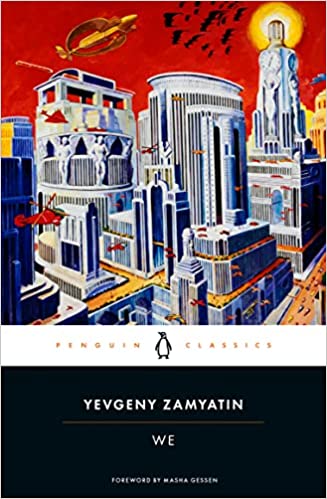
I am pretty well up on the 19th century Russian novelists, so when I was making my Classics Club list, I asked my husband to recommend someone more recent. He mentioned We.

The introduction calls Zamyatin an inconvenient citizen of both the czarist and Communist regimes, because he believed in complete freedom for the individual. His novel We is the granddaddy of dystopian novels and an inspiration to Orwell.

D-50 is a good citizen of the OneWorld, where everyone eats, sleeps, and works in unison. He is also the creator of INTEGRAL, which is going to be shot off into space to make the entire universe uniformly happy. He is writing a record to explain to the citizens of the universe why they should want to be uniform.

He thinks he is happy with O-90, whom he periodically requests for sex (the one time when they’re allowed to close the blinds of their glass apartments) until he meets I-330. There’s something mocking about her, and he thinks she’s up to something. Then she begins dragging him into situations that he should report her for to the Guardians. But he doesn’t, and soon he is madly in love with her and behaving strangely.

This novel is both dystopian fiction and a satire of some of the beliefs of Communism. At times, it is quite fevered in tone, and I wasn’t always sure what was going on. Characterization doesn’t even make sense in such a novel, so Zamyatin picks out weird facial features to identify people. Not my genre, but interesting.

Related Posts

Brave New World

Stranger in a Strange Land

American War

Review 2093: #ThirkellBar! County Chronicle

In introducing County Chronicle, I find it impossible to avoid spoilers for those who have not read the previous book, The Old Bank House. So, beware.

The novel begins where the previous one left off, if not slightly before that, with Lucy Marling wondering how her parents are going to take her engagement to Sam Adams, the wealthy older ironmonger who is not from her class. They take it comparatively well. It is her beloved brother Oliver who tries to flatten her excitement with his disapproval, so that Lucy realizes for the first time how selfish he is.

Speaking of selfish men, Francis Brandon is now happily married, but he’s been taking his mother for granted and is even rude to her. His mild-mannered wife Peggy is distressed by it but doesn’t have the courage to say anything. Others are beginning to notice, and Mrs. Brandon realizes it was a mistake for them all to live together.

Isabel Dale, a cousin of Robin Dale, takes a job with Mrs. Marling to help her with Lucy’s wedding and stays on to help her with her correspondence. She also sometimes helps Oliver with his book.

Although the Barsetshire set have tended to stay away from the Omnium Castle crowd, Francis and Peggy Brandon have been spending time there doing amateur theatrics with Lady Cora and Lord Silverbridge, the Duke’s heir. We find the ducal family impoverished but very nice. Eventually, Isabel and Oliver are introduced to the family by Roddy Wickham.

Although I didn’t like this one quite so much as The Old Bank House, it was still good. Several characters’ problems are resolved in a satisfying way, and the two romances are as sweet as they are understated.

Related Posts

The Old Bank House

Love Among the Ruins

Private Enterprise

Review 2088: Mrs. Tim Flies Home

I intended to read the Mrs. Tim books in order, but that hasn’t quite worked out, and I received this one just in time for Dean Street Press in December.

Hester Christie (Mrs. Tim) reluctantly leaves her husband in Kenya, where he is now posted, to form a household in England that her children can return to for the summer holidays. But en route she stops for two days in Rome. There she is unexpectedly met by family friend Tony Morley. Her couple days of sightseeing with him create a misunderstanding that travels all the way back to England to cause trouble for her through the person of Mrs. Alston, whom she met on the plane from Kenya to Rome.

Mrs. Tim has found a house in Old Quinings called the Small House. Although she loves the house, she finds she has a troublesome back neighbor and a landlady who isn’t to be trusted. She also meets some pleasant neighbors and helps out a young man in his romance with a nice young girl. She solves a mystery and finds out why some of the villagers are treating her oddly.

This book is another breezy entry in the Mrs. Tim series, written in the form of letters to her husband. It gets a little patronizing toward the ancient Romans (conveniently forgetting about the Inquisition), but they’re dead so they won’t mind. Otherwise, it’s an entertaining read.

I received this book from the publisher in exchange for a free and fair review.

Related Posts

Mrs. Tim of the Regiment

Mrs. Tim Gets a Job

The Two Mrs. Abbotts

Review 2084: Babbacombe’s

I asked Dean Street Press to rush me some books so that I could participate in Dean Street Press in December, and they have responded beautifully. Here’s a review of a book I received on Tuesday.

Beth Carson is a little disappointed after leaving school with high honors to take the job her father has arranged at Babbacombe’s, the large department store where he’s been employed for 30 years, instead of going to secretarial school. However, money has always been tight in the Carson household, and she is eager to help contribute.

Despite things being tight, the family is reluctant to take on a paying guest—George’s orphaned niece, Dulcie. But George feels guilty about neglecting her even though he didn’t like her father. When Beth goes to the railway station to collect her, she meets a nice young man after she is tripped up by his dog.

Dulcie turns out to be an unpleasant surprise for the family, but Beth finds herself enjoying her job in the dress department, even though it is at first exhausting. Then one day she is stuck in the elevator with the man from the railway station and finds out he is David Babbcombe, the boss’s son. When Beth learns he doesn’t work but collects an allowance from his father, she says she’d be ashamed to take money she didn’t earn.

Smarting from this, David, who threw away an opportunity at Babbacombe’s once already, goes to his father’s office and asks for a position. His delighted father starts him at the bottom this time instead of the top—in the meat department. He also has a secret from his father, he has submitted plans for a plane he designed to the government.

As David pursues Beth, her scruples interfere. Her father believes people should stay in their places, and she is sure Mr. Babbacombe wouldn’t approve of David dating one of his shop girls. Also not helping is Dulcie, who has decided she wants to marry David.

I’m having an inconsistent reaction to Scarlett’s work, probably because I don’t read too many straight romances. Although I liked another of her Cinderella stories, Clothes-Pegs, I often find the devices meant to keep the couple apart until the end are a little clumsy. In this case, Beth is almost stupidly obsessed by what their fathers will think, and Mr. Babbacombe’s confusion of the two girls doesn’t seem like him at all. Also, it seems to be a trope with Scarlett’s plots to involve a jealous, mischief-making other woman, which is a 50’s cliché. Still, this is pleasant light reading.

I received this book from the publishers in exchange for a free and fair review.

Related Posts

Clothes-Pegs

Summer Pudding

Begin Again