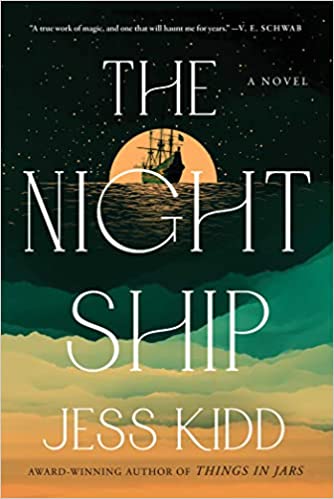
Review 2081: The Night Ship

In 1628, Mayken, the child of a wealthy Dutch merchant, sets sail on the Batavia to join her father in the Spice Islands after the death of her mother. She is accompanied by her nursemaid, Imke, but Imke being ill from the beginning of the voyage, Mayken soon has the run of the upper ship. Dressed in raggedy boys’ breeches, she also sometimes explores the depths of the ship.

In 1989, young Gil has gone to live on an island in the Indian Ocean with his fisherman grandfather after his mother’s death. Gil’s mother and her father Joss had been estranged, and Joss doesn’t seem happy to have him. The island is inhabited by fishermen who only live there during the fishing season and by archaeologists exploring the site of the sinking of the Batavia. There are rumors that the island is haunted by a girl who died after the shipwreck.

This novel is utterly fascinating. Kidd does a great job with her characters, especially the enchanting Mayken. The story of the Batavia, an actual shipwreck, is gut-wrenching, but Kidd makes her more modern story almost as interesting. This book is great.

Related Posts

Things in Jars

Himself

The Hoarder

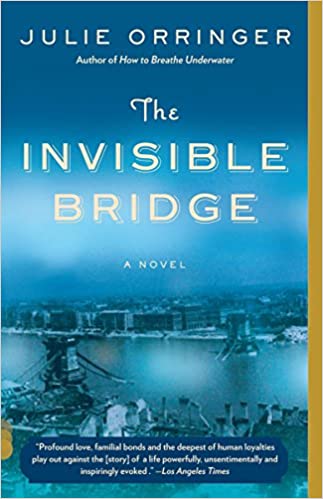
Review 2065: The Invisible Bridge

One of the reasons I learned to love reading was that I got swept up into another time or place or even world. As I got older and more discriminating, this experience happened less often. It happened most recently within a few pages of starting The Invisible Bridge, which I read for my James Tait Black project.

Andras Lévi, a young Hungarian Jew, arrives in Paris in 1937 to study architecture. He has brought with him a letter that an acquaintance asked him to mail once he was in Paris. He mails the letter but notices the address.

Soon he is involved in the technicalities of art school, made more difficult because he almost immediately loses his scholarship, a first act of the anti-Semitisim that is perceptibly increasing, although not as bad in Paris as it was in Budapest. He seeks a job at a theater from Zoltán Novak, a man he met on the train from Hungary. When he begins a friendship there with an older actress, she sends him to lunch with friends at the address on the envelope he mailed, and that’s how he meets Klara, an older woman with whom he falls madly in love.

This novel, which starts out seeming very particular, about a love affair between two people, grows into a novel of great breadth, covering events of World War II, the Hungarian Holocaust, life in work camps, the siege of Budapest. All of it is centered in the importance of family.

I absolutely loved this novel. It is sweeping, wonderfully well written, touching, harrowing. And what a story, based on the lives of Orringer’s grandparents. I can’t recommend this book enough.

Related Posts

Great House

A Town Like Alice

Between the Woods and the Water: On Foot to Constantinople: From the Middle Danube to the Iron Gates

Review 2053: #1929 Club! The Last September

I chose The Last September for the 1929 Club because I believe I’ve only read one book by Elizabeth Bowen, and that was long ago in a literature class. It is mostly a character study of a young girl during a turbulent time in Irish history.

Lois Farquar is at the point in life where she is trying to find where she belongs. She is recently out of school and has an uncertain place in the home of her uncle, Sir Richard Naylor. The life of her family and their neighbors in County Cork seems to center around visits, tea parties, and tennis with the young people in the neighborhood, including young officers of the occupying British army.

The Naylors are expecting a long-awaited visit by the Montmorencys. Lois is especially interested to meet Mr. Montmorency because he was once a suitor to her mother and she hopes to have a special friendship with him. But Hugo Montmorency chose his wife Francie instead of Laura. Francie, about 10 years older than Hugo, has become invalidish, and Hugo is constantly disgruntled and sulky. He seems to disklike Lois.

Lois is also trying to figure out how she feels about Gerald Lesworth, a young subaltern who has been courting her. At first, she seems more interested in a crush on Miss Norton, another visitor.

The events in this novel seem so mundane that it’s hard to believe that at this time the country was at war. However, slowly this becomes obvious.

This novel is beautifully written, evoking a time and place that by the end of the novel is gone. It is sensitive and observant, occasionally a social satire, but a subtle one.

Related Posts

Troubles

Good Behavior

Wild Decembers

Review 2051: #1929 Club! Classics Club Spin! Grand Hotel

The first book I chose for the 1929 Club was one that I have long heard of but never read. It was also coincidentally chosen for my Classics Club Spin!

In the 1920’s, the Grand Hotel is the most expensive in Berlin. Staying there are several guests whose lives are going to be changed.

Grusinskaya is a great ballet dancer still at the top of her form. But her clearly classical style has gone out of fashion, and after a lifetime of being alone, she’s very tired.

Kringelein is a poor clerk who has just found out he is dying and wants to experience a few weeks of luxury and “living.”

Doctor Otternschlag is an injured World War I veteran who hangs around the hotel doing nothing. He begins taking Kringelein around Berlin.

Baron Geigern is young, handsome, and personable, but he makes a living as a cat burglar, and he’s after Grusinskaya’s pearls.

Herr Preysing is the general manager of a company there to make a deal who ends up in a mid-life crisis.

Grand Hotel is a zeitgeist novel, very much a product of its time. Baum’s characters show their foibles or redeem themselves. Each one is flawed and complex.

Related Posts

They Were Found Wanting

No More Parades

The Long Take

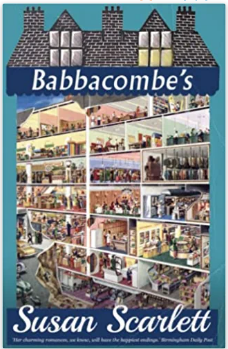
Review 2050: Summer Pudding

After Janet Brain’s employer’s office is bombed in the Blitz, she travels to the village of Worsingford where her mother and sister Sheila have made their new home. She has never been there before, but she makes a new friend on the train, Barbara Haines. Barbara’s reactions to some things she says should tell Janet that something is going on, but she doesn’t notice.

Janet arranged for her mother to move out of London into the country because her doctor urged her to make her mother get some rest without telling her she has a bad heart. Sheila was supposed to be doing the housework. But when she arrives at the cottage, she finds her mother more worn than ever and Sheila, beautiful and spoiled, doing absolutely nothing. Janet had planned to join the WAAFs but realizes she can’t leave her mother with Sheila.

Janet learns that Sheila agreed to teach Iris, the daughter of their neighbor and landlord, Donald Sheldon, months ago but has not kept her promise. So Janet goes over to Sheldon’s to offer her services. She is attracted to Donald, a widower, but finds him acting oddly when she tries to bargain for her pay. Donald also has a housekeeper, Gladys, who is jealous of him.

As Janet gets to know Donald, he alternates between seeming to care for her and seeming to disapprove of her even though she can’t figure out what she’s done. She doesn’t realize that Sheila has been telling lies.

Although the Furrowed Middlebrow books often involve some light, understated romance, they usually have other things going on as well. This is the first book I’ve read under this imprint that is a standard romance, with most of the action devoted to keeping the couple apart until the end. How good a romance is depends on how well you do this, and in this case, I think Scarlett (a pen name for Noel Streatfeild) doesn’t always handle it well. Characters over-react to other characters’ comments, for example. The situation isn’t too badly handled, though, and the book makes nice light reading. Straight romance novels are not usually my genre, though.

I received this book from the publisher in exchange for a free and fair review.
Related Posts

Ballet Shoes

Susan Settles Down

Touch Not the Nettle

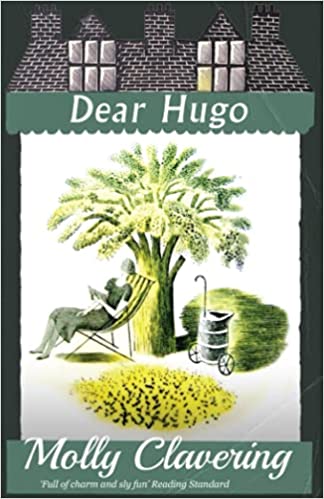
Review 2046: Dear Hugo

Sara Montieth has purchased a cottage in a small Scottish border village because she wants a quiet life. She has chosen the village because it was the boyhood home of her young man Ivo, who was killed in the war, and his brother Hugo.

Dear Hugo is an epistemological novel, consisting of Sara’s letters to Hugo, whom she has never met and who lives in Nairobi. It is about her daily life, the people she likes and dislikes, the events in the village. Although she wanted a quiet life, hers becomes eventful, especially after her cousin, who is newly remarried, asks her to take his 13-year-old son Arthur during his school holidays. It’s even more so after Hugo sends them a puppy.

The letters are written with gentle humor and describe all the village characters, including Miss Bonaly, a disapproving spinster who urges Sara not to hire Madge Marchbanks, an unwed mother, to help with the housework, and kindly, perceptive Mrs. Keith, who knew Ivo and Hugo as boys.

This is a nice, gentle novel of village life. It didn’t end quite the way I was hoping for, but I enjoyed it very much.

Related Posts

Touch Not the Nettle

Susan Settles Down

Music in the Hills

Review 2045: A Town Called Solace

I enjoyed Mary Lawson’s Crow Lake a great deal, but I can say for A Town Called Solace that at some point, I became so interested in it that I had a hard time putting it down to get other things done. This novel is set in 1972 and in memories of 30 years earlier.

Eight-year-old Clara is nearly stunned with anxiety. Her 15-year-old sister Rose ran away from home several weeks ago. Clara’s mother is prostrate from grief, and Clara stays looking out the window, because Rose told her she’d send her a message and she doesn’t want to miss it. She takes comfort in going next door to feed Mrs. Orchard’s cat, as she asked her to do when she went into the hospital. The only thing is, a strange man has appeared in Mrs. Orchard’s house.

That man is Liam. Clara’s parents haven’t told her that Mrs. Orchard died and left everything to Liam, a neighbor from her previous home she took care of when he was four. Liam has recently split from his wife and on hearing of his inheritance, quit his job and traveled all the way to far northern Ontario to Solace. His plan is to fix up the house and sell it, but he slowly becomes involved with people in the community.

Liam, who has always had trouble forming relationships, understands that Clara believes her parents are liars because they didn’t tell her about Mrs. Orchard, so he extends her the peace of his home when he is out so that she can feed and play with the cat, and the courtesy of not lying to her. Periodically, the novel returns a few months in time to Mrs. Orchard’s last few days and her memories of that time when Liam was four years old.

I absolutely loved this book. It is about loneliness and the difference that love and understanding can make in a life. It is empathetic without being mawkish or manipulative. It’s also about ordinary people trying to make their way through life. It’s lovely.

Related Posts

Crow Lake

The Northern Lights

The Haunting of L.

Review 2041: The Marble Staircase

Charlotte Moley’s life has always been dominated by others—first by her mother, both before and after her marriage and widowhood, and lately by her grown daughter Alison. Her only periods of happiness were the summers she spent in Italy with Mrs. Gamalion and her friends, long ago before the war.

Now Mrs. Gamalion has left her a legacy—a run-down old house in the coastal town of Nything. It is full of souvenirs of the old lady’s life, and Charlotte decides to keep it and stay there, much to Alison’s disapproval. She also begins making friends, meeting Mrs. Bateman her first night on the esplanade.

Charlotte has old memories to deal with, both of her mother and her disappointment in love one Italian summer. It is Mrs. Gamalion’s gift that helps Charlotte let go of the past and make herself a new life.

I have read and enjoyed every Elizabeth Fair novel that Dean Street Press has reissued. This is another very pleasant light read in this imprint.

I received this book from the publisher in exchange for a free and fair review.
Related Posts

Seaview House

Landscape in Sunlight

The Mingham Air

Review 2037: #ThirkellBar! Private Enterprise

Private Enterprise is Thirkell’s first wholly post-war Barsetshire novel. It reflects the confusion and discomfort caused by government measures that make things seem more difficult even than during the war.

The novel begins with Noel and Lydia Merton. Noel is back at his law firm, and they are now parents of two small children. To them for part of the summer holidays comes Colin Keith, Lydia’s brother, whom we first met in Summer Half. It is immediately apparent that he has fallen in love, with Mrs. Arbuthnot, a young widow. He is trying to find a house for her and her sister-in-law, Miss Arbuthnot, near Barsetshire.

Colin makes a fool of himself over Mrs. Arbuthnot but manages to find the two women a house. They move in and are quickly welcomed into the community. Again, we meet or hear about quite a few of the characters from previous books, including Mrs. Brandon and Francis Brandon, her son. Mrs. Brandon has gotten older, but we remember how young men used to fall in love with her and Noel Merton enjoyed flirting with her. We’re told several times that Mrs. Arbuthnot resembles her.

Unfortunately, Colin is not the only person who makes a fool of himself over Mrs. Arbuthnot. In the meantime, Miss Arbuthnot, older and less expectant, has her own quiet romance.

I noticed Thirkell’s snobbishness more in this novel than the previous ones, maybe because the others were more fun. It is clear that things are changing for the entitled classes and they don’t like it. Still, this novel seems an accurate record of life for these families (and to some extent of those of the less privileged) in post-World War II England, and I am still enjoying hearing about my favorite characters.

A comment about my edition. In the series up to this book, I have been reading the Virago editions, but Virago chose not to issue the post-war books, so I will have to finish the series reading Moyer Bell editions. As always with Moyer Bell, I am spotting lots of typos that seem to result from machine-reading a word wrong and substituting one that doesn’t make sense. Those are trivial, though, compared to the odd selection of the cover design and pictures at the beginning of each chapter. They are all by John Everett Millais, a Pre-Raphaelite artist. I have nothing against the Pre-Raphaelites, but they were a Victorian movement, and Millais was dead by the beginning of the 20th century. The women depicted in his paintings are dressed completely wrong for post-World War II England, of course, which makes me wonder why these paintings were selected for this novel. It’s a very odd choice. Perhaps the editors thought the novel took place after the Boer War?

Related Posts

Summer Half

Peace Breaks Out

The Headmistress

Review 2033: Astonish Me

I enjoyed Maggie Shipstead’s Great Circle, although maybe I thought it was a little overhyped. However, I liked it well enough to look for something else by her and found Astonish Me.

When ballet dancer Joan sees Arslan Rusakov dance, she falls madly in love with him. A brief encounter leads to a correspondence, and a few years later, in 1975, Joan helps him defect from the USSR. Arslan is not faithful to her, however, and once he finds that she is not a good enough dancer to dance with him, he seems to lose interest.

Joan finds she is pregnant and decides to leave the dance life. She seduces her lifelong friend, Jacob, and marries him. They settle in to a suburban life in California.

Their son Harry develops the same kind of friendship with his neighbor Chloe that Jacob had with Joan—he worships her while she seems often embarrassed by him, yet appreciates his friendship. But as they reach their teens with both turning to ballet, it becomes obvious that Harry will be a great dancer while the jury is still out on Chloe.

At first, I was turned off by Joan’s decision to deceive Jacob. I felt it was particularly unlikely for that time. However, as the novel digs deeper into the fascinating world of dance, I found it more and more compelling. I liked, too, that Shipstead’s characters have their faults. They’re human, not perfect. If anything, I liked this novel better than Great Circle.

Related Posts

Great Circle

Pippa Passes

Ballet Shoes