Review 2003: The Museum Guard

I have been a big fan so far of Howard Norman’s quirky novels. However, I had a slightly more mixed reaction to The Museum Guard.

DeFoe Russet has lived in the Lord Nelson Hotel in Halifax ever since his parents died in a freak Zeppelin accident when he was eight. As a boy, he was cared for by his uncle Edward, if you can call it that. Edward is an irresponsible, gambling, drinking womanizer with a lot of opinions.

DeFoe works as a museum guard in the small Glace Hotel, where his uncle also works when he bothers to show up. DeFoe is very much in love with Imogen Linny, the caretaker for the local Jewish cemetery. However, although they are lovers, Imogen is difficult and seems often to tolerate DeFoe.

DeFoe doesn’t seem to realize how stuck he is in his life. He has no plans except to continue working as a museum guard and to persist with Imogen. He is interested in listening to the tours of the museum given by Miss Dello, a local professor, and likes to think about the paintings.

Edward has been making himself obnoxious about DeFoe’s relationship with Imogen, whom DeFoe has kept from meeting Edward. But Imogen has recently become fascinated by a painting in the museum, Jewess on a Street in Amsterdam by Joop Heijman. Then there is a fateful meeting between Imogen and Edward in the museum. Imogen essentially dumps DeFoe and begins spending a lot of time with Edward, who without permission lets her into the museum at night to be with the painting. Soon, the novel takes a bizarre turn as Imogen begins to believe she is the woman in the painting.

The novel is set mostly in 1938 and 1939 against the background of what is happening in Nazi Germany. DeFoe tells us on the first page that he steals the painting for Imogen, and the novel is about what causes him to do that and what happens afterwards.

I guess this novel is about stepping out of ordinary life. However, a lot of time is spent on DeFoe’s obsession with Imogen, maybe a bit too much, and the novel just gets weirder as it goes along. I’m not saying I disliked it, just that it wasn’t one of my favorites of Norman’s novels.

Related Posts

The Bird Artist

The Haunting of L.

The Northern Lights

Review 2000: #ThirkellBar! Miss Bunting

Miss Bunting is another re-read for me. I’ve looked over my original review, which seems fine, so use the link for the plot synopsis. One thing I notice is that because of reading the books in order and thereby getting to know the characters better, I found the ending of this novel more affecting than I did the first time.

So, here are my observations from this time through. First, I noticed the subtleties of the class distinctions. Although I mentioned in my first review that Thirkell’s usual upper-class characters are flustered at having the wealthy and vulgar Mr. Hill thrust his way in amongst them (and thrust he does, appearing several times uninvited), Jane Gresham is shocked when he implies that he considers himself better than his landlady Mrs. Merivale, who is educated and middle class and whose daughters have better marriage prospects than Heather Hill does. Of course, Heather’s ambitions are different than Mrs. Merivale’s. I myself was surprised to find the Middletons, who seemed fully accepted in Before Lunch, being considered socially inferior (mostly by Lady Fielding, who’s a real snob). Toward the end of the novel, Lady Fielding reflects that men like Mr. Hill have taken over, and there won’t be room for people like them. Lord Fielding reassures her, but she’s not far wrong.

This novel is sad in more ways than one, but particularly affecting is Jane’s situation, not knowing whether her husband is dead or alive. I won’t give the other reason away.

Related Posts

Marling Hall

The Headmistress

Before Lunch

Review 1999: Edith Trilogy Read-Along: Dark Palace

The Edith Trilogy Read-Along calls for the second book to be read during July. This second book, Dark Palace follows Edith and the fate of the League of Nations from 1931 through the end of World War II. Although most of it is set in Geneva, Edith also visits Australia and the United States.

This novel begins roughly one year after the close of Grand Days. Edith and Robert have been married about a year, but Edith feels she has misunderstood Robert’s character. For one thing, he is not really dedicated to the success of the League, and she sometimes finds him crass. She takes the opportunity of Ambrose Westwood’s return to Geneva and Robert’s departure to cover the Spanish Civil War to rekindle her unusual affair with Ambrose.

At the League, she is considered an expert on protocol but still does not have an official title. At the beginning of the novel, she and other League officers are excitedly preparing for the conference on disarmament they are hosting.

This novel, like many middle novels in a trilogy, has a less focused plot than the first. Edith, at one point, considers moving back to Australia and visits the newly founded Canberra to fish for a job. But Canberra barely exists, and her fellow Australians don’t seem impressed by her accomplishments. The novel skips in an episodic way through several events during the war.

There are times in the novel when Edith’s didacticism is really annoying. What the novel does have, however, is a deeply affecting conclusion.

Related Posts

Grand Days

A Town Like Alice

All the Light We Cannot See

Review 1895: The Magician

Although I’ve only read one work by Thomas Mann, I still found The Magician, based on Mann’s life and writings, interesting. Although Mann himself often seems inert in this novel, he lived in interesting times, during both world wars.

The novel covers Mann’s life from a young man who is dispossessed by his father to his relocation from California to Switzerland in his 70’s. It examines the thinking behind his greatest works and although fairly meditative in tone, has some excitement during the Mann’s flight from Nazi Germany.

In some ways The Magician is reminiscent of The Master, Tóibín’s novel about Henry James, with Mann fantasizing about young men but never acting on those fantasies after a couple of abortive encounters. The difference is that James seemed almost unaware of his own proclivities. Mann still managed to have a long, successful marriage with his wife Katia.

Tóibín’s biographical fiction always seems intuitive and thoughtful to me. I enjoyed this one despite my lack of knowledge about its subject. I read this novel for my Walter Scott Prize project.

Related Posts

The Master

Nora Webster

Lady Gregory’s Toothbrush

Review 1891: Keeping Up Appearances

I’m not sure if it was because I was on vacation while reading Keeping Up Appearances, but it took me much longer to read it than usual for a novel its size. I did notice I occasionally had a hard time paying attention to it while at other times felt I was reading a script for I Love Lucy.

Daphne and Daisy are opposites in personality, but they’re constantly together. Daphne is confident, witty, and brave, perhaps a higher class than Daisy, while Daisy is shy, unsure, and not always swift on the uptake. Daisy is ashamed of her class origins and the circumstances of her birth, even though she has been raised by higher class family members. Daphne could care less about all that.

At the opening of the novel, both young women are vacationing with the Folyot family on an island in the Mediterranean. Mrs. Folyot works against tyranny and reminds me of Mrs. Jellyby. She is obsessed by her causes and so later has a hilarious scene of talking at cross-purposes with Daisy’s mother.

Both girls care for Raymond, the Folyot’s oldest son, a biologist. Although Daisy doesn’t like to look at the little animals Raymond shows her as much as Daphne does, Daisy fears she cares for Raymond more than Daphne does, but he likes Daphne more than her. Unfortunately, an incident with a wild boar makes Daisy too embarrassed to stay, and Daphne goes, too.

Daisy doesn’t think the Folyots would approve of her profession. Not only is she a successful author of middlebrow novels, but she takes assignments from a newspaper to write silly articles about women that the paper assigns her. Daisy is a snob, and she is proud of neither activity even though we suspect she is a better novelist than she thinks.

Macaulay obviously had fun skewering the newspapers, because the ideas for articles are ridiculous and sexist, as is clearly the attitude toward Daisy’s novels.

Although this novel satirizes the publishing industry, it is really about identity and self-image. Most of the characters are not quite likable except Daisy’s mother, who is a hoot.

I received this novel from the publisher in exchange for a free and fair review.

Related Posts

Dangerous Ages

The World My Wilderness

The Towers of Trebizond

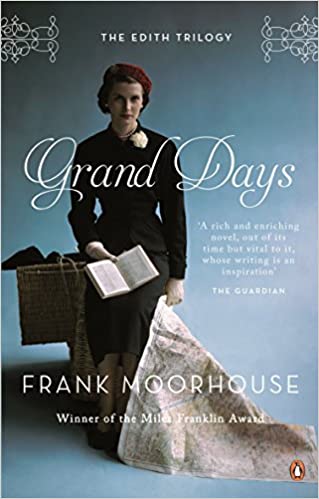
Review 1887: Edith Trilogy Read-Along: Grand Days

I decided to participate in the Edith Trilogy Read-Along hosted by Brona of This Reading Life, but my copy didn’t arrive until June 29th, so I am late for the first one, which was to be read in June. I hope to be on time for the second in the series. This series introduces me to Frank Moorhouse, a highly regarded Australian writer.

On a train from Paris to Geneva to work at the newly created League of Nations, Edith Campbell Berry meets Major Ambrose Westwood, who will be a more senior officer in another section of the League. Edith is naïve and dedicated, a quirky person who has her Ways of Going but is determined to become more cosmopolitan than her Australian roots have made her so far. On the train, she and Ambrose share a kiss.

Edith and her coworkers are excited to be working for this important organization with its worldwide focus and its aim to prevent war. Edith conscientiously studies diplomacy from Ambrose and other senior officers and makes contributions of her own, enough to attract their attention and mentorship.

She does not always make the right choices and finds herself in some ridiculous situations. She also begins an affair with Ambrose, whose unusual proclivities lead her in unexpected directions.

At first, I wasn’t sure how much I liked Edith, particularly her habit of listing and examining what she thinks she knows and her almost aggressive questioning of ideas until she’s sure she understands them. I also noticed that she seemed not to pay much attention to events developing in Europe toward the end of the 20’s. But eventually I was charmed by her.

There were some pages toward the middle of the book when she was enumerating ideas that I skipped after reading several paragraphs, and shortly thereafter, when she was contemplating her poop, a scene I know was supposed to be funny, I was not amused. Still, I’m interested to read Cold Light, the next novel, especially because the book cover description contains a detail that I hope is wrong.

Related Posts

A Town Like Alice

Midnight in Europe

The Gustav Sonata

Review 1882: After the Fire, A Still Small Voice

After the Fire, A Still Small Voice is Evie Wyld’s debut novel about how family trauma can pass down the generations. In alternate chapters, it follows Frank Collard in the present time and Leon 40 years earlier. Maybe I was dense, but it took me a while to realize that Leon is Frank’s father.

Frank has just split up with his girlfriend when he decides to restart his life. He leaves Canberra and drives to a shack on the eastern coast that his grandparents purchased years ago and where he spent holidays as a boy. He gets an occasional job loading boats. It’s a primitive life, and the loneliness starts to get to him.

Leon trains under his father to be a pastry chef and takes over the bakery after his father, in gratitude for the country that took in himself and his wife, World War II Jewish refugees, volunteers for the Korean War. Leon’s father returns damaged, unable to work, so his parents leave Leon, ending up in the beach shack. Then Leon is conscripted for Vietnam and has his own damaging experiences.

I can’t come up with the reference for this, but I remember several years ago reading a post by someone complaining about women writing like men. The implication was that they were doing so to be taken more seriously by male editors and publishers. In particular, Evie Wyld’s All the Birds, Singing was mentioned with the remark that you didn’t even know if the main character was male or female for some time. I didn’t agree that (1) just because you don’t know the sex of the main character means that the author is writing like a man (look at The Towers of Trebizond) or (2) Wyld was writing like a man in All the Birds, Singing. I certainly didn’t have that impression. However, the feel of After the Fire, a Still Small Voice is very masculine, which makes sense with her male protagonists.

The only other observation I have about the novel is that it seemed a bit all over the place for me. Perhaps this is because of my initial confusion about the relationship between the two main characters. I guess I wasn’t paying attention to last names, and Leon’s isn’t mentioned right away. In any case, for a long time I wondered where the novel was going. Also, I didn’t much like either Frank or Leon, although Leon was okay until Vietnam. But Frank’s problem isn’t really explained, and he has major anger issues.

Related Posts

All the Birds, Singing

The Bass Rock

The Towers of Trebizond

Review 1872: The Bass Rock

Told in three compelling narratives that take place over centuries, The Bass Rock is a novel about the history of violence toward women. The novel is located on the banks of the Firth of Forth, an area of Scotland dominated by the Bass Rock.

Early in the 18th century, the local priest comes upon some young men raping a very young girl, Sarah. The priest rescues her, but the young men claim she must be a witch because she enchanted them and forced them to do it. Soon, the men have burned down the priest’s house, and the entire household must flee toward the beach.

Post-World War II, Ruth and her husband Peter have recently moved into the big house in North Berwick. Ruth doesn’t quite understand the reason for the move, since Peter works in London. He says it is for the benefit of his sons by his previous marriage, Christopher and Michael, but they are being sent off to school. Soon, newly wed Ruth finds herself left very much on her own with only the housekeeper Betty for company. She begins to discover some secrets in the family.

After Ruth’s death as an old lady, Michael’s daughter Viv is hired by the family to sort through the things left in the house so it can be sold. She has recently had some mental issues and feels like she is the family failure. Almost despite herself, she befriends Maggie, a homeless occasional sex worker who has an interesting take on things. Maggie tells her there is a ghost in the house.

This is a powerful novel. Although its theme is grim, its main characters are relatable and sometimes likable. I loved All the Birds, Singing, and this is another winner from Wyld.

Related Posts

All the Birds, Singing

The House Between Tides

The Vanishing Act of Esme Lennox

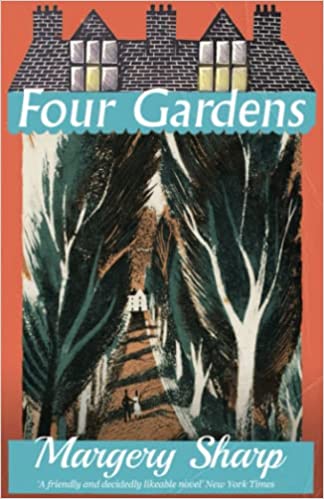
Review 1871: Four Gardens

Furrowed Middlebrow calls Four Gardens one of Margery Sharp’s most beloved books. At first, I thought the novel was just okay, but gradually it won me over. It’s essentially a character study of Caroline, a woman born into the Victorian era who has to learn to adapt to more modern times.

The novel begins with Caroline as a teenage girl, still in the 19th century. She comes from an ordinary middle-class family and recognizes a big divide between herself and the people she knows and the others from the Common, the area where the wealthier people live. She and her family, for example, work on the annual festival, but they are not invited to it.

In the neighborhood is a deserted house with extensive gardens. Although it is trespassing, Caroline sneaks in there and meets Vincent, an upper-class boy. During the summer, she runs off to meet him in the garden. But once he sees her with her family, he stops coming.

Beginning with this disappointing first romance, Four Gardens follows Caroline as she marries, has children, meets with a change of fortune, gets through World War I, and continues into middle age and older. She is an endearing heroine, realistically experiencing the changes of the times. It’s an affectionate and lovely novel.

Related Posts

Harlequin House

Rhododendron Pie

Cluny Brown

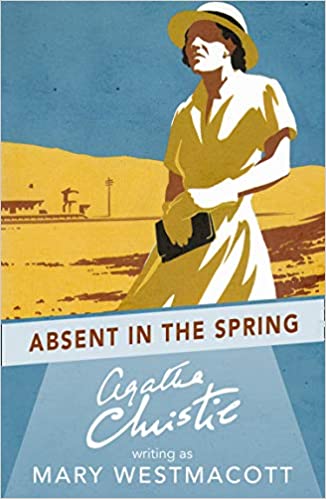
Review 1870: Absent in the Spring

For some reason, I always thought that the novels Agatha Christie wrote as Mary Westmacott were romance novels. Absent in the Spring, however, is a character study with an edge, reminding me more of some of the novels of Elizabeth Taylor.

Middle-aged Joan Scudamore gets stranded for several days at a guest house on her way from Baghdad to London. Before this happens, there is a revealing encounter between her and an old school friend, Blanche Haggard. Joan is judgmental toward Blanche, thinks she looks old and untidy and blames her appearance on the unfortunate choices she has made in life. Blanche cheerfully admits her bad choices but says she has enjoyed her life. She also hints at something about Joan’s daughter Barbara. We realize we like Blanche more than Joan.

During the five days Joan is stranded, she begins reconsidering her self-satisfied attitude, realizing some truths about herself and her family that she has hidden from herself. It is clear to the reader that she has bullied her husband and children, but she sees her behavior as doing her best for them. She thinks she has helped them to happy lives, but she has tried to make them all do what she thinks is right.

The big question is whether Joan can change her attitude. Let’s just say the novel is much more in the Realism school than Christie’s mysteries.

And by the way, let me just state my objection to this book being relabeled under Christie’s name. On the cover of my edition, the Christie name is more noticeable than Westmacott. Although I see no harm in acknowledging somewhere that they’re the same person, this is a marketing ploy that I don’t agree with. She wrote the book under the name Westmacott, so that should be the predominant name.

Related Posts

Appointment with Death

A View of the Harbor

Tales from the Queen of the Desert