Review 1423: Literary Wives! The Home-Maker

Today is another review for the Literary Wives blogging club, in which we discuss the depiction of wives in fiction. If you have read the book, please participate by leaving comments on any of our blogs. Be sure to read the reviews and comments of the other wives!

Eva of Paperback Princess
Lynn of Smoke and Mirrors
Naomi of Consumed By Ink

* * *

The Home-Maker is a reread for me, so let me just provide a link to my original review and then discuss our regular question.

What does this book say about wives or about the experience of being a wife?

Evangeline Knapp is a perfect example of a woman, like my mother, who was not suited to be a housewife, a kind of person not recognized in her time. Unlike my mother, who at home was the female equivalent of Lester Knapp at work, Evangeline compensates by becoming overzealous and overparticular in her housekeeping, making the immaculate home a miserable place for everyone, including herself.

In this ground-breaking work of 1924, the couple are forced to switch places, and Evangeline finds her place in life. At work in a department store, her efficiency and energy are appreciated, and because she enjoys the work, she loses her resentment. The Knapps change from a dysfunctional family to one that is much happier, because everyone is happy in his or her role. In  fact, to keep this happy solution in this chauvinist time, they have to come up with a rather shocking solution. The Knapps develop a true partnership in their marriage.
Literary Wives logoI like this novel because instead of depicting a family in stasis, it presents a problem that probably wasn’t much recognized in its time and shows how the family relationships improve as a result of its solution. The marriage evolves from a somewhat unhappy one to a happy one, and everyone is fulfilled. Lester understands Evangeline’s need for meaningful work, and he enjoys taking her position in the household, albeit not providing an immaculate household but a loving, slightly messy one. Evangeline’s sharp temper subsides.

In her way, Evangeline is a little more exaggerated version of Brenda in Happenstance, who began to have periods of anger before she took up quilting.

Related Posts

Happenstance

A Lady and Her Husband

The Awakening

Review 1414: Lilac Girls

I would like to say to some writers, If you are going to use multiple narrators (please don’t), they must have their own voices. If they don’t sound like different people, this technique doesn’t work. Unfortunately, either Martha Hall Kelly doesn’t know this or can’t do it. I’m not talking about expressed concerns or interests here but actual tone and mode of expression.

Lilac Girls reminds me very much of Salt to the Sea. If you remember my review of that book, you know that’s not a good thing. There’s the World War II setting, the alternating chapters with different narrators, one of whom is the evil Nazi. There is also the unconvincing narrative change, the poor characterization, and the mediocre writing.

Caroline Ferriday is a New York socialite who works for the French Consulate and is involved in charities to help French children. In summer of 1939, there are already lots of refugees fleeing from France. We guess she’s going to become involved in that; however, the first hundred pages of the novel concern her growing relationship with Paul Rodierre, an actor whose wife is trapped in France. Not very interesting, since Hall doesn’t get us to care about Caroline or Paul.

Kasia Kuzmerick is a Polish teenager living in Lublin. When the Nazi attack, she witnesses their planes firing on camps of refugees. Later on, she begins running errands for the resistance.

Herta Oberhauser is a young doctor who has bought the Nazi vision despite having difficulty getting a job because women are expected to be wives and mothers. She finally gets a job working at Ravensbrück, a concentration camp for women.

Not only did I think the characterization was poor, I felt the behavior of characters was at times unlikely. For example, Kasia is old enough to understand that her mother is being forced to have an affair with a Nazi, yet she makes a dangerous public scene with her about it. Herta is an ambitious doctor who cannot find a job because she is a woman, yet she buys the ideals of the Nazi party that is keeping her down.

I admit I did not finish this novel, which was taking a long time to get anywhere (another problem with such frequent switches in narration). I read about a quarter of the book then decided to quit wasting my time. The story of Ravensbrück is important, but this writer is not up to the task.

Related Posts

Salt to the Sea

All the Light We Cannot See

The Nightingale

Review 1412: Classics Club Spin Review! The Wise Virgins

The novel selected for me by the latest Classics Club Spin is The Wise Virgins by Leonard Woolf. This semi-autobiographical novel is partially about the courtship of Leonard and Virginia Woolf, in the characters of Harry Davis and Camilla Lawrence.

Harry and his family have just moved to the London suburb of Richstead and are shortly befriended by the Garland family, which has four unmarried daughters. Harry is disdainful of life in Richstead and of the fates of the spinster daughters, given up to good works or golf and tennis. The youngest daughter, Gwen, is naïve and gives undue weight to his discontented utterances. He amuses himself by giving her books and plays to read of Dostoevsky and Shaw.

In his art class, Harry is drawn to Camilla Lawrence, a cool beauty. When she invites him home, he finds it one of ideas and stimulating conversation. Camilla has suitors, but she is less interested in marriage than in a quest for self-fulfillment. She is repeatedly alleged to be passionless.

This novel was considered somewhat shocking in its time but was notable for examining the fates of conventional young women in Edwardian England. Harry is not a likable hero nor is Camilla very knowable. I personally did not like their glib and superior dismissal of whole classes of people. I always imagine the Bloomsbury circle snidely sniping at everyone else (and behind each other’s backs), and this novel didn’t make me rethink that idea.

This is probably taking the novel out of its time, but simply the continual reference to unmarried women by Harry as virgins irritated me to no end. He is so superior and supercilious. The introduction to the book says that “virgin” was synonymous with unmarried woman to Edwardians, but clearly for Harry there’s a sneer involved. One article I read calls Harry a truth-teller, but some of the things he says seem only designed to stir people up and make him seem more like eighteen than twenty-eight. Also uncomfortable for modern readers is the antisemitism that is accepted unquestioned by Harry and his family, who are Jewish.

Finally, there are lots of references to talking in this book, and for people who are looking for a purpose in life besides marriage and other predictable fates, they aren’t doing much actual acting. I think Woolf is pointing that out, though, by the chapter headings.

Related Posts

Mrs. Dalloway

To the Lighthouse

Flush: A Biography

Review 1408: Love Is Blind

Although generally speaking, I love William Boyd, I should have known better than to read a book named Love Is Blind. Even from the title, I could tell it was about a man who falls in love with a woman who is trouble, a plot that I hate. Although men love to write books upon this subject, most of the women incarcerated in the United States are there because of a man. Of course, it happens for both sexes, but a man enthralled by a lethal siren is the least of it and, for me, not interesting.

In 1894 Edinburgh, Brody Moncur is a piano tuner of significant skills. He is offered a position of assistant manager in his company’s Paris office which he takes, determined to get away from his controlling father.

In a promotional effort, Brody makes a deal with John Kilbarron, a famous pianist, to play only his company’s pianos. Soon, he has fallen in love with Lika, Kilbarron’s mistress, who is an opera singer. They begin an affair, and his life becomes a series of efforts to win her away safely from Kilbarron.

Disturbingly, we get very little sense of what Lika is like as a person. She serves pretty much as Boyd’s MacGuffin. The novel just focuses on Brody’s obsession and its consequences. It’s obvious that Lika has her secrets, and to me, it was even obvious what the major one was.

As well written as it is, I simply didn’t enjoy the theme of this book. As with Boyd’s other recent books, it takes in a sweep of history and visits many places while it meanders to its denouement.

Related Posts

Sweet Caress

Euphoria

The True Heart

Review 1401: The Muse

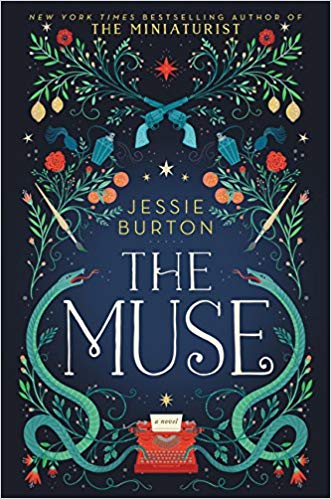
In 1967 London, Odelle Bastien has been making her way with difficulty. Although she is well educated, her race and origins in Trinidad are keeping her from getting a job. Then she gets a break. Marjorie Quick hires her as a secretary in an art institute and makes friendly overtures.

Odelle finds Quick mysterious. She asks Odelle about herself but tells her nothing. She does, however, encourage Odelle to write.

Odelle has also met Laurie Scott, a young man who is interested in being more than her friend. His mother has just died, leaving him only an unusual painting. To support himself, he intends to try to sell it. Odelle encourages him to bring it to the Skelton Institute, her workplace. When Quick sees the painting, she has a strong reaction to it.

In 1935, Harold Schloss, an art dealer, has fled Vienna with his family. Unfortunately, he has chosen Spain, which will soon be little safer, to flee to. His daughter Olive has been accepted at Slade, but she hasn’t told her father. He believes that women can’t be artists, just dabblers.

Olive meets Isaac Robles, an artist, and his sister Irene. Both are servants for the house the Schlosses are renting. Olive is struck by Isaac’s good looks and begins painting in a new style with vibrant colors.

The novel follows these two time threads as it explores the mystery of the painting. Who painted it, and how did it end up in London? How does Quick know about it?

I was struck by Burton’s weird and wonderful The Miniaturist, so much so that as soon as I finished reading it, I bought this book. I found The Muse to be a bit more mundane, with few surprises. For a long time, I was much more interested in Odelle’s section than Olive’s, particularly because Olive makes a decision about her art that I found shocking and unbelievable. In theme, this novel is similar to The Blazing World, and in an action taken by an artist, but with a crucial difference.

Also, like some other bloggers, I am wearying of the dual time-frame format. I am beginning to think it is a little lazy. After all, it seems easier to write half a book about two historical time periods (or one depending upon the time chosen for the more recent period) than a whole book about one. One of the delights of The Miniaturist was how it immersed me in the period. This novel doesn’t really do that.

Mind, it’s not a bad novel, and many people will like it. I just found it a disappointing follow-up to Burton’s first book.

Related Posts

The Miniaturist

The Blazing World

The Clockmaker’s Daughter

Review 1394: Mothering Sunday

Best of Ten!
It’s a warm day in the spring of 1924, Mothering Sunday, a day when servants are released from their duties to visit their mothers. Jane Fairchild is a young maid in the home of the Nivenses, but she has no mother. She plans to curl up with a good book until she receives a phone call from her long-time lover.

Her lover is Paul Sheringham, the only son left after World War I to a neighborhood family. Although he is to be married in two weeks, he sets up a tryst with Jane in his own home while his parents and the servants are out.

Jane is to revisit these hours spent with her lover for the rest of her life. For something happens that afternoon that changes the course of her life.

This is a remarkable novel. It is very short, but it somehow covers the course of Jane’s entire life while minutely examining one scene, the meeting with her lover. It touches on every action and word, considers them from several sides just as the mind does as it re-examines an event. At the same time, it examines what qualities make a writer and what a writer attempts to do when writing. This is an excellent novel I read for my Walter Scott Prize project.

Related Posts

Toby’s Room

C

Solace


Review 1390: End Games in Bordeaux

I had already planned to post this review today, but last week I noticed that September 1 was also the beginning of Readers Imbibing Peril, where participating readers read mysteries, horror, suspense, and so on between September 1 and October 31. I usually read a fair number of books in those categories anyway, not to mention trying to read something suitable for Halloween. So, here goes. Let me count this book as my first entry!

* * *

Those who select the shortlist for the Walter Scott Prize have an annoying tendency to choose books from the middle or end of a series. I read five long Matthew Shardlake novels just to read Heartstone for my project and then felt it wasn’t necessary to have read the other books. I didn’t realize that The Quality of Mercy was the second of two novels until I began reading it, but I found that it was easy enough to figure out what I had missed.

So, when it came time to read End Games in Bordeaux, I reasoned that since it was a mystery, it probably wasn’t necessary to read the preceding three books. That turned out to be a mistake. Not only does the novel check in periodically with a plethora of characters whose relationship to the main character is not explained, but an understanding of the plot relies heavily on the cases covered in the previous books. So, I was fairly well confused the entire time I was reading the book.

World War II is winding down. There are rumors that an invasion by the Allies will come soon. Superintendent Lannes is suspended from duty by order of the Germans for reasons that are not clear.

Count St.-Hilaire asks him to find a young girl who has run off with a ne’er-do-well, Aurélien Mabire. When Lannes finds Mabire, however, the girl isn’t with him. Mabire is, in fact, gay, and he lured the girl away with a promise to meet her father, long estranged from the family. Mabire was working at the bidding of Labiche, a crooked advocate whom Lannes despises.

The situation begins to deteriorate as people begin changing sides preparatory to the end of the war. Lannes finds himself being threatened and rumors being spread about him.

I had to wonder if I would have liked the book better if I had understood who some of the characters were and what the background was. I’m not sure I would have. The novel is narrated in terse little blocks of text while we skip from one situation to another, which doesn’t give me confidence that I would have found it much more understandable. Perhaps Massie was relying on readers’ knowledge of the other works in the series, but novels need to stand on their own. In the case of a series, therefore, some reiteration is necessary. Furthermore, the writing style makes me not want to go back and read the books in the series that I missed. One quote on the cover says the characters are evoked vividly. Well, maybe they are if you’ve read all the books. I didn’t find that to be the case.

Related Posts

City of Shadows

The Information Officer

Munich

Review 1379: The Nightingale

I wasn’t impressed by the only other Kristin Hannah novel I read, but my brother recommended The Nightingale so strongly that I decided to give her another chance. I know I’m probably in the minority.

The novel begins with an old lady living in Oregon in 1995 who is moving into a retirement home and is sorting through old papers with her son. Her son finds the identity papers of Juliette Gervaise, a person he’s never heard of. This launches most of the rest of the novel, set in France during World War II.

The two Rossignol sisters are very different women. Vianne is a mother, wife, and schoolteacher. When the Nazis arrive in the village, she is careful to follow orders and try to stay out of trouble. Isabella, however, is a rebellious teenager who runs away from school and immediately begins distributing fliers for the Resistance.

As Vianne fights to survive and protect her daughter, Sophie, she eventually finds that she can’t always follow the rules. In the meantime, Isabella’s involvement with the Resistance becomes more dangerous. Obviously, one of hooks of the novel is to find out which sister becomes the little old lady in Oregon.

It took quite a while, but I did become involved in this novel. It’s an interesting story, based on a real one. I still, however, consider the writing mediocre and trite and the characterization flat except for a few characters. I found the novel affecting, though.

Related Posts

Winter Garden

Life After Life

The Women in the Castle

Review 1355: Transcription

Cover for TranscriptionBest of Ten!
Things are not always what they seem in Transcription, Kate Atkinson’s latest novel, but it isn’t until the last pages of the book that you understand what’s going on. For this novel, Atkinson returns to the time period that was so fruitful for her last two, World War II.

Juliet Armstrong hearkens back to 1940, when she becomes, at 18, a transcriptionist for a team in MI5 that is bugging the meetings of Fascist sympathizers acting as fifth columnists. She is at once extremely naive yet clever and prone to lying. She has a crush on her handsome boss, Perry Gibbons, and does not understand that he is using her as a beard. The team’s work centers on Godfrey Toby, who has infiltrated a group of Nazi sympathizers.

In 1950, Juliet is working for BBC radio on a children’s show, but she occasionally harbors refugees from Communist Europe for her old bosses. One day, she spots Mr. Toby in the park, and he pretends not to know her. Later, she receives a note that says, “You will pay for what you did.” She fears that her life during the war is catching up with her.

Transcription seems much more straightforward than Atkinson’s last two books, but Atkinson always has something up her sleeve. The last few pages turn the novel on its head, but getting there is a pleasure. Atkinson finds some sly humor in the mundanity and ineptness of the spying operation and entertains us with Juliet’s amusing turn of thought and exactness of expression. I loved this book.

Related Posts

A God in Ruins

Life After Life

Started Early, Took My Dog

Review 1354: Weekend at Thrackley

Cover for Weekend at ThrackleyOccasionally, I have been reading the British Library Crime Classics published by Poison Pen Press, so I was delighted to find one on the shelves of my local library. I had not heard of the author, Alan Melville, but I was pleased to find the novel one of the most enjoyable of this series that I have read so far.

Jim Henderson isn’t getting ahead in life, but he’s doing it cheerfully. He has a room in a rather seedy rooming house, but he likes his landlady. He hasn’t been able to find a job in years, but he has managed to keep his membership to his club.

One morning, he gets an unexpected invitation from an Edwin Carson, who claims to have known him as a child, for a weekend at his country house, Thrackley. Jim knows nothing about Carson, but when he visits his friend Freddie Upton to borrow evening clothes, he finds that Freddie is invited, too. Freddie tells him that Carson is a jewel collector with an amazing collection, and he has asked him to bring the Upton diamonds so that he can look at them. That doesn’t explain why Jim has been invited, however.

Before the two men arrive at the house, Freddie knocks over a charming girl on a bicycle. That girl, Mary, turns out to be Carson’s ward. Jim thinks things are looking up.

When the men arrive at the house, Jim is even more perplexed about why he is invited. The four other guests have only one thing in common: they all own famous jewels. Jim does not.

The house itself, although luxuriously and tastefully finished, is gloomy and built like a fortress. Jim soon finds that both his room and Freddie’s have been bugged. Just what is Carson up to?

This novel has an engaging hero and is written in a pleasantly jaunty style. It also has some witty dialogue. As is common in the genre, Carson’s plots are ridiculously complicated, and the chapter at the end where the police inspector explains everything seems unnecessary. All in all, though, I enjoyed this light novel.

Related Posts

The Red House Mystery

The White Cottage Mystery

The Iron Clew