Day 1265: The Edge of Dreams

Cover for The Edge of DreamsHere’s another book for the R.I.P challenge!

* * *

Sometimes a wrong detail will bother me so much that it detracts from my enjoyment of a book. This happened from the beginning of The Edge of Dreams, from Bowen’s Molly Murphy series, when Bowen’s heroine Molly and her baby son are caught in a train accident and she cracks some ribs. The plot requires Molly to have someone else take care of her baby while she investigates crime—that’s the only obvious reason for this incident until late in the novel—so her husband, Daniel, asks his mother to help.

Bowen has evidently never had cracked ribs, though, or she might have picked some other ailment. My husband has, and he says it hurts so much that all you can do is lie there and cry. Although Molly remarks that it hurts to breathe, she clearly doesn’t understand what this means and gets out of bed almost immediately, begins calling on friends, and investigating crime. This mistake was irritating as the novel continues to mention Molly’s injury while she takes trains and travels all over New York City.

Daniel is investigating a series of crimes that at first are linked only by letters Daniel receives at the police department. In fact, some of the incidents had already been treated as accidental. But the killer promises to continue.

Molly is more interested in the case brought to her by her friends Gus and Sid. A young girl’s parents were burned to death, and she was found asleep outside with no memory of what happened or any sign of having been near the fire. An eager young police lieutenant thinks she killed her parents. She is having nightmares, and Gus thinks an alienist skilled in the interpretation of dreams can help her.

Predictably, the cases prove to be connected. I was well ahead of the book’s sleuths when it came to identifying the murderer, if not the murderer’s identity.

If you think I wasn’t exactly charmed by this mystery, you’d be right. Aside from a slew of rather flat characters, it has such a ridiculously unbelievable solution that I didn’t buy it at all.

Related Posts

On Her Majesty’s Frightfully Secret Service

The Ghost of Christmas Past

Girl Waits with Gun


Day 1261: The Last Painting of Sara de Vos

Cover for The Last Painting of Sara de VosBest of Five!
In 1957 New York, Ellie Shipley is a graduate student in art history who also does restorations. A contract for restoration work asks her to make a copy of a 17th century painting, “At the Edge of a Wood” by Sara de Vos, her only known work, for the owner. Soon, however, Ellie understands that she is creating a forgery, but she is too interested in the work to stop.

Marty de Groot, the painting’s owner, notices that his painting has been stolen. He determines he will find out who took it.

In 1631 Amsterdam, Sara de Vos and her husband are poverty stricken after the death of their young daughter. Because they have sold paintings without the permission of the guild, they have temporarily lost their membership. Sara has been painting flowers for a catalog and her husband has been working for a bookbinder. But secretly, Sara has been painting a symbolic memorial for her daughter, “At the Edge of a Wood.”

In 2000 Sydney, Ellie is now a respected academician and museum curator. She has discovered that both of the de Vos paintings, the original and the copy, are being sent to her museum for an exhibit on 17th century Dutch women painters. Now, after 40 years of strict integrity, she is afraid her past is catching up with her.

Although I found the story interesting, I was not at first that involved with this novel. Soon, however, I was totally captivated by all three stories. At first seemingly a crime novel, it goes much deeper. I really enjoyed it.

Related Posts

How to Be Both

Let Me Tell You About a Man I Knew

Burning Bright

Day 1252: The Sapphire Widow

Cover for The Sapphire WidowI was tempted to read something by Dinah Jefferies after reading some positive reviews by bloggers and finding her settings in Southeast Asia intriguing. The Sapphire Widow is set in Ceylon in 1935.

Louisa is a wealthy woman, she believes happily married to Elliot. They have gone through some difficulties with his gambling and her inability to have a child, but all seems to be going well finally. They have recently purchased a failed publishing concern and plan to convert it into an emporium. Then Elliot dies in a car crash when he is supposed to be somewhere else.

Louisa begins to make unpleasant surprises about Elliot. He has debts she didn’t know about. Worse, he has a mistress who has borne his son. There is more to come.

This novel seemed all too predictable for me. It was clear to me from the beginning that Elliot would prove to be a bad guy, and his secrets are easy to guess. But there are more fundamental problems with this novel than a little predictability, which might be expected from the genre.

link to NetgalleyFor one thing, the characters aren’t very interesting, and Jefferies does nothing to make them so. Readers are supposed to automatically have sympathy for Louisa just because of her situation, not because they have learned to like her. Also, athough I have complained about historical novels that don’t have a sense of place or daily life, that’s not exactly the problem here. The setting is described evocatively, but daily life is presented in minute and boring detail. Not only is this one of those novels that describes almost everything Louisa is wearing, but it can take a whole paragraph just to get her into the bathtub. Dialogue is commonplace and without spark. I struggled to keep reading this novel and finally decided to stop even though I had finished two thirds of it.

Related Posts

Sea of Poppies

The Garden of Evening Mists

Queen Sugar

Day 1244: The Blank Wall

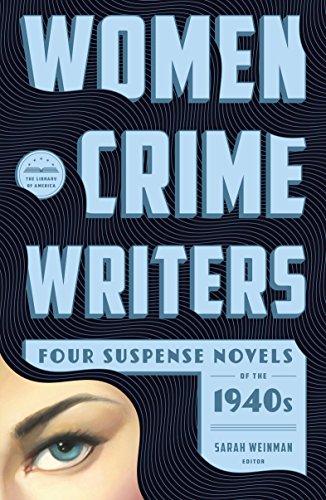
Cover for Women Crime WritersThe Blank Wall by Elisabeth Sanxay Holding is the last novel from the 1940’s in my first volume of the Women Crime Writers collection. (I skipped Dorothy Hughes’s In a Lonely Place as I have reviewed it before.) I must say that all of them have been excellent.

Lucia Holley is an ordinary upper-middle-class housewife trying to cope while her husband is away at the war. She has been having difficulty with her seventeen-year-old daughter, Bee. Recently, she found out that Bee was seeing an unsavory character, Ted Darby, who is 36. When she visited him to ask him not to see her daughter anymore, he refused. Bee has found out and is furious.

That night, Lucia spots someone in their boathouse and catches Bee on the way out to see Ted. She refuses to let Bee out, and her old father, Mr. Harper, overhears. Later he tells Lucia that he went out to tell Darby to leave and pushed him into the water.

Early the next morning, Lucia goes out for a swim and finds Darby dead in the bottom of the boat. He has fallen on the anchor, which has pierced his chest. Determined to protect her father and her daughter’s reputation, Lucia disposes of the body. But horrible events are just getting started.

At first, I was a bit impatient that Lucia’s fear for her daughter’s reputation has her cover up what is, after all, an accident. However, this story pulled me along, so that soon I was completely immersed in Lucia’s problems. I just felt that it wouldn’t have hurt Lucia’s spoiled daughter to find out the troubles her little rebellion caused.

Overall, I am so far impressed by the quality of the novels in this collection. They are not as well known as contemporary thrillers and crime writers written by men, but they are better than many of them.

Related Posts

In a Lonely Place

The Horizontal Man

Laura

Day 1242: Lady Rose and Mrs Memmary

Cover for Lady Rose and Mrs MemmaryLady Rose and Mrs Memmary is an odd little book. It shows its naive heroine in the grip of Romanticism until she learns what the real world is like.

The novel begins in the 1930’s, when it was written. A couple and their friend are touring the area and come upon Keepsfield, a beautiful old Scottish house, which is available to let. They ask if they can tour the house and are taken around by Mrs Memmary, the old caretaker. As they tour the house, Helen Dacre gets Mrs Memmary to tell her about the life of Lady Rose, the Countess of Lochule, who owns the house.

Lady Rose has been brought up on stories of Rob Roy and Mary, Queen of Scots, and Bonnie Prince Charlie. She is an extremely romantic and enthusiastic girl from a life of privilege but not luxury, the daughter of an Earl. Her parents make no bones during her debut in 1873 that their job is to marry her to a man of equal fortune and position in society.

We see little vignettes of Lady Rose’s life from the age of six until she marries Sir Hector Galowrie when she is seventeen. Her parents don’t pay attention, however, to the idea of matching Rose in temperament.

By the time the visitors appear at the house, much has changed for the aristocracy of England and Scotland. The owners of fine mansions can no longer afford to live in them. This is the story of the attitudes of her peers once Lady Rose decides she has done her duty, but it is also the story of the fall of the aristocracy.

For such messages, the novel is written in an extremely sentimental style, with gushing descriptions of the house and landscape and chapters ending in poetry. I don’t think it is altogether successful, but it is interesting as a document of the times.

Related Posts

The Scottish Chiefs

The Remains of the Day

A Footman for the Peacock

Day 1236: A Most Extraordinary Pursuit

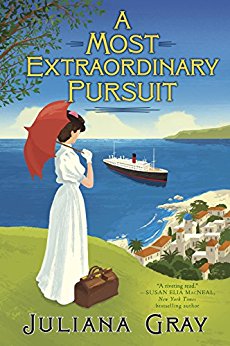
Cover for A Most Extraordinary PursuitHaving read Juliana Gray’s second Emmaline Truelove novel, A Strange Scottish Shore, a few months ago, I decided to read the first. Juliana Gray, by the way, is a pen name for Beatriz Williams, known for her historical romances.

It is February 1906, and Emmaline is finishing up the details for the funeral of her employer, the Duke of Olympia, when the Duchess sends for her. It seems that Maximillian Haywood, the heir to the dukedom, has not been heard from in months. He was off working at the newly discovered archaeological site of the palace of Knossos, but he has not sent in his expected report or responded to any messages. The duchess asks Emmaline to go find him, accompanied by Lord Silverton, a renowned womanizer but apparently also some sort of government agent.

As Emmaline sets off on her journey aboard the duke’s steamship, she finds herself re-evaluating her first impression of Lord Silverton as a simpleton. She also can’t deny he has his charms. Unfortunately, nor can most of the women they meet.

This is a fun adventure story with a bit of a twist—time travel! You’ll like the practical, redoubtable heroine, Emmaline, and the charming Lord Silverton and will probably have a good time along with them on their journey.

Related Posts

A Strange Scottish Shore

At the Water’s Edge

The River of No Return

Day 1222: West with the Night

Cover for West with the NightBest of Five!
When it was republished in the 1980’s, West with the Night was controversial because of Markham’s third ex-husband’s claim to have written most of the book and allegations by people who knew Markham that she was practically illiterate. In her biography of Markham, Mary S. Lovell effectively refutes these allegations, noting particularly that nothing like this was said the first time it was published and that part of the manuscript was submitted to a publisher before she met her third husband.

Actually, I don’t think anyone but Beryl Markham could have written West with the Night. It is beautifully written, with evocative descriptions of Africa and insights into her own thinking. It is not an autobiography. Most of the intimate details of her life are left out. We do not hear, for example, that when her father first left British East Africa for Peru, she was married to her first husband.

Instead, West with the Night is a series of recollections about Markham’s childhood and life in Africa, ending just after she flew across the Atlantic by herself. The book is deeply interesting and thought-provoking. Here and there she interjects a few stories told to her by natives. She was a remarkable woman, both Kenya’s first woman horse trainer and one of the world’s first woman pilots, the first person to fly east to west over the Atlantic (the more difficult direction).

West with the Night is sometimes compared to Out of Africa, written by her friend Karen Blixen (Isak Dinesen), but I find Markham’s book to be much better. It is both simply written and full of understated emotion.

Related Posts

Straight On Till Morning

Circling the Sun

Things Fall Apart

Day 1220: Tightrope

Cover for TightropeYet again, I had no idea that Tightrope, which I read for my Walter Scott project, was a sequel until I went into Goodreads to indicate I had started reading it and saw that it was “Marian Sutro #2.” In this case, the novel seemed to recap the events of the first novel rather heavily, so I don’t think I missed anything by skipping the first book except maybe some feeling for Marian.

I found Mawer’s The Glass Room to be icy in its distance from the characters, so I wasn’t excited about reading Tightrope. It turned out to be better than I expected but not much.

Tightrope begins toward the end of World War II, when Marian Sutro returns to England. She was one of the women sent over to infiltrate Europe during the war, where she worked with the French resistance. But she was betrayed and spent the last two years in Ravensbrück. Shortly before the liberation, she and some other women managed to escape.

Because of Marian’s background, she is of interest to the British secret service. She is of interest to the Russians, too, primarily because her brother Ned is a nuclear physicist. Her own beliefs that knowledge of nuclear weapons must be shared to maintain peace also draws her into the midst of the Cold War.

This novel is narrated by Sam, the son of one of Marian’s friends, and his story contains lots of details he couldn’t have known, even though he had access to her file and she tells him parts of her story. This narrative also allows Mawer to insert a certain amount of salacious detail, as Sam has a mad adolescent crush on Marian. I think I mentioned Mawer’s fascination with labia in my last review.

Marian is essentially an unknowable character, which kept me, as a reader, from becoming very engaged with her story. It didn’t help that she seemed to be the product of some adolescent idea of a perfect woman—a beautiful woman who sleeps with just about every man she meets and cares for none of them. Yet we are to believe she cares for one, even though there is little evidence for it. I found the book blurb, which says “Marian must risk everything to protect those she loves . . .” laughable.

Quotes on the cover call Mawer “a true master of literary espionage” and call the novel “gripping.” If you want gripping, try John Le Carré or Robert Harris instead.

Related Posts

The Glass Room

Sweet Tooth

Code to Zero

Day 1218: The Singapore Grip

Cover for The Singapore GripThe Singapore Grip is the third of J. G. Farrell’s Empire trilogy, which takes a sardonic look at various parts of the British Empire. The Siege of Krishnapur is set in the nineteenth century during the Sepoy rebellion. Troubles takes place in Ireland during the Troubles in the early 20th century. The Singapore Grip is set during the Japanese invasion of Malaya in World War II.

The novel begins in 1939. Walter Blackett is a powerful Singapore businessman whose sole concern is the profits of his company, Blackett and Webb. Despite the Allies’ need for rubber, Blackett is concerned with keeping the price up and spends his time fixing prices and manipulating the market.

His senior partner dies, and Walter awaits the arrival of Matthew Webb, his partner’s heir. Although Walter’s beautiful daughter, Joan, spends her time tormenting various young men, she readily agrees to help her father’s ambitions by marrying Matthew.

Matthew is a naive and feckless young man, whose ideals have been somewhat battered during his work for the League of Nations. Although he is chubby and unprepossessing, Joan makes a dead set for him, dismaying Ehrendorf, the previous favorite. But Matthew is more interested in Vera Chiang, a Eurasian girl who may be a prostitute or possibly a Communist or maybe neither.

This novel is peopled with Farrell’s usual peculiar characters, including a figure from Troubles, Major Brendan Archer. As Singapore begins descending into chaos, the Major attempts to organize a volunteer fire department. But his efforts are hampered by a lack of interest, as the Singaporians concentrate on selling things and the Blacketts focus all their activities on a Jubilee celebration of the company.

Farrell’s cynical look at the last years of the British in Singapore is occasionally hilarious, with a dark and deadpan humor. It also contains much to consider, as various characters discuss the benefits of colonization (whether there are any), theories of commerce, and other ideas that obsess them.

Related Posts

Troubles

The Siege of Krishnapur

The Garden of Evening Mists

Day 1217: A Footman for the Peacock

Cover for A Foot man for the PeacockA Footman for the Peacock is a strange little novel. The novel was controversial when it was first published during World War II, because it depicts an upper-class family that tries to avoid its civic duty during the war. But that activity seems almost incidental to the rest of the plot.

What is the plot? The narration flits around in time but centers on the Roundelay family. Their current configuration consists of Sir Edmund and Lady Evelyn and their household of two daughters, three elderly aunts, and three or four servants, including the retired and senile Nursie. When we finally seem to be settling somewhere, on the new Lady Evelyn’s growing acquaintance with the village and regional customs, we stay only long enough for her to hear an old running song, which Evelyn in her innocence takes to be about hunting. then we skip over to her daughter, Angela.

Angela seems to have a sensitivity to an upper-floor servant’s bedroom where the words “Heryn I dye, Thomas Picocke, 1792” are etched on a window pane. She makes an odd connection between this room and an unfriendly peacock in the grounds of the estate, which seems to be signalling Nazi bombers to destroy the house.

I guess I found this novel, which has a supernatural element, peculiar enough to be amusing, but it certainly has an unusual premise. I had more of a problem with the scattered narrative style, which took a long time to get somewhere. Ultimately, the novel becomes a story of class abuse and cruelty in the 18th century.

Related Posts

Harvest

Longbourn

His Bloody Project