Day 1213: A Country Road, A Tree

Cover for A Country Road, A TreeBest of Five!
I know little about Samuel Beckett except that he was Irish, and I have the most basic knowledge of Waiting for Godot and Krapp’s Last Tape. (“A country road, a tree” is his setting for Godot.) So, I would not be able to say whether the novel at all conveys a true sense of what Becket was like. I can say, though, that I’ve read other works of biographical fiction that felt as if they gave a false or poor sense of their main character. A Country Road, A Tree is much more plausible in depicting Beckett.

The novel does not cover his entire life but concentrates on the war years, 1939-1945. Beckett is already a published writer, although probably not to much attention. He is friends with James Joyce and other writers and artists in Paris.

At the beginning of the war, Beckett is in Ireland. He feels stifled there, though, and chooses to return to Paris despite the instability. There he lives an increasingly stressful and straitened existence with his lover, Suzanne. At first, he has no papers, which complicates things when he and Suzanne are forced to evacuate Paris with the German invasion. Later, he decides to work with the French underground, which makes their lives even more precarious. Finally, they must flee to the countryside again.

Although this novel does not concentrate on the literary side of Beckett’s life—in fact, during much of it he is unable to write—it grabs your attention and keeps it. It also provides some insight into the man who produced his later works. I loved Jo Baker’s Longbourne and have been waiting for her to produce a work equal to it. This is that work, which I read for both my Walter Scott Prize and my James Tait Black projects.

Related Posts

Longbourn

The Mermaid’s Child

Ghost Light

Day 1209: The Red House Mystery

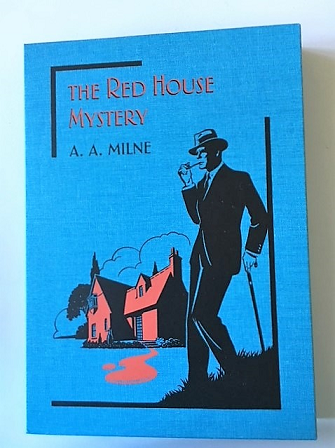
Cover for The Red House MysteryWho knew that A. A. Milne wrote novels for adults, let alone mysteries? I didn’t, until Simon of Stuck in a Book reviewed The Red House Mystery. Then I saw it advertised in Folio Society, of which I am a member.

Our detective is an amateur, Antony Gillingham, who comes on the scene accidentally. He is visiting in the area when he remembers his friend, Bill Beverley, is staying at the Red House, a guest of Mark Ablett, so he decides to drop by. He finds a man hammering on the library door. This man is Mr. Cayley, Mr. Ablett’s secretary, who reports he has heard a gunshot from within the locked office.

Cayley and Antony break in and find the body of a man who has been shot in the face. Cayley identifies him as Robert Ablett, the ne’er-do-well brother of Mark, just arrived from Australia. Mark Ablett, who had been in the room with his brother, is nowhere to be found. The police decide Robert has been murdered and begin looking for Mark.

Antony begins noticing clues about the crime. Enlisting his friend Bill as his Watson, he decides to solve the mystery.

With typical Golden Age verve, Milne makes this puzzle just about as complicated as possible. I usually don’t hope to solve these mysteries because of that. However, I did guess at part of the solution and then decided it wasn’t possible. Apparently, it was.

What I enjoyed about the book was the congenial duo solving the crime. Antony is bright and witty, and Bill is jovial and loyal. The Red House Mystery makes a fun light read.

Related Posts

The Moving Toyshop

Thirteen Guests

The Iron Clew

Day 1208: Zelda

Cover for ZeldaZelda is Nancy Milford’s famous biography of Zelda Fitzgerald. It is meticulously researched and beautifully written. The book was Milford’s dissertation for Columbia University, and she later went on to write other noted biographies, such as Savage Beauty about Edna St. Vincent Millay.

Zelda’s relationship with F. Scott Fitzgerald is legendary, and I was happy to finally learn the truth of it, as I’ve heard half-truths for years and read them in fiction. I was especially interested to contrast this biography with Z, Therese Ann Fowler’s novel about Zelda.

One of the fundamental problems of the Fitzgerald’s relationship was Zelda’s feeling of a lack of purpose combined with Scott’s breathtaking assumption that her entire life could be co-opted for his fiction. Early in their marriage, Zelda had an opportunity to publish her diaries, but Scott claimed them, saying he needed them for his fiction. Later, when she began writing, he feuded with her over her right to her own history, telling her that he was the professional, she just an amateur. Of course, he did not cause all their problems. There was his drinking and her crippling mental illness. But I could see why Zelda would feel like she was being erased.

Although the biography contained a little too much quoting from their fiction for my taste—points were made over and over—still, this is a truly revelatory biography and well worth reading if you have an interest in these people or their time.

Related Posts

Savage Beauty: The Life of Edna St. Vincent Millay

Z: A Novel of Zelda Fitzgerald

Mrs. Hemingway

Day 1207: White Houses

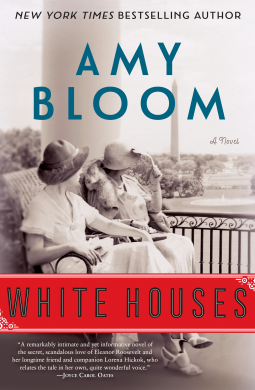
Cover for White HousesAmy Bloom’s latest novel, White Houses, leads me to a topic that I’ve mentioned before. I think it is important, when writing fiction about real people, to keep their characters true to that of the original person. Historians disagree about whether Eleanor Roosevelt’s warm friendship with Lorena Hickok was a full-blown lesbian affair. Those who believe it was, base their supposition on Eleanor’s exuberant letters. Those who do not, base it on Eleanor’s dislike of being touched. I think that’s significant, and I think people these days misinterpret the tone of letters from earlier times, when friends expressed themselves more affectionately than we do.

Amy Bloom has chosen to believe that the women’s relationship was a lesbian affair, and that’s what White Houses is about—and all that it’s about. It is written from the point of view of Lorena Hickok—or Hicky, as she was called.

link to NetgalleyThe novel paints a relatively convincing portrait of Eleanor, although I don’t buy the bed bouncing, and it is a sad story and ultimately touching. Its premise, though, makes me uncomfortable for the reasons stated above.

Franklin does not appear in a positive light, and in terms of their marriage, he should not. The character study of Hicky as a downright, plain-speaking reporter who gave up her career for love is a good one, and one I can believe.

Related Posts

Lucky Us

No Ordinary Time

Rules of Civility

Day 1198: Consequences

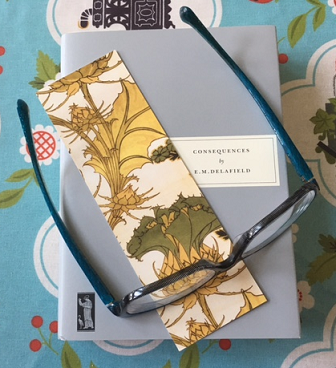
Cover of ConsequencesIf you expect E. M. Delafield’s Consequences to be like her witty Diary of a Provincial Lady, you will be surprised. Although it addresses themes that Diary touched on much more lightly, it is serious, sad, and even bitter.

Alex Clare grows up in the typical environment of a Victorian child of wealthy parents. She and her brothers and sisters are raised by Nanny and only see their parents at specific times. Alex is an aggressive child with her siblings, but her desire is to have someone care about her. Since Nanny dislikes her and Cedric and Barbara band against her, she tries to please her mother.

But a childish game causes a near tragedy. Alex’s part in it is misinterpreted, and she feels too guilty to defend herself, so her parents send her away to a convent school in Belgium.

Here, Alex begins a lifelong pattern of fastening upon someone for whom she will do anything. In school, it is Queenie, for whom she breaks rules to give treats and try to hang around her. These kinds of crushes are forbidden, and Alex is constantly in trouble for breaking rules, while Queenie blithely accepts forbidden treats and gets away with it. Alex does not learn to develop standards of behavior. She just yearns for love and understanding without having the ability to evoke it from others.

This childhood does not prepare her for young womanhood, where the only expectation is that she will marry well. She does not enjoy all the parties and events she must attend and is unable to hide her discontent.

Alex is not an attractive character. She is needy, unprincipled, and depressive. But her small transgressions are magnified by her family until she feels friendless and isolated.

Consequences is Delafield’s indictment of this kind of upbringing and the expectations for women of her class and time. It is also a character study of a woman who feels lost wherever she is. It is quite the feminist statement, published in 1919. The reviews included in the appendix of the Persephone edition show that its message was not well understood or accepted by the (presumably) male literary world of its time.

Related Posts

The Diary of a Provincial Lady

The Home-Maker

A Lady and Her Husband

Day 1192: The Priory

Cover for The PrioryBest of Five!
Saunby is an old estate that belongs to Major Marwood. It was once a priory, and the ruins are still there. The major is a poor landlord and manager who cares only for cricket. Although he has hundreds of pounds of unpaid bills and the house is falling to bits, he spends a huge amount of money every year in hosting two weeks of cricket matches.

The major is most unhappy about how the house is being run. His sister, Victoria, who is supposed to be in charge of the house, pays attention to nothing but her art, producing one atrocious painting after another. His two daughters, Christine and Penelope, are happy in their isolation up in the nursery, making odd-looking dresses and ridiculing the neighbors. The servants do what they want. Everyone in the household is completely self-absorbed.

So, the major decides it is time he remarried, principally to get someone to take care of the house and keep expenses in check.  He has his eyes upon Anthea Sumpton, a woman no longer young who he is sure will be sensible.

Unfortunately, Anthea is in love with him and doesn’t understand he is making a marriage of convenience. Soon, she will have a rude awakening.

Everyone in this novel is due for a rude awakening, however, as the focus of the novel moves to Christine and what happens when she falls in love with Nicholas Ashwell. He is one of her father’s cricket players who has been raised to be as selfish as her family is.

This novel is also somewhat an Upstairs/Downstairs novel at first, when the new maid, Bessy, falls in love with Thompson, who helps with the cricket. He returns her feelings but doesn’t reckon with the rejected Bertha.

This novel is the best kind, the type in which characters develop and you change your mind about them. Beginning in the late 1930’s, it is also winding its way slowly toward the war. I found the novel beautifully written, involving, and ultimately touching, as a dysfunctional family learns to become slightly more functional. I have enjoyed all of Whipple’s novels, but I think I liked this one best, so far.

Related Posts

They Knew Mr. Knight

Someone At a Distance

Greenbanks

Day 1186: Toby’s Room

Cover for Toby's RoomI know I’ve talked about this before, but I find it interesting to see what the blurb writer finds to comment about a book versus the book itself. In the case of Toby’s Room, the blurb says something about a family torn apart by war. Well, World War I begins well into the novel, and the family is fairly well torn apart already.

The novel begins in 1912 when, in a weekend break from Slade, where Elinor is an art student, her relationship with her older brother Toby undergoes a shocking change. She and Toby have always been close, but they have difficulty closing the gap after this incident.

Later, shortly after the war begins, the family receives a telegram stating that Toby is missing, presumed dead. Elinor feels there is something not right about the letters she receives from his commanding officer and the chaplain. Letters to her friend Kip, who served with Toby, receive no answer. Elinor asks her friend Paul, who is home wounded, to help her find out what happened.

That makes the book sound like a mystery, but it isn’t. It is more about Elinor’s unresolved feelings for her brother, and latterly about the horrors of war.

Although Toby’s Room is a sequel to Barker’s Life Studies, and I have not read the first book, I felt myself immersed in this fully realized world. This is another situation, like with The Quality of Mercy, where I was reading the novel for my Walter Scott prize project and chose not to read the first one. Unlike The Quality of Mercy, though, I don’t think my not having read the first book affected my appreciation of the second. Although I do wish the Walter Scott prize judges would stop putting sequels on their short list, I enjoyed Toby’s Room. It examines serious issues while still capturing our attention.

Related Posts

The Quality of Mercy

The Stranger’s Child

C

Day 1184: The Garden of Evening Mists

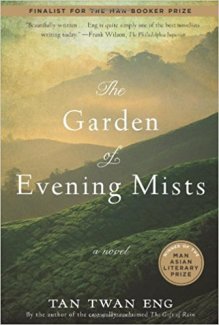
Cover for The Garden of Evening MistsBest of Five!
Yun Ling Teoh, a Malayan federal judge of Chinese descent, has decided to retire early. She has been diagnosed with a neurological ailment that will cause more and more frequent episodes of aphasia and will eventually destroy her language abilities. She decides to return to Yugiri, a Japanese garden in Malaya that she inherited from its creator, Aritomo.

On the advice of her friend Frederik, the owner of a nearby tea plantation, Yun Ling decides to record her memories. She begins in 1951, when she went to Aritomo to ask him to design a garden in memory of her sister, Yun Hong, who died in a Japanese labor camp during World War II. Yun Ling also was in the camp, and her hatred of the Japanese makes it difficult for her to ask for Aritomo’s help. But her sister loved Japanese gardens.

Aritomo refuses her request but makes her a different offer. If she will take on the job of apprentice, he will teach her enough to design her own garden. She decides to accept the offer, having quit her job as prosecutor.

It is a difficult time in Malaya. No sooner did the war end than the government began fighting Communist guerillas, who were attempted to take over the country. And Akitomo has his secrets. He came to Malaya before the war, having resigned as the Japanese emperor’s gardener, but Yun Ling occasionally hears that he played a role for Japan during the war. He had some kind of influence, because he saved his neighbors from the Japanese labor camps. Yun Ling, we find, has her own secrets.

The Garden of Evening Mists is the best kind of historical fiction, immersing me in its time and place while informing me of events I was formerly unaware of. I found it deeply interesting and affecting. The descriptions are delicate and evocative, and the characters feel real yet mysterious. This novel was part of both my Walter Scott Prize and Man Booker Prize projects, as well as the winner of the Man Asian Literary Prize. It is a powerful novel.

Related Posts

The Glass Palace

The Narrow Road to the Deep North

The Ten Thousand Things

Day 1182: Suzanne

Cover for SuzanneSometimes you read a book that makes you want to consider it. Maybe you feel ambivalent about its subject matter or its approach. Maybe you want to ponder the choices made by its characters. Maybe the fact that you want to think about it marks it as good. I had all these thoughts about Suzanne.

This novel was given to me to read by my French-Canadian sister-in-law. It is an imagining of the life of the author’s grandmother, a poet and painter who abandoned her family when her daughter was three.

The novel is written originally in French and translated by Rhonda Mullins. It is written in the second person in short excerpts. Suzanne Meloche was always rebellious, it seems, and when she had to choose, she chose herself. After a difficult, poverty-stricken childhood in rural Ottawa, she struck out for Montréal. There, she almost immediately was taken up by a movement of artists and writers, called Automatism, led by Paul-Émile Borduas. Many of the people she associated with became well-known Quebecois painters. Eventually, she married Marcel Barbeau, an artist.

This novel makes compelling reading, as it explores the question of how far you should go to pursue your own goals. Suzanne is an interesting character who leads a rich life, although I don’t like her very much. In fact, I think her granddaughter is a little too understanding of her foibles. Perhaps her interpretation of Suzanne’s thoughts and feelings is correct—Suzanne did after all keep the pictures of her grandchildren that her daughter sent her. To balance that, though, is the harm she did her children by abandoning them and her reception of her daughter and granddaughter the one time they went to visit her.

As a work of authorship, it’s brilliantly written and compelling. Will you like it? I suppose it depends on how you feel about the subject.

Related Posts

The Blazing World

How to Be Both

The View from Castle Rock

Day 1181: The Zone of Interest

Cover for The Zone of InterestIn Martin Amis’s The Zone of Interest, the Zone is a Nazi factory and concentration camp in Poland. Interestingly, Amis makes this setting a source of some very black humor.

The novel is written from the points of view of several characters, mostly Nazis, but it is mainly from that of Thomsen, an officer in charge of production at the rubber factory. He is a womanizer, but he begins to have feelings for Hannah Doll, the commandant’s wife.

Doll himself is a vile human being. He has his rival for Hannah imprisoned and uses threats against inmates’ relatives to force them to do things.

In fact, most of the characters are vile. And that’s the difficulty with this novel. First, is the Holocaust fodder for humor? I’m not sure it is in general, but it isn’t for me. Also, even though Thomsen is the least criminal of the characters because he’s working subtly against the war effort, these are people busily explaining away their own terrible actions.

Amis’s goal, I think, is to give some insight into the behavior of these people. Whether you want to read a novel on this subject probably depends on whether you’re interested in that insight. It made me a little queasy. This is one of the books I read for my Walter Scott Prize project that I didn’t really enjoy.

Related Posts

Maus I

Great House

The History of Love