Day 1115: On Canaan’s Side

Cover for On Canaan's SideBest Biweekly Book!
I just wanted to comment that this is the third book in a row I’ve reviewed that has a title starting with “On.” That has to be unusual.

While I was reading On Canaan’s Side, I kept comparing it to Jane Smiley’s Last Hundred Years trilogy. I think that’s because, although it approaches its subject matter much differently, it has one goal similar to the trilogy’s. It covers events in almost the same period, only in terms of one woman’s life span. But it does so in a mere 256 pages and with a limited number of characters, as opposed to Smiley’s three large books and a plethora of characters.

Lilly Bere is almost ninety years old. Her beloved grandson Bill has just died, and Lilly has decided to follow him. Before she goes, she writes an account of her life.

Lilly grew up in Dublin, but shortly after the First World War, she has to flee to America. The army mate of her dead brother has become her fiancé, Tagh. But after he takes a job as a Black and Tan, Lilly’s father hears he is on a hit list, and she with him.

Lilly’s cousin is no longer at the address she has in New York, so she and Tagh travel to Chicago to try to find her second contact. They are just settling down when Tagh is murdered at an art museum.

Lilly must flee again. In her subsequent life, she finds friends and love, but she also has mysteries in her past that Barry skillfully spins out.

The point of view is kept at Lilly’s, and we feel we get to know her and share her joys and sorrows. This novel’s prose is quite beautiful, and I was touched by events in Lilly’s life. Whereas I felt distances from Smiley’s trilogy, I was pulled into Lilly’s story. This was another excellent book I read for my Walter Scott prize project.

Related Posts

Some Luck

Early Warning

Golden Age

Day 1113: On Her Majesty’s Frightfully Secret Service

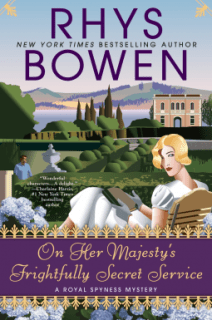
Cover for On Her Majesty's Frightfully Secret ServiceI had never read anything by Rhys Bowen, but recently I noticed reviews of her books popping up here and there. When Netgalley offered On Her Majesty’s Frightfully Secret Service, I was intrigued. What I found was a frothy story of intrigue. This novel is the 11th in her “Her Royal Spyness” historical mystery series.

Bowen’s heroine is Georgie Rannock, the sister of a duke and 34th in line for the throne. She is on the impoverished side of the family, though. It is 1935, and Georgie is staying at the ancestral home of her fiancé, Darcy, at Kilkenny Castle in Ireland while they plan their wedding. Since Darcy is Catholic, Georgie may not marry him unless she renounces all claim to the throne, and to do so, she must have permission from the throne.

Darcy is employed by the government in some secret capacity, and he is called away. In his absence, Georgie decides to pop over to London after receiving a belated summons by Queen Mary. In her late mail, she also finds a plea from her friend, Belinda, who is in Italy. Belinda has gotten pregnant and is hiding out in Italy until she goes across the lake to Switzerland to have her baby. She wants Georgie to stay with her.

Summoned to tea at Buckingham Palace, Georgie goes to discuss her wedding difficulties with Queen Mary. When the Queen learns her immediate destination in Italy, she proposes getting Georgie invited to a swank house party there. The Prince of Wales and Mrs. Simpson will be attending, and the Queen wants to know if Mrs. Simpson has her divorce.

link to NetgalleyAt the house party, Georgie finds herself enmeshed in more than one drama. Her mother, the famous actress, is there, and she is being blackmailed. Some of the party are German generals, and something seems to be going on with them. And soon there is a murder.

I mildly enjoyed this little romp, although I knew who the murderer was even before the murder (if that makes sense). That is, I noticed something immediately and once there was a murder, knew who it was as a result. Perhaps I would have enjoyed the novel more if I had started with the beginning of the series. Georgie gets herself into some ridiculous situations, the murder is worked by a bone-headed Italian policeman, and the novel is just silly fun.

Related Posts

Pigeon Pie

As Chimney Sweepers Come to Dust

The Iron Clew

Day 1112: Brook Evans

Cover for Brook EvansSusan Glaspell’s novel Brook Evans shares some themes with her more famous Fidelity, but she makes an interesting inversion in the plot. Still, the ultimate message is the same as in her earlier novel.

Brook Evans’s story begins with that of her mother, Naomi Kellogg, in 1888. Naomi has been secretly seeing Joe Copeland since his mother objected to their keeping company. They plan to be married in the fall, after the harvest.

But Joe is killed in a farming accident. Seeing no alternative but disgrace, as she is pregnant, Naomi reluctantly marries her other suitor, Caleb Evans, and leaves her beloved Illinois home for Colorado.

Nineteen years later, Brook Evans wants to go to a dance with Tony Ross. Not only does her father, Caleb, not believe in dancing, being religiously strict, but Tony is a Catholic and part Native American. Naomi sees Brook’s relationship with Tony as an echo of hers with Joe, and she is determined not to sacrifice her daughter’s life to worries about what others may think. Unfortunately, the disagreement with Caleb brings out the truth of Brook’s parentage, with unforeseen results.

In Fidelity, the heroine’s decision to grasp life by running away with her married lover blights her life. In Brook Evans it is the instinct to conform with societal norms that is blighting. Still, the ultimate message of both books is to follow your heart. Although I wasn’t so fond of Brook’s ultimate choice (or the perceived alternative) I found this novel thoughtful and so touching that at times I was in tears. Glaspell’s characters show several sides throughout the novel, so that at times you change your mind about them. This novel is another thought-provoking read from Glaspell.

Related Posts

Fidelity

Greenbanks

Someone at a Distance

Day 1111: The Gustav Sonata

Cover for The Gustav SonataUntil the very end of The Gustav Sonata I wondered what its point was. It is a novel detached from its characters even as it puts them through events that should make us sympathetic. Further, although it is set in a specific time and place, there is little feel for what it was like then and there. This effect is in strong contrast to Tremain’s two novels about Merivel, set in Restoration England.

The novel begins in 1947, when its main character, Gustav Perle, is five years old. Although Gustav is Rose Tremain’s exact contemporary, parts of the novel are set earlier, before Gustav was born.

Gustav’s father died when he was a baby. He was a member of the police force for their small town in Switzerland, but he lost his job before Gustav was born, under circumstances that Gustav’s mother does not fully understand. All she knows is that Erich died “helping the Jews.”

Gustav’s mother Emilie has raised him without a shred of affection but only with criticism. The lack of affection is tempered somewhat by his lifelong friendship with Anton, whom he meets the first day of Kindergarten. Emilie does not like Gustav’s friendship with Anton, because Anton is Jewish. But Anton and Anton’s family are all Gustav has, really.

Anton is always a self-absorbed person. He is nervous and highly strung, a musical prodigy. Anton’s mother thinks he will become a famous musician, but he is terrified in competition and performs badly.

An important theme in this novel is Swiss neutrality and its correspondence with personal neutrality. Gustav, although faithful to his friends, is always concerned with self-mastery and holds back from his own life events. But so does this novel hold back from its characters, as if observing them through a glass.

I found this novel interesting but not involving. I think it took too long to get to its point. It is another novel for my Walter Scott prize project.

Related Posts

Merivel: A Man of His Time

The Glass Room

A View of the Harbor

Day 1106: Unnatural Habits

Cover for Unnatural HabitsPhryne Fisher meets Polly Kettle, a journalist on the track of a story about pregnant women disappearing from the Abbotsford convent, where they work in the Magdalene laundry. Phryne thinks that Polly is too naive and foolhardy and that she will soon run into trouble. And she is right—almost immediately, Polly disappears.

When Phryne looks into it, she learns that several girls have disappeared from the laundry. She also hears that a shady employment agency is offering actresses parts overseas and that her friend, Doctor MacMillan, has been asked to verify the virginity of a surprising number of young women lately. Could a white slavery ring be practicing in Melbourne? But why would they want pregnant women?

link to NetgalleyI am finding with Greenwood that things that appear to be related usually aren’t. As with the other Phryne Fisher novels I’ve read, there is more than one criminal involved, which I feel is a cheat.

Also, Phryne is beginning to seem a bit cartoonish to me as she battles evil and sexism. For light reading, these novels are enjoyable, but I think I have read enough of them.

Related Posts

Raisins and Almonds

Murder in the Dark

Lady Cop Makes Trouble

Day 1100: The Stranger’s Child

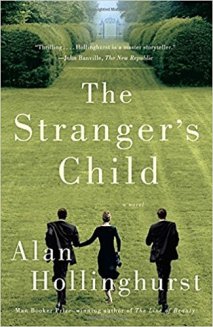
Cover for The Stranger's ChildI had the oddest experience with The Stranger’s Child. Although it was well written and sounded like something I would be interested in, for a while every time I started to read it, I fell asleep. There is very little movement to this novel, which isn’t necessarily a bad thing, but the end of it had me wondering what the point of it was.

The novel is multigenerational, beginning in 1913 and ending in 2008. In 1913, Daphne Sawle, who is 16, is attracted to her brother George’s friend, Cecil Valance, down for a visit from Cambridge. Cecil is an aristocrat and a poet. Unbeknownst to naive Daphne, he and George are having a wild affair.

The next section of the book takes place ten years after World War I. Cecil died in the war, and the family is dedicating a memorial to him. The family includes Daphne, as she has married Cecil’s younger brother, Dudley, and they have two children. However, she is in love with Revel Ralph, a set designer for the theater.

By far the bulk of the novel is set in the 1960’s and 70’s and is from the point of view of Paul Bryant. In the 1960’s, he is a shy bank clerk. He has become involved with the family through his boss, who has married into it, and through his affair with Peter Rowe, a schoolteacher at Corley House, which used to be the Valance home. Cecil is now regarded as one of England’s minor poets.

Ten years later, Paul is a biographer, determined to out Cecil as a gay man despite the claims of Daphne to have been his fianceé. It is unfortunate that I found this main character of the longest section to be so unappealing and completely focused on who was or was not gay, although I realize that the 1970’s was the time for that kind of revelation.

Part of my problem with the novel may have been the blurb, which really oversells aspects of the plot. For example, it says, “Over time, a tragic love story is spun . . . .” Well, there are several love stories that come out, but I wouldn’t call any of them tragic, and it’s actually difficult to tell which of them this comment refers to. One of the secrets is so understated during the novel that even though it is the last revelation, it seems anticlimactic. I suppose it’s supposed to be ironic that Paul is so focused on the possibility of one affair that he completely misses another.

Finally, this is a novel so focused on the sexuality of its characters that it gives the impression that the entire upper class male population of England is gay. We see a little into Daphne’s infatuations, but otherwise, only from the point of view of various gay men trolling for sex or obsessing about it. Those of you who know me will realize that I would have the same complaint if the sole focus was on heterosexual sex. So, not one of my favorites for my Walter Scott prize project.

Related Posts

Arctic Summer

A Place Called Winter

The Summer Before the War

Day 1094: The Girls

Cover for The GirlsBest Book of the Week!
Sometimes a novel is imaginative in its approach or subject matter, but The Girls is an imaginative act of empathy. For Emma Cline has drawn a convincing portrait, in her main character Evie Boyd, of the kind of girl who could be attracted to a cult, inspired by the Manson Family.

In the summer of 1969, 14-year-old Evie is insecure and dying to fit in somewhere. Her parents are newly divorced, and she blames her mother for failing to hold her philandering father’s attention. She has just been abandoned by her childhood friend, Connie, as teenage girls will do.

She spots Suzanne at the park. She and her friends are different, dirty and sort of feral, but free. When Evie gets picked up by Suzanne and her friends after her bike breaks down, she goes with them to the ranch.

The ranch is centered around Russell, an older man whom his followers consider a genius. He uses various techniques to manipulate the girls surrounding him, and he befriends famous people in hopes of using them to become famous himself. He organizes the activities at the ranch around some half-baked philosophy.

Evie can actually see through some of this, but she willfully blinds herself to what is wrong at the ranch through a love for Suzanne. When things at home get worse, she ends up with only one place to go.

The novel is brilliantly written, and I was completely enthralled by the description of Evie’s journey. I found the story believable and watched in dread as Evie got pulled ever deeper into the dangerous group.

Related Posts

Arcadia

Wylding Hall

The Interestings

Day 1093: Pomfret Towers

Cover for Pomfret TowersSomeone once remarked to me that the Angela Thirkell novels set before or during World War II are the best, and so it seems to me, reading this one. Pomfret Towers is set before the war.

Timid young Alice Barton is terrified when she learns she must accept an invitation for a weekend at Pomfret Towers along with her brother, Guy. Lady Pomfret is home on one of her infrequent visits from Italy, and Lord Pomfret wants some young people around to entertain her.

But she needn’t have worried: almost everyone is kind to Alice. Phoebe Rivers, a cousin of the family, has made sure Alice’s room is next to hers and helps her pick out her outfits for dinner. Alice’s good friends, Roddy and Sally Wicklow, are there, Roddy being the junior estate manager. Gillie Foster, Lord Pomfret’s heir, is extremely kind and fetches her shoes for her from the servants. Even Lord Pomfret, who is known for his rudeness, is kind.

One figure who continues to be terrifying is Mrs. Rivers, a best-selling author. Although Alice’s mother is also an author (a better one, we suspect), she is modest about it, unlike Mrs. Rivers, who constantly talks about herself and tries to arrange things for everyone, as if she were the hostess.

Another egoist is Julian Rivers, but Alice only sees how handsome he is and how wonderful he seems to be. His behavior is sometimes unusual, but he is an artist.

One of the things Mrs. Rivers is trying to manage is a marriage between her daughter Phoebe and Gillie Foster, but Gillie seems to prefer talking to Alice or working in the office with Sally. And Phoebe keeps running off with Guy to look at buildings he and his father are restoring.

Pomfret Towers is another romance by Angela Thirkell, full of delightful characters and slightly winking at society. This novel is one I particularly enjoyed. Alice is a little silly, but she is young and lovable, and we are sure everything will come out all right.

Related Posts

Wild Strawberries

Miss Bunting

Vittoria Cottage

Day 1091: Raisins and Almonds

Cover for Raisins and AlmondsThis ninth Phryne Fisher mystery is set in the Jewish community of Melbourne. It begins when a young scholar, Simon Michaels, dies in a book shop. He is quickly found to have died of strychnine poisoning, and a bottle of strychnine has disappeared from the shop. Miss Lee, the shop owner, is immediately arrested, but Phryne has been retained by Mr. Abrahams, Miss Lee’s landlord, to find the real killer.

Phryne soon figures out that the death my have something to do with a formula developed by Yossi Liebermann, a gifted chemist, who has been studying alchemy and the Kabala. Apparently, this formula has gone missing, and Phryne has it, but it is in code. No one except Yossi knows what it is for.

In the meantime, unpleasant events are happening. Someone ties up a woman in her house, and there is a break-in at Phryne’s.

link to NetgalleyIt was difficult for me to tell whether the perpetrator was hard to guess, because I saw this first as an episode of the “Miss Fisher Mysteries,” and they stuck fairly closely to the book (unlike with Murder in the Dark). On the other hand, the guilty party barely appears in the novel, which is a form of cheating, and as in Murder in the Dark, there is more than one guilty party.

Also, as I mentioned before, I’m not really fond of descriptions of sex mixed with this genre. In this novel, Phryne cavorts with the young Simon Abrahams. Jack Robinson is more of a presence than in the previous book I read, but his bad grammar tells us that he is not going to be a romantic interest, as he is in the television series.

Related Posts

Murder in the Dark

Girl Waits with Gun

Birds of a Feather

Day 1086: Lady Cop Makes Trouble

Cover for Lady Cop Makes TroubleLady Cop Makes Trouble is the second book in Amy Stewart’s Kopp sisters series, set in pre-World War I New Jersey. Although entertaining, it did not really live up to the energy of the first novel.

Constance Kopp is in limbo in her career with the sheriff’s department in Paterson. Sheriff Heath has wanted to hire her as a deputy ever since the state of New Jersey made it legal to hire women as police. But the sheriff’s office is different, lawyers advise, and until he can hire her as a deputy, he has her working as a matron in the jail.

When a German-speaking inmate claims he needs medical attention, he refuses to describe his symptoms in English. Constance speaks German, so Sheriff Heath has her accompany the deputy and the prisoner to the hospital. When the hospital experiences a blackout, Constance sends the deputy away, claiming she can guard the prisoner, Baron Matthesius, herself. But the Baron escapes.

A law makes the sheriff responsible for escapes, so Sheriff Heath could be imprisoned for Constance’s mistake. Constance is determined to recapture the prisoner.

I didn’t find the plot of this novel as interesting as the last, nor were the characters as vibrant. Like the first novel, this one is based on newspaper clippings from the time. Constance Kopp really existed and had some interesting adventures.

Related Posts

Girl Waits with Gun

Dandy Gilver and a Bothersome Number of Corpses

Birds of a Feather