Day 934: One Fine Day

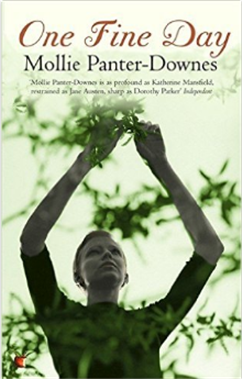
Cover for One Fine DayBest Book of the Week!
It is shortly after World War II, and Laura Marshall and her family are trying to return to normal life during the privations of post-war England. With only one part-time housekeeper, Laura is struggling with unaccustomed chores. The house and garden are beginning to look shabby, which bothers Laura’s husband Stephan, who struggles with the lawn every weekend.

The family is also having to accustom itself to living together again. Through the war, Laura and her daughter Victoria shared the house in a relaxed way of life with various female friends and children. Stephan is inclined to be more fastidious, while Laura is dreamy and untidy.

This novel takes place over the course of a fine summer’s day as Laura does her chores and thinks about a way of life that is disappearing. It is beautifully written, with evocative descriptions of nature. Barrow Down, which looms over the landscape, is an important feature of this novel.

This is a lovely short novel.

Related Posts

Enter Sir Robert

Greenbanks

Wild Strawberries


Day 930: Early Warning

Cover for Early WarningEarly Warning is the second in Jane Smiley’s Last Hundred Years trilogy. It continues the story of the Langdon family, picking up in the 1950’s and ending in 1985.

The family, which began with a couple and their children and the occasional appearance of other relatives, expands during this period to grandchildren and eventually their children. As you can imagine, by 1985 we are dealing with many characters.

This is one of my criticisms of the novel. With so many characters, we don’t spend very much time with any, which creates distance from the novel. I already felt this with the first book, and this feeling increases for the second.

But is the purpose of this novel to follow the characters or the main events during these times? It seems to be the second, as we look at the ennui of suburban housewives in the 50’s, the Cold War, the Vietnam War and its associated protests, the counterculture and Jonestown, to name a few. Smiley manages to have at least one family member involved in each of these events or movements, which is quite an accomplishment for one family from Iowa.

Of the Langdon children whose families are the focus of this novel, Frank concentrates most of his attention on business and sexual escapades, while his wife Andie struggles with a feeling of pointlessness and self-absorption. Neither of them pays much attention to their children, except that Frank puposefully fosters competition between his two twin boys, Richie and Michael. All of his children suffer from this upbringing, and the boys are at times truly scary.

Joe is the only Langdon to stay on the farm, and although he was one of my favorite characters in the first book, we don’t see much of him in this one. He and Lois have had some lucky breaks, and the farm is in better financial shape than their neighbors’, but decisions of the Reagan administration make small farms a tough business.

Lillian and Arthur raise a rowdy and happy family in Washington, D.C. But Arthur’s job with the CIA brings him under terrific pressure, and a tragic loss creates ramifications for years. This family has more than its fair share of sorrows.

Claire eventually marries a doctor and settles down in Iowa. But she has selected her husband almost in competition with a friend and eventually regrets her choice.

The novel is saved somewhat at the very end by a touching event linked to the presence of a character who isn’t explained until the end, one who appears in the middle of the book and at intervals throughout. At first I found the introduction of this character confusing, but I figured he had to be a family member, so then it wasn’t too hard to guess who he is.

I will read the final book, but I fear that the distance I feel from the story will only increase.

Related Posts

Some Luck

A Thousand Acres

The All-True Travels and Adventures of Lidie Newton


Day 929: The Railway Children

Cover for The Railway ChildrenThe Railway Children is a classic British children’s story, written in 1906. At the beginning, Roberta (Bobbie), Peter, and Phyllis live a happy and comfortable life with their parents in a suburb of London. Then one evening two men come to see their father, and they hear angry voices. Their father goes away with the men, and shortly afterward they move with their mother to a cottage in the country.

Here things are a bit more primitive. They only have one servant, a housekeeper, and a pump in the yard for water. They have to help their mother more, and Peter can’t go to school. Their mother can’t play with them, because she is busy writing stories for money. They are poor and have to be careful how much coal they use and what they eat.

Near their house is the railway, and they find lots to entertain themselves watching the trains and getting to know the men at the station. They wave to an old gentleman on the morning train every day, and they have adventures related to the railway.

I can see why children would love this story. Although the children’s adventures are all realistic, they would be exciting reading for children. There is also the mystery about their father. Character development is not a strong suit of the novel, but the children and their mother are sympathetic and the children behave like actual children.

Perhaps the novel does not have as much to offer adults, especially those who didn’t read and love the book as children. Still, it’s easy to see why the book is still popular.

Related Posts

The Secret Garden

Anne of Green Gables

Charlotte’s Web

Day 920: Sidney Chambers and the Dangers of Temptation

Cover for Sidney Chambers and the Dangers of TemptationSidney Chambers and the Dangers of Temptation is the fifth book in the series known as the Grantchester Mysteries, even though Sidney no longer lives in Grantchester. I have only previously read the first book, and much has changed in Sidney’s life since then. It is 13 years later, Sidney is married to Hildegard and has a four-year-old daughter Anna, and he is an archdeacon.

Like the first book, this Sidney Chambers book is also presented as a set of short stories, but this is a bit of a misnomer. The mysteries are contained within a story, and many of them are very slight, but the back story and the other events continue through the book as if it were a novel. Consequently, the focus has moved from solving mysteries to the discussions of various spiritual issues. I believe the Father Brown mysteries touched lightly on similar issues, but Runcie is much more heavy-handed.

In “The Dangers of Temptation,” Sidney is drawn back to Grantchester by a former parishioner, Mrs. Wilkinson. Sidney both does not like her and is attracted to her. She has asked him to do what he can to extract her teenage son Danny from a commune run by Fraser Pascoe. Sidney is unsuccessful, but then Pascoe is murdered.

In “Grantchester Meadows,” young Olivia Randall loses a valuable family necklace while she is fooling around in a meadow during a drunken party for May Week. At the same time, there is a general panic because a young man across the field is nearly trampled by cows.

Sidney’s good friend Amanda’s marital troubles come to the fore when her husband’s first wife is murdered. The murder is secondary to the plot about what will happen with Amanda’s marriage.

link to NetgalleyIn other stories, Sidney and his family travel to East Germany to vacation with Hildegard’s family, and an arson and blackmail force Sidney’s ex-curate Leonard to consider his sexuality. “The Return” has a plot suspiciously similar to a Father Brown story.

For the most part, these stories devolve into discussions of a spiritual nature. In fact, the mysteries started to seem like excuses to springboard these musings. I, for one, did not find it interesting. Further, I prefer the 50’s setting of the older mysteries to the 60’s setting.

Related Posts

Sidney Chambers and the Shadow of Death

The Tuesday Club Murders

Dandy Gilver and a Bothersome Number of Corpses


Day 918: Ghost Light

Cover for Ghost LightBest Book of the Week!
The Irish playwright John Millington Synge was engaged to marry an actress, Molly Allgood, when he died in 1909. Their relationship was of several years’ standing, but it was considered scandalous because of the difference in their ages and stations. Synge was nearly twice as old as Molly, and Molly was from a poor and uncultured family.

Ghost Light is a fictionalized account of this relationship, and O’Connor freely admits to taking liberties with it. The novel begins in 1952, when Molly is an old lady, nearly destitute and living in a cheap rooming house in London. The story follows her for one night and day of her life, during which she remembers the events in her love affair with Synge.

This novel is beautifully and atmospherically written, poetic at times, and partially in different flavors of Irish vernacular. It eloquently tells a story of frustrated love and loss. This is a compelling characterization of Molly and her view of the character of Synge. Ghost Light has been another interesting experience from my Walter Scott Prize list.

Day 911: A Place Called Winter

Cover for A Place Called WinterI read A Place Called Winter for my Walter Scott Prize project, the second book I’ve read for the 2016 list. Like one of the other books I read recently for that project, Arctic Summer, it has as a major theme the main character’s homosexuality. However, I found myself feeling much closer to the characters and more interested in the plot of this novel than I did for Arctic Summer.

At the beginning of the novel, Harry Cane is being treated, or rather mistreated, in an asylum in Canada. Shortly thereafter, he is transferred to an experimental center that treats the patients much more humanely. We understand that Harry has committed a crime, but we don’t know what it is. Between short chapters about his life at the center, we learn what brought him there.

The story of Harry’s life begins when his wealthy father dies. His brother Jack is still in school, and Harry undertakes his education and expenses. Harry is a man of no occupation who feels that he would like one, but he doesn’t know what to do about it. He feels vaguely that he would like to work an estate or a farm but thinks he has to be born to it. A shy man with an occasional stammer, he likes reading and horses. Eventually, he marries a shy woman, Winnie, who informs him on their wedding night that she loves someone else. Nevertheless, he cares for his wife and loves his daughter.

An investment recommendation by his brother-in-law takes a large part of Harry’s inheritance, and Harry and his family are forced to move in with his in-laws. He is an innocent-minded person, so it is not until he meets an actor named Browning that he realizes he is homosexual. He begins an affair with Browning, but then disaster strikes. His affair is exposed to his in-laws by a blackmailer and Harry is forced out of the family. Even his brother Jack, whom he loves, is pressured by his wife not to correspond with him.

Now totally alone, Harry emigrates to Canada and ends up in Saskatchewan, which is just being opened to settlement by the arrival of the Grand Trunk Railway. On shipboard, he meets Troels Munck, who finds him a position where he can learn farming and then helps him purchase a homestead. Munck, though, is a bully, and from the moment Harry meets him, we know that relationship will not end well.

link to NetgalleyHarry finds that a farmer’s life suits him. He settles in, works hard, and makes friends. But we know where he is at the beginning of the book, so the tension builds as we find out how he got there.

Although the time spent to get him to Canada, where the book really captured me, seems a little long, by the time he gets there, we know Harry very well. He is a kind and polite person, but he earns our respect when he finds his niche. Eventually, I became deeply involved in his story. It was also interesting in its details of early homesteading and treatment of mental illness.

Related Posts

Arctic Summer

This Godforsaken Place

Giants in the Earth


Day 906: Enchanted Islands

Cover for Enchanted IslandsEnchanted Islands is a novel based on the lives of Frances and Ainsley Conway, an American couple who lived on the Galapagos Islands in the late 1930’s and the 40’s. Although based on two memoirs written by Frances Conway, Amend has expanded the novel to cover most of Frances’s life and her friendship with Rosalie Mendel, all presumably fictional.

This book is a rather odd one. It begins with Frances and Rosalie in their old age and then returns in time to their childhood in Wisconsin. It spends some time there, following them until Frances’s late teens, when she discovers Rosalie with her own boyfriend and flees. Then it glosses over the next 20 years until Frances meets Rosalie again in California and later marries Ainsley. After that, Frances and Ainsley go on a spying mission for the Navy, something Frances is never able to tell her friends about.

The result creates a sort of divided effect. First, sections of the novel are either full of Rosalie or have no Rosalie, which made me wonder, why even bother with her? Why not just write about Galapagos? The other parts seem to belong to a different novel.

Then there is Galapagos, which Amend simplifies to the island Floreana when actually the Conways lived on three different islands. The existence there seems harsh, bleak, and lonely. There is little description of scenery or anything else to make us understand why, according to Amend, they came to love it. In fact, there is very little going on there, even including the spying.

I felt a distance from all these characters. Although we learn a lot about Frances, we don’t ever feel as if we understand her, and Ainsley is a sort of charming enigma. Most of the time, we don’t even like Rosalie.

link to NetgalleySo, a middling reaction to this novel. I was interested enough to finish it, but only mildly interested. I thought there was no sense of place in any of the settings. The characters didn’t seem like real people. The cover of the novel is lovely, but the islands seemed in no way enchanting. Did Amend bother to visit them, or is she just not good at description? Or are they not lovely?

Amend comments that she is a novelist first and only a mediocre historian. That remark irritated me, because I think that’s what’s wrong with with many historical novels. If authors aren’t willing to do the research to bring a time and place to life, maybe they should stick to contemporary fiction.

Related Posts

Exposure

Euphoria

Midnight in Europe

Day 903: Some Do Not

Cover for Some Do NotBest Book of the Week!
Some Do Not is the first volume of Ford Madox Ford’s tetrology “Parade’s End,” which is considered one of the great novels about World War I. For those who are interested, an excellent TV series came out a few years ago starring Benedict Cumberbatch (or maybe for those who are interested in Benedict Cumberbatch).

When we first meet Christopher Tietjens in 1912 or so, he is separated from his wife Sylvia and on a golfing trip with MacMaster, his coworker and friend from school days. We eventually learn that Sylvia was having an affair with a married man when she met Tietjens, and the paternity of their son is in question. Sylvia has run off to Europe with a lover, but Christopher has just received a letter from her asking to come back.

Christopher Tietjens is a big clumsy man who is a sort of genius with facts and figures and works for the government. (That was the one weakness of the casting of Cumberbatch, who is neither big nor clumsy, in the part, as several times he is forced to refer to himself that way, which struck me as odd before I read the book.) He is also absolutely principled and honest. He agrees to take Sylvia back because that is how a gentleman behaves.

On this golfing trip, though, complications begin that are to affect the rest of his life. A member of the golfing party is General Campion, an idiotic but well-meaning man who likes Sylvia and so thinks that any problems in the marriage must be Christopher’s fault. When Christopher helps a couple of suffragettes escape from the police, the General immediately concludes that one of them, Valentine Wannop, must be Christopher’s mistress, even though Christopher has never met her before. Later on, similar misunderstandings contrive to blacken his reputation.

Egging everyone on is Sylvia, who takes a long time to understand the character of her husband. She believes he and Valentine must be lovers and even spreads the rumor that he is sharing a mistress with MacMaster. Mrs. Duchemin, whose husband is an academic with mental issues, is indeed having an affair with MacMaster, but Christopher’s only crime is to help MacMaster financially. Some of Sylvia’s ex-lovers or would-be lovers are also eager to harm him.

Christopher does fall in love with Valentine, but he doesn’t act on it because he is incapable of treating her dishonorably. With social ruin threatening him, he goes to war.

I tried out this first volume to see if I would like it after having watched the TV series. As soon as I finished it, I ordered the other three volumes. This is a great novel, about how a completely honorable but reticent man is misunderstood and dishonored by almost everyone around him.

Related Posts

Goodbye to All That

The Summer Before the War

The Happy Foreigner

Day 902: Who Was Changed and Who Was Dead

Cover for Who Was Changed and Who Was DeadWho Was Changed and Who Was Dead is another eccentric and original novel by Barbara Comyns. With its characters and plots, it contains more than a slight touch of the bizarre.

We meet the Willoweed family after the nearby river has flooded. Some of the family are wading on the lower floor of the house, and Ebin Willoweed has taken the girls out in the boat, from which they are observing the dead animals floating by.

The novel is almost entirely concerned with the Willoweeds. Ebin is a writer who lost his newspaper job years ago and hasn’t worked since. He lives in his mother’s ramshackle but enormous house with his three children, the entire household terrorized by his tyrannical mother.

The Willoweeds seem stuck in a monotonous existence. Ebin occupies some of his time by having an affair with the wife of the village baker. Emma, the oldest daughter, yearns for pretty clothes and shoes but has to be content with clumsy ones made in the village. Dennis and Hattie love playing in the river.

Then a mysterious malady strikes the village. People begin to run mad and commit suicide. No one knows who will die next.

Who Was Changed and Who Was Dead is narrated with the same innocent simplicity of Comyns’ other novels, which deal with similar grotesque situations and characters. It’s one of the things that makes them so readable, yet so eerie.

Related Posts

Sisters by a River

The Vet’s Daughter

Let Me Tell You

Day 900: The Monogram Murders

Cover for The Monogram MurdersThe Monogram Murders is the first Hercule Poirot mystery written since Agatha Christie’s death that was approved by her estate. It is written by the British thriller writer Sophie Hannah, whose books I have enjoyed. I was curious to see how authentic the novel seemed as a Christie mystery.

Hercule Poirot visits Pleasant’s Coffee House every Thursday night because he finds that its delicious coffee activates the little grey cells and he likes the astute observations of a waitress named Fee. One evening a regular patron comes in disturbed, behaving as if she fears for her life. When Poirot tries to convince her to confide in him or go to the police, she runs away. All Poirot can find out about her is that she works in some large house across town and her name is Jennie.

Hercule returns to his rooming house to confide in his fellow lodger, Mr. Catchpole, who works for Scotland Yard, but Catchpole is disturbed by having just attended the scene of a murder. Three people have been found dead at the exclusive Bloxham Hotel, and each had a monogrammed cufflink in his or her mouth.

Investigation soon finds that the two women victims, Harriet Sippel and Ida Gransbury, both lived in the small town of Great Holling. They traveled up separately to London and had rooms on different floors, but they both had tea with the third victim, Richard Negus, at 7:15 PM. They were all found dead in their rooms after 8 PM.

It soon becomes clear that the deaths have something to do with a tragedy years before in Great Holling, when lying rumors about the town’s vicar resulted in the loss of his reputation and the subsequent suicides of his wife and himself. The three dead were the couple’s biggest traducers, and a servant named Jennie Hobbs told the original lie. But who is the murderer? Some pieces don’t fit.

So, how does The Monogram Murders stack up against other Christie mysteries? It is certainly as complex as any other Poirot mystery and as difficult a puzzle. Hercule Poirot is very much himself. Catchpole is a suitably dense sidekick, a bit reminiscent of Mr. Watson in another series. The novel is engaging and interesting. The one distinctive characteristic of Christie’s novels that it lacks are her deft characterizations, her way of making readers be able to visualize them with just a few sentences. Still, this novel makes a fairly worthy entry into the series.

Related Posts

At Bertram’s Hotel

Death on the Nile

The Truth-Teller’s Lie