Day 702: Dead Wake: The Last Crossing of the Lusitania

Cover for Dead WakeIn Dead Wake, Erik Larson has written another fascinating history—the story of the last voyage of the Lusitania. As he sometimes does, Larson goes after the story with a two-pronged approach: on the one hand following preparations for the voyage and the actual trip, on the other hand following the progress of the U-20, the German U-boat that sank it. In this book, the story has a third, weaker prong—the romance of President Woodrow Wilson with Edith Bolling Galt, who would become his second wife.

Even though everyone reading the book knows what will happen to the Lusitania, a passenger ship en route to England from the United States during World War I, Larson manages to create a fair amount of suspense. He tells us about a number of the passengers, and we want to know who survives, of course. I think this ability of Larson’s to create suspense even from a story where we know the outcome is quite a talent.

Aside from learning about the ship, the voyage, and the results of the attack, we also learn about things that are more surprising. In particular, Larson leads us to wonder whether the British admiralty was incompetent or whether the hope that some event like this would force the Americans into the war made them negligent. There were several actions the admiralty could have taken to keep the ship safer.

I recently read an article about the man who bought the wreckage of the Lusitania, who believes that the ship secretly carried armament meant for England. It is true that there was an unexplained second explosion after the U-boat’s torpedo hit the ship, but if the theory turns out to be correct, that makes the British admiralty’s conduct even more perplexing.

Related Posts

In the Garden of the Beasts: Love, Terror, and an American Family in Hitler’s Berlin

The Daughters of Mars

Midnight in Europe

Day 700: Some Luck

Cover for Some LuckSome Luck begins in 1920, five months after the birth of Frankie, Walter and Rosanna Langdon’s first child. They have only been settled on their own farm a short while.

This novel is the first of a trilogy about the Langdons, an Iowa farm family. It covers a turbulent 33 years, during which occur the Great Depression, the long drought, and the Second World War.

Most of the novel concentrates on the Langdon children. Frankie is active and always into trouble. He teases his younger brother Joey unmercifully. Joey is gentle and good with animals, dutiful and obedient. Lilian is angelic looking and well behaved, good at taking care of the younger children but a bit prissy. Henry is self-contained and spends as much time reading as possible.

It is hard to describe this novel. It moves constantly from character to character in viewpoint and has no main character, but is more like an ensemble piece. The action that takes place is mostly that of everyday living, although there are births, deaths, and weddings. Rosanna goes through a religious phase after one child’s death and drags the family to a fundamentalist church for several years and then stops.

Smiley’s characters are very human, with faults and foibles. So far, this trilogy is developing slowly, but the family’s lives make interesting reading.

Related Posts

A Thousand Acres

The All-True Travels and Adventures of Lidie Newton

Gilead

Day 694: The Paying Guests

Cover for The Paying GuestsSarah Waters builds on some of her themes from Affinity in the post-World War I novel The Paying Guests. Frances Wray lives with her mother in the family home, a large house that is getting a little seedy. Since the death of Frances’ father, they have had to dispense with servants, and Frances does all the housework herself. Now they have been forced to take in “paying guests,” giving up most of the top floor of their house to be their lodgers’ apartment. The lodgers are a young couple, Leonard and Lilian Barber.

Frances did not see her life like this. Not so long ago, she was in love with a friend, Christina, and they planned to make a home for themselves. But after the death of her father, Frances discovered he had lost all his money, leaving her mother nearly destitute, and she decided to stay to help her mother. Now she feels as if Christina and her new friend Stevie are leading the life she and Christina planned.

Class is an important issue in this novel and comes up constantly. Frances and Mrs. Wray feel they’ve been deceived when they take stock of their new guests, who are considerably less genteel than they thought. Frances often refers to them as being in the clerk class, but Lilian’s family is considerably more common. On the other end of the class scale, Frances has to wait to do her housework when her mother is out, because it appalls her so to see her daughter doing physical work. Her mother herself does none.

Different classes or not, Frances and Lilian tentatively develop a friendship. Soon, though, their relationship becomes a love affair. Frances wants them to run away to lead their own lives, but Lilian thinks she is fantasizing. Soon, their plans put them into peril.

This novel creates a fully realized time and place, with reference to many of Britain’s post-war issues. Unemployed soldiers on the streets are a problem as well as a growing sense of a less-ordered society.

I found Frances to be an interesting character but was less interested in Lilian, who seems more formless. I found the story compelling, though, wondering how the women would get through a difficult situation.

Related Posts

Affinity

Practical Magic

Trick of the Dark

Day 687: Someone At a Distance

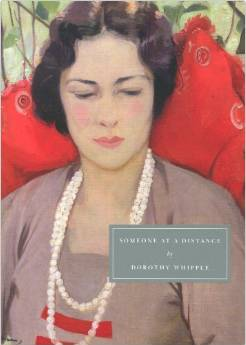
Cover for Someone at a DistanceBest Book of the Week!
I would normally not give away something important that happens well into a novel, but the book blurb openly presents it as the novel’s central conflict. The Norths are an affectionate and happy family with little to discontent them in post-World War I England. Avery enjoys his work as a partner in a publishing firm and is a loving husband and father. He dotes on his daughter Anne especially. Ellen loves her family and her garden. Although she perhaps does too much for her family, she enjoys it. Hugh is serving his term in the army but can’t wait to get out and work at his father’s firm. Fifteen-year-old Anne loves her family and especially her horse.

The only small annoyance in the family’s life is Avery’s mother, who is critical and discontented, wanting more attention than the busy family can provide. But she soon solves her own problem by hiring a companion, a French girl named Louise Lanier.

Louise is a selfish and discontented young woman who is fleeing the end of an affair in which she was felt to be socially inferior to her lover and unworthy of marrying him. Eventually, she sets her sights on Avery, heedless of any destruction she may wreak with her harmful intentions and toxic personality.

I spent the first half of this novel entranced by this perceptive and layered novel and the last third in tears. The characters are wonderfully realized. Perhaps Louise’s character lacks a little nuance, but we have all met people who are able to justify their own bad behavior to themselves. This is a great book that should have had more attention since it was written in the 1930’s.

Related Posts

The Watch Tower

A View of the Harbour

The Travelling Hornplayer

Day 674: In a Lonely Place

Cover for In a Lonely PlaceWhat makes this post-World War II noir crime novel stand out is that it was written by a woman and the crime is solved by two sharp women. Although there are plenty of women mystery writers, it is less common to find women writing noir mysteries at that time. Reminiscent of The Killer Inside Me, In a Lonely Place tells the story of a serial killer of women from the point of view of the killer.

Dix Steele is an ex-pilot being supported by his uncle in Los Angeles while he pretends to write a novel. He is living in a posh apartment of an old Princeton friend, wearing his clothes and driving his car and telling everyone his friend is in Rio. About once a month he picks up a girl at a bus stop or some other lonely place and strangles her.

Dix decides to get in touch with an old friend from the military, Brub Nicholai, but is taken aback to find Brub is now a police detective. Brub has also married, and his wife Sylvia doesn’t like Dix.

Dix meets an attractive redhead, Laurel Gray, who lives in the apartment complex and is divorcing her wealthy husband. Soon they begin a torrid romance.

This novel was convincing in its depiction of a serial killer. Although we see things from Dix’s point of view, we are not drawn into his dilemmas as we are, say, for The Talented Mr. Ripley. We want him to be caught and worry about Laurel or about the next time he is going to find the need to kill.

Related Posts

The Killer Inside Me

The Talented Mr. Ripley

Roseanna

Day 671: Lila

Cover for LilaBest Book of the Week!
In Lila, wonderful writer Marilynne Robinson returns to the small Iowa town of Gilead, the setting of her previous novels Gilead and Home. In these novels Lila Ames is not much of a presence. She is referred to as the surprising choice of a wife for the elderly, gentle, and educated pastor John Ames—much younger, rough, and uneducated.

Lila has lived almost her entire life on the tramp, ever since Doll stole her away, a neglected, starving, feverish little mite who lived mostly under the table or was locked out of the house. Doll and Lila joined up with a group of travelers lead by Doane, wandering from job to job, and life was just fine until the long, dark days of the Depression and the Dust Bowl. Years later, Lila has stopped outside Gilead and is living in a shack, walking to nearby farms and houses and asking for work.

Lila knows nothing about religion, but on occasion she has been curious about it and was warned away by Doane, who claims all preachers are charlatans. So, one day she ventures into the church. There she sees and is drawn to John Ames, and he to her. Eventually, they marry.

The action of this novel is mostly interior. Lila is tormented by some of the memories of her previous life and feels unworthy of Ames. She is afraid that he may ask her to leave at any minute. All the same, she occasionally wants to return to the freedom of her old life.

Ames, on the other hand, is happy to have Lila’s company, for he has lived alone ever since the death of his wife in childbirth, years ago. He is afraid she will decide to leave him one day.

As with Gilead and Home, this is a quiet novel, characterized by religious discussions as Lila tries to read and understand the Bible. She has no prior relationship to religion, but she has vowed that John Ames’s son will be brought up praying, as his father does. The discussions in Gilead between the two pastors were way over my head, but these are more fundamental.

I am not particularly interested in religion, but what I like about Robinson’s books is that they are about good people trying to be good. That is a refreshing theme these days. And the writing is superb, the subject matter approached with delicacy. I can’t recommend any book by Marilynne Robinson strongly enough.

Related Posts

Gilead

Home

Housekeeping


Day 665: The Sleep Room

The Sleep Room In this atmospheric novel set in the 50’s, Dr. James Richardson is a young psychiatrist when he accepts what appears to be an exciting opportunity to work with the world-famous Dr. Hugh Maitland. Maitland has just opened a clinic in rural Suffolk where he will be employing some experimental therapies and hires Richardson as a doctor for the facility. Richards is surprised to find he’ll be the only doctor on staff with just weekend relief.

When Richardson begins work at the clinic, he is surprised that Maitland will not let him examine the patient records. One of Maitland’s beliefs is that mental problems are chemical and need chemical solutions, not psychotherapy. In the Sleep Room,  one of his experimental therapies is keeping six women asleep for months.

Although Richardson has some twinges of doubt about Maitland’s ideas, he defers to him as the expert. Soon he has other things to think about. He becomes very busy with his work and is also romantically involved with a nurse, Jane Taylor.

Small odd things happen beginning almost with his arrival, though. He thinks someone is behind him when no one is. He hears sounds when no one else is in the room. Things disappear and reappear in places where they shouldn’t be. Richardson begins thinking that the stately home housing the clinic has a poltergeist.

The Sleep Room is a difficult book to review because it slowly builds up quite a bit of suspense, but then I found the explanation for the events absurd. Yet, there is a reason for that and I can’t really get into it without giving away too much. Let’s just say that after an apparent climax there is a long, boring explanation followed by a short, apparently aimless follow-up, and then everything gets turned upside down.

One problem is that the final twist isn’t signaled well enough by the rest of the novel and actually doesn’t make sense in terms of the total of the novel’s narrative style. I can think of another book that employed a very similar trick but much more successfully. So, although I was captured by this book, I find that it ultimately doesn’t work.

Finally, the novel is only adequately written and poorly edited. In particular, I noticed loads of unnecessary passive voice and several instances of confused homophones: “knave” instead of “nave” and “taught” instead of “taut,” for example. These problems were with the published book. I was not reading an advance reading copy.

Related Posts

The Solitary House

Your Presence Is Requested at Suvanto

Andrew’s Brain


Day 661: The Bully Pulpit: Theodore Roosevelt, William Howard Taft, and the Golden Age of Journalism

Cover for The Bully PulpitNoted historian Doris Kearns Goodwin approaches her subject of the relationship between Theodore Roosevelt and William Howard Taft from several insightful angles. Although her book examines their careers separately, it is focused on the differences in their personalities and approaches that finally led to the serious rift in their friendship of many years. This rift also led to Roosevelt’s third run for president, which split the Republican ticket.

One of the major differences that Goodwin identifies is their relationships to and use of the press. The journalists particularly close to Roosevelt and involved in the fortunes of both presidents all worked for McClure’s magazine and make up an impressive list of names in journalism: Ida Tarbell, Ray Stannard Baker, William Allen White, and Lincoln Steffens.

I wanted to read more by Goodwin after I read Team of Rivals, the great history of Lincoln’s career that inspired the movie Lincoln. Although I also have her book about FDR and Eleanor Roosevelt in my queue, I was interested in this one because I know only a little bit about Teddy Roosevelt and almost nothing about Taft, just the broad outlines of their careers.

Without going into detail about the careers and personalities of either man, although I developed respect for both, after reading this book, I confess to having a lot of sympathy for Taft over their split. The fact is that Roosevelt regretted his decision not to run for a third term and so looked for excuses to find fault with Taft’s presidency. After Roosevelt’s return from Africa, he criticized Taft’s record of progressive legislation even though it was actually better than Roosevelt’s own. Taft later acknowledged that he wasn’t as good as Roosevelt in publicizing his accomplishments or explaining his policies to the press.

This book is thoroughly interesting and revealing of the characters of both men. It is carefully researched, and it is also very well written. Although quite hefty at 750 pages, it moves along at a good pace and does not get bogged down with extraneous details.

Related Posts

Team of Rivals: The Political Genius of Abraham Lincoln

The River of Doubt: Theodore Roosevelt’s Darkest Journey

The Gods of Gotham


Day 658: Euphoria

Cover for EuphoriaI switched around my book for today so that I could review a book that is about love rather than about hate (my original selection). I wasn’t thinking about Valentine’s Day coming up tomorrow when I originally selected the review. Happy Valentine’s Day!

***

Best Book of the Week!
Lily King based many of the events in her novel Euphoria on the life of anthropologist Margaret Mead. The result is a fascinating examination of another culture and Mead’s work methods as well as a love story.

When Nell Stone and her husband Schyler Fenwick (Fen) crawl out of the New Guinea jungle after grueling months spent studying the Mumbanyo, they don’t even know it is Christmas Eve. Nell has found the Mumbanyo people too militant and unsympathetic to work with, so she has insisted they leave against Fen’s wishes. We see almost immediately that Fen is jealous of Nell’s fame from the publication of her book on the Solomon Islands and that he can be brutal. Since the anthropologists consider the territory around the Sepik River to be already claimed by Andrew Bankson, their plan is to study the Aborigines in Australia.

At a Christmas party in their hotel, they meet Bankson. He has been working alone for two years and is dreadfully lonely, has even recently attempted suicide. He also feels stymied in his approach to research, wanting someone to bounce ideas off of. He has been begging for a partner to no avail.

Feeling an instant connection to Nell and Fen, Bankson urges them to pick a tribe to study near him on the river, and he takes them along it to choose. He hopes they choose the people in a village that is close to him, but they choose the Tam, seven hours away.

Here, Nell settles down to work hard, learning about the women and children. She is not allowed in the men’s street, so Fen’s job is to collect information about them. But Fen seems to be more interested in doing things with the men than in actually working on his research.

In the meantime, Bankson has been resisting his terrible loneliness and his attraction to Nell. But finally he comes to visit.

This brief novel is really wonderful in its characterizations, its descriptions of life in a New Guinea village, in its sheer richness. It reminded me a lot of another wonderful book, State of Wonder by Ann Patchett.

Related Posts

State of Wonder

The Bone People

The Cruelest Journey


Day 657: The Fish Can Sing

Cover for The Fish Can SingÁlfgrímur is an orphan boy who has always known life in a simple turf cottage with his foster parents, Björn of Brekkukot, whom he calls Grandfather, and Grandmother. His grandfather lives a life of integrity, with no interest in ambition. Words are so important in their household, Álfgrímur explains, that they are only spoken to hide things.

Álfgrímur grows up with his only ambition to live in his grandparents’ cottage and fish for lumpfish with his grandfather. But his grandmother has other ideas, so when he is old enough, he goes reluctantly off to school.

Most of this novel is an account of everyday life at Brekkukot, peopled by the peculiar residents of the grandparents’ loft, some permanently there and others passing through. These people are all good but eccentric. For example, there is the Superintendent, whom Álfgrímur as a boy thinks is the superintendent of the entire city of Reykjavic but turns out to be in charge of the public toilets at the harbor.

Hanging on the wall of their neighbor Kristín’s cottage is the picture of a young man. When Álfgrímur asks about him, his grandparents answer “He was a nice little boy, that Georg,” Kristín’s son. But Georg is now Garðar Holm, a famous Icelandic opera singer. Garðar Holm seldom comes home. When he does and his patron schedules a concert, he never appears, but he does take an interest in Álfgrímur. Álfgrímur can sing and he wants to learn to sing “one true note.”

In this novel, Laxness is interested in exploring the tension between fame and obscurity, but he is also interested in the importance of morality and honest dealing. Serious as its intent is and primitive as are the characters’ surroundings, this is not at all a grim novel. It is told with a wry and ironic sense of humor and is full of colorful characters. With Laxness, you can be sure that there is plenty going on beneath the surface of things.

Related Posts

Independent People

Cod: A Biography of the Fish That Changed the World

The Beautiful Mystery