Day 591: Goodbye to All That

Cover for Goodbye to All ThatThis is my book for the most recent Classics Club Spin! I originally announced that I would post my review a day late, on October 7, but I decided to post it early instead, so as to meet the spin deadline, since Monday, the deadline, is Literary Wives.

Goodbye to All That is the only memoir by Robert Graves, written in his 30’s about a dozen years after World War I. Nowadays, Graves may be best known as the author of I, Claudius, but the publication of Goodbye to All That was extremely controversial. It was one of the first memoirs about the war, and it was one of the most critical.

But before Graves turned a satiric eye on the war, he pointed it at the public school system. I did not always understand what was going on in his boy’s school, but the layers of hierarchy and the customs seem ridiculous. Not surprisingly, this same complexity extends to the different regiments in the military and their customs—where to wear their decorations, what to wear (for one regiment in France, the answer is shorts), and who may speak or drink in the officer’s mess.

Graves, who enlisted early in the war at the age of 21, was soon viewing it all skeptically. One scene of high satire takes place in a meeting of battalion officers, who are all called in to listen to the complaints of their colonel that the men aren’t buttoning their pocket flaps and so on—the worst offence being that he heard a soldier actually call a noncommissioned officer “Jack”! This meeting takes place at the same time that the division is issuing commands for the men to perform impossible missions that would have gotten them all killed had they not been cancelled at the last minute.

Graves also deals somewhat facetiously with the premature reports of his own death, sent by the military to his family after he was wounded, by putting a polite announcement in the Times.

This memoir is interesting enough, although at times I could not follow the nuances of the events, having no knowledge of British school or military terms. There is a short glossary of military terms at the beginning of the book, but it is insufficient. These days, news of incompetency and jingoism during the war is no surprise, but when this book was published, it was the cause of a storm of letters containing all kinds of accusations against Graves.

Day 588: I Await the Devil’s Coming

Cover for I Await the Devil's ComingI had a strong reaction to I Await the Devil’s Coming, which I will explain in a moment. This book was written in 1901 and belongs in the category of confessional literature. It apparently was quite a sensation at the time and had a great following by young women.

Mary MacLane was a 19-year-old woman living in a Montana mining town. In the book she declares herself a genius and an egoist who is waiting for her life to start when the Devil takes her away to be his love. This book is claimed as an early feminist work, and in the introduction, there is a statement to the effect that if MacLane had been a young man, she could have gone off and made her mark.

I don’t see this book as a feminist work at all but more likely as an expression of mental illness. I have met a similar person in a relative, who complained that life was hell on earth and that the people of our town were all provincial philistines. MacLane wasn’t going to act, she was waiting for things to happen to her. You could reply that in her time and place there was nothing a respectable woman could do to change her life, but of course, MacLane didn’t care about being respectable, at least she said she didn’t.

MacLane was mentally ill not because she said she was waiting for the Devil, but because she showed signs of severe depression alternating with fervor and euphoria, and she heard voices. If she had been a young man, she would have been incapable of striking out on her own and making a success of herself.

In fact, she did not. Her book was published and she was kicked out of the house. We don’t really know how she led her life after that. She wrote another book years later that was not a success, and she died alone in her 40’s in a hotel room.

It is a sad story. The book is well written, visceral at times, but it is not a feminist masterpiece. Charlotte Perkins Gilman was a feminist. George Eliot was to some extent a feminist. Mary Wollstonecraft was a feminist. Mary MacLane was not.

Could the situation of women at the turn of the century make a woman ill? That is another question. Charlotte Perkins Gilman obviously thought so.


Day 584: The Shining Girls

Cover for The Shining GirlsBest Book of the Week!
The Shining Girls is a clever, clever novel, a hybrid of a fantasy novel and a crime thriller. I read rave reviews of it, and it deserves them.

Harper has just killed a man in a Chicago Hooverville in 1931. He is being pursued in the freezing cold when he murders a blind woman for her coat. Inside the pocket he finds a house key, and somehow he knows the way to the house. It is a boarded up old wreck on the outside, but inside it is warm and comfortable, even prosperous looking. When Harper goes into an upstairs room, he finds souvenirs and girls’ names written on the wall. He understands that the house wants him to kill these girls. When he goes back outside, he finds himself in another time.

In 1993, Kirby Mazrachi interviews for an internship at the Chicago Sun-Times. She has asked to work with Dan Velasquez, a former crime writer who now covers sports. Her goal is to find the man who attacked her and nearly killed her in 1989. She believes he is a serial killer, and she is planning to use the paper’s resources to find more of his murders.

As Kirby continues her investigation, finding evidence that doesn’t make sense, Harper tracks down his shining girls one by one, visiting them when they are young and then going back for them as adults, over a time period of 60 years. He takes something from each one and gives it to the next.

This novel is completely absorbing, well written, and suspenseful. It is also haunting and unusual, with everything cleverly linked up. In the larger context, it explores the issues of fate and free will, but as entertainment, it keeps you pinned to your seat.


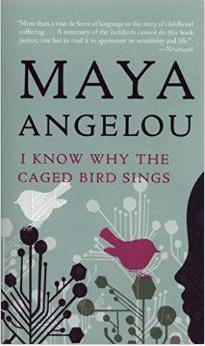
Day 583: I Know Why the Caged Bird Sings

Cover for I Know Why the Caged Bird SingsThe picture on the cover of my old copy of I Know Why the Caged Bird Sings shows an angry and dignified woman, and in some ways this is an angry memoir. Although I’m sure this anger helped sustain Maya Angelou during a difficult life and pushed her to make significant advances for herself and her people, I hope she became happier later. She earned it.

This book is the powerful story of the first 16 years of Maya Angelou’s life. She and her brother Bailey were raised by their grandmother in the small town of Stamps, Arkansas, after being sent there alone on a train from California at the ages of three and four by their parents. Much of the book deals with her upbringing by a strict and religious, somewhat reserved but caring grandmother in the racially segregated South.

Although life in Stamps was no picnic, her brief visit to her mother in St. Louis when she was eight was disastrous. There she was raped by her mother’s boyfriend. That was not the only event in her life that could have proved catastrophic.

Angelou speaks with raw transparency about the feelings of insecurity that she battled through her girlhood, a combination of her treatment by whites and her own feelings of unattractiveness. In her younger years she was saved by her love of reading, later by her own dignity and will to succeed.

This book is deeply involving and at the same time sometimes disturbing reading. I was brought to tears at the description of Angelou’s nearly ruined graduation, not when the pompous white guest speaker put the class in its place, but by how the valedictorian rescued the occasion. I was thrilled when Angelou’s perseverance won her a position, at the age of 15, as the first African-American cable car employee of San Francisco.

I think this story of pride and dignity against bigotry is inspiring for anyone.

Day 579: The Daughters of Mars

Cover for The Daughters of MarsNaomi and Sally Durance are sisters and Australian nurses in 1914. They are divided by old grudges and a new crime. The older Naomi deserted their home in the bush for a career in Sydney, leaving Sally stuck there with their parents. More recently, their mother was struck down with cervical cancer and suffered terribly. Sally stole enough morphine from her own hospital to help her mother die, but one day after Naomi arrived, Sally found their mother dead and the drugs gone. Sally feels guilt at her part of the crime and resentment that Naomi could do what she could not.

There is a fervor in Australia for the war, so both women decide independently to volunteer as nurses. They set out by ship for Egypt, then to serve on a hospital ship off Gallipoli, and finally to France.

This novel shows extensive research into the conditions of World War I for nurses, and of their treatment. Although by and large they receive respect, that is not always the case. In an incident based on a true event, their hospital ship Archimedes is employed for one mission as a troop carrier, its red crosses blacked out. It is torpedoed and the survivors, including Sally and Naomi, wait in the water clinging to a raft for hours for rescue. During this traumatic wait, one soldier after another simply lets go.

After the nurses are rescued, they are put to work in a hospital on Lemnos, where the officer in charge sees no use for them and lets the orderlies treat them with disrespect. All their possessions lost, they are given local peasant dresses to wear instead of uniforms. Eventually, an orderly rapes one of the nurses and after a perfunctory investigation, gets off lightly.

The adventures of the sisters and their friends are indeed interesting and provide a different view of the war. With the few of Keneally’s books that I have read, Schindler’s List being the most well known, I have felt a certain distance from events and characters. This book is no exception, but at the same time I wanted to see what would happen.

Although told in a straightforward limited third-person narrative that moves between the point of view of the two women, Keneally offers up an alternate ending. It is not one we can choose between, but one where he tells us what might have happened and then tells us what did happen. The ending brought tears to my eyes but also seemed a little like a trick.


Day 577: Red Sorghum

Cover for Red SorghumRed Sorghum is absolutely brutal. It tells the story of a Chinese family during the time of the Second Sino-Japanese War. Most of the action of the book takes place in 1939 and a few years thereafter, although there are glimpses of years before and later. I say book, because it is described in some places as a series of novellas and in other places as a novel.

The two main characters are Yu Zhan’ao, the narrator’s grandfather, also known as Commander Yu, and Dai, his grandmother. The narrator’s father Douquan is a less important character. The narrator himself only makes an appearance in the last two pages.

The book begins with an ambush of the Japanese near Black Water River. But nothing here is related in a straightforward manner. The narration moves back and forth in time as Commander Yu’s preparations for the battle alternate with the story of Uncle Arhat’s kidnapping as slave labor for the Japanese and the story of how Yu Zhan’ao meets Dai. There is plenty of violence in all of these stories, and we are not spared any details of guts falling out, decapitated heads, or anything involving bodily functions.

The Chinese are at war through most of the book, of course, but various factions of Chinese fight and kill each other just as viciously. Although Commander Yu wins the battle of Black Water River, almost all of his men are killed when his ally, Detachment Leader Pocky Leng, fails to turn up at the ambush, then steals all of the captured armament.

Earlier in time but later in the book, Grandfather Yu meets Dai on her way to marry a rich man’s son. Her father’s greed has betrothed her to a leper. Yu seduces her on her way back to visit her parents after three days of marriage and then goes off to murder her husband and father-in-law, leaving her a rich widow.

Sometimes the violence in this book is so extreme it is almost funny. People behave grotesquely—they are crude, barbaric, disgusting, venal, and revengeful. Commander Yu is almost more eager to kill Pocky Leng than he is the vicious Japanese, who are nearly cartoonish in their evil.

In between scenes of almost unbelievable brutality are beautiful descriptions of nature, with a strong emphasis on color. Red is consistently a symbol of life and goodness while green is its opposite. Sometimes blood is green instead of red and too the sun can be green. This use of color comes to a focus in the last pages of the novel, where Mo Yan laments the disappearance of the wonderful red sorghum (a major presence in the novel) and excoriates its green hybrid replacement.

I found very little to like in this book. I read it all, but I basically had to force myself to finish it (and beautiful descriptions or not, I got tired of reading about sorghum). I know the book has received a lot of admiration, and I do not exactly agree with the criticism that it glorifies violence, but there is a lot of very graphic violence in the novel.

Day 575: All the Light We Cannot See

Cover for All the Light We Cannot SeeI felt a bit of distance while I was reading All the Light We Cannot See, but by the end I was brought under its spell. It is about a German boy and a French girl who meet briefly during World War II.

Werner is growing up in an orphanage in Germany. He has always been fascinated by how things work, particularly electronics, and he is far advanced of his teachers in math. One day he discovers a broken radio set in the trash and is able to make it work. He and his sister Jutta discover a children’s broadcast from France in which a man explains science topics and plays music. This station delights them for years until it becomes dangerous to listen to under the Nazi regime.

With all his gifts, Werner is slated to work in the mines when he is old enough. He gets an opportunity, though, to attend a technical school. Against Jutta’s advice, as Werner has avoided being pulled into the orbit of Nazi politics, he takes his chance.

Marie-Laure’s father is a locksmith employed by a Paris geological museum. At the age of five she becomes blind. Her father teaches her to find her way in their neighborhood by making a model of it, which she learns by feeling her way. She loves spending time at the museum, learning about all its treasures and handling the shells. She also loves reading adventure stories in Braille.

When the Nazis are due to invade Paris, the museum gives four stones to four employees to keep safe. One of them is the museum’s most precious possession, a fabled diamond with a curse attached; the others are fakes. Marie-Laure’s father receives one of them, and the two leave the city, eventually arriving in St. Malo, where Marie-Laure’s great-uncle lives.

The diamond acts as sort of a MacGuffin in this novel. Of course, we are sure who has the real stone.

The stories of Marie-Laure and Werner’s pasts alternate with the bombing of St. Malo in 1944 by the Americans. Werner is trapped with some German soldiers in the basement of a hotel, while Marie-Laure is hiding in her great-uncle’s house from a German officer searching for the diamond.

This novel is beautifully written and shows the hardships of war from both sides of the conflict. Werner struggles with his desire to do what is expected vs. what is the right thing. Marie-Laure tries to resist the chaos of war in other ways. I felt for a long time that the novel would end predictably, but I was pleasantly surprised and delighted by how the ending opened up from a claustrophobic setting to a more universal feeling.

Day 572: Lisette’s List

Cover for Lisette's ListIn 1937, Lisette and André Roux are on their way to Provence. Lisette has abandoned the opportunity to become an apprentice at the Galerie Laforgue and André his job as the frame builder for famous artists. They have left their beloved Paris to take care of André’s grandfather Pascal, for Pascal has written to say that he is dying.

When they arrive in Pascal’s village of Rousillon, however, they find Pascal has been out playing boules. Lisette is horrified at leaving her life behind on a false pretense. Pascal is sometimes ill, but he is mostly lonely.

He also has a legacy he wants to pass down. Pascal owns seven paintings by masters that he traded for picture frames back when the painters were struggling. He wants to pass to Lisette the stories about these paintings, three by Pisarro and three by Cézanne and one study of heads by an unknown artist. Pascal is also proud of Rousillon, where workers have dug ochre out of the ground for centuries to make the paints used in these paintings.

Although Vreeland’s descriptions of Provence and Rousillon are evocative, I feel that the first part of the novel gets bogged down in these teaching moments of Pascal’s. Even though I am interested in art, these conversations are too didactic to come across as authentic.

There are other moments like this farther into the novel, but it picks up during and after World War II in Lisette’s efforts to survive as a Parisienne alone in the village. André leaves to fight at the beginning of the war. Before he leaves, though, he hides the paintings because he has heard that the Germans will search out art and either take it or destroy it because of decadence.

http://www.netgalley.comI was mildly interested in this novel. It is clear that Vreeland loves art, and she does a fine job of evoking the paintings and the gorgeous landscapes of Provence. She is so interested in these subjects, though, that we get a much sketchier idea of the character of Pascal, for example, or André.

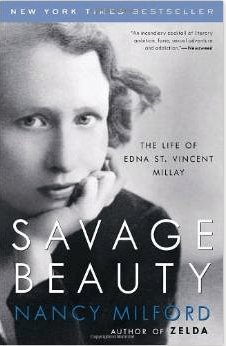
Day 566: Savage Beauty: The Life of Edna St. Vincent Millay

Cover for Savage BeautyNancy Milford, author of an acclaimed biography of Zelda Fitzgerald, was able to gain unlooked-for access to Edna St. Vincent Millay’s papers to write this compelling biography. She explains in the prologue that she stopped by the house of Millay’s sister Norma in 1972, hoping to talk her into working with her on a biography. Norma, who had all along refused access to her sister’s legacy, decided it was time.

The result is a riveting biography, full of excerpts of letters—some never sent—poetry and scraps of poetry, and notes. It is unflinching in looking at Millay’s lifestyle and addictions.

Millay, of course, is famous as the voice of a newly liberated youth, particularly of women, in the Jazz Age. She began publishing her poetry at a young age and became famous after her first book, when she was in her early twenties. For a long time, she was wildly popular—movie star popular—which is interesting in a nation that generally doesn’t love poetry. And, like many a modern idol, she had a lot of attention paid to her appearance, which was small, with fiery red hair, and sprite-like.

That is about all I knew about her—that and a bit of her verse. Her childhood was hard. Her mother left her father when Edna and her sisters were young and was away much of the time trying to make a living for them as a nurse, while the girls fended for themselves. Still, she brought the girls up with a love of music and poetry. Millay published a few poems in a children’s poetry magazine and won all their awards, but her big break came when she attracted the attention of a wealthy patroness, who arranged for her to attend Vassar.

I am not going to relate Millay’s life story in this review—you can read the book for that—but instead ruminate on some ideas this book made me consider. One is the strange relationship Millay had with her mother Cora and her sisters Norma and Katherine. For Cora, her letters always expressed much affection, often resorting to baby talk. Yet increasingly, Millay kept her mother at arm’s length, sending money instead of visiting her.

With Norma, too, the messages were affectionate, but the visits were few. In her case, there seems to be fair enough evidence that Edna’s husband Eugen Boissevain acted as a barrier between Millay and some people, including her family. As time progressed, for example, almost all of Norma and Katherine’s letters to Edna were answered by Eugen.

Katherine’s case was different, a life that seemed to be an attempt to compete with Edna in her own backyard, and failed. Edna’s patroness also saw Katherine into Vassar, from which she failed to graduate. She published a couple of prose books and some poetry, but her work was deemed too similar to her sister’s to succeed. This evaluation must have been disheartening, but in later years she claimed that Edna stole her ideas, an allegation that was patently absurd, especially as they had barely been in touch for years. Katherine’s relationship with Edna toward the end consisted solely of letters that were a combination of vituperation and demands for money. Like Edna, Katherine was an alcoholic, although not apparently a high-functioning one.

Edna’s relationship with her husband was unusual, too. After a gay and determinedly single life including many affairs with both men and women, Millay married not long after the failure of an affair with another man. Eugen is frequently described as a man who did everything for Edna, including absenting himself so that she could have an affair with a much younger man. Her family and some of her friends seemed to blame him for keeping her apart from them, but I can’t help feeling that most of that was at her desire, since she seemed to see who she wanted to see.

All of this makes me wonder how far a creative person can go in selfishness—how acceptable that is in the service of art. Millay was certainly one of those extremely charismatic people who attracted others like moths. How often such people are completely self-absorbed, even if they are not geniuses. If a person’s genius is fueled by intense emotion, is it okay to fire that  emotion at the expense of others? To blow hot and cold on people’s passions until they are madly in love and then discard them? I don’t really know. Many of Millay’s lovers remained her lifelong friends after the affair was over, but it seems that charismatic people are more often forgiven their actions than others. I haven’t come to any conclusions on this. These ideas are just some the biography made me consider.

I read this book in tandem with The Selected Poetry of Edna St. Vincent Millay. Review to come.


Day 561: Lucky Us

Cover for Lucky UsI was enchanted by Away, so I was excited to find that Amy Bloom had another book out. This novel is good but does not live up to the other.

Eva Acton has not met her older half-sister Iris until Eva’s mother dumps her on the front porch of her father’s home. Up until then, Eva worshipped her father, but she begins to see that he has his flaws, a second family being a major one of them. Another is stealing the money Iris wins in talent competitions.

Once Iris has managed to hide enough money from her father, she and Eva take off for Hollywood, where Iris is determined to make it big. At that point, Eva’s formal education comes to a halt, when she is 14.

Iris is beginning to have some success when her chances are ruined by betrayal and scandal. The girls, their friend Francisco, and their father, who has joined them upon premature news of Iris’ success, set off for New York.

This Depression-era novel is written in a light, jaunty tone, narrated mostly from Eva’s point of view punctuated by letters. For after a lot has happened, the girls are eventually separated.

The conflict of the novel is around some choices Iris makes, causing Eva to take on responsibilities and struggles that Iris has initiated. Iris commits several unconscionable acts.

http://www.netgalley.comI cared about what would happen to Eva and some likable friends, but I felt that the end of the novel was too easy on Iris. I also felt that this novel lacked the originality of Away. It is interesting, though, because I was never sure what would happen next, and the narrative style has its charms.