Day 435: Literary Wives: The Wife, the Maid, and the Mistress

Cover for The Wife, the Maid, and the MistressToday is another Literary Wives posting, where along with several other bloggers, I post reviews of the same book with the theme of “wives.” For more information, see my Literary Wives page.

The famous disappearance of Judge Crater, who like Jimmy Hoffa was never heard from again, certainly has potential for a noirish whodunnit. I just wasn’t that satisfied with Ariel Lawhon’s version of the story.

For one thing, although the plot has all the elements of a noir mystery, the writing style doesn’t reflect the cold crispness and snappy dialogue I expect from noir. It is merely pedestrian.

At the beginning of the novel, Judge Crater’s wife Stella meets Jude Simon, the detective who was on the case, years later in 1969 to give him a confession. Then we return in time to 1930. The bulk of the novels flits restlessly between different days and times around and before this period, returning occasionally to 1969 to Stella and Jude’s meeting.

This time shifting was one of my problems with the novel. I do not remember dates readily, and it was difficult for me to keep my place in time. Possibly a fault that will be cleared up in the published book (I was reading an advanced reading copy) is the problem of the dates at the beginning of sections, which sometimes are there to signal a change in time and sometimes are not. The first time the time changed with no indication, I thought it was a mistake, but then it happened several more times.

In addition, a few scenes that return to an earlier time have no apparent purpose. Perhaps they are intended to establish something about the Craters’ relationship, but I find them unnecessary to the story. The example that comes to mind is a dinner scene where the judge tells Stella where he wants her to shop from then on.

For the plot, the judge disappears at the beginning of the book. His mistress Ritzi is hiding in the room when he is taken, so it is no surprise to find out who took him. His wife Stella and their maid Maria also have some guilty knowledge. Maria sees her husband Jude plant some money in the house after the judge’s disappearance, and Stella removes money from the house and all their assets from the bank before reporting the judge as missing.

Overall, I found the novel mildly entertaining. It does manage a surprise at the end, which I didn’t expect because the novel seemed otherwise predictable. I also think more could have been done to make the time period and the setting more evocative.

Now to our questions for Literary Wives.

What does this book say about wives or the experience of being a wife?

There are two prominent wives in the novel–Stella and Maria. The judge sees his wife’s role as being an ornament and an asset on his way to the top, and Stella seems to have agreed to take this role, although she obviously has lost her respect for him over time. There are some references to happier times, but we frankly can’t see that he has any redeeming qualities. Stella’s only other concern seems to be to make sure she has money after the judge’s disappearance.

Maria’s relationship is more loving. She seems to see her role as to protect and support her husband and to try to become a mother. However, we don’t really see very much of Jude and Maria together, and Jude seems to be preoccupied with his difficulties at work.

In what way does this woman define “wife” or is defined by “wife”?

Except for one central act, which I don’t want to give away, both women are essentially defined by their roles as wives, which are fairly stereotypical for the time. Stella is the society wife. Maria is the religious little woman. This defining act tells us there is more to both of them, but we don’t really understand these women very well as people, and this act is only revealed at the end of the novel, giving us no opportunity to view them in another way. I think Ritzi is the most fully developed character, and although she is actually a wife as well, that part of her character isn’t really explored.

Be sure to view the posts of the other “wives,” as follows. An interview with Ariel Lawhon is posted on Audra’s blog, Unabridged Chick.

Ariel of One Little Library
Audra of Unabridged Chick
Carolyn of Rosemary and Reading Glasses
Cecilia of Only You
Emily of The Bookshelf of Emily J.
Lynn of Smoke and Mirrors

Day 422: Studio Saint-Ex

Cover for Studio Saint-ExAnia Szado has written an interesting historical novel based on the writing of Antoine de Saint-Exupéry’s classic The Little Prince. The novel centers around a relationship between the famous aviator and author and a young French-American woman, Mignonne Lachapelle. This relationship is fictional, although Saint-Exupéry, or Saint-Ex, as he is called in this novel, was known to have such connections.

Mignonne is a recent graduate of design school who is struggling to start a career in fashion design during the early days of the American involvement in World War II. Although with Paris out of the picture things are looking up for American design, no one is ready to hire a rank beginner for a design position. So, Mignonne is forced to turn to Madame Véra Fiche, her instructor from design school who stole Mignonne’s ideas for a dress collection to open her own atelier. Fiche takes her on under a vague promise of partnership.

Mignonne has just returned from Montreal, where she has been staying with her mother, but she is already under the spell of the middle-aged Saint-Exupéry, whom she tutored in English the year before. They have carried on a sort of dalliance. On the scene, however, comes Saint-Ex’s tempestuous wife, Consuelo, whom he continually tries to dodge. He claims he cannot get any peace while she is around and cannot work, yet their relationship is more complex than that.

Saint-Ex himself worked to get America involved in the war in an effort to save his beloved France. Lately, he has been lobbying to join the services, but he is considered too old and too frail to fly, having crash-landed his airplanes many times in the course of his adventures. To calm his frustration and anxiety, he begins writing The Little Prince and seeks refuge from Consuelo in the Atelier Fiche studio to work and see Mignonne. Soon Mignonne is caught up in a tangled relationship with Saint-Ex and Consuelo.

This novel is well written and evokes its time successfully. I don’t think I was taken with its characters so much, though. I had some sympathy for Mignonne, but in her own way she is almost as difficult as Consuelo. Consuelo herself seems almost uniformly manipulative and conniving, and it is difficult to comprehend why Saint-Exupéry stays loyal to her, albeit in his own way. I frankly find Saint-Exupéry himself to be not so much a spellbinder as a high-strung and excitable man encouraging the attentions of a beautiful young woman without really paying much heed to her. I don’t find him romantic so much as also manipulative.

Nevertheless, I was engrossed in the story and found the details of Mignonne’s work and her sensual descriptions of the fabric fascinating even though I don’t pay attention to fashion. The story of the launching of The Little Prince around a fashion show and play was interesting, too.

I won this book in a giveaway from Unabridged Chick blogspot.

Day 419: The Bones of Paris

Cover for The Bones of ParisHappy Halloween! I tried to select a book that was appropriate for the occasion, although I didn’t have a ghost story lined up.

Laurie R. King’s series about Mary Russell and Sherlock Holmes is very popular, but I prefer her Kate Martinelli series or, even better, some of her dark psychological stand-alone novels. Folly is my favorite. With The Bones of Paris, she brings some of that darker sensibility to what looks like the beginning of a new mystery series.

Harris Stuyvesant is an ex-FBI agent who has been scraping a living in Europe by taking private investigation work. Among the hordes of American expatriates in 1929 Paris, he is searching for a young woman, Pip Crosby, whose relatives have not heard from her in months. A cause for possible embarrassment or worse is that Harris met Pip in Nice the year before and had a brief fling with her. Ever since a disastrous incident that ended his career and cost him his fiancée, he has been living an aimless and bohemian existence.

Two of Harris’ first stops in his search for Pip are Pip’s flatmate, Nancy Berger, and the Paris Missing Persons Bureau. Nancy seems to have a hangover but is actually suffering the effects of travel. She just returned from an archaeological dig in Greece and has not seen Pip for months. Harris finds the police officer, Doucet, concerned about what may be a series of killings.

Harris’ attentions soon narrow on three men connected with the art world whose names keep surfacing in connection with Pip and who all have a fascination with the macabre. The artist Man Ray‘s photographs of Pip focus on a gruesome scar from an accident in her youth. Count Dominic de Charmentier is a wealthy patron of the arts who owns a theatre that alternates grotesque and frightening scenes with comic ones. He also hosts parties that feature macabre decorations and terrifying staged events. Didi Moreau is a creepy, disturbing artist who makes displays of found objects, including human bones. Pip has a few of these displays in her room, as well as some of Man Ray’s photographs. When Harris begins investigating these men more closely, he finds to his alarm that his ex-fiancée, Sarah Grey, is working as de Charmentier’s assistant.

King evokes the time and place with mastery, introducing us to a dissolute café culture populated with famous figures such as Cole Porter and Josephine Baker. She also cleverly raises the creep factor by interjecting short chapters about the bones that underlie parts of Paris, foreboding snippets of conversation, and other indications that something monstrous is going on behind the scenes of glittering nightlife.

Day 412: Stone’s Fall

Cover for Stone's FallBest Book of the Week!
Ever since Iain Pears wrote the stunning An Instance of the Fingerpost, I have been waiting for him to come out with something that could match it for complexity and interest. He has finally achieved this with Stone’s Fall.

Did he fall or was he pushed? might be the question journalist Matthew Braddock is asked to answer when Elizabeth Stone hires him after her husband falls to his death from his office window. Instead, she asks him to find the child John Stone mentioned in his will. Stone’s estate is tied up during the search for this unknown heir, but Elizabeth says she has no ulterior motives except a sincere wish to follow her husband’s wishes. As Stone was an extremely wealthy but private arms manufacturer and the only person who could understand the complex structure of his inter-related companies, many are concerned in his affairs, even the British government.

Completely infatuated with the older woman and feeling wholly unqualified to find the child, Braddock instead concentrates on investigating the last days of Stone’s life and the state of his corporations. In doing so, he finds evidence that Stone’s net worth was not nearly as large as everyone thinks. He also has questions about the involvement of Henry Cort, a mysterious figure believed to work for the Foreign Office. Braddock relates the tale of what he discovered quite some time after his 1909 investigation, in 1953 after Elizabeth Stone’s funeral.

Braddock’s story does not answer many questions even though he believes he has found some facts, but after his narrative, he includes a manuscript sent to him by Henry Cort. Cort takes his own story back further, to events in Paris of 1890, when he befriends Elizabeth after having known her years before.

The final section of the novel takes us to Venice in 1867, when as a young man John Stone meets Cort’s parents and the man who invented the torpedo that began Stone’s empire. It is in this final section of the novel that we begin to understand the answers to the mysteries of John Stone’s life and death.

This series of narratives is like a set of nested gift boxes–as we unwrap each one, we learn more and go deeper into the story, finally beginning to understand the mysterious Stone. The novel is impeccably plotted and beautifully written–a great reading experience for those who appreciate a mystery that is not formulaic.

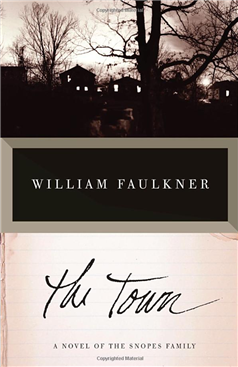
Day 403: The Town

Cover for The TownThe Town is the second of Faulkner’s “Snopes” novels about the rise to power of Flem Snopes in Jefferson, Mississippi. Written in a style that is remindful of a bunch of old Southern men sitting on the porch swapping stories, it is narrated by three different alternating voices. As a pioneer in novels with multiple narrators, Faulkner is a master.

One of the narrators is a character we met already in The Hamlet, V. K. Ratliff, the itinerant sewing machine salesman who is most knowledgeable about Snopes’ true character, having been deeply scorched by him. Ratliff enlists the Jefferson city attorney, Gavin Stevens, in his observations of Snopes. The third narrator is Charles Mallison, Stevens’ nephew, who tells us himself that he wasn’t even alive during the times of his first tales but was told the stories by his cousin Gowan.

The novel covers the events of nearly 20 years, from the arrival of the Snopes family in Jefferson to the events shortly following the death of Flem’s wife Eula. Although some of the events are tragic, the tone of The Town is more comic than that of The Hamlet, perhaps because the lives of the folks in Jefferson are not as grim as those of the poor sharecroppers in the first novel.

The novel focuses first on the young Gavin’s infatuation with Eula Snopes. Rumor has it that Snopes’ appointment as power-plant supervisor–highlighted by his attempted theft of all the plant’s brass fixtures accompanied by an effort to frame the plant’s two black firemen for the theft–is in return for him closing his eyes to his wife Eula’s affair with Manfred de Spain, the town’s mayor. Young Gavin, newly returned from university at the time, is incensed by this rumor and determined to protect Mrs. Snopes’ reputation. Later, as Eula’s daughter Linda grows up, Gavin tries to save her from “Snopesism” by helping educate her and trying to get her a place in an eastern university.

These two novels are fascinating because of Faulkner’s ability to make central a character who barely has a line of dialogue in either book. He effectively makes Snopes the major presence in the novels by having the other characters observe the results of his actions while endlessly speculating about what he actually does and why he does it. As always with Faulkner, the prose is beautiful.

Day 398: The Strange Fate of Kitty Easton

Cover for The Strange Fate of Kitty EastonIf you prefer a book to leap immediately into action, this is probably not the mystery for you. The second in a series, it starts slowly, with Speller taking the time to develop the setting and characters.

Laurence Bartram is a young man damaged by World War I, during which his wife and child died and he was injured. Laurence is an expert on church architecture, and he is happy to be summoned to the estate of Easton Deadall by his friend, William Bolitho. William wants him to look over  a small but unusual church, for which William is designing and installing a window.

Laurence is soon pulled into the affairs of the Eastons, a family that is haunted by the war, but moreso by the disappearance in 1911 of the young daughter of Digby Easton, the oldest of the three Easton brothers. Digby died during the war, but Kitty still obsesses her mother Lydia, an invalid who sometimes speaks of her as if she is alive.

The middle Easton son, Julian, has been doing his best with the estate, which Laurence finds beautiful but slightly crumbling, while Lydia’s sister Frances takes care of her. Laurence finds the subject of Kitty lurking behind every conversation and wonders if they will discover her body in the course of their renovations. Soon, the third Easton brother, Patrick, returns to Easton Deadall after an absence of years, first at Oxford and then on an archaeological dig in Greece. It becomes obvious that there is tension between him and Julian.

The family decides to make up a party to visit the Empire Exhibition. William, who was left wheelchair bound by the war, does not feel he can handle it, and Lydia is too ill, but the rest of the family goes. The expedition includes Eleanor, William’s wife, and Laurence. They also bring along David, the estate’s man of all work, and the teenage maid Maggie to help care for William and Eleanor’s young son Nicholas. At the exhibition, Maggie and Nicholas go missing, and although the others find Nicholas, Maggie is nowhere to be seen.

Distressed by Maggie’s disappearance, which can’t but echo the earlier one of Kitty, the family begins falling apart and secrets emerge, especially about the charismatic Digby and his relationships to his family and to his troops during the war. A few days after the disastrous outing, Laurence and David are clearing an area in the church to prepare for the installation of William’s window when they discover a trap door in the floor under the altar. When they open it, they find the body of a woman. The police are able to quickly ascertain that the body is of a woman too old to be Maggie, but then, who can it be? Could it even be Kitty, grown up and returned from wherever she has been?

Laurence does not exactly detect so much as look into a few things the others haven’t thought of, and he eventually unearths a tangle of secrets. Although the novel takes awhile to get going, I soon found myself unable to put it down. It slowly and skillfully builds to suspense. I found it well worth my patience.

Day 388: Wise Blood

Cover for Wise BloodFlannery O’Connor stated that she didn’t understand when her works were termed Southern Gothic or grotesque. She continued throughout her life to emphasize that the theme of her works is redemption. Nevertheless, Wise Blood is grotesque.

Hazel Motes has returned from the service after World War II to find his home town in Tennessee deserted and his house crumbling and decrepit, so he goes to live in the city, the fictional town of Taulkinham, Alabama. Having grown up in a fundamentalist environment, he has decided that Jesus was just a man and there is nothing from which to be redeemed. Soon, he is preaching outside movie theaters about the Church of Christ Without Christ.

Haze doesn’t see anything he’s looking at and doesn’t hear anything anyone says to him. He is totally wrapped up in his obsessions about religion. He becomes fascinated by Asa Hawks, an evangelist who supposedly blinded himself for Christ, and can’t see that this man is a con man who is not even blind.

He also meets Enoch Emery, a whining zookeeper who spends his days peeping out of the bushes at the women bathing in the park swimming pool. Enoch tells Haze that his family has “wise blood,” that is, his blood tells him where to go in life and what to do. Enoch’s blood is obsessed with a mummy in the museum, which he thinks would be a Jesus for Haze’s church, not seeming to fully understand the point of Haze’s church. But Enoch doesn’t see or listen either.

In fact, no one in this novel listens to what anyone else says, and all of the characters are incredibly ignorant and uncultured. They are all grotesque, repellent creatures. Although the novel is supposed to be comic, it only made me laugh despite myself, as the situation becomes more and more ridiculous. O’Connor’s humor is brutal.

Everything in this short novel seems significant, is to be paid attention to, even the characters’ names. Both of Hazel Motes’ first and last names refer to the eyes, and Haze can’t see. Enoch Emery is abrasive. Asa Hawks is the “blinded” con artist who can actually see, and his daughter Sabbath Lily is anything but a lily. Hoover Shoats and Onnie Jay Holy try to take over Haze’s church. And speaking of Shoats, keep an eye out for the pig imagery, and think about what pigs are a symbol for in the Bible.

This novel is deemed a work of “low comedy and high seriousness.” Just speaking for myself, the religious theme is not one I find interesting. Yet, when you read O’Connor, you can’t help but be drawn along to the end.

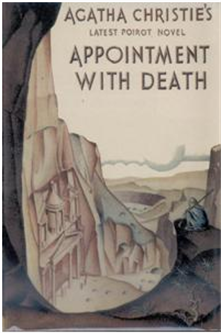
Day 387: Appointment with Death

Cover for Appointment with DeathHercule Poirot is in his hotel room in Jerusalem when he overhears two people discussing a murder. He finds that these two people, Raymond Boynton and his sister Carol, are discussing their stepmother, a sadistic, manipulative, demanding head of a wealthy family. The family is part of the expedition Poirot is taking to Petra.

All of the family are traumatized by their mother’s behavior. Raymond and Carol are eager to escape from their stepmother’s control. Their sister Ginevra is barely attached to reality. Lennox, the oldest son, rarely speaks, and his wife Nadine is threatening to leave him.

Poirot finds the rest of the party in the camp at Petra interesting. Sarah King is a studying psychiatrist who is romantically interested in Raymond, but Raymond does not have the courage to tell his mother. Dr. Gerard is a famous French psychiatrist. Lady Westholme is a well-known politician, and she is accompanied by her friend Miss Pierce.

When Mrs. Boynton dies, the cause is not clear. She was overweight and in poor health. Did she die of natural causes, or was she murdered? If she was murdered, there are plenty of suspects in their party, most of them in her own family. Colonel Carbury, an official assigned to the case who is known to Poirot, asks him to help.

This novel is not one of Christie’s best, even though she continues to deftly draw believable characters. It is marred by some silly psychobabble that was probably popular at the time. Perhaps Christie was trying to reflect then-modern topics of conversation, or perhaps she was writing dialogue that would be typical of the two psychiatrists. In addition, she pulls one of her tricks, making the solution depend upon information that is not possible for the reader to know.

Day 380: Lady Gregory’s Toothbrush

Cover for Lady Gregory's ToothbrushLady Gregory’s Toothbrush is more of a biographical essay than an extensive biography of Lady Gregory, one of the founders with William Butler Yeats of the famous Abbey Theatre in Dublin and a huge figure in the Irish cultural revival of the 1890’s and early 1900’s. The title of the book is based on a comment she made that reflected her own inconsistencies, that is, her firm roots in the Protestant aristocracy against her support for the culture of rural, Catholic Ireland. When Playboy of the Western World was being produced by the Abbey, there was a huge uproar by Catholic nationalists. Lady Gregory remarked that the dispute was between “those who use a toothbrush and those who don’t.”

Tóibín’s sketch effectively shows the contradictions in Gregory’s character. It would be easy to dismiss her as an elitist snob, but Tóibín makes very clear her contributions to Irish theatre and folk lore. She was one of the first people traveling to rural Ireland to collect Irish folk tales before they were forgotten. As well as writing her own plays as part of the movement to encourage and advance Irish culture, she collaborated with Yeats on his without credit, and some of her contemporaries believed she wrote the bulk of one or two.

An interesting detail from Lady Gregory’s life is how this redoubtable woman cossetted and gave in to Yeats. Tóibín recounts her son Robert’s indignation, for example, when he found that his mother had served Yeats “bottle by bottle” the entirety of his prized Tokay handed down to him by his father.

Copper Beech in Coole Park
The copper beech at Coole Park

Tóibín makes very clear the love she had for her husband’s estate, Coole, which she carefully preserved for her son while he was in his minority. There she entertained many of the great talents of Ireland, including Yeats, his brother Jack, J. M. Synge, George Bernard Shaw, and Sean O’Casey. The home no longer stands, Tóibín says it has been covered in concrete, but I myself have seen the great copper beech bearing their initials.

If I have any complaint of this short book, it is at my own ignorance (even though I have done some reading), for my lack of knowledge of the events of this time and particularly of the plays discussed makes it difficult to understand some of Tóibín’s remarks, particularly the furor around some of the plays. Having never read or seen Playboy of the Western World, for example, I don’t understand what was so upsetting (and indeed he implies that a modern audience may not).

Tóibín effectively and elegantly draws a brief but balanced portrait of this complex woman, showing us both her accomplishments and faults. Although I have read some of Yeats’ poems and some of Shaw’s plays, this short work makes me want to do more exploring around these figures in the Irish cultural nationalism movement and their works.

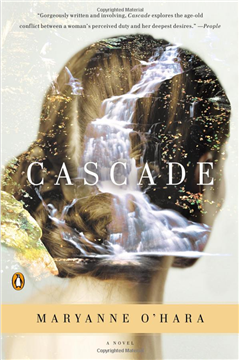
Day 378: Cascade

Cover for CascadeIt would be nice to know how much O’Hara expects us to like Desdemona Hart Spaulding, the heroine of Cascade. Unfortunately, I think we may be thrust too abruptly into Dez’s troubles to get to like her.

A promising artist who has studied in Boston and Paris, Dez has already been forced to leave that life when we meet her. The Great Depression cost her father his fortune, and he had to close down the famous theater he founded in the resort town of Cascade and sell his treasured First Folio of Shakespeare. Dez was forced to withdraw from art school and hastily married her childhood friend Asa Spaulding so that she and her father would have somewhere to live. Her father dies soon after, and she is taken aback to find he has left the theater to Asa.

Still, considering she married a man with little interest in or understanding of her drive to create art, Asa has set aside a bright room in their house for her studio, and she paints for several hours on most days. Asa wants a child, though, and Dez fears that her precious painting time would be taken up with child rearing. She is secretly doing what she can to prevent conception.

Two things soon make her dissatisfied with her life. Her art school friend Abby stops by on her way to a new life in New York, and suddenly everything in the depressed town looks shabby, even the beloved playhouse. Dez has also formed a friendship with a Jewish man named Jacob Solomon, who has taken over his father’s peddlar’s route. Jacob, though, is a gifted artist who plans to sell his father’s inventory and move to New York, hoping for a job with the Works Progress Administration. He meets Dez once a week to discuss art, but after a dispute, Asa asks her to stop meeting Jacob.

Asa is concerned because the town is under threat. Cascade is one of two possible towns that may be flooded to create a reservoir that will supply water to Boston. Asa wants to mobilize an effort to save Cascade, and Dez has the idea to paint a series of postcards showing Cascade in the past and present in an attempt to garner public support for the town. She is able to sell this idea to a prominent national magazine. All the while, however, she is secretly hoping the town will lose and she will have an excuse to move to a large city. The agreement she makes with the magazine and other disastrous decisions cause her to betray her husband, her town, and finally even Jacob.

I think O’Hara wants us to sympathize with Dez in her growing ambition to go to New York and take up a career in art. But some of her actions don’t just show poor judgment; they are despicable. As the plot advances, I feel less and less sympathy for her.

A review from the Boston Globe calls Dez complex and says she doesn’t always make the right choices. I think it’s worse than that; the trouble is really with where she places her priorities. The town is in danger of dying, in the horrible economy many people’s welfares are at risk, but Dez puts her future as an artist first and barely gives the other townspeople a thought, in fact, seems to feel superior to them. She supposedly yearns to reopen her father’s playhouse but doesn’t seem to give it much attention when it is threatened, although she eventually makes a deal that saves it. She has married for selfish reasons and is all too ready to give up on her marriage.

Of course, the principal theme of the novel is how much to give up for art, but in this case, it is not Dez who does the sacrificing. I wish I had liked this novel better. I think that if we’d had a longer time with Dez in her art student life and gotten to know her before she began a series of lies, deceptions, and betrayals, I could have felt more sympathy with her struggle.