Day 367: Between the Woods and the Water: On Foot to Constantinople: From the Middle Danube to the Iron Gates

Cover for Between the Woods and the WaterBest Book of the Week!

In December 1933, 19-year-old Patrick Leigh Fermor set out to walk from Amsterdam to Constantinople. He wrote about the first leg of this journey years later in A Time of Gifts, ending the book as he crossed a bridge from Czechoslovakia into Hungary. In 1986, he finished this memoir of the second leg of the journey, which begins on that same bridge in Esztergom the evening of Easter Sunday and ends in the early autumn of 1934.

In the second part of the journey, Leigh Fermor breaks his rule of making the entire trip by foot and also spends much of the time in more luxurious surroundings than he did in the first part. As he makes his way through Hungary and the Romanian border, as it was then, into Transylvania, he is passed by his growing list of acquaintances and friends from one kastély to another, spending days with a learned professor discussing languages and history, borrowing a marvelous horse from a count for part of the journey across the Hungarian plain, staying for weeks with a new friend named István in Romania, and dallying with a young married woman on a motor trip with István to Prague.

Leigh Fermor does not spend all his time in such exalted circles, though. He happily camps out with gypsies, spends the night outside a shepherd’s cottage, is hosted by a Jewish family after an afternoon spent discussing the Hebrew language, sleeps in a cave, and camps on an island in the Danube near a village inhabited by resettled Turks. On his way, he describes the scenery in lyrical terms, explains the ancient history of each area he passes through, and tells us about the people he meets and the sights he sees. His chronicle is supported by the notebooks he kept and a nearly photographic memory of a remarkable journey. In addition, he tells us that he revisited some of the areas 20 years later.

This memoir is beautifully written. Although relatively unacquainted with formal learning, having abandoned military school at that early age, Leigh Fermor has an astonishing range of interests, and he tells us all about them. He is constantly plunging into dusty tomes in his hosts’ libraries but is just as ready to dance and drink the night away. This is a delightful series of books, still full of the youthful joy and enthusiasm Leigh Fermor must have felt when he was 19 and 20 years old.

In the Appendix to this book, Leigh Fermor reflects on how many of the sights he writes about in this book are now under water, for the Danube valley that he traversed and the torrents and currents that once rushed along it as well as the Iron Gates themselves have been subsumed by a huge concrete dam and hydro-electric power plant. And of course there have been other causes of destruction since 1934.

Unfortunately, The Broken Road, the unfinished manuscript of the final portion of the journey, is being republished but is not available from Amazon until March of next year! (It may be available used from some other site.) I am so disappointed to find the book never gets us all the way to Turkey but stops in Greece.


Day 358: People of the Book

Cover for People of the BookBest Book of the Week!

I read People of the Book several years ago and remembered that it was good, but when re-reading it for my book club, I enjoyed it even more. The novel is based on the history of a Hebrew codex known as the Sarajevo Haggadah. Part of the novel is envisioned based on what is known of the book’s history, while the rest is invented.

In the immediate aftermath of the Bosnian war, Hanna Heath, an expert in the restoration of old books, is asked to restore the priceless Sarajevo Haggadah, a famous book believed twice to have been destroyed by war that was both times rescued by Moslem museum curators. The book is especially important because of its beautiful illustrations, as before it was discovered, scholars believed that old Hebrew books did not contain such illuminations.

While Hanna is working on the book, she makes observations and collects artifacts that will help trace its history. She notes that the book once had clasps that are now missing, collects an insect wing, and scrapes residue from staining.

Hanna also becomes involved with the man who rescued the book, Ozren Karaman, whose wife was killed during the war and whose baby son is in the hospital with a brain injury. As Hanna was raised by an aloof and competitive mother, though, she is poor at forming attachments.

When Hanna finishes restoring the book, she follows up with research into the clasp and the artifacts she collected. As she finds out about each item, the novel goes farther back in time, explaining what happened to the book and telling the stories of the people involved with it, until the creation of the book in 15th century Spain.

A poor Jewish girl named Lola works for the partisans in the forest outside Sarajevo during World War II after the Jews are expelled from the city by the Nazis and her family is shipped off to camps. Later she is helped to safety by the Moslem curator of the museum, who also has a book to hide. A 19th century Viennese bookbinder who is dying from syphilis steals the beautiful silver clasps from the book to exchange with his doctor for treatment. In 1609 Venice, a priest working for the Inquisition saves the book from burning but confiscates it from its owner. A young girl saves the book as the Jews are expelled from Spain in 1492.

These are just the bones of some of the absorbing stories that draw you along as Brooks imagines the history of the book. Each tale is vividly imagined and skillfully told, and they are all held together by Hanna’s experiences. People of the Book is a gracefully written and imaginative novel that emphasizes the contributions of multiple cultures and religions to the book’s creation and safety.

Day 351: The Fixer

Cover for The FixerBest Book of the Week!

In 1911 Russia, Yakov Bok is tired of his difficult life in the shtetl. So, after his wife leaves him for another man, Yakov travels to Kiev in hopes of making a better living. When he helps a drunken man who is passed out in the snow, Yakov is offered a job supervising a brick yard. However, in order to take this job, Yakov must live in a part of the city forbidden to Jews.

It is this circumstance followed by a series of mishaps that ends up with Yakov being accused of murdering a boy he chased away from the brick yard. As the case continues, it becomes clear that the murder is being used by authorities an an excuse to trump up charges of ritual murder against the Jewish community.

The novel becomes more and more difficult to read as literally everything that happens to Yakov makes things worse for him. The gentiles he knows in Kiev tell lies about him. Once he is in prison, the jailers do everything they can to incriminate him, including trying to entrap him into breaking the rules or admitting his guilt.

Yakov goes into jail a nonpolitical, irreligious, naive man who hopes for justice, and the novel is partially about his development into an angry man who refuses to be beaten. Although almost nothing in the way of plot or action happens from the time he goes to jail, I was absolutely compelled to finish reading.

Written in a storytelling fashion that I associate with the tales of Sholem Aleichem or Isaac Bashevis Singer, this novel is more grim than most of the stories I’ve read by these other writers. However, both The Fixer and The Bloody Hoax, by Aleichem, are based on a true event from 1911 Kiev, called the Beiliss blood libel case.

Day 349: The Silver Sword

Cover for The Silver SwordThe introduction of my edition of The Silver Sword says it is a beloved British children’s book that has not been out of print since it was published in 1956. When I began to read it, the names of the characters seemed vaguely familiar, and when I read that it was published in the US as Escape from Warsaw, I realized that I too had read it as a child.

Joseph Balicki is taken away from his family in Warsaw during the Nazi occupation of World War II for the crime of turning Hitler’s picture to the wall during a scripture lesson. He eventually manages to escape from prison and make his way back to Warsaw, only to find his house destroyed, his wife imprisoned, and his children missing.

Since the first days of the war, the family planned that if they ever got separated, they would meet in Switzerland at his wife’s parents’ house. Joseph decides to head for Switzerland, but first he befriends a street urchin named Jan. Joseph gives Jan a trifle belonging to his wife, a silver sword, and asks him if he ever meets his children to tell them to go to Switzerland.

The novel flashes back to when the Balicki’s mother was arrested. After the arrest, Ruth, Edek, and Bronia take to the streets and live through the war in cellars or in the woods outside the city. Edek is taken away to a German labor camp. Finally, at the end of the war, Ruth meets Jan and decides to make the trip to Switzerland. But first, she and Bronia, and Jan, for he comes too, must travel to Germany to find Edek.

The story goes quickly, narrated in a simple manner that does not focus much on emotion or characterization. Serrailler was cognizant of the sensibilities of children and also wanted, in the postwar years, to focus on reconciliation, so there are good people among all the nationalities the children encounter. He tries to show the horror and destruction of war without being too violent.

Perhaps Serailler was unaware that the Russians waited outside of Warsaw hoping that the Polish resistance would be completely wiped out by the Nazis. In any case, he did not express at all how much the Poles feared the arrival of the Russians. The story is probably not going to be very satisfying for an adult to read, from this standpoint and that of the style, but I remember being riveted by it as a child.

Day 346: Behold, Here’s Poison

Cover for Behold Here's PoisonAlthough Georgette Heyer’s Regency romances are some of the best historical fiction around, also entertaining are her few mystery  novels, set in the time period in which they were written (this one in 1936). The only problem with many of them is that the murderer is frequently the only unlikeable character (except the victim, usually) and therefore highly identifiable. However, Heyer’s novels are character driven, and her lifelike and amusing characters are what make them so enjoyable.

There are plenty of characters to dislike in Behold, Here’s Poison. Gregory Matthews is found dead at his country home. His family assumes the death is because of his bad heart, but the police find traces of nicotine poisoning.

Suddenly, all of the surviving Matthews are suspects, including the domineering Aunt Gertrude, hypocritical Zoë Matthews, and malicious nephew Randall. Inspector Hannasyde and Sergeant Hemingway find that one big stumbling block is their difficulty in figuring out how the poison was administered.

The dialog is especially witty in this novel and the characters lively. As always, Heyer is a brilliant writer.

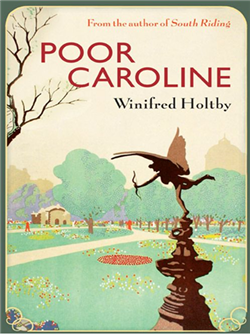
Day 343: Poor Caroline

Cover for Poor CarolinePoor Caroline begins with the death of Caroline Denton-Smyth, a do-good spinster who has dreamed of forming the Christian Cinema Company, which will clean up the film industry. This satire of charitable organizations is a little different from the other Winifred Holtby novels I have read, which are about small town Yorkshire.

Caroline, an elderly eccentric, although virtually penniless, forms the film company and manages to put together a board of directors of dubious character. Basil St. Denis is an elegant dilettante who is hoping to use the charity to make some money. Clifton Johnson is a seedy American scammer. Joseph Isenbaum is a wealthy social climber (and not a Christian) who wants St. Denis to sponsor his son at Eton. Charles Guerdon is a Quaker nonentity, Father Mortimer is carrying scars from World War I, and Hugh Macafee is a film inventor who is obsessed with his work. The makeup of the board alone is an object for satire.

Caroline is in some ways admirable, with a buoyant, energetic personality, who devotes herself to one cause or another, only to have it fail or have the rest of the workers desert her. However, she is totally self-absorbed as she pursues her goals.

There are only two completely sympathetic characters in the novel. Caroline’s young cousin, Eleanor de la Roux, wants to learn to be successful in business and break ground for other women. Roger Mortimer, a young Anglican priest, wants to live a life of poverty and service and falls in love with Eleanor.

I am not sure whether I like this novel or what I think about Caroline herself. She is completely blind about her charities, and from the point of view of her relatives has cadged from them shamelessly for years. Certainly she is a believable type, reminiscent of Mrs. Jellyby in Dickens’ Bleak House, who spends all her time on charities for Africa while her children are uncared for and her house falls to pieces.

Day 340: Death on the Nile

Cover for Death on the NileIn this classic Agatha Christie mystery, Hercule Poirot observes a young couple at a restaurant in London and thinks their behavior indicates that the woman loves the man too much. A few months later he meets them again in Egypt, but the man, Simon Doyle, has married the woman’s rich friend Linnet. The first woman, Jacqueline de Bellefort, is haunting their every move during their honeymoon. Poirot thinks no good can come of it and tries to tell Jackie to leave the Doyles alone.

The Doyles sign on for the same Nile river cruise as Poirot. To their fury, Jackie appears on board. Also on board is Poirot’s friend Colonel Race. Race is hunting a criminal who has murdered several people. He believes the person is on board, but has not been able to identify him.

On a tour of some ancient ruins, a boulder falls, nearly missing Linnet and Simon. The obvious suspect is Jackie, but she was on the boat the entire time.

That evening, the drunken Jackie makes a scene in the lounge and then shoots Simon in the leg. The next morning Linnet is dead from a gunshot wound, but both Simon and Jackie seem to have solid alibis. The nurse was with Jackie all night, and Simon was incapacitated with his injury. Poirot and Colonel Race begin looking into other enemies that Linnet may have had.

I think Agatha Christie is the best of the “Golden Era” mystery writers at characterization. She quickly sketches convincing and sympathetic characters. Sometimes you even sympathize with the murderer. Her books are also often set in exotic locations and give you a flavor of a certain place and time. I always find Christie’s mysteries to be enjoyable, and they make fun beach reading.

Day 335: A Time of Gifts: On Foot to Constantinople: From the Hook of Holland to the Middle Danube

Cover for A Time of GiftsIn December 1933, nineteen-year-old Patrick Leigh Fermor set out alone on a great adventure, a walking trip from Amsterdam to Istanbul, or as Fermor still called it, Constantinople. (It was renamed in 1930.) He had no idea when he left that he would not return until 1937. In 1977, he collected his notebooks from the trip and wrote A Time of Gifts and its sequel Between the Woods and the Water.

Although Leigh Fermor had one notebook stolen from him with all the rest of his gear, he otherwise must have kept careful account and his memories of the trip must still have been vivid, for the result is an entrancing account of scenery and architecture, tales of chance encounters, glimpses of foreign customs and celebrations, and so on. Jan Morris, who wrote the introduction, calls him “one of the great prose stylists of our time,” and Wikipedia, quoting an unnamed British journalist, “a cross between Indiana Jones, James Bond and Graham Greene,” presumably for his work with the Cretan resistance in World War II as well as his writing. (He was also a friend of Ian Fleming.)

From his drinking bouts with Dutch barge men to his extended stays in various German, Austrian, and Czech castles, Leigh Fermor plunges enthusiastically into every experience on offer. At one moment he is sleeping in a barn, in the next hanging out with fashionable youth in Vienna. Along the banks of the Danube he is mistaken for a 50-year-old smuggler. All of these adventures as well as his observations of nature are described in beautiful, evocative prose. To add interest to the modern reader, he is describing a Europe that no longer exists.

If I have any complaint, it is one of my own education, for Leigh Fermor’s writing assumes for his audience a familiarity with classical culture that is no longer common. The book often alludes to mythology and refers to obscure historical events that I do not fully understand. Finally, in the footnotes, which are Leigh Fermor’s original ones, all utterances in modern languages (some of which I could have taken a stab at) are translated, but the quotations in Latin are not. They are not integral to comprehension, but it is a little frustrating to be unable to understand them. (Of course, I could have googled them, but I was almost always reading this on the bus.) That being said, I look forward to reading the sequel.

Day 333: Pigeon Pie

Cover for Pigeon PieThis exceedingly silly book about Britain just before World War II has its amusing moments. Although it is not one of Mitford’s best, it still made me laugh out loud at times. The novel spoofs British high society, spy stories, and religious cults.

The heroine is Lady Sophia Garfield, a stupid, frivolous society matron who lives happily, mutually ignoring her husband, who admires Hitler. As events move toward war, she begins to suspect she has a nest of German spies in her home. Although no one believes her, she eventually manages to foil them.

One of the funniest moments for me has to do with Lady Sophia’s chief social rival, whom she distinctly remembers as the ordinary school girl Baby Bagg but who goes around pretending to be a Russian princess, Olga Golgothsky. Inclined to the theatrical, Olga frequently makes remarks about what would happen to her if she went to Russia–she says she would be handed over to the peasants to do what they please. Our heroine reflects on what Russian peasants must be like, thinking that if she were handed over to British peasants to do what they please, they would put her in the best bedroom and give her a cup of tea.

Day 327: The Five Red Herrings

Cover for Five Red HerringsAlthough I am normally a fan of Dorothy L. Sayers’ Lord Peter Wimsey series, The Five Red Herrings is exactly the novel I’m talking about when I say that I don’t care for the Golden Age mysteries full of railway timetables. This type of novel boils down to a puzzle designed to confuse the reader with a lot of detail. I do like Lord Peter, but I like him better when I have to keep track of fewer things.

Lord Peter is visiting an artists’ colony in Scotland when a painter is found dead. He is Sandy Campbell, a talented artist but one who also has a talent for getting drunk and picking fights. He is found in a stream with his half-finished painting on the bank high above, and the reasonable explanation is that he accidentally fell to his death. However, Lord Peter immediately notices inconsistencies that make it impossible for Campbell to have painted the picture.

Whoever the murderer is, he or she must also have been a talented painter, for the picture is exactly in Campbell’s style. Six other artists in the area who had quarrels with Campbell have enough ability to be the killer. Some of them have convincing alibis, and the solution revolves around–yes–railway timetables.

As usual, Lord Peter is entertaining. His man Bunter is not as much in evidence as in other novels, which is a little disappointing, but Sayers capably depicts a group of colorful suspects.