Day 326: Life After Life

Cover for Life After LifeBest Book of the Week! Year!

From the descriptions of this book, I wasn’t sure I would like it even though I usually enjoy Kate Atkinson, a very playful writer. But what a great book–completely engrossing, oddly funny, and immensely satisfying.

Ursula Todd is born on a snowy night in 1910, but the umbilical cord is wrapped around her throat, so she dies. On the same night, Ursula is born again, but this time she lives. As she gets older, she faces various hazards, some of which she does not survive. Each time she is born again, on the same snowy night.

Through vignettes during the course of Ursula’s life, Atkinson skillfully and compellingly weaves the story of how small decisions in life can affect larger issues. We know a very large issue is coming up from the beginning, because in the first scene of the novel, Ursula assassinates Adolf Hitler and is killed in turn by his men.

Life After Life is a stunningly inventive novel about choice, fate, free will, and the nature of time, which Ursula explains to her psychiatrist (who believes in reincarnation) is not a circle but a palimpsest–a manuscript that has been overwritten but on which you can still see some of the writing.

I found this novel amazing, having never read anything quite like it. It is fascinating, funny, touching, and thought-provoking. I personally am going to miss Jackson Brodie, but Atkinson has launched herself far beyond him.

Day 319: Murder on the Orient Express

Cover for Murder on the Orient ExpressMurder on the Orient Express is Agatha Christie’s classic mystery featuring Hercule Poirot. Everyone has of course seen the lush 1974 movie featuring a flock of movie stars and Albert Finney as Poirot.

Hercule Poirot is visiting Istanbul when he unexpectedly receives a telegram prompting him to cancel his plans and book a seat on the Orient Express leaving that night. He is able to book a compartment in first class, but only after some difficulty.

Poirot’s fellow passengers include a Russian princess, a Hungarian count and countess, a Swedish missionary, a British colonel, an annoying American widow, and other unusual characters. As always with Christie, her characters are expertly and colorfully drawn.

On board the train, Poirot is approached by the repellent Mr. Ratchett, an American businessman who believes his life is being threatened, asking for protection. Poirot dislikes Ratchett and declines his offer.

After a disturbed night, during which Poirot is awakened by a cry and spies a woman in a lurid silk kimono walking down the hall, Ratchett’s body is found dead in his compartment. He has been stabbed 12 times. The railroad executive traveling on the train begs Poirot to attempt to solve the crime before the train reaches Yugoslavia.

It begins to look as if an intruder disguised in a railway uniform broke into Ratchett’s compartment and murdered him then escaped out into the snow. Poirot’s investigation turns up a suggestion that Ratchett was the leader of a gang who kidnapped and killed the child Daisy Armstrong (a crime based upon that of the Lindbergh kidnapping), resulting in much tragedy for the family. He also begins finding links between some of the passengers and the Armstrongs.

This particular mystery is famous not only for its exotic locales but also for the unusual solution to the murder. Despite my familiarity with the plot, it made enjoyable reading.

Day 308: Love in a Cold Climate

Cover for Love in a Cold ClimateLove in a Cold Climate is more of a companion novel to Nancy Mitford’s The Pursuit of Love than a sequel, because it focuses on a different group of characters. Fanny is still the narrator, and she returns to tell a little more of her own story but mostly that of her beautiful friend and distant relation Polly Hampton.

When Fanny receives an invitation to stay with the family upon their return from India, she is happy to renew her friendship with Polly. Polly’s demanding mother, Lady Montdore, has been pushing her toward marriage, but Polly resists. Polly has always been difficult to read, unlike Fanny’s Radlett cousins from The Pursuit of Love, who “told everything.” Although Polly is so beautiful that she could have her pick of the eligible bachelors, she tells Fanny that she finds the whole life of the social season boring.

Lady Montdore is a rapacious, snobbish manipulator with social ambitions, although not without charm. Another family member who is important to the novel is also a snob, “Boy” Dougdale, the husband of Polly’s aunt, Lady Patricia. Fanny and her cousins have always called Boy “the Lecherous Lecturer” because of his tendency to furtively grope very young girls. Much to everyone’s surprise, Polly’s secret comes out when, shortly after Lady Patricia’s death, she marries a reluctant Boy, for she has been in love with him for years.

Polly is ostracized from her family and cut out of her father’s will as a result. But the plot thickens upon the arrival of Lord Montdore’s heir, the effeminate and hilarious Cedric Hampton.

As usual with Mitford, we have a strong suspicion that all her ghastly and funny characters strongly resemble real-life society members of her time. Her novels are full of vivid characterizations and incisive dialogue. Even in today’s world, so removed from her own, her novels are extremely funny.

As a side comment about the cover art, I find the covers of the most recent editions of Mitford’s novels to be too romantic and to do nothing to convey the spirit of her novels. I was able to find a better cover for The Pursuit of Love, but this was all I could find for Love in a Cold Climate.

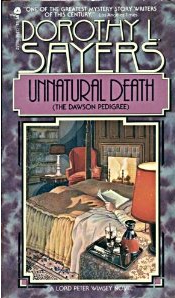
Day 307: Unnatural Death

Cover for Unnatural DeathAfter a long battle with cancer, Miss Agatha Dawson dies, leaving her considerable fortune to her great niece, Miss Whittaker. Nothing may be suspicious about this, but a local doctor is uneasy. He did not attend her at her death, but he treated her earlier and distrusts Miss Whittaker. When he cautiously voices his doubts, he is drummed out of the community for blackening Miss Whittaker’s name. So, he turns to Lord Peter Wimsey for assistance.

Miss Dawson’s nurse insists that the old lady was delirious the last month of her life and couldn’t possibly have written a will. The witness to Miss Dawson’s will claims that Miss Dawson did not want to be involved in the signing of the document. This does seem suspicious. Lord Peter is vaguely interested, but when he starts looking into the case, odd things happen. The first is that the maid dies.

Lord Peter and his friend Inspector Parker pursue the case, Lord Peter with his usual humor and urbanity. Lord Peter is an interesting character. A World War I veteran who is still haunted by the events of the war, he hides his nerves with bouts of silliness. He is a collector of rare books and a pianist who also flies his own plane and barrels around the countryside in his motorcar.

By and large, I enjoy Sayers’ Lord Peter Wimsey novels, although on occasion they get bogged down in a myriad of details, for, as a Golden Age mystery writer, Sayers prefers to present her readers with puzzles rather than motives. However, the complexity in Unnatural Death is created with the plethora of suspects who managed to traipse through the dying woman’s bedroom, all with their own stories–an approach that is more to my taste than complicated railway timetables.

Day 300: The Land of Green Ginger

Cover for The Land of Green GingerJoanna Burton is a naive girl with a huge sense of adventure who has always wanted to travel the world in this most touching of Winifred Holtby’s books. Born in Africa but brought to England as a small child, Joanna has never felt like she quite fit in and has always wanted to return to the “land of green ginger.” During World War I she meets a young officer, Teddy Leigh, who tells her he is going to give her the world as a golden ball, and she believes him.

Several years later, however, she is living on a Yorkshire farm with two little girls and an ailing husband. Not only was Teddy gassed during the war, but he hid from her his history of tuberculosis.

As Joanna struggles to deal ineptly with the farm, her husband, and her children, a nearby landowner asks if they could take a Hungarian man in as a roomer. Joanna is so preoccupied with her troubles that she doesn’t notice her husband’s irrational jealousy or the rumors starting up in the village about her relationship with the Hungarian.

This novel is beautifully written and painful to read at times, as the readers see Joanna unconsciously make misstep after misstep and the neighborhood gossips become vicious indeed. Holtby only wrote a few books before she died at the age of 37, but she was a master at depicting life in the Yorkshire countryside and small towns.

Day 294: Death on the Nevskii Prospekt

Cover for Death on the Nevskii ProspektGiven my interest in Russia and the time period, this novel should have been a slam-dunk for me, but I was disappointed. Lord Francis Powerscourt is asked to investigate the death of a British diplomat in Russia, who was discovered with his throat cut on a bridge across the Nevskii Prospekt. No one in the British government knows why the victim was in Russia, and the Russians, having reported his death, pretend that they know nothing about it.

Powerscourt’s investigations seem to be pointing to the victim having had a secret meeting with the Tsar. In addition, Powerscourt may be running up against the Russian secret police, the Okhrana.

The book begins with a completely unnecessary chapter or two devoted to efforts to try to persuade Lord Powerscourt’s wife to release him from his promise not to take any more investigations. In addition, the real circumstances of the death seem completely unlikely. Characterization was minimal, and the plot had several unlikely points.

Dickinson’s historical research is commented on in the blurbs, but there was little in the novel that anyone doing the most cursory reading about Tsarist Russia’s last days wouldn’t know.

Day 290: The House of Velvet and Glass

Cover for The House of Velvet and GlassThe House of Velvet and Glass is a slow starter, which I don’t usually complain about, because if I’m enjoying a book enough, it can move as slowly as it wants. Nevertheless, considering how much I enjoyed Howe’s first book, I was surprised at how impatient I became with this one.

The novel begins with Helen and Eulah Allston, two entirely trivial women, mother and daughter, journeying back from a European husband-hunting expedition–on the Titanic. Although we’re told which ship they are on only at the very end of the first chapter, as if it were an ironic or surprising fact, the ship’s identity was very clear from early in the chapter.

Three years later, Sybil Allston is comforting her grief and anger at the death of her mother and sister on the Titanic by visiting a psychic. She is wholly convinced that she is receiving messages from the afterlife. On one of her visits, the psychic gives her a piece of crystal called a scrying stone.

Sybil’s father Lan Allston is a wealthy man who made his money through shipping, but he seems to spend all his time in his dark back parlor. Her brother Lanny looks as if he may be entering the life of a ne’er-do-well gambler and womanizer.

Not everything is as it seems, but I became extremely impatient waiting for the novel to go somewhere while we occasionally skipped backward in time to Lan as a young man in Shanghai or to Helen and Eulah on the Titanic.

Eventually, the novel becomes about a woman discovering her own powers, and the second half of the novel is much better than the first. But I did rebel against one thing. I particularly dislike it when characters in historical novels behave like modern people. I felt it would be extremely unlikely that Sybil would urge her father to bring home a woman they both think is a prostitute (and by their lights, is one) just because she has her brother’s blood on her dress. And I certainly don’t believe that her father would encourage Sybil to get to know her, although there turns out to be a reason for that. Completely unbelievable is the scene where Sybil takes her to her club or the scene where she goes, however, unwittingly, with her to an opium den.

So, a very mixed reaction to this novel. Ultimately, it became interesting, although the much-vaunted twists at the end were largely foreseeable.

Day 289: Birds of a Feather

Cover for Birds of a FeatherMaisie Dobbs is a “psychologist and investigator” solving cases in post World War I London. Birds of a Feather is the second book in the series by Jacqueline Winspear. Maisie’s background is unique, in that she is a former serving girl who was taken up by a mentor, educated, and trained in some unusual techniques to use in her investigations.

Maisie accepts the case of a wealthy owner of grocery stores, Joseph Waite, to find his daughter Charlotte, who is in her 30’s, and return her home. As Maisie investigates the case by locating Charlotte’s friends, they begin dying. At each crime scene, a white feather is left. White feathers were traditionally given to young men during World War I to shame them into enlisting, as they are a symbol of cowardice.

I read the first book in this series, Maisie Dobbs, and was not enthralled with it, so I only read this novel because it was chosen for my book club. I finally decided that I like the book a little, but it certainly has its flaws. Winspear is not very good at delineating Maisie’s character, I feel. Maisie also speaks surprisingly modern American English for a British woman in the 1930’s.

The biggest problem I have with Maisie, though, is that the unusual skills she has picked up to use in her investigations are far too New Agey to be convincing for a character in the 1930’s. It does not help my enjoyment of the novel, I fear, that I find many New Age ideas irritating.

In addition, it makes no sense to me at all that no one seems surprised to find the detective is a young woman. Even in P. D. James’ classic An Unsuitable Job for a Woman, written in 1972, characters express surprise to find a woman in that role. All-in-all, this makes too many anachronisms in the series to suit me.

Finally, I know this is a silly quibble, but I feel that Winspear spends too much time describing Maisie’s clothes.

Day 285: Full Dark House

Cover for Full Dark HouseThe back cover of this mystery calls it “mapcap” and “great fun.” I found it mildly amusing in a silly way.

John May arrives at work in the present time to find the place has been blown up, apparently with his partner Arthur Bryant inside. He investigates this incident while he thinks back to their first case together.

John joined Arthur during the Blitz in World War II working in the Peculiar Crimes Unit. Their case was that of a dancer at a theatre in Covent Garden who is drugged and then dragged into the elevator with her feet sticking out, so that when the elevator moves, her feet are cut off.

There are many gothic touches in this novel, which is not surprising because the author is apparently a writer of horror fiction. However, after references to phantoms, vampires, spiritualism, and so on, the murderer turns out to be human after all. I came away feeling that this book promises more, in the way of humor and the unusual, than it actually delivers.

Day 283: My Alsace

Cover for My AlsaceDuring a visit to Alsace several years ago, I was fascinated by this book, especially by the pictures, but I could only find it in French. Then, awhile back, I found it on Amazon in English.

My Alsace was written by Hansi (Jean-Jacques Waltz), a beloved Alsatian poster and children’s book artist who grew up in the late 19th century under German occupation. In the 19th and early 20th centuries, the region of Alsace, which identifies itself as French, changed hands between Germany and France four times. In the German school at Colmar as a boy, Hansi only learned about the great Prussian victories and the defeat of Alsace in his history classes. He deemed this period the worst in his life and wanted Alsatian children to know that Alsace has a prouder history.

My Alsace is a selection from the history he wrote in 1912 and some writings from after World War I. The latter section of the book goes on to tell about the trouble he got into with the German authorities during World War I because of his jokes about Germans in the earlier book. He was originally fined and later he was given a year’s prison sentence for insulting a German officer. He published the latter part of the book in 1919 to celebrate the region’s liberation from the Germans.

Hansi’s drawings are wonderful. He was well known for his pictures of Alsatian villages, people in traditional costumes, and celebrations of Alsatian life from an earlier time. The text is amusing, although it is full of anti-German satire. Written for children about eight years old, it is also entertaining for adults.