Day 282: Speaking From Among the Bones

Cover for Speaking From Among the BonesEleven-year-old chemist and detective Flavia de Luce is back with her latest adventure in Speaking From Among the Bones. An expert in poisons and an accomplished snoop, Flavia has already solved four crimes before the ripe old age of twelve.

Having accompanied her sister Ophelia (Feely) to her organ practice one night, Flavia hears a flapping in the organ pipes that she thinks is a trapped bat. Feely is practicing for the Easter Sunday service, as Mr. Collicutt, the organist, has vanished.

The next morning when Flavia goes back to the church to get the bat out of the pipes (so that she can look at its blood under her microscope), she gets distracted into eavesdropping on a confrontation between the vicar and the bishop’s secretary over the unearthing and reburial of the bones of St. Tancred from his crypt in the church. The vicar has previously received permission to do this and now the bishop is trying to rescind it through a magistrate.

The vicar insists on going ahead, and the men open the sealed crypt enough so that Flavia can look into it. Inside the crypt is the body of Mr. Collicutt, with his head in an old gas mask.

Flavia’s investigations take her as usual all over the village and turn up all sorts of secrets, including a man hidden away in an old house, a secret passageway into St. Tancred’s crypt, and the whereabouts of a diamond that was buried with his body in the saint’s crozier. At the same time she worries about family problems, such as her sister’s impending marriage and the sale of the crumbling family mansion, Buckshaw, for back taxes.

As usual, Flavia herself is the most charming part of the series, as she plunges recklessly into and out of difficult situations, contemplates the structure of blood and the properties of ether, irritates her older sisters, and rides all over the village on her trusty bike Gladys. The novel is funny, the mystery absurd, the writing splendid, and Flavia always entertaining.

Day 281: Gilead

Cover for GileadBest Book of the Week!
Gilead is the novel that precedes Marilynne Robinson’s Home, although it is set in the same time frame and covers some of the same territory. This novel won the Pulitzer Prize for fiction.

John Ames is an elderly Congregationalist minister in 1956 who believes he is dying. He has a much younger wife and young son, a surprising blessing in his old age. The novel is in the form of a diary addressed to his son in the expectation that he will not live long enough to personally pass on his family history and advice.

Ames lives in Gilead, a small Iowa town on the prairie near the border with Kansas. The town was founded by abolitionists during the Free State wars in Kansas as a refuge for slaves and fighters the likes of John Brown. Ames’ grandfather, also a minister of the warrior-for-God ilk, had visions of God and once preached a sermon in a bloody shirt with a gun in his belt. With that upbringing, his son was naturally a pacifist, who left the church for awhile after that sermon to worship with the Quakers. One of Ames’ most powerful memories is of the journey he made with his father to Kansas, in terrible conditions, to retrieve the body of his grandfather, who had returned there.

Although Gilead is certainly about the history of the town–the wars, the Depression, the Dust Bowl years–it is more about the relationship between fathers and sons, both from the secular and religious points of view. Not only does it explore the relationships within Ames’ own family, but it also looks at that between Ames and the son of his best friend the Presbyterian minister–Ames’ surrogate son–John Ames Boughton.

The story of John Ames Boughton is the one more thoroughly explored in the sequel Home, although interestingly enough, Gilead tells Boughton’s story more explicitly, while Home, narrated by Boughton’s sister Glory, only hints at some of the facts.

The novel, a celebration of life and faith, is beautifully written and full of ideas to ponder. That being said, as I do not particularly have a religious background or bent, I did not fully understand some of the narrator’s ideas and preoccupations. I found Home, although told from the point of view of the same goodness and piety, a more accessible novel than Gilead.

Day 275: A Dead Man in Athens

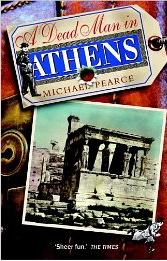
Cover for A Dead Man in AthensThe “Dead Man” series sounds interesting because of the exotic locales (Athens, Istanbul, Trieste, Tangier, Malta) and the time it is set (pre-World War I), but it proves a bit light for me. I like mysteries that are funny or have an edge, but my idea of humor doesn’t match that of many writers. This book was called “effortlessly funny,” but its humor escaped me. A Dead Man in Athens is the third in the series, and I still don’t know why the books are always named “dead man” here or there, except as possibly a suggestion of Anthony Burgess’s novel A Dead Man in Deptford. Otherwise, believe me, there is no comparison.

Sandor Seymour, a multi-lingual Scotland Yard detective, is sent out to Athens by the Foreign Office because someone has poisoned the cat of the Ottoman sultan living in exile there. The Foreign Office fears someone may be practicing for an attempt on the sultan.

Seymour soon believes that the poisoning may be simply domestic in nature, but the Foreign Office is sure it has something to do with war brewing in the Balkans. Then someone poisons the British engineer hired by the Greeks to take care of Blériot machines, early airplanes that the engineer feels could be useful to the Greeks for reconnaissance during the war.

The novel has many characters, but few are more than narrowly drawn. The mystery is not very complicated, and the absurdity of investigating the death of a cat doesn’t really carry the novel, as far as humor goes.

Day 259: The Greatcoat

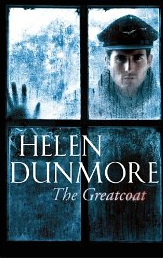
Cover for The GreatcoatI am not familiar with Helen Dunmore, but I looked for this book after reading a review of it on another blog citing it as a good ghost story.

At first I was inclined to dislike it. Isabel Carey is a new wife in 1952, married to a young doctor in a small village in Yorkshire. Isabel is a poorly trained housewife who spends her time disliking her new home in the bottom floor of the landlady’s house and feeling as if everyone is looking at her. She especially dislikes the landlady, Mrs. Atkinson, who paces back and forth on the floor above, sometimes all night.

Unable to get warm in the dank little house, one night she searches through a cupboard and finds an officer’s wool greatcoat, which she uses as an additional bedcover. The next night a strange man dressed as a World War II officer comes and taps on her window.

Soon the officer, Alec, begins coming to visit her and by his behavior shows that he thinks they are lovers. She knows almost immediately that he is a ghost but seems to passively accept their relationship. Who the soldier’s actual lover was should be almost immediately apparent, but Isabel doesn’t seem to guess.

At this point, I was extremely annoyed with the novel, believing I was supposed to find all this romantic when all I could think about was Philip, Isabel’s poor, hard-working husband, who only treats her kindly. The only negative thing about his character is his desire to protect Isabel from everything, and I believe that attitude was typical of the times. I also thought Isabel is a spoiled little brat who does little but complain and thinks nothing of launching into an affair with another man, ghost or not.

Eventually, though, the novel takes a more sinister turn, which is more to my taste. My final overall impression was ambivalence.

By the way, the Amazon write-up of this book (probably taken from the publishers) compares Dunmore as a historical novelist to Tolstoy and Emily Brontë. Aside from the oddness of an implicit comparison between those two writers, this is a gross overstatement of Dunmore’s abilities. What Dunmore has written is a slight, moderately entertaining novel that cannot be compared to the work of the other writers.

Day 258: Busman’s Honeymoon

Cover for Busman's HoneymoonI have always thought that, with a few exceptions, the arrival of Harriet Vane into the Lord Peter Wimsey series pretty much ruined it. Some of those mysteries are not so bad, and Have His Carcase (wherein Lord Peter meets Harriet) and Gaudy Night (wherein Harriet solves a mystery on her own) are very good, but Busman’s Honeymoon is just too sappy. It is hard to know if Peter and Harriet’s marriage is Sayers’ idea of an ideal relationship or a reflection of some relationship she actually had, but I find that Lord Peter’s galumphing happiness contrasts strangely with Harriet’s odd undertones.

Lord Peter and Harriet are married and travel for their honeymoon to a house they bought in the country. But when they arrive, they find the house is not ready for them and the previous owner, Mr. Noakes, is nowhere to be found–until next morning when Bunter finds him dead in the basement. In the meantime, the servants have been cleaning, and all the clues are gone.

One positive point for the novel is that the Dowager Duchess shows up, a favorite character. We also get a little more background on the relationship between Wimsey and Bunter.

I guess this isn’t the best selection for Valentine’s Day, since I’m criticizing it for sappiness, but if you have different tastes than mine, you might like it. I see that the reviewers on Amazon are remarking at how romantic it is. And also commenting on the subtle humor. Well, I didn’t find it so subtle.

Day 255: Anderby Wold

Cover for Anderby WoldMary Robson is a young married woman who has been working for years to save her family farm, Anderby Wold. She even married John, her much older husband, whose hard work has kept it going these past years. She is a managing woman who thinks it is her duty to oversee the welfare of the village, making herself disliked by many. Because of her preoccupations, she seems much older than she actually is.

One day she encounters David Rossiter, a young radical journalist who disagrees with everything Mary believes in. David is trying to get farm workers interested in unionizing, and Mary becomes unsuitably obsessed with the younger man. The schoolmaster, Coast, becomes involved in the unionization issue expressly to make trouble for Mary, whom he detests.

Anderby Wold is an interesting slice of Yorkshire life in the 1920’s. It reflects the issues of the times, when farmers were facing increased demand for workers’ rights. Another of Winifred Holtby’s consistent themes that appears here is getting on with life after the death of a loved one. This novel is Holtby’s first, and its realistic depictions of village life of the times reflect her background as a journalist.

Day 245: Unbroken: A World War II Story of Survival, Resilience, and Redemption

Cover for UnbrokenUnbroken is the incredible story of Louis Zamperini, an Olympic runner whose plane went down in the Pacific during World War II. He and his pilot Phil (Russell Allen Phillips) survived many days on a small raft only to be captured by the Japanese and interred in a series of brutal POW camps.

The book begins with Zamperini’s childhood in California as an almost feral creature who was always in trouble for stealing and other mischief. His unconquerable spirit served him well through his travails in adulthood but caused problems for his parents and himself when he was a child. His unruly years were ended, or at least subdued, by his brother Pete’s interest in training him as a runner, as he had always been the kid who ran away from his pranks the fastest. Once Louie began to take the sport seriously, he became a very fast runner and began winning medals. Although he only finished 8th at the 1936 Olympics, he ran his last lap in 56 seconds, and his dream was to return to the Olympics and medal.

After Pearl Harbor Louie became a bombadier and made many flights in dangerous and ill-equipped planes until his B-24, known as a lemon, went down during a search for another missing plane. I was particularly surprised at how unsafe the planes were and how ill-equipped the men were when their plane went down. Their raft contained only some chocolate and a few flares, and its repair kit pieces were ruined because they weren’t kept in a waterproof envelope. The three men who survived the crash had no equipment to make drinking water from sea water and were reduced to attempting to catch rain water. They had no food except the chocolate (which one of the men ate the first night). Braving strafing by a Japanese plane, shark attacks, dehydration, starvation, and a typhoon, Louie and Phil survived more than 40 days at sea. The other man died.

Their raft landed on an atoll in the Marshall Islands, where they were immediately captured by the Japanese. At first treated kindly, once they were transferred to POW camps, they encountered unbelievable brutality. Aside from being routinely starved–while Red Cross shipments intended for them were stolen by the Japanese–they were forced into hard labor and regularly beaten. Louie in particular because of his ungovernable nature became the scapegoat of an insane, brutal guard named Mutsuhiro Watanabe.

About half of this book is devoted to the men’s experiences in the camps, with the focus on Louie after he and Phil were separated. Eventually, though, the men were saved with the end of the war. The rest of the book related Louie’s trials with PTSD and alcoholism and how he overcame those problems to live a productive life. The book ends with his accomplishments even in an active old age, including carrying the torch at the 1988 Olympics in Nagano on his 81st birthday.

Overall, this is an interesting book, but I found the descriptions of the brutality at the camps overwhelming. Although I am not squeamish by any means, I kept reading a few sentences only to have to put the book down. I read it for a book club, and the other members reported having the same difficulty, even skipping over complete sections. The writing was excellent–Laura Hillenbrand’s Seabiscuit is a favorite–and the story compelling, but the details difficult to absorb.

Day 243: The Pursuit of Love

Cover for The Pursuit of LoveIt’s always fun to re-read Nancy Mitford’s charming and funny autobiographical novel about her youth and young womanhood. Mitford’s alter ego is Linda, a young woman with terrible taste in men, who throws herself from one extreme to another in pursuit of love.

Mitford’s strength is her portrayal of peculiar but lovable characters, all modeled upon her own eccentric family or on figures in society. The novel is narrated by Fanny, a sensible but lonely girl who spends a lot of time with her cousins, the Radletts. Her terrifying Uncle Matthew (modeled on Mitford’s father) loves to hunt his children instead of foxes, a game the children love. Aunt Sadie is unutterably vague, which she probably has to be to live with Uncle Matthew. Uncle David is a cultured hypochondriac. The Bolter, Fanny’s mother, is supposedly a portrayal of Lady Idina Sackville, a famous society woman who kept leaving her husbands and was a member of Kenya’s famous Happy Valley set.

Mitford starts the novel with childhood–the children are hunted, hang out in the linen cupboard fantasizing about running away, and generally run wild–and follows the older girls into young adulthood. The novel finally centers on the story of how Linda first impetuously marries a stuffy banker who bores her silly, then leaves him for a communist who only thinks about his causes, and finally falls into the arms of Fabrice, a French duke who is a world-class womanizer. Characterized by facetious observations of society life and dialogue brimming with zingers, Mitford’s novel is a joy to read.

Just as an aside because I’ve recently read a few posts about cover design, I originally copied into this post the most recent cover of the book, which shows a romantic black and white photo of a debutant holding a bouquet of flowers with a pink banner for the title. I decided to replace it with this older cover (the one on the copy I have), which I think does a much better job of conveying the type of novel it is, much more of a social commentary than a romantic novel.

Day 234: Rules of Civility

Cover for Rules of CivilityBest Book of the Week!
In 1966, the former Katey Kontent and her husband Val are attending an exhibit of Depression Era photographs at the Museum of Modern Art when they spot two pictures of an old friend of Katey’s, Tinker Grey. In one, he appears as a sophisticated, well-dressed banker, and in the other, shabby and unkempt, but lit from within. Val assumes that the man lost his money in the Depression, but Katey says that is not exactly the case.

Back in 1937, Katey and her best friend Eva Ross are two carefree working-class girls trying to have fun in New York on a very limited budget. On New Year’s Eve, they are at a scruffy jazz club when a young, immaculately dressed man comes in to meet  his brother. It is Tinker Grey, a wealthy investment advisor. The girls end up spending the evening with him and then seeing him regularly. From the first, he seems more attracted to Katey than to Eva, but fate takes a hand and links Tinker and Eva, seemingly irrevocably.

Katey and Eva are introduced through Tinker to the life of privileged young New York, entering the highest echelons of society. As Katey’s future life is decided by the people she meets during the next year, she learns to judge appearances more accurately and to hone her own acute moral sense.

Katey is a smart, witty, and engaging heroine with a strong sense of self. I found the novel to be beautifully written and absorbing. Rules of Civility is an impressive first novel from Amor Towles.

Day 231: I Am Half-Sick of Shadows

Cover for I Am Half-Sick of ShadowsAnother comic mystery starring the eleven-year-old sleuth Flavia de Luce, I Am Half-Sick of Shadows is the usual fun, even though the clues don’t add up until after the murderer is revealed.

Flavia’s father has rented out the house for Christmas to a film company in an effort to save the estate, since the family is so badly in debt. On Christmas Eve, the lead actors, Phyllis Wyvern and Desmond Duncan, perform a small benefit concert for the village of Bishop’s Lacey, after which everyone is snowed in by a blizzard. During the night, Wyvern is murdered, strangled to death with a length of film. This situation leaves the entire film crew and population of the village as potential suspects.

Although Flavia doesn’t know who the killer is, she becomes trapped on the roof where she has gone to shoot off fireworks and perform a scientific experiment. She has devised a super-sticky bird lime and has spread it all over the roof in an effort to capture Father Christmas, if he exists. Unfortunately, the murderer finds some reason to suspect that Flavia might be on his or her trail.