Day 119: Daphne Du Maurier: The Secret Life of the Renowned Storyteller

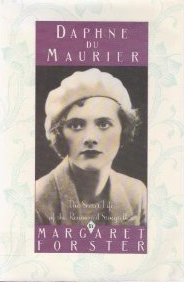
Cover for Daphne Du MaurierI have enjoyed reading Daphne Du Maurier’s books for many years, so I was interested to come across this biography by Margaret Forster. The main revelation of the biography is that Du Maurier struggled with bisexual and homosexual feelings all her life and always thought she was putting on a show of a normal life. She explained to others that she was two people, one with a female side–wife and mother–and the other with a male side–lover–that was the fuel for her creative energy.

The book examines Du Maurier’s life and works in terms of these feelings and how they conflicted with her roles as a wife and a mother. In fact, she seemed at times extremely self-obsessed and stunningly unkind to her children when they were young, as she was cold and immersed in her work. She was also unkind to her husband when he returned from service in World War II. By that time, she was living in the home in Cornwall that she never wanted to leave. Her husband “Tommy” Browning was asked to serve the royal family, which he had to do from London. He was obviously lonely, but she refused to move there or even visit. Instead, he made the trip out there every weekend for years after his strenuous, lonely weeks working for the royals. Until he didn’t. She eventually divorced him and later remarried.

The book also tells about Du Maurier’s long-time affair with the actress Gertrude Lawrence and her attraction to Ellen Doubleday, the wife of her American publisher.

Du Maurier tended to hide herself in her Cornwell home while she was writing. Although she became more sociable as she aged and many people remembered her as a warm and funny hostess, she eventually ended up almost a recluse who was devoted to her own daily routines.

The biography is interesting and well written.

Day 116: 22 Britannia Road

Cover for 22 Britannia RoadAlthough the subject matter of 22 Britannia Road should have been interesting, a major flaw of this novel by Amanda Hodgkinson is that I always feel removed from the actions and characters. This feeling of distance may be because we, the readers, are immediately thrust into their woes without first getting a chance to know them.

One minute they meet, the next minute they have a baby, the next he is off to war. The two main characters, Janusz and Sylvana, are natives of Poland before the invasion of the Nazis, but aside from knowing that, you wouldn’t believe that anything unusual is going on. Later, they are in Poland, fleeing, with the Nazis invading, but except for a few events, you wouldn’t know there was a war. It’s as though the author is unable to imagine what it might be like first to live in Poland when the war is building and worse to be there once the Nazis arrive.

The novel actually begins after the war, with Janusz waiting in England, where he has spent most of the war, for the arrival of Sylvana and their son Aurek from Poland. Later it tells the story of their meeting, courtship, marriage, and war through unconvincing flashbacks.

It also tells the story of their floundering marriage, which happens because they tell each other nothing. This post-war story is a little more realized than the story of their past.

I have some sympathy for Janusz at the beginning of the novel, when he is waiting for his family to arrive. He has obviously meticulously prepared for them and is hoping to give them a good life. But I think Sylvana is a stupid woman, who is cloyingly overprotective of Aurek. She is harboring a big secret, but I guessed it almost from the beginning.

Although I was mildly interested in the story of the novel, I felt it could have been done much better.

Day 110: Maus I

Cover for MausMaus I is a graphic novel that is both about Art Spiegelman’s relationship with his father, Vladek, and about Vladek’s survival of the Holocaust. The characters are depicted as different types of animals–Jews are mice, Poles are pigs, Germans are cats, Americans are dogs, and Swedes are reindeer. Spiegelman explained in The Comics Journal (according to a reader review on Amazon.com) that his idea for using these animals is not entirely original but is extrapolated and expanded from the names the Germans called Poles and Jews.

In the novel, as Vladek tells Art the story of his experience during World War II, they also argue. The story is compelling, although the relationship between the two is less so. Vladek is difficult and eccentric, but Art seems childish and spoiled, with no patience or understanding for his father. However, the novel makes the point that he, too, was scarred by his father’s experiences.

I am not by any means an expert on graphic novels, having only read one other, which was the beautifully illustrated Britten and Brülightly. However, the art in Maus I is so primitive that I could not tell any of the characters of a single species apart except for their clothes. I suppose, though, that that in itself is a statement. Still, the art shows a strength of line and a simplicity that make it interesting.

Maus I is apparently intended for young adults, and as such, is probably a powerful educational piece. I think it is less successful for adults.

Day 105: This Side of the Sky

Cover for This Side of the SkyThis Side of the Sky is Elyse Singleton’s novel about the friendship between two African-American women. It begins when the two are growing up in a small town in Mississippi during the 1930’s. Myraleen is a light-skinned beauty but sarcastic and stubborn, who sometimes tries to pass for white. Lilian is dark, more educated, quiet and hard-working.

The two girls become close friends, even though Lilian’s mother looks down on Myraleen. Eventually, they move away to Philadelphia where they get menial jobs. There they find more freedom but segregation that is more hidden. With still more ambition, they join the Women’s Army Corps towards the end of World War II, eventually ending up posted in London and then Paris.

Although the plot of this novel is sometimes interesting, the characters never seem to be real people. Each of them has only a few characteristics. Nor does the period setting seem particularly convincing except for the details of small town life in a poor, rural area. London during the war is not very well depicted, and Paris is barely depicted at all, as if the author has never been to either city. A few chapters from the point of view of Kellner, a German prisoner of war who is involved with Lilian, seem particularly unconvincing.

Overall, I felt this story should have been very interesting, but it was ultimately lacking in the kind of detail that would make it believable.

Day 101: The Uninvited Guests

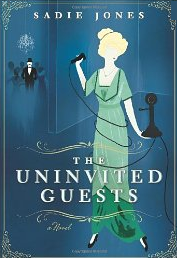
Cover for The Uninvited GuestsThe Uninvited Guests is a delightfully original novel. At first it seems to be an Edwardian family social comedy that reminds me of the light, eccentric novels written by Stella Gibbons or Dodie Smith, but then it takes a turn toward the bizarre.

The Torrington-Swifts live in a large, ramshackle house that is at risk because they can’t afford it. The grown children, Emerald and Clovis, make a show of resenting Edward, their kind, patient, one-armed stepfather. Clovis is sulky and irritable, while Emerald is more likeable. Charlotte, their mother, is selfish and used to being cossetted. Smudge, the youngest girl, is used to being ignored.

It is Emerald’s 20th birthday, and the family is preparing for guests and a party, but Edward must miss the party because he has to travel to Manchester to try to borrow money to save the house. The guests are settling in and a storm is building when other people begin to arrive. A horrendous train accident has occurred a few miles away, and the railroad has sent the passengers to the house for shelter. Among them is an odd character in a red waistcoat who insists upon inserting himself into the birthday party.

Here is where the story begins its strange turn as the party gets odder and odder.

The novel is extremely well written and completely captivating, with a touch of the bizarre.

Day 96: The Forgotten Garden

Cover for The Forgotten GardenKate Morton’s The Forgotten Garden was one of my big discoveries two years ago. I absolutely love this book.

A four-year-old girl walks off a ship in Australia in 1913 with a little white suitcase. No one meets her. She won’t say who she is or where she came from. The harbor master takes her home, calls her Nell, and adopts her, and she forgets her previous life. When she is 21 and on the verge of marriage, he tells her about it. This information is so shocking to Nell that she breaks with her fiancé and her family and isolates herself, feeling that she has been living a lie.

In 1975, Nell’s irresponsible daughter drops her own teenage daughter, Cassandra, at Nell’s house and drives away, never to return. Nell has other plans, but puts them aside to take care of her granddaughter.

In 2005, Cassandra is mourning Nell’s death. She has inherited Nell’s property but is only vaguely aware of her history. When she looks through Nell’s things, she finds a white suitcase with a book of fairy tales in it. She also finds that Nell never stopped looking for her real family. Continuing Nell’s search, Cassandra ends up in a small Cornish village where she learns she has inherited a small cottage on the Mountrachet estate.

Cassandra finds an entrance into a walled garden, and another one from there to the estate. Eventually, she also discovers the history of her grandmother’s parentage.

The book traces Nell’s history by alternating among these times. The modern story is one of investigating one’s roots, but the older tale is more gothic. Ultimately, it is the story of two cousins, the wealthy Rose Mountrachet and the slum-born Eliza Makepeace, who comes to live with her and be her companion.

A mystery about family secrets, the story is complex and enthralling. Some readers may be daunted by its length, but once you begin reading, you will not be able to stop.

Day 69: The Information Officer

Cover for The Information OfficerI really enjoyed Mark Mills’s book Amagansett from a few years ago and liked The Savage Garden. However, I did not find his third book, The Information Officer, as satisfying.

It is World War II during the siege of Malta. The British are trying to get their Spitfires to Malta to defend it, but in the meantime the strategic island is being heavily bombed. Major Max Chadwick’s job as information officer is to deliver updates to the local newspaper that are as positive as possible and figure out what is truth and what fiction.

Max’s good friend Freddy comes to him with information that someone is murdering Maltese dance hall girls, and there is evidence that the murderer is a British submariner. Freddy, a doctor, has already raised the problem with the high command and gotten nowhere, so Max decides to investigate. In the meantime, the murderer is plotting his moves.

The novel was interesting enough, with good descriptions of Malta and a fairly involving plot. However, I did not grow to care very much about the characters. I figured out the murderer, although not his motive, fairly easily.

Day 66: The Lacuna

Cover for The LacunaBest Book of Week 14!

My experience with reading Barbara Kingsolver has been uneven. Her first books were interesting and heartwarming, but some of her later work is more political and sometimes degenerates to lecturing on certain causes. However, The Lacuna is an absolutely enthralling historical novel.

Harrison Shepherd is a young man, half Mexican and half American, who survives an upbringing by a feckless mother and a cold father and finally begins making his own way in 1930’s Mexico. He finds a job working in Diego Rivera’s kitchen and ends up as the cook and plaster mixer in Rivera’s household with Frida Kahlo. Later, when they give Leon Trotsky a home, Shepherd works for Trotsky as a secretary and translator, and finally he returns to the United States to write Aztec historical potboilers.

The novel covers major historical events in a turbulent period, including the Communist Worker’s Movement, Trotsky’s assassination, FDR’s terms in Washington, World War II, and the House Unamerican Activities Committee. Although Shepherd’s life is extraordinary by any standards, Kingsolver was able to make it feel absolutely persuasive. While I usually dislike historical novels where ordinary people keep running into famous people, I completely accepted every sentence of this book.

Told by diary entries, newspaper articles, and letters, the novel gets going a little slowly, but eventually enthralls. Kingsolver does a great job of creating colorful and believable characters from the lives of real, historic people, something that is not simple, and completely involves readers in the events of their lives.

Day 64: The River of Doubt: Theodore Roosevelt’s Darkest Journey

Cover for River of DoubtIn 1913, ex-President Theodore Roosevelt departed on a trip up an unknown river in the Amazon with a party that included his son Kermit, Brazil’s most famous explorer Candido Mariano da Silva Rondon, and the naturalist George Cherrie. Because the trip was originally planned to be less challenging and also because it was provisioned (by the leader of a failed arctic expedition) with more of an eye to comfort than practicality, the party soon found itself in dire straits, and by the end of the trip Roosevelt was near death.

In The River of Doubt: Theodore Roosevelt’s Darkest Journey, Candice Millard writes a compelling tale of this dangerous journey to a completely unexplored region, which ended by putting a 1000-mile river on the map of Brazil. In a hostile environment that the explorers found strangely lacking in food, they were at times very close to attack from the Cinta Larga Indians, who had only had a small amount of exposure to Brazilian rubber hunters–and that had been violent. The group also had to deal with boats that were unsuited to the rapids they encountered, disease, dangerous animals, and theft and murder by one of their party.

Whether Millard is explaining the scientific reasons behind the jungle’s apparent lack of food, the geology of the region, or the dramatic events of the trip, she writes with absolute clarity and interest. Although this book reminded me a great deal of The Lost City of Z, which I reviewed earlier and also enjoyed, I thought it was much more interesting and better written.

Day 63: An Atlas of Impossible Longing

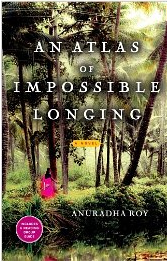
Cover for An Atlas of Impossible LongingIn An Atlas of Impossible Longing by Anuradha Roy, a family in turn of the (20th) century Bengal lives in a small remote village where the husband has moved for business. He, Amulya Babu, neglects his wife Kananbala for work, but he supports a boy in the local orphanage named Mukunda. Amulya and Kananbala have two grown sons, Kamal and Nirmal. Nirmal marries Shanti and is happy with her. But after she dies at her father’s house in childbirth, he deserts his family. His daughter Bakul is brought up in his father’s house by Kamal and his wife and by Kananbala, who is soon widowed.

On one of Nirmal’s visits after his father’s death, he goes to the orphanage to see who his father has been supporting for years and brings back Mukunda, who is casteless because no one knows his parentage. Mukunda and Bakul are raised together and allowed to run wild as each other’s only friends and companions.

The story eventually becomes about the relationship between Mukunda and Bakul and in the last section is narrated by Mukunda.

I had an ambivalent reaction to the book. I felt that the glimpses of Indian life were interesting and so was the historical context, even though momentous events are touched upon lightly. The book spans about thirty or forty years and three generations, ending in the 1940’s or 50’s. For a novel of such scope, however, it seemed too short to adequately develop the material. In the multigeneration story and the themes of the book, I was reminded of two other recent books, The God of Small Things by Arundhati Roy and The House of Blue Mangoes by David Davidar. But both of these books were much more satisfying.

I felt little connection to any of the characters, who seemed sketchily depicted. The love story that the book focuses on in the final part of the book is the least interesting part of the story because Roy has not made me care about either of the lovers. I was curious about what would happen but at the same time did not care very much about which way things would go.