NYT 100 Best Books of the 21st Century: Last Installment

This week, the New York Times began posting its list of the 100 best books of the century so far, as determined by 500+ writers, editors, and so on. Each day, as it posts the next 20 books in the list, I’m going in and adding to this post, which I will publish on Friday. I already published comments about the lists from the first two days (#61-100) on Wednesday.

Wednesday’s List

I started out the last article by listing the books from the NYT list that I had read. So, here it is for the books listed Wednesday.

For books #60-51:

For 50-41:

As of Wednesday, they have made it possible to submit 10 of your favorite books for an audience favorites list. I made up a list and submitted it, So far, the only ones on the NYT list that I put on mine were Life After Life and The Goldfinch, but, full disclosure, I scratched off The Goldfinch in favor of a more obscure book because we are limited to 10. However, I might have included Middlesex if I’d thought of it and am happy to spot more books that I enjoyed appearing on the lists as we go up to #1.

Of these lists from Wednesday, I loved several of the books and actually didn’t like a couple of them at all, particularly A Brief History of Seven Killings and The Vegetarian. I was indifferent to one other.

To keep my count up, if I counted right, 11 of the 20 authors listed for these books are women. So far, that makes 33 out of 60.

Thursday’s List
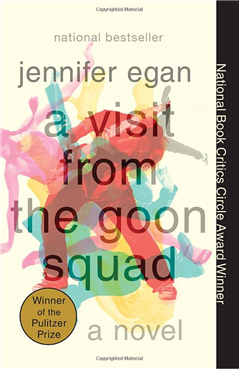
Cover for A Visit from the Goon Squad

Continuing my listing, of the list from Thursday, here are the books I’ve read:

For books #40-31:

Well, that’s a pretty bad showing for those numbers.

For books 30-21:

I’m at least liking most of these selections as we get closer to the highest numbers on the list. I see there are some more Alice Munro books I need to read. Of the list of my top 10 that I submitted to the NYT on Wednesday, A Visit from the Goon Squad was on it, and both Atonement and The Overstory were on my shortlist and got taken off to get down to 10. If I’d thought of Cloud Atlas, it probably would have been on there, too. I think, actually, that I failed to check its publication date and thought it was before 2000.

Continuing my count of the women writers included, 13 out of 20 are women, for a total count of 46 out of 80. At this point, some names are duplicated, but since there are 100 books, I’m counting them each time they appear. It would be much more challenging to figure out how many women and men are listed, because of duplicates (which I’m still not happy they’ve included, that is, more than one book by an author).

Friday’s List and the Top Twenty!
On Friday, the NYT listed their top twenty books of the 21st century (along with the rest of the 100). Here’s my list of how many I have read.

For books #20-11:

For the top 10:

For my own part, I have done a lot better at having read the top books. Fifteen out of twenty isn’t bad! Of these, I found a flaw in my method of making my own list of favorite books, which was to go through my Best of the Year posts, but my blog only started in 2012, I think. So, for example,. I may have included Never Let Me Go in my list if I’d thought of it.

Of the ones on the list of 11-20, there are more books that I didn’t enjoy that much than on any of the other lists. The Sellout, for example, was a DNF for me, despite it being on one of my project lists. The only books I liked a lot were The Amazing Adventures of Kavalier and Clay and The Year of Magical Thinking.

I did much better with the top ten list. I considered The Known World and Wolf Hall for my own list. I liked all the others except, it’s now official, I must be the only person in the world who didn’t like My Brilliant Friend. Of course it came in at first place!

We are doing worse on the count of women writers for this one, only 7 out of 20. That brings the total to 53 out of 100, though, which is fair and much better than in previous lists by other organizations.

NYT 100 Best Books of the 21st Century: What Do I Think So Far?

Cover for Olive Kitteridge

As of this writing (on Tuesday), the New York Times has posted numbers 100-61 of their best books of the 21st century, 20 each day this week, as decided by 503 critics, writers, poets, and other book lovers. When I saw they were doing it, my first reaction was, I hope it’s a better list than the Time Magazine best books of the 20th century, which had only one book on it written by a woman, if I am recalling correctly. (I take that back. There were 20. However, the list I just looked at doesn’t seem to exactly be the one I remember, so maybe they revised it. And anyway, really, guys?) And two by Philip Roth, which, gag me with a spoon. (Bad news, because these new lists already have two by Philip Roth.) My other reaction was that 24 years into the 21st century was a bit early to be doing this.

Regardless, I thought I’d write a post about my reaction to the lists so far.

First of all, how many have I read? Not as many as I might have.

For books 100-91:

For 90-81: none

For 80-71:

For 70-61:

Obviously, I haven’t read enough of these to make any overarching comments. One thing is obvious. There are more books by women writers, 22 (if I counted them right) out of 40. So much better. And there are quite a few by minorities.

Of the ones that I read, I personally thought several were excellent but not all. In particular, I liked Bel Canto, Bring Up the Bodies, and Olive Kitteridge best. I liked how to be both, On Beauty, All Aunt Hagar’s Children, and Demon Copperhead well enough, A few others I felt indifferent to, but at least I didn’t actively dislike any of them.

But there is Philip Roth again, two of his books in the bottom 40 (admittedly, I haven’t read any of them, but I read several of his books and those were enough for me), the guy who writes the same book over and over again. There aren’t two books by any other authors listed twice in the list so far. Usually when I make my top 10 lists for the year, I have a rule that only one book per writer can be on the list. That makes for hard decisions, but I think it’s a good choice.

What about you? Take a look at the complete list at the link at top. Have you read any from the list so far? What do you think of the choices? I will be reporting back later this week once the rest of the list is published.

Review 1664: Greenwood

Best of Ten!

Greenwood starts with an image of the cross-section of a tree trunk, this showing the novel’s structure. The novel begins in 2038, the outer ring of the tree, and visits four different years in the past, the center being 1908. Then it returns through each of those years to 2038.

In 2038, Jake Greenwood is an overqualified scientist working as a forest ranger in one of the few forests left on earth after the Great Wilt. She is glad to have the job in a world of excessively rich people and have-nots. Greenwood Island is a sort of private park that entertains the very wealthy by touring them through the forest.

Jake doesn’t think her family has a connection with the Greenwoods of the island, once owned by the fabulously wealthy lumber baron Harris Greenwood, but a lawyer arrives saying that she may have a claim to the island.

The novel returns back in time to visit Jake’s ancestors at important events in their lives. In 2008, Jake’s father Liam’s girlfriend leaves him and then lets him know she is pregnant. Later, doing a carpentry job, he has a serious accident.

In 1974, Liam’s mother Willow, an environmental activist, lives with Liam in her van and travels around sabotaging logging equipment.

In 1934, Everett, who makes a little money tapping and selling maple syrup, finds a baby hanging on a tree outside his cabin. Although he at first tries to give her away, he begins to think she’s in danger.

In 1908, two nine-year-old boys are the only survivors of a massive train wreck. When no one claims them, the town puts them in a cabin and provides the bare minimum of their needs, the boys growing up almost feral. The boys cannot remember their names, so the town calls them Harris and Everett Greenwood.

The novel is beautifully written and like The Overstory is concerned with trees and their impact on the world. Its descriptions of forests are lyrical. The plot itself is at times so involving as to read almost like a thriller. This is an unusual and absorbing novel.

The Overstory

Maddaddam

The Sunken Cathedral

Day 1297: The Weight of Ink

Cover for The Weight of InkThe Weight of Ink is a dual time-frame novel set in the current time and the 17th century. At first, I wasn’t as captured by the present-day sections as I was by the past, but eventually the entire novel absorbed me. There is a big revelation at the end that I anticipated, but that did not lessen the power of the novel.

In the present day, Helen Watt is an English university professor of Jewish history who is elderly and ill. Requested by a previous student to examine a cache of papers he found in a wall of his 17th century house, Helen does not expect any great finds. What she discovers is a genutza, the hidden papers of a 17th century rabbi, and on one page, a mention of Spinoza. Understanding that this could be a major discovery, she requests help and gets that of Aaron Levy, an American graduate student.

One of their first, startling discoveries is that Rabbi HaCoen Mendes’s scribe, identified only by the Hebrew letter aleph, is a woman. Having reported her initial findings to Jonathan Martin, the head of the History Department, so that he could buy the papers from the owners, Helen is dismayed to find her place on the investigation usurped. She can continue working with the papers, but Martin has also given Brian Wilton access. He arrives with four graduate students to beat Helen and Aaron to any discoveries and immediately publishes an article about one of the topics in the letters.

In 1657, Ester Velasquez is a young Jewish woman who has been allowed an unusual education. In these dangerous days of the Inquisition, her family fled Portugal for Amsterdam, where her parents were killed in a fire. She and her brother Isaac are part of the household of Rabbi HaCoen Mendes, who travels to England to educate the British Jews in their heritage, these people having been hiding there pretending to be Protestants during hundreds of years when Jews were not allowed in England. Rabbi Mendes’s difficult job is made harder when Isaac, his scribe, leaves. But the rabbi lets Ester take his place.

Offered an opportunity of knowledge, Ester comes to know that she does not want to return to a woman’s life. So, she sets about a daring deception.

Aside from covering some key events of its time—the Inquisition, the return of Jews to England, the plague, and the Great Fire—The Weight of Ink offers us an intrepid, determined heroine in Ester as well as an interesting modern story. I was really touched by this novel. It’s terrific—the kind of novel I look for in historical fiction.

Related Posts

The People of the Book

The Bookman’s Tale

The Last Painting of Sarah de Vos

Day 1289: The Clockmaker’s Daughter

Cover for The Clockmaker's DaughterBest Book of Five!
The first character we meet in The Clockmaker’s Daughter is the ghost of the clockmaker’s daughter. Although she used the name Lily Millington, we don’t find out her true name, or why she haunts Birchwood Manor, until the end of the novel.

The novel begins in the present, though, with Elodie, an archivist. She is about to be married, but she is having trouble concentrating on the wedding. That is because, in going through the archive of James W. Stratton, a philanthropist, she has found the belongings of a Victorian artist, Edward Radcliffe, in particular, a sketchbook. This discovery is of interest because inside it is a picture that she realizes is of a house from a children’s story handed down in her own family.

link to NetgalleyWhile Elodie begins exploring this link between Radcliffe and her family, we slowly hear the stories of Lily Millington, of a beloved house, and of a long-lost family heirloom. We also learn the stories of a series of inhabitants of the house.

Although I love a good ghost story, I wasn’t sure whether I would appreciate the ghost being one of the narrators. And this is not a traditional ghost story, for the ghost is not one that frightens. Kate Morton is a masterful storyteller, however, so that I was engrossed as always. Although this is not my favorite book by Morton, which still remains The Forgotten Garden, I really enjoyed it.

Related Posts

The Forgotten Garden

The Secret Keeper

The Lake House