Review 2704: #ReadingIrelandMonth26! Glorious Exploits

There seem to be lot of novels out recently that are set in the world of ancient history or myth. I have read a few of them, but it’s not really a time of interest for me. In fact, I am so ignorant of the Peloponnesian War that I thought it only involved Athens and Sparta. But it was a lot more widespread than I thought.

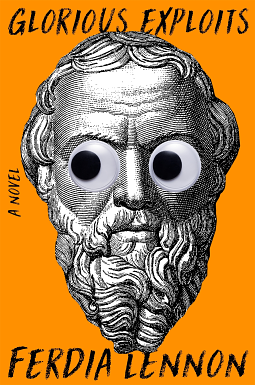
If it hadn’t been for my Walter Scott shortlist project, I wouldn’t have chosen this book to read. (For one thing, I find the cover off-putting.) And it didn’t start off very well for me. It is written completely in modern vernacular with an Irish accent, which I initially found grating. But I got used to it.

Lampo, our narrator, and Gelon are two mates, essentially layabouts. Lampo is 30 years old and still lives with his mother. They are Syracusans; it is 412 BC, a few years after the Athenians attacked Sicily. The Athenians were eventually beaten, and 7000 Athenian soldiers were imprisoned in the quarries of Syracuse, basically just left there.

Now Gelon decides to go to the quarry to feed the Athenians. He is a huge fan of the plays of Euripides, and he is afraid that with the defeat of Athens, Athenian culture will die out and Euripides’ work will be lost. So, he decides to put on a play using the Athenian soldiers for actors, paying them with food.

On the way into the quarry, Lampo and Gelon run into a grieving father, Biton, who has just beaten an Athenian to death and is working on his friend. Gelon talks Biton out of it, and this is when he announces his plan to direct Medea. They rescue the other Athenian, Paches, and Lampo decides he must be in the play. Much to Lampo’s astonishment, they manage to find funding for this project from a wealthy foreigner.

In the meantime, no-hoper Lampo has fallen in love with Lyra, a Lydian slave girl who works at his local bar. Her owner wants an exorbitant fee to sell her to Lampo so he can set her free, more money than he can hope to ever earn, but that’s what he vows to do. With these twin goals, Lampo begins to pull himself together.

“Riotously funny,” as the blurb calls it, this book is not, but I found Lennon to be a terrific storyteller. This novel is about the power of friendship, the importance of art, and personal loyalty. I would never have read it on my own, but it is rough, touching, and terrific.

Related Posts

The Last of the Wine

House of Names

The Silence of the Girls

Review 1676: The Last of the Wine

It’s the fifth century BC, and the Peloponnesian War has been going on as long as Alexias can remember. As a boy almost reaching manhood, he is more interested in his training as a runner and the teachings of Sokrates. He is often at odds with his father, who has a poor opinion of the Sophists, in which group he includes all the philosophers. Alexias is a beautiful boy who fends off in disgust the advances of his father’s friend Kritias, but he eventually falls in love with Lysis, a man about 10 years older than he, and they form a fast friendship.

Things change as his father Myrom is dispatched to fight against Syracuse. The city of Athens has approved an attack proposed by the charismatic, mercurial Alkibiades. Then, shortly before the fleet is due to leave, someone destroys all the Herms in town, and Alkibiades is accused of this impious act. He leaves with the fleet and is found guilty in his absence without a trial, so he flees, leaving the fleet without the only leader who could have prevailed. Myron is sent with the second wave of warriors.

Before Alexias has even reached his official manhood, he goes off with Lysis to fight Spartans encroaching into the Attican farmlands. The Spartans attack every year to steal or spoil the harvest. The novel follows the two in war, under siege, in famine, and in civil conflict through 10 turbulent years in the history of Greece.

As usual, Renault’s novel is meticulously researched and elegantly written. After so recently reading her Alexander trilogy, though, I began to feel a sameness about her writing. The narration from book to book sounds the same to me, not like different characters (except the one narrated by the Persian boy), and she examines the same themes in Greek culture, although the books are set in different times. Maybe I’m just a little tired of ancient Greece. I read this book for my Classics Club list.

Related Posts

Fire from Heaven

The Persian Boy

Funeral Games

Day 434: Coriolanus

Cover for CoriolanusCoriolanus is one Shakespeare tragedy with which I was previously unfamiliar, and it is a powerful one. More than any other Shakespeare play I’ve read, it is about politics, class dissension, and the fickleness of popularity. It is also about excessive pride.

The play has references to events of the time it was written, for it begins with a riot over corn, the like of which had taken place in Warwickshire the year the play was written. Its war between the Romans and the Volscians is also a reference to the war the English and Spanish had been carrying on intermittently.

Caius Marcius is a warrior who has spent most of his life as a soldier and has no social graces. He is proud and arrogant and disdains the common man. After he soundly beats the Volscians in battle, particularly his bitter enemy Aufidius, and conquers their city of Corioles, the Roman generals rename him Coriolanus and the senate wants to award him a consulship. This office as ruler of Rome is the one that all great men aspire to. Unfortunately, to have the office, Coriolanus must beg the honor from the public and show them his wounds gained in defending the state.

He is reluctant to do so, knowing that he is unable and unwilling to ask for what he thinks he deserves, but his austere mother Volumnia and his supporters talk him into it. Two jealous tribunes, who are representatives of the people, are afraid that Coriolanus will strip them of their offices. So, the two, Brutus and Sicinius, work to enrage the people after they have already sworn to support Coriolanus.

The result is another riot, and instead of receiving the high honor, Coriolanus is declared a traitor. The tribunes even try to have him executed, but he is banished.

The seeds of Coriolanus’ downfall are sown both by the treachery of his rivals and by his own hubris. Things go downhill from there.

It is interesting that in the class divide, Shakespeare’s sympathies seem to align with the men of power even while he deplores Coriolanus’ flaws. There are several speeches about the public not being able to make a decision, about their fickleness, and so on, and the actions of the public seem to bear these ideas out. You can image what Shakespeare would think about a democracy or about our current political situation.