Day 1168: Hodd

Cover for HoddI was never one for the romantic legends of Robin Hood. I always thought that, if he did exist, he was probably just the leader of a gang of thugs. And such, apparently, is indicated by the older ballads about him. In Hodd, Adam Thorpe weaves a story of the man that is closer to that told by the older ballads.

This novel is all about the manuscript, as the text of Hodd is supposedly the find of a medieval manuscript, written by a 13th century monk. The narrator, who remains unnamed, is writing the story of his youth. The novel includes scholarly notes from its translator and comments by its discoverer, a soldier in World War I. Some of these notes are funny, and some, I think, are meant to be parodic.

The narrator is about 14 when he is traveling with his master, a monk named Thomas, to Nottingham. They are held up by Hodd’s men and the narrator’s harp is stolen. He decides to go back and get it and is captured by Robert Hodd and his men.

Hodd is actually a sort of lunatic cult leader, who believes that there is no sin and that he is better than God. His followers believe him. He keeps himself intoxicated and has constant visions. He and his men are utterly ruthless and cruel. But rather than killing the narrator, Hodd decides to keep him as one of his men. He is a musician, and he can write songs about Hodd.

The narrator tells a parallel story of his education and upbringing by a holy hermit. This story continues throughout the book and comes in strongly at the end.

I think Thorpe realistically imagines the workings of the medieval mind, showing us strange beliefs. As such, this is a very unusual novel. I could have done without some of the religious moralizing, which filled the novel, as it would a medieval manuscript.

If you are a reader who needs a character to like, this is probably not the book for you, for even the relatively innocent narrator is perfidious. He so much wants to be loved that his jealousy turns him against people.

This is another interesting book I read for my Walter Scott Prize project.
Related Posts

Ulverton

The Scottish Chiefs

The Owl Killers

Day 1034: Ulverton

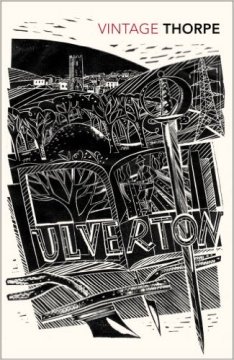
Cover for UlvertonBest Book of the Week!
We’re now more familiar with novels written as related short stories, but Ulverton was written in 1992 and may be the first novel of this kind. The novel covers 300 years of English history and is set in one place, the fictional village of Ulverton. Other hallmarks of this unusual novel are that each chapter is written in a distinctly different voice and the chapters are written in different formats, from a tale told in an inn to the captions from a photographic display to the script of a documentary.

In 1650, the novel opens with the return of Gabby Cobbold from the Cromwellian wars. He meets the narrator, a shepherd named William, on his way home, but William does not have the courage to tell him that his wife, Anne, thinking he was dead, has remarried Thomas Walters. Gabby explains that he was away earning money to support the farm. Gabby disappears, and William is sure that Thomas and Anne killed him. But three hundred years later, Gabby gets his own back against a descendent of Thomas.

In 1689, the foolish Reverend Brazier tells the story of a strange night out on the downs, when he, William Scablehorne, and Simon Kistle were making their way through a snowstorm. As related in his sermon, they were apparently attacked by the devil and Mr. Kistle went mad.

Diary entries made in 1717 reveal a farmer’s preoccupation with improvements to his property and begetting an heir. Since his wife is ill, he does not touch her but begins trying to impregnate the maid.

In 1743, Mrs. Chalmers writes letters to her lover while shut away after childbed. Apparently having read her letters, her husband gets his doctor to keep her isolated longer.

And so it goes, stopping in about every 30 years, so that we sometimes hear of characters again. Through time, names are repeated and the story of incidents changes.

On occasion I had problems with the vernacular, although I tried to stick with it. The most difficult stories for me were the 1775 letters of Sarah Shail to her son and one side of the 1887 conversation between a man plowing and two boys. Sarah Shail is illiterate and is dictating her letters to John Pounds. However, this chapter has its own humor as Sarah is writing to her son Francis, who apparently answers her abusively, to the indignation of Pounds, who begins adding threats to the letters. Pounds’ spelling is so bad, though, that the letters are sometimes incomprehensible. In the case of the plowman, his dialect is so thick that I kept rereading parts of it but was unable to understand very much.

This was just one chapter, though. Overall, I found this novel deeply original and interesting. The countryside is so integral to the story that it features almost as a character. The writing is lovely, and the novel contains a great deal of drama and humor.

Related Posts

The Wake

Harvest

The Quickening Maze