Day 538: Treasure Island

Cover for Treasure IslandIf I had to guess which of Robert Louis Stevenson’s books is the most popular, I’d pick Treasure Island. My own favorite is Kidnapped, though, and I probably wouldn’t have reread Treasure Island except that it came free with a reading app for my iPad. Still, it’s a pretty good adventure story.

The plot is familiar to everyone. Jim Hawkins and his parents run the Admiral Benbow Inn in an isolated location near the English seashore. A shifty old sailor comes to stay. He seems to be on the watch for someone, and asks Jim to alert him to strangers. Soon more shifty sailors arrive looking for him. The Hawkins’ guest is drinking himself to death, though, and he dies soon after Jim’s father does. In his sea chest is a treasure map.

Jim has gone for help to the Squire Trelawny and Dr. Livesey. Soon they prepare a ship to go collect the treasure, taking Jim with them. A crucial misstep occurs when the Squire hires the crew without waiting for the captain (something that seemed not only improper but stupid to me). He hires as the cook a one-legged man named Long John Silver. Silver and a good part of the crew turn out to be pirates who know about the map and want the treasure.

I was struck by a few cases when the protagonists behave nonsensically, the biggest being abandoning the ship when they find out a mutiny is afoot. Almost all the sailors are ashore at that point. It seemed like they should just sail away to another part of the island.

Still, the novel is written really well, and Stevenson is good at building suspense. I’m sure that successive generations of young people are thrilled to discover this adventure story.

Day 515: Robinson Crusoe

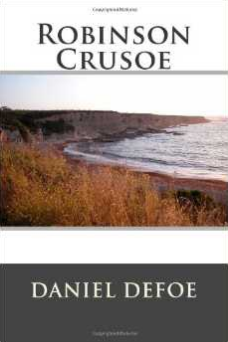
Cover for Robinson Crusoe Here I am with my third review for the Classics Club. Robinson Crusoe is a difficult novel for the modern reader. It is one of the earliest novels and as such lacks some of the characteristics we associate with the form. It has no chapters—just a few breaks here and there—little dialogue, minimal characterization, and a primitive plot structure. If you think of the novel as a children’s story, you are wrong (although when I was looking for a cover for this article, I saw that it is marketed as such).

In fact, the story that has made several exciting movies is related in a mundane manner with little notion of building suspense and would probably bore most kids silly. Instead, Crusoe’s novel is an expression of the importance of self-reliance and an assertion of Defoe’s religious faith.

The story is familiar, although I was surprised by just how much happens before the famous shipwreck and after the rescue. As a young man, Robinson Crusoe is in a position where he could live a good life at home. His father urges him to be content, but he determines to be a sailor. He makes several voyages, ending in Brazil, where he accumulates property and an estate. But he is not satisfied to stay at home. He takes on an errand from neighbors to travel back to Europe for business, and that is when he is shipwrecked.

The rest of the novel is about his efforts to survive and make himself a home, his religious musings, and (after years of being alone) his encounters with other people. As I mentioned before, none of the characters are fully realized. In fact, aside from Crusoe, only Friday even has a name. Everyone else is just called by his station. (I say “his,” because there are no female characters.)

Modern readers may also have problems with such issues as racism or sexism in the novel (sexism only in the sense that Defoe ignores women—he mentions a few, but they are clearly unimportant). I don’t think that works should be judged outside the standards of their time, though. By the standards of his own time, Crusoe probably treats Friday pretty well.

The only other novel I have read by Defoe is Moll Flanders, which has the advantage of being bawdy. I think the way to approach this novel is not as an adventure story but as an example of an early novel and as a story about self-reliance.

Day 496: My First Classics Club Review! The Long Ships

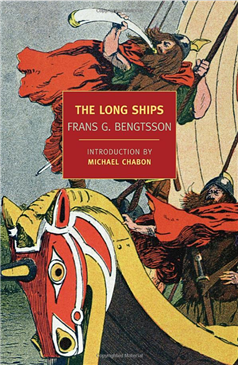
Cover for The Long ShipsBest Book of the Week!
Today I’m posting my first review for The Classics Club, the one chosen for me by the Classics Club Spin #5!  The Long Ships is a great start to the Classics Club for me. I found it to be a rousing adventure story full of deadpan humor.

This book is the result of Bengtsson’s desire to write a realistic novel about the Vikings. A poet, Bengtsson also wrote essays and a biography of Charles XII, but he became more widely known for The Long Ships.

His protagonist Orm Tostesson is only a boy when the novel begins. Orm is eager to go a-viking to Ireland with his father and older brother, but his mother tends to be protective of him, so he stays home. Shortly after the men leave, he attempts to stop some sheep stealing on the part of a group of Vikings from Lister and is kidnapped by them. The Vikings soon find him an able and intelligent companion, so he becomes part of their crew rather than being kept a slave.

In the course of their adventures down the western coast of Europe, they are initially successful but eventually are captured and sold as galley slaves. In return for a service they performed for a Jew from Córdoba, they are freed to serve as bodyguards for lord Almansur, the regent and imprisoner of the young Caliph of Córdoba. There they serve for years until circumstances force them to flee for home.

This voyage is the first of three related in the novel, during which “Red” Orm meets his bride to be, loses her when his best friend Toke steals her father’s concubine, goes a-viking to England to try to retrieve her from English priests, and many years later travels down the Dnieper to bring back a stash of hidden gold. Even when he is settled at home, he is involved in tiffs with his neighbors, attempts to murder him on the orders of the evil King Sven, visits from unusual acquaintances, rowdy celebrations, and a Thing, a convocation of various groups of Vikings for settling their differences.

There is plenty of action in this novel, but what I find most charming are its air of insouciance and its ongoing (although somewhat grisly) humor. It has a sense of playfulness, especially about the differences between the Norsemen’s old religion, Christianity, and Islam, to which Orm and his fellows are temporarily forced to convert. Take, for example, this passage from the prologue, about the arrival of the shaven men, or priests, in Skania:

They had many strange tales to relate, and at first people were curious and listened to them eagerly, and women found it pleasant to be baptized by these foreigners and to be presented with a white shift. Before long, however, the foreigners began to run short of the shifts, and people wearied of their sermons, finding them tedious and their matter doubtful . . . . So then there was something of a decline in conversions, and the shaven men, who talked incessantly of peace and were above all very violent in their denunciation of the gods, were one by one seized by devout persons and were hung up on sacred ash trees and shot at with arrows, and offered to the birds of Odin.

To give you another idea of the humor in this novel, a Viking tells a story of a wedding that broke up into a fight. When the bride sees the groom’s friends beating up one of her relatives, she hits the groom with a torch, which starts his hair on fire, beginning another fire in which 11 people are killed. Everyone agrees that it was the best wedding they ever attended.

The story of Red Orm is told in a detached manner but by a truly talented storyteller. It is full of sly humor and observations of human folly. I really enjoyed it.

Day 446: Holiday Story! Spirit of Steamboat

Cover for Spirit of SteamboatWhen Craig Johnson was asked to write a Walt Longmire story for Christmas, he got a little carried away and wrote a novella, Spirit of Steamboat.

A strange oriental woman shows up at the Sheriff’s Office in Durant on Christmas Eve and asks to speak to the sheriff. When Walt comes out to see her, she asks if he recognizes her and also wants to meet the previous sheriff. A mystified Walt takes her to see old Lucian Connelly at the rest home, to whom she says one word, “Steamboat.”

The story returns 25 years to another Christmas Eve. Walt has just become sheriff, and he receives a call that a helicopter is bringing in a child who has been injured and burned in a car accident. If she can’t be flown to Denver immediately for burn treatment, she will die. Unfortunately, Wyoming is in the midst of a violent blizzard, and the airport doesn’t have a plane big enough to fly in the storm.

Well, it has one, but no one to fly the old B-25 bomber named Steamboat, which is in questionable condition. Walt rousts out Lucius, a former World War II pilot who took part in the Doolittle Raid. Because Lucius only has one leg, he needs a copilot, so Julie Leurman comes along, a pilot certainly, but not one certified to fly that class of planes. When the helicopter arrives with the girl and her grandmother, the EMT refuses to come, so Walt enlists the terrified Dr. Isaac Bloomfield to care for the girl during the flight. Although everyone at the airport thinks they are insane, soon the six of them are aloft.

This novella is not a mystery but a straight adventure story. Although the outcome is never in question given the beginning of the book, it is still quite exciting, with medical emergencies, equipment problems, and horrible weather conditions. The novella also contains nuggets of information about WW II era planes and about Steamboat, the emblem of Wyoming, a famous rodeo bronc for which the plane is named. This is a quick, enjoyable read containing a bit of sentiment for the holidays.

Day 424: Mutiny on the Bounty

Cover for Mutiny on the BountyMutiny on the Bounty did not seem like the type of book I would normally pick to read, but when my friend Karen learned I had never read it, she sent me a copy. Now that I have read it, I’m glad she did, for it is a true adventure story, extremely interesting and well written.

The story of the famous mutiny is told by Roger Byam, the only fictional character on the ship. At the beginning of the novel Lieutenant Bligh (not, apparently, a captain at the time) meets the young man socially and invites him along on the journey because of Roger’s facility with languages. One of Bligh’s directives for the voyage besides its mission to collect breadfruit trees is to draft a dictionary of the Tahitian language, a task for which Bligh does not feel competent.

Once aboard, Byam soon learns how ill-fitted Bligh is to command men. Byam commends him as an excellent navigator, but Bligh has no control over his temper and abuses all his men verbally, no matter their station. He is prone to order the most vicious punishments for slight or even imagined offenses. As time goes on, the men also come to believe that Bligh is cheating them out of their due rations with the connivance of Mr. Samuel, his clerk. Bligh even accuses his officers of the theft of cheeses that he himself had delivered to his own house before departure.

Bligh’s clash with Fletcher Christian is perhaps inevitable. Christian is one whom Bligh first views as a friend and promotes to second-in-command over the head of the ship’s master. However, Christian is an upright man whose attempts to soften Bligh’s behavior and whose rebukes in the name of fairness are not well received. And Christian is victim to his own passions. Nordhoff and Hall build slowly to the famous mutiny, which takes place shortly after the ship has departed Tahiti for home.

Although Christian is depicted more positively than Bligh, his fault lies in taking actions that affect the lives of the men who are innocent of the mutiny. Fully half the novel deals with the aftermath of the mutiny, culminating in the trial of eight men, three of whom are innocent.

The novel is carefully researched and the tale told is enthralling, from the details about shipboard life in the 18th century to the customs and culture of Tahiti. Even though the first chapter makes you aware of Byam’s fate, as he is tried for mutiny although entirely innocent, the suspense at the end of the novel still holds you to the page.

I was surprised to learn that this novel is the first of a trilogy. Men Against the Sea, which I had not heard of, tells the story of Bligh and the other men set adrift in a small boat, and Pitcairn’s Island, which I had heard of, relates what happened to the men who left with Fletcher Christian on the Bounty after they departed Tahiti for the second time. I will certainly read these other two novels.

Day 413: Doll Bones

doll-bonesI just realized I had inadvertently reviewed a slew of historical novels in a row, so here’s something contemporary.

I really appreciate a children’s book that has as much to offer an adult as a child. I’m thinking of those books of Frances Hodgson Burnett, Philip Pullman, J. K. Rowling, or Robert Louis Stevenson as examples. Doll Bones doesn’t actually fit into that category, but I’m sure that tweens and younger kids will enjoy it.

Zach Barlow is growing up. He’s put on enough height this year to join the middle school basketball team. What he still enjoys most, though, are the games he plays with his best friends Alice Magnaye and Poppy Bell, where they use dolls and action figures to act out elaborate stories. However, they never touch one doll belonging to Poppy’s mom that they call the Queen, an old porcelain doll that seems very creepy.

Zach’s dad left him and his mother for a few years, but now he has returned to them and is still trying to figure out how to be with them. One afternoon Zach comes home thinking about what will happen next to Pirate William, only to find his dad has thrown away all his toys and dolls. Zach is too upset even to explain to Alice and Poppy why he won’t play anymore. The two girls are devastated.

One night the girls come to see him. Poppy explains she’s had a ghost visitor who says her ashes are inside the Queen. The ghost girl has asked them to bury her ashes in her grave in East Liverpool, Ohio. Poppy believes the ghost and wants to go on a quest to return the bones, which are in the bag that makes the doll’s body. So, despite their fears of getting into major trouble, the kids get on a bus in the middle of the night to travel from Pennsylvania to Ohio.

Of course, on this trip they run into difficulties, including getting scared off the bus part way and having to make their way on foot or any other way they can find through a landscape of urban blight. On the way, some adults creepily seem to believe there are four of them. Eventually, they solve the mystery of who the girl is and what happened to her. As they meet these difficulties they grow up a little and figure out better how to handle their changing relationships.

I think kids will relate to the problems of Zach, Alice, and Poppy. I also think they’ll like the spookiness of the story. Doll Bones falls among the more innocent of contemporary books for tweens and younger teens, with a few chills but no violence or bad language. It would make a good story for any kid from ages eight or nine to, say, twelve or thirteen.

Day 401: Literary Wives: Ahab’s Wife Or, The Star-Gazer

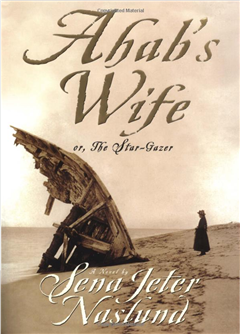
Cover for Ahab's WifeToday I am doing something a little different–participating in a virtual book-discussion group with Literary Wives. Literary Wives is a group of bloggers who are wives and are reading books about how wives are depicted in fiction. Toward the end of my normal review of this month’s choice, I will answer some specific questions that appear in every Literary Wives review. Be sure to check out the other reviews by Audra of Unabridged Chick, Ariel of One Little Library, Emily of The Bookshelf of Emily J., Carolyn of Rosemary and Reading Glasses, Cecilia of Only You, and Lynn of Smoke and Mirrors.

I have quite got to like what appears to be a newish fashion of rewriting works of fiction from a different viewpoint. Although it has produced some mediocre results, it has also produced some gems, a few of which are Wide Sargasso Sea by Jean Rhys, The Solitary House by Lynn Shepherd, and now, Ahab’s Wife by Sena Jeter Naslund.

I was somewhat put off by Naslund’s writing style in her most recent novel, The Fountain of St. James Court; however, it is imminently suited to her most well-known novel, this one, which is a reworking of Moby Dick. This novel is truly an adventure. It begins with a brief look forward to Una Spenser’s delivery alone in a cabin in the wilds of Kentucky of Ahab’s child, which does not live long, and the subsequent discovery that her mother has died in the snow while going for help. If this isn’t enough going on, while she is in labor, Una also has an encounter with bounty hunters looking for an escaped slave. Later, she helps the slave girl escape.

After this glimpse ahead in time, the novel returns to take a relatively straightforward path, beginning with twelve-year-old Una’s banishment from this same cabin in Kentucky. Una has faced some abuse at the hands of her father because of a difference in religious beliefs, so her mother sends her to her Aunt Agatha and Uncle Jonathan, where they live on a lighthouse island off Massachusetts. So begins Una’s fascination with the sea.

Although not every 19th century woman would think life with a loving, thoughtful, intellectually curious family confining, Una eventually finds it so, when she is sixteen. Her feelings are complicated by the arrival of two young men who come to prepare for the installation of a new light for the lighthouse. They are best friends Giles Bonebright and Kit Sparrow. Una knows she likes them both but is not at first sure which one she likes best. This fateful meeting is to affect the rest of Una’s life.

But I am writing nothing here that reflects how unusual this novel is. First, it documents the extraordinary life of an extremely uncommon character. If some of the other characters are not so fully drawn, you really feel as if you know Una. Next, in its occasional long asides and fits of oratory, it is a fitting companion to Moby Dick, with its dissertations on bits of whaling gear and its exhortations by Ahab. If any woman is a match for Ahab, Una is. Finally, its language and ideas are lyrical and soaring, as Una grows intellectually, meets her own life full on, and becomes acquainted with historical figures from her time and place.

If I have a caveat, it is that I feel the exceptional Una would have had more problems of acceptance in the actual 19th century American setting. In keeping with a theme about the enjoyment of life, not only does Una throw off debillitating experiences with little trouble or regret, but she also finds warm friends and acceptance everywhere she goes. It would give away too many plot points to discuss why I find this unlikely.

For Literary Wives: What does this book say about wives or about the experience of being a wife?Literary Wives logo

This novel does not draw on a conventional idea of a wife, particularly for the time it is set. For Una, being a wife seems to mean giving unstinting loyalty up to a point, but this loyalty can vanish fairly quickly if the relationship becomes disrespectful, and Una’s natural ebulliance takes her over some terrible difficulties with relative (and perhaps unlikely) ease.

I don’t think Una lets the conventional notions of wifehood affect her at all. She just does what she wants and what she thinks is right, but her ideas of right are different from other people’s. For her, a husband seems to be the more modern idea of a partner. Certainly, mutual respect, sexual attraction, and love enter into this equation but not so much the typical 19th century idea of duty.

In what way does this woman define “wife”–or in what way is she defined by “wife”?

I don’t think Una is defined by “wife” at all. I think “person” is more what Naslund is interested in. In a review of this book, it was referred to as a feminist, earth mother, reinterpretation of Moby Dick. I don’t see the earth mother so much, but the feminism is certainly there. “What was a promise? A way to enslave the future to the past,” Una thinks at one point.

Day 367: Between the Woods and the Water: On Foot to Constantinople: From the Middle Danube to the Iron Gates

Cover for Between the Woods and the WaterBest Book of the Week!

In December 1933, 19-year-old Patrick Leigh Fermor set out to walk from Amsterdam to Constantinople. He wrote about the first leg of this journey years later in A Time of Gifts, ending the book as he crossed a bridge from Czechoslovakia into Hungary. In 1986, he finished this memoir of the second leg of the journey, which begins on that same bridge in Esztergom the evening of Easter Sunday and ends in the early autumn of 1934.

In the second part of the journey, Leigh Fermor breaks his rule of making the entire trip by foot and also spends much of the time in more luxurious surroundings than he did in the first part. As he makes his way through Hungary and the Romanian border, as it was then, into Transylvania, he is passed by his growing list of acquaintances and friends from one kastély to another, spending days with a learned professor discussing languages and history, borrowing a marvelous horse from a count for part of the journey across the Hungarian plain, staying for weeks with a new friend named István in Romania, and dallying with a young married woman on a motor trip with István to Prague.

Leigh Fermor does not spend all his time in such exalted circles, though. He happily camps out with gypsies, spends the night outside a shepherd’s cottage, is hosted by a Jewish family after an afternoon spent discussing the Hebrew language, sleeps in a cave, and camps on an island in the Danube near a village inhabited by resettled Turks. On his way, he describes the scenery in lyrical terms, explains the ancient history of each area he passes through, and tells us about the people he meets and the sights he sees. His chronicle is supported by the notebooks he kept and a nearly photographic memory of a remarkable journey. In addition, he tells us that he revisited some of the areas 20 years later.

This memoir is beautifully written. Although relatively unacquainted with formal learning, having abandoned military school at that early age, Leigh Fermor has an astonishing range of interests, and he tells us all about them. He is constantly plunging into dusty tomes in his hosts’ libraries but is just as ready to dance and drink the night away. This is a delightful series of books, still full of the youthful joy and enthusiasm Leigh Fermor must have felt when he was 19 and 20 years old.

In the Appendix to this book, Leigh Fermor reflects on how many of the sights he writes about in this book are now under water, for the Danube valley that he traversed and the torrents and currents that once rushed along it as well as the Iron Gates themselves have been subsumed by a huge concrete dam and hydro-electric power plant. And of course there have been other causes of destruction since 1934.

Unfortunately, The Broken Road, the unfinished manuscript of the final portion of the journey, is being republished but is not available from Amazon until March of next year! (It may be available used from some other site.) I am so disappointed to find the book never gets us all the way to Turkey but stops in Greece.

Day 349: The Silver Sword

Cover for The Silver SwordThe introduction of my edition of The Silver Sword says it is a beloved British children’s book that has not been out of print since it was published in 1956. When I began to read it, the names of the characters seemed vaguely familiar, and when I read that it was published in the US as Escape from Warsaw, I realized that I too had read it as a child.

Joseph Balicki is taken away from his family in Warsaw during the Nazi occupation of World War II for the crime of turning Hitler’s picture to the wall during a scripture lesson. He eventually manages to escape from prison and make his way back to Warsaw, only to find his house destroyed, his wife imprisoned, and his children missing.

Since the first days of the war, the family planned that if they ever got separated, they would meet in Switzerland at his wife’s parents’ house. Joseph decides to head for Switzerland, but first he befriends a street urchin named Jan. Joseph gives Jan a trifle belonging to his wife, a silver sword, and asks him if he ever meets his children to tell them to go to Switzerland.

The novel flashes back to when the Balicki’s mother was arrested. After the arrest, Ruth, Edek, and Bronia take to the streets and live through the war in cellars or in the woods outside the city. Edek is taken away to a German labor camp. Finally, at the end of the war, Ruth meets Jan and decides to make the trip to Switzerland. But first, she and Bronia, and Jan, for he comes too, must travel to Germany to find Edek.

The story goes quickly, narrated in a simple manner that does not focus much on emotion or characterization. Serrailler was cognizant of the sensibilities of children and also wanted, in the postwar years, to focus on reconciliation, so there are good people among all the nationalities the children encounter. He tries to show the horror and destruction of war without being too violent.

Perhaps Serailler was unaware that the Russians waited outside of Warsaw hoping that the Polish resistance would be completely wiped out by the Nazis. In any case, he did not express at all how much the Poles feared the arrival of the Russians. The story is probably not going to be very satisfying for an adult to read, from this standpoint and that of the style, but I remember being riveted by it as a child.

Day 337: A Folly of Princes

Cover for The Stewart TrilogyIn the sequel to Lords of Misrule, Prince David Stewart is now a young man ready to challenge his ruthless uncle Robert Stewart for the Governorship of Scotland, under the weak rule of David’s father, Robert III. Jamie Stewart, our hero, who has always suspected Robert Stewart of having his lord, the Earl of Douglas, murdered, has declared himself David’s man.

But the Stewarts are an unruly bunch. David’s governorship is more fair and less corrupt than his uncle’s, and he puts in place reforms, but he takes no care in dealing with the proud nobles of Scotland and behaves wildly and promiscuously in his private  life. Although Jamie continues to support him, he is disappointed in his prince and fears that all will not be well.

While this is going on, changes in the Plantagenet monarchy in England threaten the border. At the same time, Donald of the Isles is making his own forays farther north. This northern threat gives Jamie an opportunity of renewing his acquaintance with Alexander Stewart of Badenoch.

Again, Nigel Tranter does a wonderful job of explaining the complicated politics and alliances of early 15th century Scotland, while spinning an absorbing adventure story.