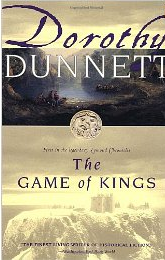
Day 61: The Game of Kings

Cover for Game of KingsBest Book of Week 13!

If you love an authentic, well-researched, exciting historical novel that makes you almost feel like you are in the period, then I can’t recommend a better author than Dorothy Dunnett.  I have been trying to get people to read her for years with the caveat that her books are challenging, not for the reader of light romantic history.

Lady Dunnett is described on her Wikipedia page as a “leading light in the Scottish arts world and a renaissance woman.” Her books are loaded with detail about medieval customs, dress, politics, religion, food, and literature, and have labyrinthine plots full of action. She is most renowned for two series, the Lymond Chronicles, written in the 1960’s and 70’s and set in 16th Century Europe and Africa, and the House of Niccolò, written in the 1980’s and 90’s and set in 15th Century Europe, Asia, and Africa. Dunnett died shortly after finishing the last book in this series.

Game of Kings is the first book in my favorite series, the Lymond Chronicles. Francis Crawford of Lymond makes a rollicking and disruptive re-entrance into his home country of Scotland despite the charge of treason hanging over his head. He forms a band of outlaws and begins roaming around the countryside, sneaking across the border to play tricks on the British and harassing his own family. For quite some time, you don’t know whether he is a hero or a villain. He never explains himself, so it is left up to the reader (and the other characters) to figure out his motives for sometimes seemingly wrongful acts. His enemies think he is responsible for the explosion that killed his sister and is trying to murder his older brother Richard so he can inherit the estate. His friends are absolutely devoted to him but suffer doubts when he misbehaves, as he often does. His brother doesn’t know what to think, and his mother, Sybilla, is silent.

Francis is a mimic and a rogue, a musician and a polyglot, a poet and a swordsman, as swashbuckling a character as you will ever meet with in a novel. In among the action of cattle raids, impersonations, intrigues, duels, and archery contests, you actually learn a lot about Scottish history and politics.

Game of Kings is Dunnett’s first book, and my only criticism of it is that Lymond is a bit too fond of quoting poetry in antique languages. Most of it is incomprehensible unless you are a medieval scholar, but skipping over it does not hurt your understanding of the novel. Dunnett does this much less in the other books in the series. If you read this book and continue with the series, by the second book you won’t be able to stop.
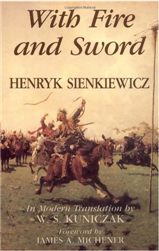
Day 51: With Fire and Sword

Cover for With Fire and SwordBest Book of Week 11!

Two years ago I read an exciting trilogy of Polish novels written in the 19th Century by Henryk Sienkiewicz, a Nobel prize winner for lifetime achievement in writing epic literature. The books were wildly popular for about 50 years, and Polish friends of mine tell me that they were their childhood reading. My review of the trilogy was published on Nancy Pearl’s blog (the librarian who has her own action figure), and I wrote to her awhile back asking if I could republish it here. She did not respond, so without further ado, I am going to write another review of the first book, With Fire and Sword. I will of course crib from my original review. The three books are stand-alone but with recurring characters, so you can read just one without missing important plot points.

It is 1647, and the Polish-Lithuanian Commonwealth is having some trouble—there are rumblings of rebellion among the Cossacks, who are a major force in the Polish army. Yan Skshetuski is a young Polish officer in the hussars of the Ukrainian Prince Yeremi Vishnovyetski. Prince Yeremi sends him on a mission as an emissary to Bohdan Hmyelnitzki, the leader of the Cossack rebellion. Yan has just become engaged to the beautiful Helen, but duty calls, so he makes his way through down the river to where the Cossacks are gathering.

Yan has been sent too late, though, for the rebellion has already started when he arrives, and he is made a prisoner. He escapes with difficulty and makes his way through the war-torn landscape, all the time worrying about Helen.

The political situation in Poland is very unstable, so no one comes to Prince Yeremi’s aid as he is attacked by hoards of Cossacks from the southeast. Even though Helen has been kidnapped by the wild Cossack Bohun, Yan cannot take time to look for her because he is embroiled in another mission for the Prince. So, his friends, the fat buffoon Pan Zagloba, the lovelorn knight and master swordsman Michal Volodyovski, and the gentle Lithuanian giant Longinus Podbipyenta decide to help Yan by rescuing Helen themselves.

This novel is all adventure and romance, and it is truly exciting. Along the way, you learn something about 17th century Polish history.

If you are interested in reading the book, you may have  a hard time finding it (although I see it is available in a print-on-demand basis). It is also available in several translations, about which there is some debate. The original translation by Curtin is said to be truer to the book, but I took a look at it, and it is also fairly badly written. The translation that I read by Kuniczak takes some liberties with the structure of the novel, but is eminently readable, if you can find it. The cover picture at the beginning of the article is from the edition that I read.

Day 48: The Cruelest Journey: Six Hundred Miles to Timbuktu

Cover for The Cruelest JourneyMore than two hundred years ago, the Scottish explorer Mungo Park set off on a journey to try to discover where the Niger River ends up. At the time, it was not known whether the Niger comes out in the Mediterranean, joins with the Nile, or does something else. (It does–curves back out into the Atlantic.) Park made it as far as Timbuktu, but after he left, he was never seen again. Later he was reported to have been murdered.

In The Cruelest Journey: Six Hundred Miles to Timbuktu, Kira Salak relates her attempt to re-create Park’s journey by kayaking alone up the Niger River from Old Segou in Mali to Timbuktu. Although modern readers might believe that there are much fewer dangers in this journey than the one taken by Mungo Park, it is still one of the most desolate regions in Africa. She states that she is the first person and only Caucasian woman to travel alone in the region after one was murdered in the 30s.

Taking only what she can carry in her little kayak, Salak is forced to come ashore for food and shelter, sometimes when she would prefer not to. She encounters friendly people, hostile people, and people who are threatening, including some men who chase after her down the river to demand money. Although the river seems to be mostly slow moving, she runs into stormy weather and worries about being attacked by hippos. She has to keep paddling despite injuring her arm on the first day, and later she has an attack of dysentary after eating spoiled food fed to her by some villagers.

Although she is certainly alone for much of the time, she periodically meets up with a larger craft containing a National Geographic photographer and his crew. They have a deal that he is not to interfere in her trip, but simply to take pictures. I feel it was unfortunate that none of the photos were included in the book except on the cover. Instead an address is given to the National Geographic web site.

The book is well written and interesting, although it contains a lot more of her musings and fewer descriptions of what she saw than I would have preferred. She also appears to have made this journey without much preparation, including understanding the customs of the people she will be visiting, as she finds when she attempts to buy the freedom of some slaves.

As she approaches Timbuktu, she is struck by how much more the villagers seem to be changed by tourism than earlier on the river, increasingly hostile or begging for money as she passes by. Considering that she knew in advance that Timbuktu is no longer the legendary city it used to be, I was surprised by how disappointed she is when she reaches it. It is hard to decide which she is more disappointed about, that there is no sign of the legendary city built by the gold and salt trades or that she can’t stay in a nice hotel as she planned because the town is packed with tourists (or maybe that the town IS packed with tourists).

Although perhaps it was part of her sense of adventure to be relatively unprepared, I felt that more research before she made the trip would have been in order. I couldn’t help feeling at times that her reactions to a few events or sights were uninformed. (As one Amazon reviewer points out, she mistakes a pile of rubble for the National Museum in Bamako.) Nevertheless, it is an interesting story. I couldn’t help feeling that Salak combines in herself both courage and foolhardiness.

Day Seventeen: The Lost City of Z: A Tale of Deadly Obsession in the Amazon

Cover for The Lost City of ZThe Lost City of Z by David Grann tells the story of a famous British explorer, Percy Fawcett, and his obsession with finding the fabled city of El Dorado in the Amazon. He was the last of the great Victorian adventurers and possibly the inspiration for Indiana Jones (and for the explorer in the movie Up).

Fawcett made a career of exploring the Bolivian and Brazilian Amazon, beginning with being hired by the Bolivian government to establish its border in the Amazon. He became convinced that there had been a large city, which he called Z, in the region of the Xingu River. Hundreds of expeditions had been made to find it, beginning in the 16th century, and many of them were never seen again.

In 1925 Fawcett set off on an expedition funded by the Royal Geographical Society with a small party that included his son and son’s best friend. He sent daily dispatches back from the jungle that were published in the newspapers and waited for with anticipation by the general public. Then the dispatches stopped, and he was never seen again.

But the story wasn’t over. Others went into the jungle to try to find out what happened to him, including a famous movie star. Many of them never returned, either.

Grann, a staff writer for The New Yorker, became interested in the subject, which he came upon while working on another project. During his research, he met with members of the Fawcett family and was given access to a some previously unpublished personal papers. He is able to provide insight into the explorer’s character and thought processes, which makes for a fascinating story.

Grann also became consumed with the fate of the Fawcett expedition and found himself deciding to follow in Fawcett’s footsteps. Although his trip through the Amazon in a jeep was no Victorian expedition, he himself is no explorer. He was surprised to find the Amazon almost as wild today as it was 100 years ago.

And maybe he solved the mystery of what happened to Fawcett’s expedition. The story of Fawcett’s adventures makes compelling reading, and the ending is unexpected.

Day Six: Waverley

Cover for WaverlyI have been trying to offer a mix here, not just mystery mystery mystery, and so far I have just reviewed books I’ve liked. But I plan to also review books I didn’t like. This book isn’t one of them; I’m just warning you.

I had a hard time even getting interested in reading anything by Sir Walter Scott after having been forced to plow through the dreaded and deadly dull Ivanhoe in high school. I tried rereading it again some years ago because sometimes things you find dull in high school are more interesting when you’re older, but it wasn’t. I have often wondered what criteria high schools use when picking the English curriculum, when there are much more vibrant classics available. I can only suppose that they thought a tale of knights, derring-do (whatever that is), and Richard the Lionheart would interest high school students. When you read Ivanhoe, it’s hard to imagine that at one time Scott’s books were waited for with bated breath by the whole family.

But most of us probably haven’t tried to read his Scottish novels, or the Waverley novels, as they are called. This review is about the novel called Waverley, presumably the one the others are named after. It was written in 1814 but is set in 1745. Scott’s Scots dialects are a little difficult—a glossary would be nice—and he can occasionally be a bit long-winded, but his Scottish novels are much more interesting and amusing than Ivanhoe.

Waverley is a dreamy, wealthy youth brought up in England who has been neglected by his father and raised by his uncle, a man of Jacobite sympathies. A romantic man of undetermined principles, he cannot decide what to do with himself, so he is sent off by his uncle to join the army.

On leave from a regiment stationed in Lowland Scotland, he goes to visit an old friend of his uncle. He makes a visit to the Highlands out of curiosity and ends up embroiled in the Jacobite conspiracy. He is charged with desertion and treason, mostly because he’s in the wrong place at the wrong time.

Part of Scott’s intent, I believe, was to show the British of the times that the Highland Scots were not just a bunch of savages and to depict them realistically.

The book is entertaining and humorous at times, and also occasionally a little ponderous. Waverley is a hapless hero who finds himself drawn into one fix after another, which perhaps makes him a more modern protagonist than you would expect.